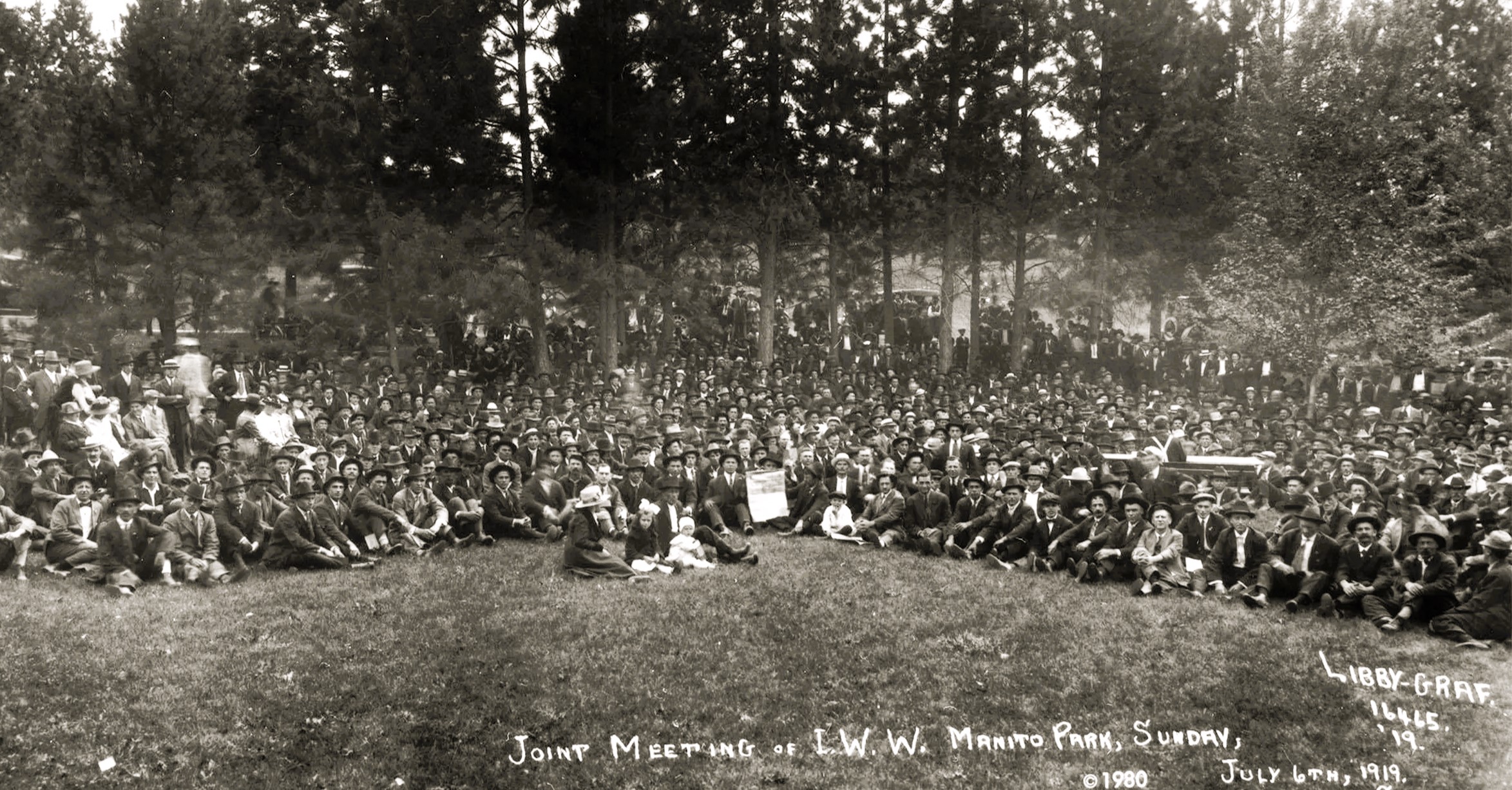
Details of the vibrant I.W.W. local in Spokane, Washington, where in 1909, with 1500 dues-paying members, the new ‘Industrial Worker’ was published as the wobbly paper in the West.
‘Growth of the I.W.W. in Spokane’ by James H. Walsh from Industrial Worker. Vol. 1 No. 7. April 29, 1909.
The growth of the Industrial Workers of the World in Spokane during the past six months has been phenomenal, as compared with many other places, and yet it has been solid, as is, evidenced by the continuous flow of dues paying members.
About a year ago the organization was few in numbers, as there was only about seven or eleven. members, but what they lacked in numbers they made up in philosophy. At that time the headquarters was near the Northern Pacific depot in a large hall about 7×11. The appearance of an organizer who was not so long on philosophy at that time as the “clear” members, was not hailed with delight. However, work was started to get something moving, and in a few weeks the organization had secured a new headquarters, costing $30 per month.
Constant and constructive work was then carried on for the remainder of the year. It was in November, after the last convention, that the writer arrived, and since that time six months have elapsed, during which time the organization has grown from a few hundred to several hundred, and the $30 headquarters has been given up and a new and larger place secured.
The Large Headquarters.
The I.W.W. is now located in an excellent place for its revolutionary propaganda work, and is paying $125.00 per month rent. There is a large library and reading room where no smoking or talking is allowed, and where an excellent selection of books can be found, and to which additions are being made weekly. There is a double office of the several financial secretaries, and for the secretary-treasurer of the executive committee. There is a large assembly hall that holds hundreds of people, in which the unions meet, and also in which are held propaganda meetings each Tuesday, Thursday, Saturday and Sunday. In an appropriate part of this large hall is a cigar and news stand run by the union. Just outside of the hall is a metal house in which a fine new Edison moving picture machine is operated. The light is thrown through a swinging transom, and by this means saves the exorbitant insurance increase which is now exacted by the insurance companies wherever a moving picture machine is installed.
Our Own Moving Pictures.
On each Thursday, Saturday and Sunday night, at the propaganda meetings, besides having the usual dry economic lectures, moving pictures and illustrated songs are on the program the same as at the theaters. So far it has proven a success and the small charge of admission of five cents per night assists in replenishing the treasury without working a hardship on any individual.
The announcement is always made that if they do not get five cents worth to go to the secretary and get their money back, and the same also, with the literature. It is seldom that a person comes to the meetings and buys a book or pamphlet who, after reading it, returns it and asks for his money back. And no one has yet been found who wanted his five cents back after seeing the pictures and hearing the lecture. The five-cent charge has also served in keeping out an element of “barrel stiffs,” who, half-soaked with booze, often saunter into meetings when the admission is free, and who are as worthless to the working class movement as the politicians.
On the Theater Circuit.
The I.W.W. at present receives its moving pictures and illustrated song slides from the same exchange that supplies the first class theaters; and as a result we are up against the problem of getting very much matter of a revolutionary nature. Of course, in the future when more of these places are established over the country, the manufacture of revolutionary pictures will be the order of the day, and then, and not until then, will we have the selections that we so much desire.
At the present time comic and entertaining subjects are selected to the best advantage possible while the illustrated songs are of a sentimental nature, except the Red Flag, which has been arranged in this city.
The Editorial Room.
During the past six months the fight has been so serious with the city authorities as to holding street meetings, etc., that it became evident that the publication of a weekly paper was imperative. So on March 18, the first issue of a paper under the name of “Industrial Worker” appeared. It was a success, except financially, and of course no one expected the first issue to be a success from that point of view. However, the third issue of the paper overcame this deficiency, and is now practically paying its own way. The large editorial room and mailing department is one of the subdivisions of our large headquarters. This issue promises to be one of the finest labor papers ever published in America for a edition, and the receipts already guaranteed will practically cover the expense of getting the same out. This is certainly gratifying in so short a time, and the size of the paper will be double that of the former issues.
Law Firm by the Year,
The organization has been making such a fight on the robbing employment sharks, that it has become necessary to hire a law firm by the year. As a result, the membership have the advantage of legal advice and assistance at a very small cost. Scarcely a day passes that from one to a dozen cases are not handed into the office and sent to our lawyers.
One member, recently injured on the railroad, received $500 without a suit, while hundreds of them have been able to collect money that otherwise would have been lost, because of the individuals not having sufficient money to hire a law firm themselves. This may not seem revolutionary to some, but it certainly does to the boss. In many instances where the boss discovers that he must “come through” or fight a law firm employed by the year by an organization, he meekly submits.
Our Hospital Protection.
The first of the year the unions adopted the hospital protection, making a charge of 30 cents per month, and guaranteeing a protection of $10 per week, not to exceed ten weeks in a year, and of course the member to take care of himself the first week of any sickness. The hospital protection was not made compulsory, but is handled by the unions, through the executive committee of the several unions and branches. Some $600 is now in the bank in the hospital fund, besides several hundred dollars that have been paid out during the past four months for sickness. In this country the logging camps, railroad camps and mills hiring men, charge them a hospital protection of a dollar a month, even though they may only work a week in the place where they have paid the hospital protection for a month. If fired or laid off they must go to another camp or a job and at the same time pay another hospital protection. In many instances men have paid as high as $5 and $8 per month for hospital protection, and’ then had no protection whatever.
The law firm has come in handy in this matter. When the I.W.W. men finish their jobs they refuse to pay the hospital fee to the company, and in every instance that the company has insisted on taking the same from their wages, the return of the money has been made through our lawyers.
Membership and Finances.
The membership has continually grown during the past six months and continues growing larger and larger every day. There are now something like 1,200 or 1,500 members here in good standing, with about 3,000 or 3,500 on the books of the several unions and branches. Something over 200 due stamps are used per week, or between 800 and 900 per month, and this is a slack time just now, as hundreds of the members are out working. The receipts for initiations and dues run, approximately, from $15 to $70 per day. The receipts from the paper are from $12 to $30 per day. The expense of hiring help such as janitor, secretary, editor, organizer, piano player, singer and literature agent to attend to the library and look after the cigar stand is about $80 per week. These figures are given because we all know too well that details on the finances are interesting to the general membership. I can only give them in round numbers as the secretaries, who have charge of the books are not all present.
On a call for finances from headquarters a short time ago it just took 20 hours to raise $500, and besides this hundreds of dollars flow from here to Chicago as will be seen by the quarterly reports issued from headquarters.
Constructive Ability Does It.
Many will be interested in knowing how, or what is it, that causes the I.W.W. to grow and continue to grow in Spokane. Briefly speaking, it is constructive efficiency. The membership is composed of none but strictly wage workers, and any member who gets out of that class is given a withdrawal card. They have all passed the stage of political fanaticism or anything of that kind, and while there are probably some who would rather split hairs over trifling matters, as a general rule, the membership is practical, constructive and revolutionary.
Something like 150 lectures have been delivered in the past six months. This, connected with the literature that is circulated, the free reading room and library, has educated the membership to understand the functions of an industrial organization, at this stage of development, and with the quality of stick, connected with the ability of construction, and the absence of fanatical disruptive efforts, the Industrial Workers of the World continues to grow in Spokane.
L.U. 222 I.W.W., of Spokane, now meets Tuesday, 8 p.m., rear 412-420 Front Avenue.
The Industrial Union Bulletin, and the Industrial Worker were newspapers published by the Industrial Workers of the World (IWW) from 1907 until 1913. First printed in Joliet, Illinois, IUB incorporated The Voice of Labor, the newspaper of the American Labor Union which had joined the IWW, and another IWW affiliate, International Metal Worker.The Trautmann-DeLeon faction issued its weekly from March 1907. Soon after, De Leon would be expelled and Trautmann would continue IUB until March 1909. It was edited by A. S. Edwards. 1909, production moved to Spokane, Washington and became The Industrial Worker, “the voice of revolutionary industrial unionism.”
PDF of full issue: https://www.marxists.org/history/usa/pubs/industrialworker/iw/v1n07-apr-29-1909-IW.pdf
 Revolution's Newsstand