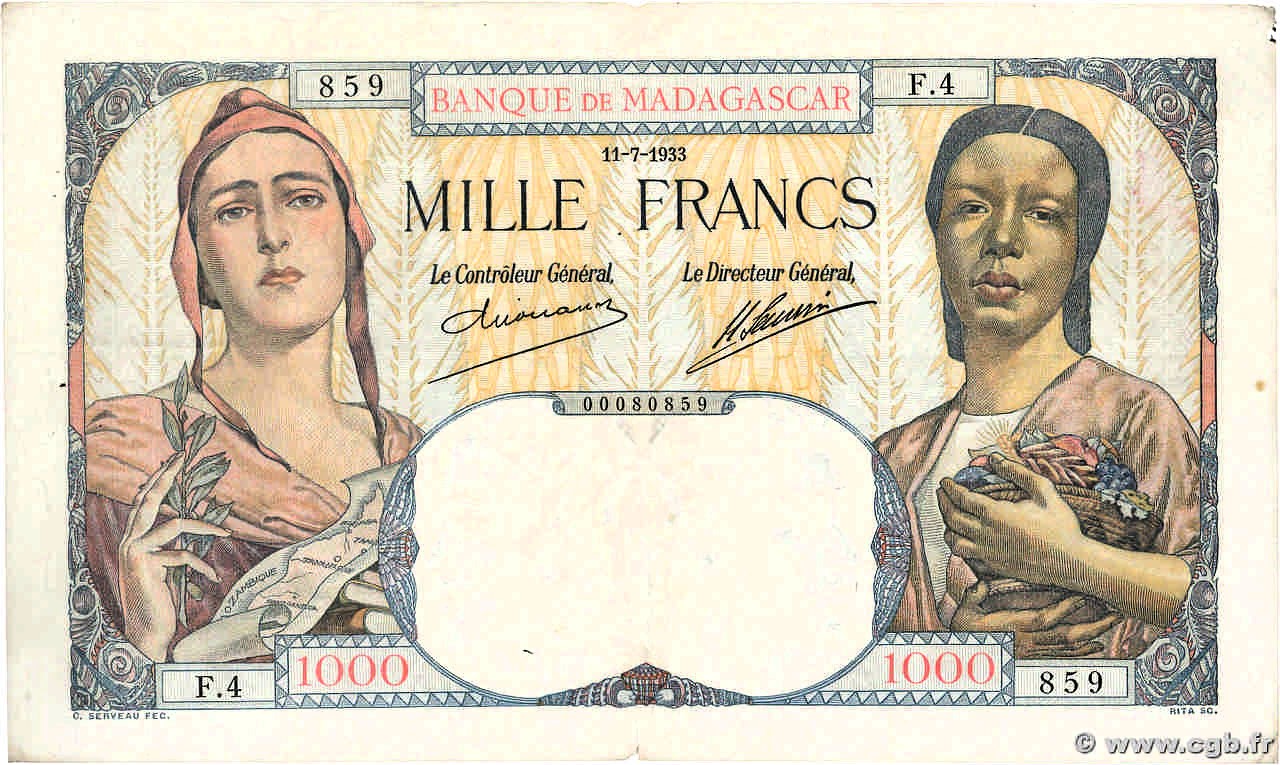
Liberte, fraternite, egalite, and the Franc.
‘How the French Imperialists Are “Civilizing” Madagascar’ by B. Jan from The Negro Worker. Vol. 5 No. 2. May 15, 1932.
Before the Invasion.
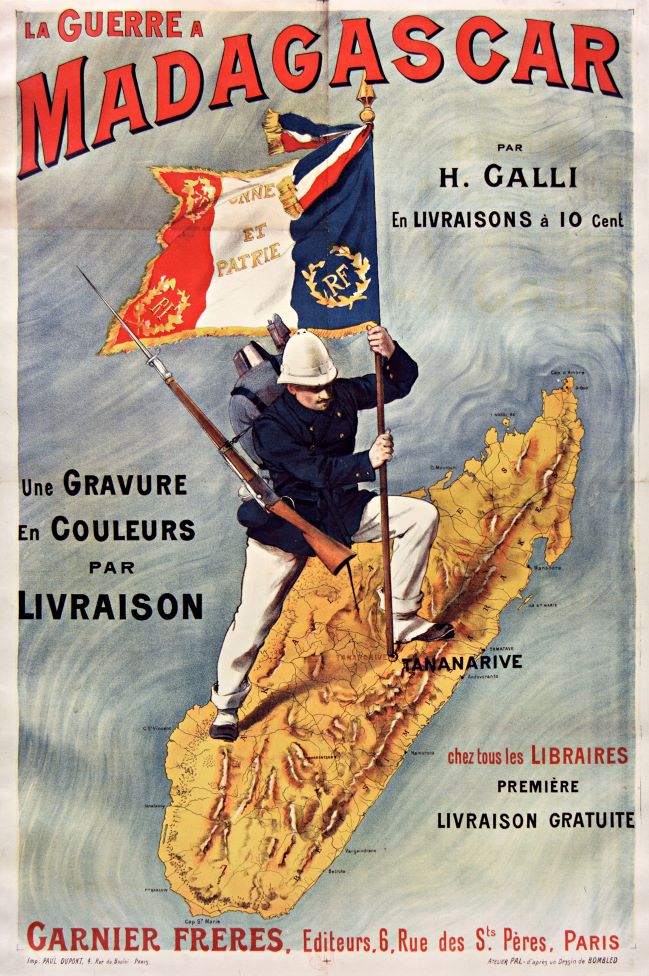
There are about four million natives living in Madagascar. an island, somewhat bigger than the territory of France. At various times, during three centuries, the French imperialists endeavoured to obtain a permanent foothold in that country, but had made very little headway. After having fought again the natives for two years in 1882-1884, they finally seized Madagascar in 1896.
At the time of the French “conquest”, agriculture was giving fine results to the industrious native population. The Malagasy people owned more cattle per head than any other people in the world. Scientists and travellers who visited the island reported not only about the splendid physical development of the people, but also about their well regulated tribal life. Neither was there a basis, at that time, for the usual hypocritical excuse of imperialist robbers, that these happy islanders needed the French to bring them the “blessings” of Christian “civilization”. For at the time of the invasion there already stood 20 churches in Antananarivo, the capital, more per head of the population than in Paris, Christianity had been introduced into the island in 1810. Out of a population of between three to four millions, there were more than 500,000 known and registered Christians. And, as an American bourgeois writer puts it, “from the standpoint of morals, the Malagasians would have been warranted in taking over France more than in being taken over”.
As a matter of fact, it is interesting to note, that, while the last independent native ruler, Queen Ranavalona, had issued a decree against all idol worship and superstitions such as voodoo practices, the French “civilizers” set this law aside, and thus threw the less enlightened masses in far-out country districts again at the mercy of native charlatans. The superstitions, the spirit of intertribal hatred which these exploiters of their own people created in the minds of the most backward groups of the population, the atmosphere of fear and distrust, suited the French invaders, for it enabled them to fasten the yoke of domination tighter and tighter on the necks of the Madagascar toilers.
But this is only the old, old story. The French, like all imperialist plunderers in all colonies, were really not out for any “civilizing mission”, when they landed their troops of over 20,000 men, and their naval force, consisting of three cruizers and eleven dispatch and gunboats on this peaceful island. They were after the spoils to be gained from this extraordinary rich country, which, in the hands of an industrious population, produced, among many other things: Rice, coffee, sugar, tobacco, rubber, manioc, and vanilla, the forests were rich of valuable woods; there were plants for medical purpose; cattle breeding, silk weaving was well developed; while the mineral richnesses of the soil-gold graphite, etc. promised likewise big dividends for the French capitalists. Furthermore, France wanted to make the island a market for her manufactured goods, an outlet for her capital, and recruiting reservoir for her colonial army.
After the Conquest.
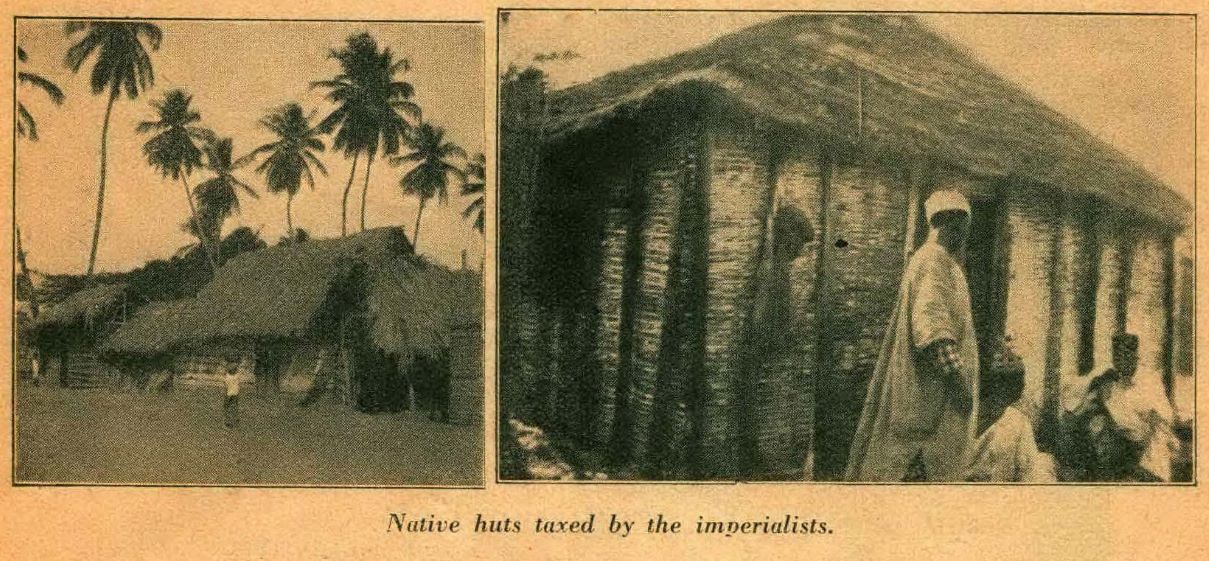
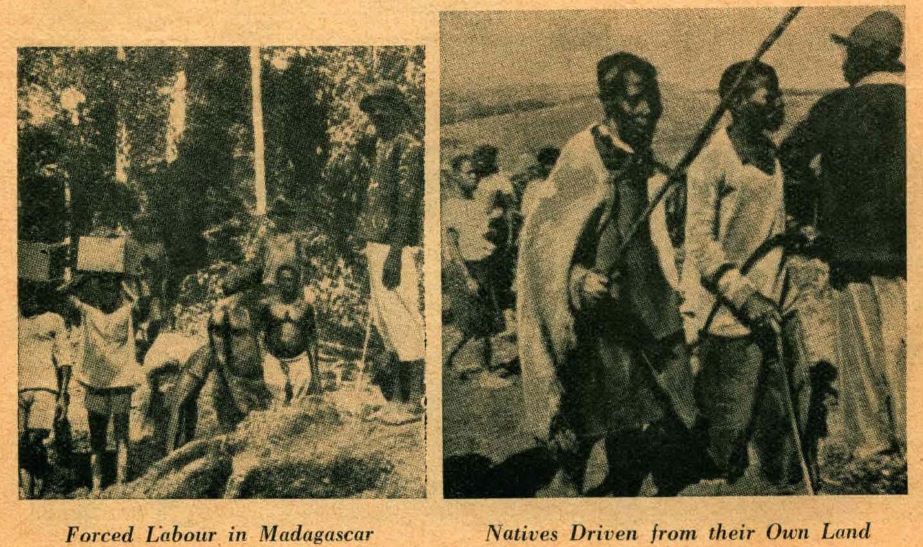
Now, how do the people of Madagascar live today, under French rule? The first thing the newcomers did was to introduce taxes on the natives (including a poll tax, and a special tax on land, cattle and houses). In some parts of the island, especially among the Sakalava tribe, it took the French years to enforce their robbery system. A number of fights took place on account of this taxation, during which the French conducted regular warfare against the “rebels”, burnt up villages, and murdered thousands of men, women, and children, or drove them off their own land. While the economic situation of the natives, due to their enslavement and the world economic crisis has gradually become worse and worse during recent years, their taxes have been increased, especially in the cities.
Madagascar, unlike several other French possessions, is not represented in the French Parliament. There is only a so-called Economic and Financial Delegation, composed of twenty-four French white citizens and twenty-four natives. These, together with four European and two members of a “Consultative” Council of Administration are supposed to yearly “examine” the government budget proposals. It goes without saying that the colonial government has always been. able to enforce its policy, with or against the “consulted” native representatives. This is not only true for the taxes imposed; but it can also be seen from the fact that public works were started in Madagascar, in order to create profitable investment for French bankers and to facilitate speculations of foreign landowners and traders. For the purpose of carrying out these so-called public works, the colony had to contract loans. Later, further loans had to be made for the liquidation of former loans, and as a result, from the time Madagascar has been “blessed” by French administration, a public debt of £ 4,200,000 has been contracted: It goes without saying that the yearly interests on these loans have to be paid from taxes extorted out of the sweat and blood of the Malagasian workers and peasants.
Together with the public works, another gift of European “civilization” which has been lavishly bestowed upon the natives, is: Forced Labour. Officially, this is said to have been abolished in 1901. But the truth is that, until the present day thousands of natives are being condemned yearly by the native tribunals of “justice” to be employed under the forced labour system. This “punishment” is inflicted upon these natives for the most trifling “crimes” and constitutes a profitable source of cheap labour for the white rulers.
The Malagasians are also forced to serve in the French colonial army. In peace time the troops in Madagascar are made up of 5,736 natives and 1,542 Europeans. The police and militia, consisting of 3,300 natives, are maintained out of the local budget. It is a fine expression of the unbroken independent spirit of the Malagasies that they can claim for themselves the fact that not one Malagasy served willingly in the French army during the world war. There is no doubt that the Malagasian youth of today is going to live up to this anti-militarist tradition, when the French imperialists will again try to carry out their ruthless desires of setting the world aflame by attacking the first Workers’ Country, Soviet Russia. There is certainly not going to be one Malagasian youth, who would permit the French imperialists to use him as cannon-fodder.
Capitalist Terror.
What has aroused, more than anything else, the spirit of protest and revolt among the natives in recent years, is the system of French “justice” as it is being administered in Madagascar.
Under this presumably most “liberal” colonial power, France, there are two district systems of “Justice” instituted in the island. One, represented by the usual French courts, for the “civilized” people, that is, the whites and the native capitalist class, and another, represented by tribunals composed of administrative officials, for the native toiling masses. This system of “justice” is based on a decree of 1909, and although there is a possibility to “appeal” from the lower to higher tribunals, it makes no difference to the poor people for they are entirely at the mercy of autocratic white and native officials.
As a result, hardly a day passes without some shocking outrages against the working masses in the name of “justice”. For instance, a native by the name of Rahitsaka who was working on a forced labour gang, because he defended himself against the blows of his white overseer, was tied to a tree, cruelly beaten by his torturer in this position and then left so for three days. His friends were even prevented from giving him food. Again, another native, by the name of Rapaoli, serving a term of imprisonment because he could not pay his taxes, was hired out to a white railway official as a cook, but suddenly disappeared and it is feared that he has been beaten to death for the ridiculous “crime” of not having cooked the soup, one day, to his master’s taste. Editors who dare to reveal these and other cruelties in their papers are being persecuted, heavily fined and imprisoned.
To enumerate all such cases would make a book. There is however one case, going on at present, fought out day by day between the French slave masters and the awakening Malagasian masses, which deserves our special interest. It shows the beginning of an organized united struggle of the Malagasians.
Last year a cooperative Society was organized at Antananarivo, (the capital, with a population of over 70,000 called “Union des Coopérateurs Malgaches”, the purpose of which is to distribute the chief commodities necessary for the consumption of the toiling population, to members, without a trade profit. This Cooperative is affiliated with the “Fédération Nationale des Coopératives de Consommation” in France as well as with the “Magasin de Gros des Coopératives de France”. The purpose of the organizers of the cooperative evidently was to make themselves “independent” as they hoped from their imperialist masters, by providing for their consumption on their own cooperative basis. The French authorities, in order to crush every attempt of the natives. to improve their economic conditions, have directed their attacks upon the cooperative movement. For example, from the very first day that the Cooperative has opened, in Sept. last in Antananarivo, the imperialists and their watchdogs have persecuted the clerks on all sort of frame up charges. They have been hauled before courts where they have been fined and imprisoned; the police has spied upon and tried to intimidate the customers, and when the editors of the working class papers (which appear under the names of “L’Aube Nouvelle“, and “L’Aurore Malgache“) dared to publish the facts of these outrages, they too, have been reminded that the Madagascar people– to use these comrades’ words–are only French citizens for the paying of taxes and serving in the army, but they are not supposed to even enjoy the doubtful legal “rights” of a Frenchman.
By any “normal” procedure, the authorities, if they had any objections against the Cooperative, would have had to frame up a case against the Society as such, or against its president, who is a white Frenchman. But in this way they would never have been able to win any argument against the Society which was perfectly legally organized. Therefore, what they did and are doing, is to accuse the native clerks of the shop, after provoking them, of all kind of “crimes”, such as disobeying police orders, etc. These they can put before the native tribunals and there they can do with them what they like. The comrades involved have often even refused to lend themselves to the farce of an “appeal” to the higher court, because they would get as little “justice” there as in the lower one.
This persecution of the Malagasian Cooperative by the French authorities and their lackeys and spies among the police has now been going on for half a year. More and more the sympathetic interest not only of the revolutionary workers in France but of the international working class, has been aroused. But more real help is needed.
The organization of this Cooperative can only be considered as a first step in the march towards a strong, active anti-imperialist movement of the Malagasian workers and peasants. There is an old theoretical school of Cooperationists in France, whose spokesman is Charles Gide, who want to make us believe that social justice and economical freedom can be obtained by peaceful cooperation, without any class struggle. Our brothers in Madagascar must not fall victim to these illusions. To win over or to eliminate the capitalists by mere persuasion, this has proven a futile attempt in France, in England and wherever workers have tried it. It would be more utopian a plan in a colony, like Madagascar where the French imperialists are absolute dictators.
The Cooperative can be useful to the Madagascar people in so far as it may help them to rally the native toiling masses to fight for their economic improvement and national independence. But in order to successfully carry through this fight, it will be necessary to organize a strong, powerful movement embracing all native peasants, and all workers of hand and brain. They must therefore build peasants’ leagues, workers’ unions and fight for their economic, political and social demands.
The French imperialists and their lackeys (like the editor of the reactionary paper, “Union”, of Tamatave), besides using open force and intimidation, are also trying to undermine the growing anti-imperialist spirit in the island by playing out the various tribes against each other, creating artificial differences and distrust among them. But our comrades are not to be misled. They are openly refuting such attempts in their own revolutionary press. It is now up to them to proceed from anti-imperialist agitation and propaganda to the building up of a powerful organization for themselves. And it is the task of the revolutionary workers in France to do their utmost in supporting their brothers in Madagascar with advice and active help.
First called The International Negro Workers’ Review and published in 1928, it was renamed The Negro Worker in 1931. Sponsored by the International Trade Union Committee of Negro Workers (ITUCNW), a part of the Red International of Labor Unions and of the Communist International, its first editor was American Communist James W. Ford and included writers from Africa, the Caribbean, North America, Europe, and South America. Later, Trinidadian George Padmore was editor until his expulsion from the Party in 1934. The Negro Worker ceased publication in 1938. The journal is an important record of Black and Pan-African thought and debate from the 1930s. American writers Claude McKay, Harry Haywood, Langston Hughes, and others contributed.
PDF of full issue: https://www.marxists.org/history/international/comintern/negro-worker/files/1932-v2n5-may-15th.pdf
 Revolution's Newsstand