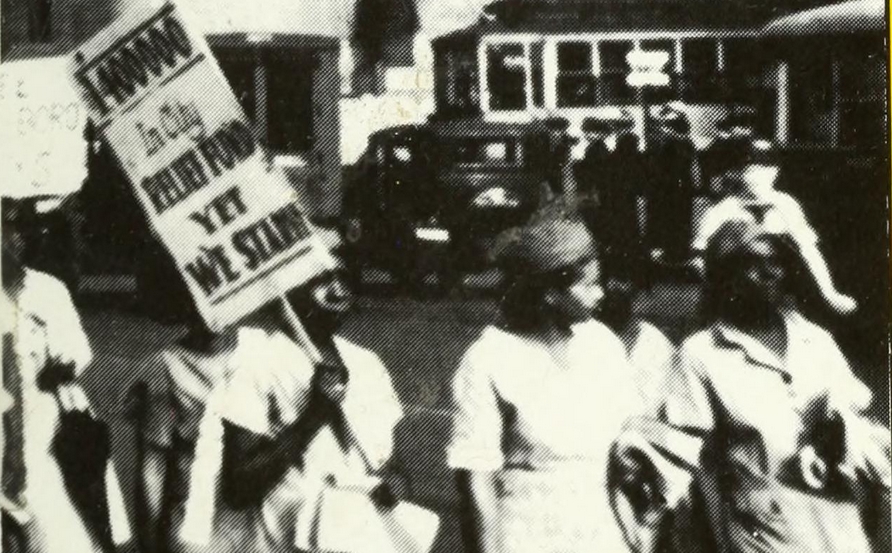
An inside look 1933’s Funsten Nut strike. The T.U.U.L.’s Food Workers’ Industrial Union organized a successful strike in the St. Louis nut picking industry with its almost all Black women workforce. From the Communist Party’s internal bulletin.
‘St. Louis Nutpickers’ Strike Sets Example’ by R.S. from Party Organizer. Vol. 6 No. 7. July, 1933.
This strike is a splendid example of Party leadership and initiative in organizing workers for struggle. The nut picking industry in the St. Louis territory consists of 16 factories, employing about 3,000 women, 90% Negro. Working hours are 9 per day, five and a half days per week. In the past two years they received two wage cuts. Negro women earned from $1.80 to $3.00 per week; while white girls, from $3.00 up. 605 were on the relief roll. Many grievances existed, and slight attempts were made to organize these workers in the last two years. But the assignments were made to “concentrate” and that was all.
How the Strike was Organized
Actual organization of the strike took two months. One of our comrades was assigned to the factory where he had connections. Since the largest factory in the city was hard to penetrate due to an unsuccessful strike in 1927, we decided to start in a smaller plant and use it as a wedge for getting into the others. The first meeting of the shop group consisted of three Negro women. We showed them how to select the best contacts in the shop. We explained the lessons of the Scottsboro case, dealt with the unity of Negro and white workers. The shop group steadily grew and when the number reached 20 we discussed the concrete demands to be raised, not yet, however, for a strike. The question of connection with other shops was taken up. The women finally decided to demand an increase of 4 cents to 10 cents per pound for halves and from 2 cents to 4 cents for pieces. Their demand became a famous slogan. “We want 10 and 4” was shouted and sung on the streets of St. Louis during the ten-day strike.
Finally the shop group extended to three factories belonging to the largest company. At a meeting which we organized of the workers, they decided to put their demands up to the boss and if he didn’t agree, they would call a strike. The workers also decided to test their strength in the west end factory where the union had 100 members out of 200 in the shop. A committee of 12 was organized to make the demands upon the boss, and we arranged that the rest of the workers were to stop working and to go to the office to hear what the answer would be. Not only did the 100 in the union stop working, but every worker but seven came to support the demands.
For May First we issued leaflets to the nut pickers, asking them to join the demonstration. This actually agitated the whole plant so that part of them were ready to walk out and the Executive Committee of the Food Workers Union local had to issue a special leaflet on the morning of May First, calling on the women not to walk out, but to stand ready when called later. In the meantime we spread our organization to other factories in order to defeat the plans of the company to isolate one factory, because it was not a busy season.
Workers Decide on Action
The next two meetings were concentrated on the main plant in the city employing 700 white and Negro women. In another two weeks we had 15 women enrolled from the main factory into the union. By this time the workers had been waiting 3 weeks for an answer to their demands by the boss. That night the women decided that they could not wait any longer. They felt that any further delay would give the bosses a chance to split their forces by shutting down temporarily some of the shops and scaring the others. Therefore, it was decided to call an open mass meeting at which an open vote for a strike would be taken. The strike was voted on.
The workers arranged the original committee from the west-end plant would go to the boss and demand an answer to their demands. If they were granted they would stay in the shop and notify other shops that the demand was granted. If not, they would all walk out aid march to the largest shop, giving the shop group in the plant a signal for a walk-out. On that day, we had machines and trucks outside the plant in readiness. The women began to walk out. The trucks were loaded and before the boss knew what happened, the women were brought to the doors of the largest plant, hailing the other workers and signaling the shop committee inside to call out all workers. The first day 900 workers walked out. The second day two other shops and two small factories walked out, totaling 1,400 women. At the same time, the white women walked out in solidarity with the Negro women.
How the Leadership of the Strike Was Organized
Three days after the strike was declared, all shops were striking, except one. This was done, not by a general strike call, but by pulling out one shop after another. In order to properly control the activities and lead the strike, each shop elected its own strike committee, and captains on the picket line. At the same time a central strike committee was organized. Each day, in addition to the meetings of the shop in the morning, general strike meetings were held to advise and let the strikers know of the developments. The Central Strike Committee met before and after each negotiation with the bosses. Every step was thoroly gone over and every trick of the bosses exposed at each meeting of the strikers. Relief was organized and about 1200 women were fed each day. While poor preparations were made for feeding, the women strikers responded to the collection of food, funds, etc. The strikers actually carried on the main burden of relief.

Every day mass picketing was organized. The leadership of the Communist Party and the unemployed councils worked closely with the strikers. On the third day of the strike came the offer of 33 1/3% increase in wages. This offer was flatly rejected. The capitalist press then tried to turn the sentiment of the St. Louis workers against the strikers by saying: “the offer of increase was rejected because the Communists are leading the strike and simply want trouble.” The answer of the workers was: “The Communists are our friends.” To defeat the bosses propaganda the Central Strike Committee decided to open fire against the City government. Since 60% of the women were on the city relief roll, the city government was supporting the big bosses in the nut industry to maintain bad conditions. A mass demonstration was organized before the City Hall, and a demand was made for release of the arrested strikers. The demand was won; the workers sticking to their posts until the organizer of the Food Workers Industrial Union had spoken. Only thru close contact and attention to every form of demagogy or attack was it possible for the revolutionary leadership to defeat the attempts of the bosses and the government to split the ranks of the workers. Each of these issues was brought to the Central Strike meeting where the women themselves exposed the maneuvers of the bosses.
Force Bosses to Concede Demands
On the seventh day of the strike, the General Strike Committee served notice to the City Government, that other shops would be closed if the demands were not met. Also preparations were made for another demonstration In the meantime, sentiment spread among the laundry, shoe and needle trades workers. The bosses tried another trick, offering what looked like a concession, but which was exposed as an actual wage cut. Despite all efforts of the bosses to inject the issue of Communism, the workers stuck and demanded that the TUUL organizer be present at the negotiations. Finally the company offered concessions and agreed almost entirely to grant the demands of the workers. The strike committee told the company they would report to the strikers and vote on the proposal.
Build the Union
A vote was taken on the proposal of the company, the revolutionary union and the strike committee explaining the offer of the bosses and the question of the recognition of the union. Eleven locals of the Food Workers’ Industrial Union have been organized and solidified in the course of the strike and Since the strike. There are 1400 regular members of the union and about 50 unemployed members who have joined in support of the strike and are part of the union. Also, organization of the locals is progressing fast in East St. Louis, where 900 women are employed in three plants of the same company.
How Organizational Consolidation Was Achieved
While a great part of the consolidation of the union was conducted during the strike, on the picket line, at meetings and in explaining the union, the main organizational consolidation came after the strike, in the following way:
1. Immediately after the settlement, the locals of each shop met, checked the leadership, strengthened it where it was necessary, elected its shop committees from the best fighters on the picket line and on the strike committee and made rules how to examine each member as to union card, etc., before entering the shop.
2. Duty of the shop committees in each department or floor was explained and strict maintenance of agreement in the shop. Dealing with the boss thru the shop committee.
3. One man, a TUUL comrade, was assigned as organizer to each local to help and advise the members from day to day. Organizer joined the Food Workers Union and was voted upon as a member in that capacity.
4, Each day organizers made contact with the shop committee inside to find out how things are and to advise or help in solving any grievances that may arise. In this way we are in constant contact with the developments and conditions in the shop.
5. Establishment of City Control Board of the Union, with representatives from each local union, which meets every week, decides on policies and brings them to each local union.
6. Educational and social activities. 40% of the women are youth. They are already organizing baseball teams and will compete with each other Picnics, outings, etc., are organized.
7. Headquarters of the Union are being established close to each shop. Small locals go together to one place. while big locals have their own headquarters.
Strict Party Control—But Building Party Still Main Task
The following steps are taken in order to assure that the Union and Party grow:
1. Assigned organizers to each local have become members of the Union and actual steps are taken to make them responsible to the point of forfeiting their membership in the Party for laxity. Each organizer is present at the shop in the morning when the plant opens, at noon and at night. At each of these three appearances at the shop, the organizer speaks with the shop chairlady and inquires if all is OK in the shop. In case something goes wrong or any problems arise that the women cannot solve themselves they consult the organizer and he helps. When grievances arise we settle them right on the spot and try to solve them at once, also at the same time we carry on ideological campaign against bosses’ influence.
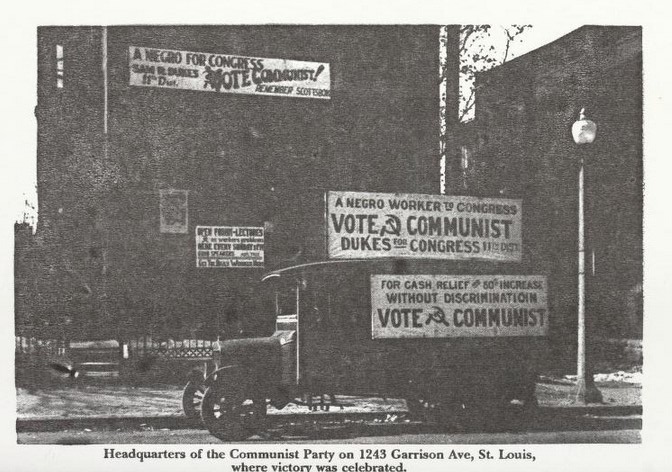
2. Definite assignment and responsibility of each organizer for all work, also for building the Party unit in the shop. Organizers and leadership of the union are so linked that we know every few hours what goes on in the shop as well as out. The Party is brought sharply to the front from day to day. The Communist Party and Young Communist League were not only recognized as leaders of the struggle, but part and parcel of every action.
3. Letters to each local are sent by the executive (City Central) of decisions each week, and are acted upon by each local. The union leadership in the shop is strengthened by enlarging the executives and electing several more officers of the union.
4, Altho the Party led this entire movement, altogether 200 have made applications to the Party. Out of 9 locals, 8 have shop nuclei, but no steps were taken to consolidate the units and such simple organizational questions as issuing membership books have not been taken up. This question was tested very sharply.
The news of these experiences has spread throughout the whole section. The influence of the strike has spread to the southern belt of which this city is a gateway. The influence of it upon the rank and file of the AFL Amalgamated Food Workers is tremendous. Workers in the Amalgamated here openly admit that their strike was misled by the fakers of the AFL and that they “need leadership like the nutpickers”. Members of the Boot and Shoe Workers Union are also coming closer as a result of this splendid example of Party leadership and initiative.
The Party Organizer was the internal bulletin of the Communist Party published by its Central Committee beginning in 1927. First published irregularly, than bi-monthly, and then monthly, the Organizer was primarily meant for the Party’s unit, district, and shop organizers. The Organizer offers a much different view of the CP than the Daily Worker, including a much higher proportion of women writers than almost any other CP publication. Its pages are often full of the mundane problems of Party organizing, complaints about resources, debates over policy and personalities, as well as official numbers and information on Party campaigns, locals, organizations, and periodicals making the Party Organizer an important resource for the study and understanding of the Party in its most important years.
PDF of full issue: https://archive.org/download/party-organizer_1933-07_6_7/party-organizer_1933-07_6_7.pdf
 Revolution's Newsstand