
Theresa Malkiel admonishes New York City Socialists for being worse than hostile to work among women, for being indifferent.
‘Agitation Among Women’ by Theresa Malkiel from The New York Call. Vol. 4 No. 45. February 14, 1911.
Editor of The Call:
I hope you will grant me space to express my sentiments concerning the attitude of our New York Comrades to the work of Socialism and suffrage among the working women of this great metropolis.
I will not say, as some ventured to say, that it is hostile, nor could I conscientiously affirm as to its enthusiasm. It is worse than either. It is indifferent.
In their active work for the abolition of wage slavery, for the realization of Socialism, the New York Comrades seem to consider woman’s enfranchisement of no importance to the main issue, of no consequence so far as the class struggle is concerned, and therefore hardly worthwhile for any true Socialist, be he man or woman, to spend time and energy upon; hence this listlessness and unconcern wherever the woman’s movement is in question.
But let us pause and reason out! whether it is really so–is woman’s enfranchisement of no consequence to the outcome of the class struggle?
It has been a long acknowledged fact that the liberation of the working class must be accomplished through the efforts of the workers themselves. The sooner we succeed in enlightening the proletariat, the sooner may we hope for the Socialist regime.
Now, proceeding from this point, every true Socialist will have to acknowledge that woman at present constitutes a great part of the proletariat. Already the census gives us almost 9,000,000 engaged in earning their own living, of whom at least 5,000,000 belong to the proletariat class. These numbers do not remain at a standstill but grow with an alarming rapidity.
The economic condition of these wage-earning women is by far worse than that of the wage-earning men. Capitalism cares for neither men nor women: it craves fer cheap wage slaves. Is it not the chief duty of those pledged to work for the abolition of wage slavery to make every effort to awaken these wage slaves to an understanding of their condition?
Socialists at least should realize that the movement for woman’s enfranchisement does not rest on woman’s natural rights as human beings, but is the outcome of woman’s economic position in present society. In New York City, with a population close to 5,000,000, we have almost half a million wage-earning women. Do our New York Comrades realize of what help these women could be to the Socialist movement. Already we have the spectacle of 30,000 women belonging to the middle class suffrage movement. How much we could have gained by having them enlisted in our ranks I leave to the Comrades themselves to judge.
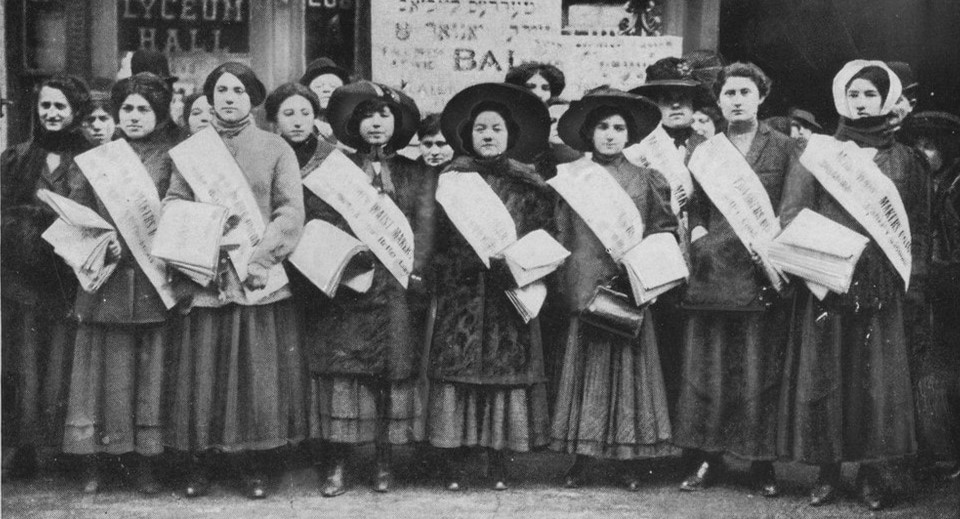
The mere fact that the middle class women, with scarcely a weighty argument to present, with no definite principles, no further hope than the mere granting of the vote, could within one year gain a membership of 30,000 shows that woman is in a state of transition from the old to the new, And at this crucial moment, if we only adopted the proper means, it would not be hard to arouse the many thousands of proletarian women to a clear consciousness of their position and to the necessity of their alliance with the Socialist movement.
And it is because of this possibility that our New York Comrades, be they men or women must take up their place in the vanguard of the class conscious movement for woman’s enfranchisement. The recent organization of the Socialist suffrage clubs gives them a good opportunity. It is not hard for every one of the 3,000 members belonging to Local New York to see to it that through his or her efforts at least one working woman should be enlisted as a member of the club where she will have an opportunity to learn something about the close connection existing between the economic and political movement: where she will be given to understand that woman suffrage should and must be achieved, but that it is only one of the steps to the goal and that woman’s complete independence can be accomplished only under Socialism. Where she will be taught not only the necessity of obtaining the ballet, but the way to use it. And from where, it is hoped, she will emerge a full-fledged Socialist, a member of the Socialist party. Another means of gaining the ear of New York’s wage-earning woman is through the distribution of literature specially written for women and by women. The woman’s department at the national office has any number of such leaflets addressed to women. Why should not each branch deem it its duty to distribute this literature as it is distributing the literature addressed to the male workers? And last, but not least, why should not each party member commence the agitation for Socialism in his own home, and try to enlist his wife or any other female member of his family into the Socialist movement.
The New York Call was the first English-language Socialist daily paper in New York City and the second in the US after the Chicago Daily Socialist. The paper was the center of the Socialist Party and under the influence of Morris Hillquit, Charles Ervin, Julius Gerber, and William Butscher. The paper was opposed to World War One, and, unsurprising given the era’s fluidity, ambivalent on the Russian Revolution even after the expulsion of the SP’s Left Wing. The paper is an invaluable resource for information on the city’s workers movement and history and one of the most important papers in the history of US socialism. The paper ran from 1908 until 1923.
PDF of full issue: https://www.marxists.org/history/usa/pubs/the-new-york-call/1911/110214-newyorkcall-v04n045.pdf
 Revolution's Newsstand