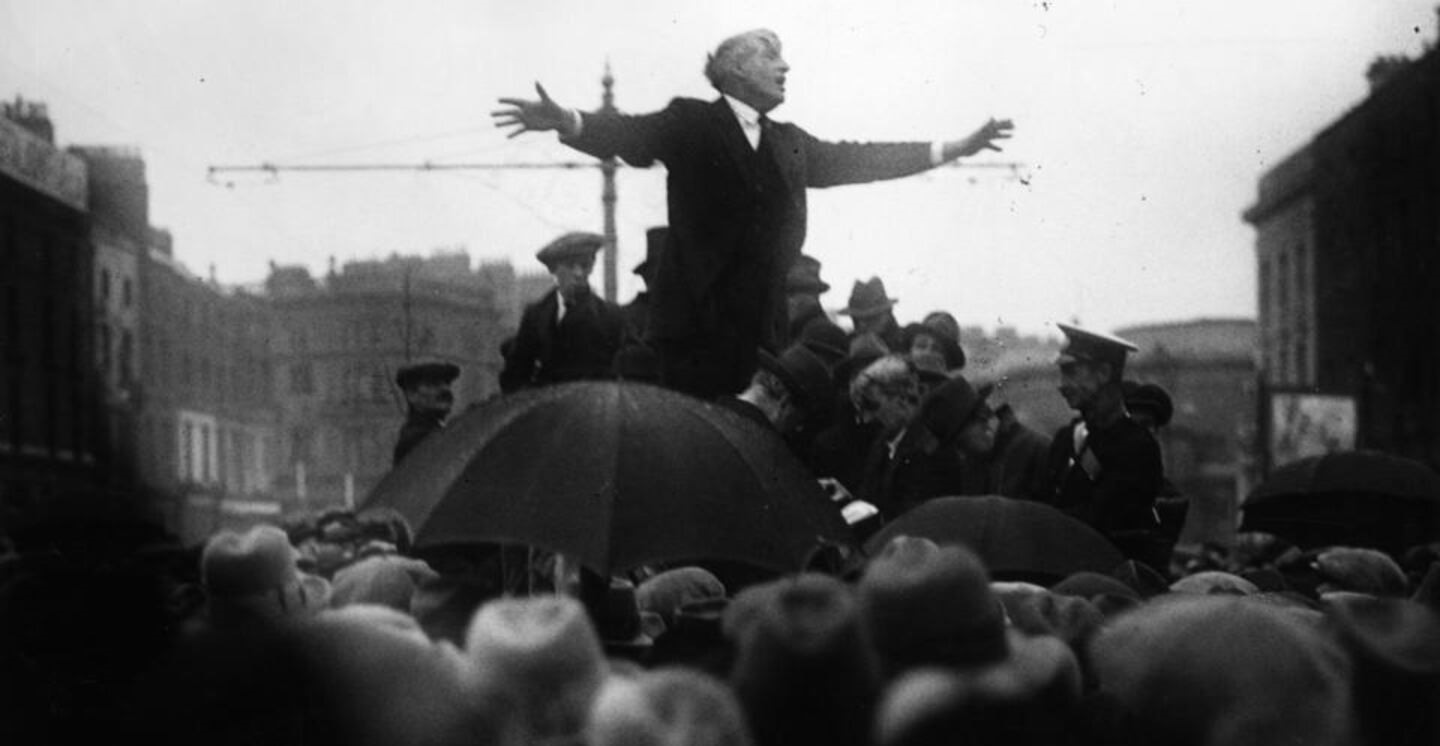
By 1918 James Larkin had been in the U.S. for four years and was emerging as a major figure in Left Wing of the Socialist Party, where he was a close friend and collaborator with John Reed. His old comrade from Ireland Jack Carney, also in the U.S. and editing the Duluth ‘Truth,’ introduces Larkin to an American audience and reproduces a speech by Big Jim during the 1913 Dublin lockout as an example of his character.
‘James Larkin’ by Jack Carney from Truth (Duluth). Vol. 2 No. 53. December 27, 1918.
There are two types of leaders in the world. Those who talk and those who act. The hero of the hour is President Wilson, his speeches will go down in history as memorable speeches. President Wilson is receiving the applause of the multitude for what he said. Larkin will someday return to Ireland and the reception that he will receive will outshine the reception that President Wilson received when he set his foot upon the shores of France. Larkin has proved by his deeds that he is a true representative of the working class. Some comrades in this country, one an associated editor, mind you, of a Marxian Socialist paper tells friends that Larkin’ is at sea with his ideas. It is the voice of a philosopher who is unable to translate his ideas into action. Men who sit all day in study classes and are far removed from the real activity of the movement, which is on the job, cannot understand those who go down on the job and inculcate a class-conscious spirit into the workers. For years revolutionary Socialists, redder than the Red Flag had tried to educate the workers of Ireland. James Connolly tried for twenty years. The results were very small. Along came Larkin. He sized up the position. He told his comrades in the movement that you cannot educate a starving worker. You must first of all feed him and place him in decent surroundings. Larkin was applying the philosophy of a gardener to the workers’ position. You cannot get good flowers from ash-heaps, neither to the slums produce the best rebels. The slums are the recruiting grounds for scabs, gunmen, etc. So Larkin went on the docks of Dublin, into the factories, breweries, etc. and organized the workers. The task he set out upon was a super-human one. Poverty of the lowest order had the workers of Dublin in its grip. They had long been fooled by masters who were Home Rulers, that if the Irish workers would only have patience, Home Rule would solve the poverty problem. England was their enemy said the Irish masters. Larkin upset those ideas and told the workers that if you want anything you must get it yourself. The workers were organized. They had strike after strike. They learned of a class-struggle from actual experience not from text-books. It is impossible to enumerate here the thousand and one institutions that were commenced by Larkin and still exist. They all had one purpose in mind and that was to cement the workers together, so that solidarity meant more than a phrase, it was a living reality. What was the result of all this? It simply meant that the Irish workers were in a better position to accept the principles of Socialism. Ask any of the members of the Socialist Party of Ireland what advantage did they gain from Larkin’s activities in Ireland? The S.P. of Ireland is no reform organization. Its principles are the same as those of the S.L.P. The workers through the work of Larkin realized that THEY were the sole support of Ireland. They began to understand that without Labor society cannot exist. There is a spirit in e workers that can never be crushed. When the British Government sought to fasten conscription on Ireland, it was not the Sinn Fein movement that prevented it, it was the workers of Dublin. So class-conscious were they, that they marched out on that Easter morn of 1916 and gave their lives, so that their children might not know the horrors of conscription. Is there any Union in America that would do as much for their children?
Someday Larkin and his message will be understood. His is the message of action, rather than that of the class room. We need education, as all will admit, but in these times, we need action. In closing we quote an extract from a speech delivered by Larkin before a Commission held in Dublin in 1913 to discuss the Dublin strike. This speech was not prepared, it was delivered at a moment’s notice.
“When I came to Dublin I found that the men on the quays had been paid their wages in public houses, and if they did not waste most of their money there they would not get work the next time. Every stevedore was getting 10 per cent of the money taken by the publican from the worker, and the man who would not spend his money across the counter was not wanted. Men are not allowed to go to their duties on Sunday morning. After a long day’s work they get home tired and half-drunk. No man would work under the old conditions except he was half drunk. I have tried to lift men up out of that state of degradation. No monetary benefit has accrued to me. I have taken up the task through intense love of my class. I have given the men a stimulus, heart, and hope which they have never had before. I have made men out of drunken gaol-girds. The employers may now drive them over the precipice; they may compel them, after a long and weary struggle, to recognize the document submitted to them not to belong to the Irish Transport Workers’ Union, but it will only be for a time. The day will come when they will break their bonds, and give back blow for blow. They may bring to their aid men like Father Hughes, of Lowtown, who went round in a motor-car and used the power of the church against the poor to induce them to sell their bodies and souls to capitalists like Mr. Waldron. Father Hughes has got men to sign a document that they would not belong to the Union. There were men in the pulpits of all the denominations getting up and denouncing Larkinism, but can any of them say anything against me or my private life! Yet, having taken upon themselves high office and sacred calling, they denounces Larkin–said he was making $90.00 a week and had a mansion in Dublin, and was gulling the working men. Do they not live in mansions and enjoy life!
THE NEED FOR LARKIN
“I am told I am an Atheist. Why, it is the clergy who are making the people Atheists, making them Godless, making them brutes! The people are going to stop that, and are going to be allowed a chance of exercising their religion. Mr. Waldron, a member of the Privy Council, and an ex-M.P., would not allow his slaves to bow down to the Creator on Sundays because he wanted to make profit out of their bodies. Mr. Waldron has admitted that his men went to bed in their boots. What else could he expect? After walking 30 miles along a canal bank, foodless, but always having the enemy, Drink, waiting for them, foul alcohol to poison and chloroform them, quarts of porter on credit! leg-tired, soul-tired, they lay down in their dirt. I have seen 13 men in one room lying round a big coke fire, heads to feet, in an establishment owned and controlled by this Privy Councilor. That was the man talking of Christianity! That was the man sent from Stephen’s Green to ask for Home Rule for Ireland!
“Is it any wonder a Larkin arose? Was there not need for a Larkin. I have proved out of the mouth of an alleged Catholic that workmen were brutalized and denied the right to worship their God on Sunday, Catholic and Protestant employers have been equally guilty in this matter. There are conditions of the same kind in Ulster, Munster, Leinster, and Connaught and then Ireland sent 103 men to the House of Commons, all speaking as in the Tower of Babel. But the workers speak with one voice, and will stop this damnable hypocrisy. We want neither Redmond nor Carson, neither O’Brien nor Healy. We want men of our own class to go there and tell the truth. We want to tell Carson that he is preaching rapine, slaughter, and disorder. Yet nobody interferes with him. Why? Because the Government knows it is all gas–all froth. But they know that the workers mean business and are going to unite on the field of economic activity and abolish all racial and sectarian differences. It will be a good day for Ireland when the Carsons of all classes are cleared out of the country. Mr. Healy, with all this eloquence, could not preach what I have preached because it would not pay. The politicians dine and wine together. The workers neither dine nor wine but they suffer and starve together. If the employers want peace they can have peace, but if they want war they will get war.”
Truth emerged from the The Duluth Labor Leader, a weekly English language publication of the Scandinavian local of the Socialist Party in Duluth, Minnesota and began on May Day, 1917 as a Left Wing alternative to the Duluth Labor World. The paper was aligned to both the SP and the I.W.W. leading to the paper being closed down in the first big anti-I.W.W. raids in September, 1917. The paper was reborn as Truth, with the Duluth Scandinavian Socialists joining the Communist Labor Party of America in 1919. Shortly after the editor, Jack Carney, was arrested and convicted of espionage in 1920. Truth continued to publish with a new editor J.O. Bentall until 1923 as an unofficial paper of the C.P.
PDF of full issue: https://www.mnhs.org/newspapers/lccn/sn89081142/1918-12-27/ed-1/seq-4
 Revolution's Newsstand