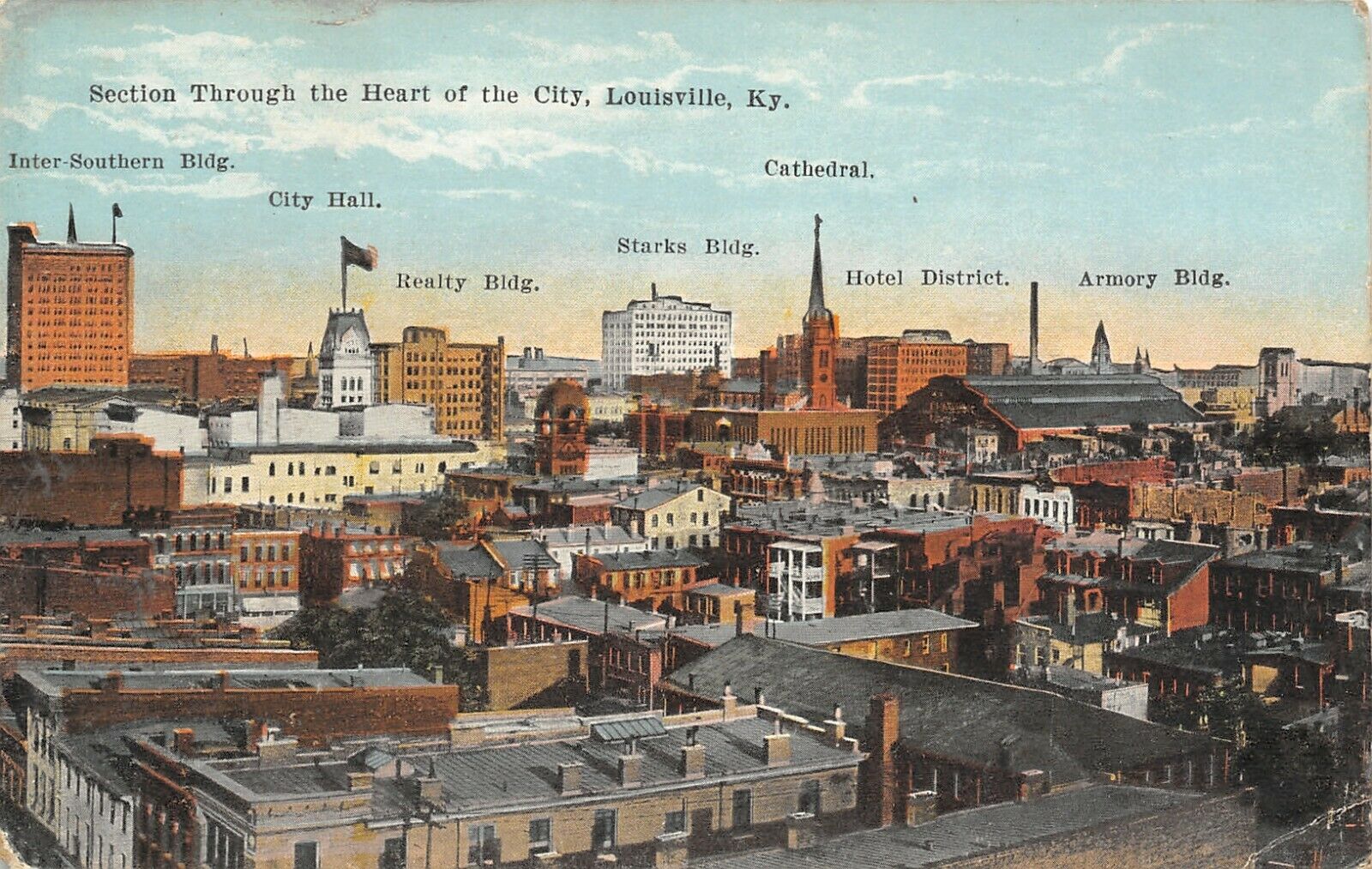
Report of S.L.P. activities in Kentucky where Louisville, and its large German population, had a strong craft union tradition, especially for a Southern city. Includes strikes and debate with the Socialist Party local over trade union policy.
‘News of Section Louisville, Socialist Labor Party’ from The Weekly People. Vol. 14 No. 12. June 18, 1904.
DOINGS IN THE WORLD OF TRADES UNIONISM AND SOCIALISM.
“Labor Mayor” Graniger Employs Scab Iron Workers to Build New Hotel–Tells Committee To Go To H-L–S.L.P. Men Demonstrate Their Belief In the Solidarity of Labor–Other Items of Interest.
Louisville, Ky., June 8. Section Louisville, Ky., not having been heard from in the columns of The People for a long time, desires herewith to make up for lost time, and write up all matters of interest occurring in this “neck of the woods” to date.
To begin with, our Commune Celebration was a big success, both financially and artistically, the principal feature being the rendition of the “Marsellaise” in English by a selected children’s chorus of sixteen voices, under the direction of Comrade Henry Schmidt. In fact, the introduction of a large number of our young people of both sexes in our programme, has taught our amusement committee that we have hitherto neglected a very important field in this respect, and that next season we must still further develop the rising generation for festival purposes.
With the beginning of the early spring months we also had our bunch of pure and simple “craft struggle” strikes, consisting of the meat cutters, carpenters, bricklayers, and painters. The structural ironworkers have been on strike since last Fall, losing out completely in their fight against Graniger & Company, who have the contract to build the new Seelback Hotel at Fourth and Walnut street. Graniger is the present Democratic mayor of Louisville (whom the labor fakirs heralded as a “labor mayor” prior to his election). The “labor mayor” brutally told the committee of ironworkers (who called on him to ask his AID in behalf of organized labor) to go to h-l, and that $1.50 per day was a fine salary for any ironworker.
The hotel is rapidly nearing completion, all the iron that is furnished for the “scabs” being made by “union” (?) men. The line of demarcation denoting just where the union man ends and the scab begins, is getting (thanks to pure and simpledom) altogether obliterated.
Next, the organized meat cutters began a strike against Cudahy’s “Louisville Packing Company,” which also lasted several months, the whole affair finally being “settled” by the vice-president of the national body “to the satisfaction of all parties concerned.” “The Journal of Labor,” as usual, claimed a great victory, but the truth was that the most of the strikers were ready to return under any conditions, so long as the union was at least partially recognized. Some of the most active strikers have not been taken back, while others had to take inferior jobs.
The bricklayers and carpenters are still “out” at the time of writing, and the “aristocrats” of labor, the “printers,” will have plenty of time to think over their superiority over the common craftsmen, or else accept the “open shop,” which is the ultimatum given them by the big printing firms of J.P. Morton & Company, Courier Journal Job Printing Company, Nunemaiher & Company, and Bradley and Gilbert Company.
At the first mentioned company, one of our comrades was employed as janitor, but, upon seeing the printers leave, he also promptly quit his job, thereby proving the S.L.P. spirit of class solidarity. This action of our comrade is a doubly moral slap in the face of pure and simpledom, for the comrade is the very man whom the local “labor fakirs” forced out of his job at Beck’s Hall, a year and a half ago.
In all the printing establishments mentioned the press feeders and other “union men” still continue to furnish work for the scabs who have taken the places of the striking printers.
Union’ scabbing seems to be the order of the day, as usual other comrades who quit work opposing wage reductions had their places promptly filled by good union men, Comrade Tom Sweeney, of Ironmolders Union No. 16, being a notable example and victim of pure and simple rascality and perfidy.
Last, but not least, John Mitchell the great, was here in person to adjust the trouble existing between the miners and operators of Western Kentucky. After several days of deliberation this notorious fakir gave the miners a “throw-down,” declaring that the “conference” he had with the operators convinced him that the demands of the miners were unreasonable and unjust to the mine owner. This is “nobly waging the class struggle,” according to our deluded friends of the “Socialist” party, with a vengeance.
May Day, Section Louisville held a public meeting, which ought to have filled Beck’s Hall, considering the labor situation. However, either the times are as yet not hard enough for the majority of our wage workers, or the rank and file of the unions are so cowed and bullied by the fakirs, that they lack the moral courage to attend our meetings, for the meeting was but poorly attended, although those present enjoyed the splendid addresses by Comrades Doyle and Giffey.
Two weeks ago Section Louisville received an invitation from the local of the “Socialist” party, through one J.H. Arnold (ex-S.L.P. member, whom we expelled last year), to attend their meeting and discuss with them the “Socialist attitude towards trades unionism.”
Now, as is well known, the Socialist Labor Party has repeatedly challenged the “Socialist” party to debate this question, as well as various others. However, the local freaks never accepted the challenge. It now appears that the recent awful throw-down which the “Socialist” party, received at the hands of the fakirs at Boston, and the still more recent silencing of the class conscious minority at the Chicago convention, has had a bracing effect on that element within the “Socialist” party that wants the truth to triumph. They are eager for the Socialist Labor Party message, which the “intellectuals” and fake Socialists (just like their pure and simple fakir brothers) have kept from them, by crying “S.L.P. bossism” and “Union wreckers.”
Four comrades of the Socialist Labor Party were accordingly present at this meeting to deliver the Socialist Labor Party message, and it is no boast to say that at the conclusion it was not the Socialist Labor Party that regretted the meeting.
Before the discussion was well under way, it could be noticed that several of the “Socialist” party men were already supporters of the Socialist Labor Party’s trade union policy, while several more were “on the fence” to use a popular phrase. The only strong supporters of the pure and simple trade unions were those members of the “Socialist” party who hold offices in the pure and simple bodies locally, as if to emphasize their office holding proclivities they seem also to hold all the offices in the “Socialist” party.
As none of these, however, were considered strong cards against the Socialist Labor Party, they had present, of course, “accidentally” (!) the great and only Dobbs, formerly employed by the Evening Times, but now with the “Millionaire Socialist” (whatever that may be), Wilshire of New York. The Socialist Labor Party men used to consider Dobbs fairly straight while in Louisville, after hearing him that Sunday, however, lauding the pure and simplers to the skies, we are convinced that the present material conditions surrounding Dobbs are not of the purest kind. Considering that he is also a close friend of M. Hilkowitz, from whom he draws his inspirations and who is the right bower and lawyer of the Volkszeitung Corporation of private property worshipping Socialists, (?) Dobb’s drift toward fakirdom seems inevitable.
In his ardor for pure and simpledom, Dobbs rashly stated “that neither the ‘Socialist’ party nor the Socialist Labor Party amount to anything whatsoever, but that the A.F. of L. represented the only visible expression of the class struggle.”
Comrade Doyle and Kleinhenz, as old and tried trade unionists, demolished Dobb’s bombastic claim by proving by argument and experience that pure and simple trade unionism is not an expression of the class struggle at all, but an expression of purely selfish craft struggles, totally devoid of any and all feeling of class consciousness or class solidarity.
Dobbs, in reply, evaded the argument, by throwing bouquets at the Socialist Labor Party members, whom he said he highly esteemed as men and Socialists, etc.
One of his colleagues wanted Dobbs to define the trade union resolution, adopted at the Chicago convention, but received the reply that the resolution was so explicit that it needed no defining. Our comrade, Schmidt, here said that although the Socialist Labor Party members had not yet received a copy of the resolution under discussion, yet he was convinced that it would he just as explicit as the “Kautsky” resolution, seeing that both were framed by “intellectuals”
Dobbs here pulled out his watch and Gompers like, said he had to leave to catch the next train to New York.
Robinson (S.P. pure and simpler) tried to defend Dobbs after his rapid exit, claiming that he meant the entire trade union movement including the Socialist Trade and Labor Alliance, and the American Labor Union, when he spoke of the class struggle.
The Socialist Labor Party men, however, pointed out that only the A. F. of L. had been under discussion, Dobbs especially ignoring the American Labor Union and Socialist Trade and Labor Alliance altogether.
It was a good meeting for the S.L.P. and again demonstrated the superiority of our organization, for while our men were a unit in all questions discussed, the “Socialist” party were wrangling among themselves, no two men agreeing on anything. More anon.
Press Committee, Section Louisville, Ky.
New York Labor News Company was the publishing house of the Socialist Labor Party and their paper The People. The People was the official paper of the Socialist Labor Party of America (SLP), established in New York City in 1891 as a weekly. The New York SLP, and The People, were dominated Daniel De Leon and his supporters, the dominant ideological leader of the SLP from the 1890s until the time of his death. The People became a daily in 1900. It’s first editor was the French socialist Lucien Sanial who was quickly replaced by De Leon who held the position until his death in 1914. Morris Hillquit and Henry Slobodin, future leaders of the Socialist Party of America were writers before their split from the SLP in 1899. For a while there were two SLPs and two Peoples, requiring a legal case to determine ownership. Eventual the anti-De Leonist produced what would become the New York Call and became the Social Democratic, later Socialist, Party. The De Leonist The People continued publishing until 2008.
PDF of issue: https://www.marxists.org/history/usa/pubs/the-people-slp/040618-weeklypeople-v14n12.pdf
 Revolution's Newsstand