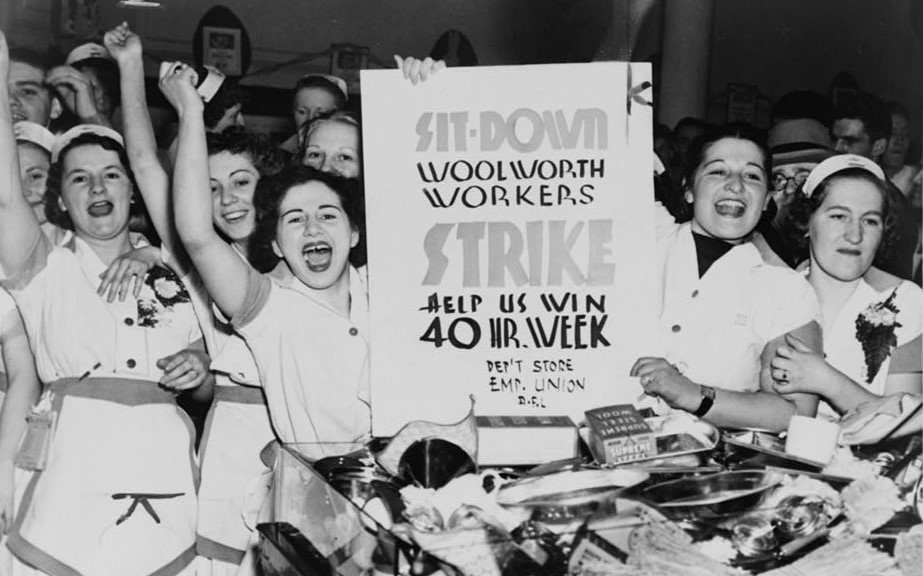
Passed at the Profintern’s Fourth World Congress, the first in four years, held in 1928.
‘Resolution on Work Among Women’ from Report of the Fourth Congress of the Red International of Labor Unions, 1928.
WORK AMONG WOMEN.
Capitalist rationalisation has furnished the basis for the replacement on a mass scale of skilled labour by unskilled labour. To an ever greater extent the cheaper and less well organised labour of women, young workers, children, foreign and colonial workers is being drawn into production. The increase in the number of women workers is being accompanied by a general worsening of the position of the whole proletariat and by increased unemployment.
Therefore, the fundamental task of all revolutionary proletarian organisations, and in the first place of the Red trade unionism, is to obtain the mass enrolment in the trade unions of all sections of the proletariat and the creation of a united fighting proletarian front irrespective of sex, nationality and age.
I. CAPITALIST RATIONALISATION AND THE WOMEN WORKER.
In the advanced capitalist countries women workers and women office employees represent from 25 per cent. to 40 per cent. of the total proletariat and their numbers continue to grow.
The wages of the vast bulk of women workers and office employees is so low that starvation forces a whole group of women workers to take up prostitution to obtain additional earnings.
For the same work that men do women get one-half to two-thirds of the wages paid to men. Work on a conveyor system brings with it a greater nervous exhaustion of the woman worker and threatens the life of the nursing mother and her child. Amongst women workers nervous diseases, accidents and even cases of permanent incapability and death from exhaustion are growing at an alarming rate. The capitalists not only sabotage the execution of the legislation relative to the protection of labour, meagre and insufficient though it be, but are actually vitiating what social legislation there is. The position of the woman worker is particularly appalling in the East and colonies where a 16-hour day is worked, and where they are beaten up with impunity and even murdered, while children are crippled and die off.
It is only in the country of the proletarian dictatorship that the rationalisation brings with it an improvement in the position of the men and women workers. In the U.S.S.R. rationalization is being carried out in close unison with the trade unions and the mass of the men and women workers. Together with it the 7-hour working day is being introduced, measures are being taken to raise the skill and wages of women workers, there is an increase taking place in the number of crêches, nursery schools, kindergartens, etc.
II.THE WOMAN WORKER AND THE TRADE UNIONS.
(1) MASS NATURE OF THE WOMEN’S LACK OF ORGANISATION.
In spite of the fact that in world production tens of millions of women workers are employed and in spite of their monstrous exploitation, the vast majority of women workers have not yet been organised. In Germany, nearly 25 per cent. of all women workers have been organised. In Britain, 20 per cent.; in France, from 3 to 4 per cent.; in U.S.A., 3 per cent; in Japan, .8 per cent. But the women workers who are organised take very little part in trade union life and in recent years the drop in female trade union membership has been considerably greater than the decrease in male membership.
(2) BOURGEOIS INFLUENCE ON WOMEN WORKERS.
Repressions and terror are the main instruments used by the bourgeoisie to give the women workers no opportunity of participating in the class struggle, but in addition the bourgeoise is making big efforts to hold up the development of the class conscious outlook of women workers by setting up Christian, national, employers and fascist unions, by founding philanthropic institutions, by using the influence of the pulpit, the school, the Press, etc. Reformists are the main helpers of the bourgeoisie in this counter-revolutionary work.
(3) WORK OF REFORMISTS AMONG WOMEN.
The leaders of the reformist trade unions bear the chief responsibility for the weak organisation of the women workers. Owing to their policy of collaboration with the capitalists, they are sabotaging the drawing in of women workers into the class struggle. The whole of their work among women is done with a view to confining women to minor social measures and philanthropic institutions and so sidetrack them from the fundamental questions.
Therefore, one of the basic tasks of the R.I.L.U. adherents is to carry out constant work to expose the reformists and show the mass of women workers by the whole of their activities that only the revolutionary trade union movement is the defender of their interests.
III. TASKS OF THE R.I.L.U. IN REGARD TO WORK AMONG WOMEN.
The fundamental tasks of the R.I.L.U. in regard to activities among women workers are:
(1) Constant struggle for bettering the position of all categories of women workers, office employees and out-workers, and for gaining the confidence of the broadest masses of the women of the working class.
(2) Systematic work in the mass enrolment in the trade unions of women workers, office employees and home workers.
(3) Training of active women trade unionists and their promotion to directing work in the trade union organs and those organs to which the unions delegate their representatives.
(4) Mobilisation of the views of workers for assisting the strike struggle.
Congress is of the opinion that the work done up to now by the Red trade unions and revolutionary minorities among women workers has been insufficient and urges them to extend this work as far as possible.
Congress stresses the fact that the enrolment in the trade unions of the millions of unorganised women workers and measures to retain them in union membership constitute one of the fundamental tasks of the Red trade unions and the revolutionary minorities as a whole.
IV. R.I.L.U. PROGRAMME OF DEMANDS FOF WOMEN WORKERS.
The R.I.L.U. shall fight for the following programme of demands for the women workers:
General raising of
(1) Wages. Equal pay for equal work. women workers’ wages in correspondence with the price in the cost of living and productivity of labour. A minimum wage shall
be established for the women workers of the backward branches of industry, agriculture, and home workers or house workers.
(2) Working Hours. Introduction of a 7-hour day and 6-hour day for harmful occupations. A 4-hour day on Saturdays and the days before holidays. Introduction of an annual monthly holiday on full pay.
(3) Labour Protection. Prohibition of night work, overtime, and work in particularly difficult and harmful occupations, and underground work for women and persons under 18. Until this be carried into effect, night work and overtime shall be prohibited for expectant and nursing mothers.
All women employed for wages shall be given confinement leave on full pay for 8 weeks before and 8 weeks after confinement. Nursing mothers shall be allowed paid intervals of not less than half-an-hour for feeding the child every three-and-a-half hours during the working day. Organisation of special
rooms in factories where nursing mothers may feed their children. Organisation of free crêches for the children of women workers at the cost of the employers and under the management of the workers and their organisations.
Instalment in factories of special dressing rooms, washrooms, shower baths, a sufficient number of seats, etc., for the women workers and women office employees.
The whole body of legislation relative to labour protection and all forms of social insurance shall cover not only the industrial women workers but all women working for wages.
4. BENEFIT FOR UNEMPLOYED WOMEN.
All unemployed shall be entitled to unemployment benefit which can secure the maintenance of their families and dependents during the whole period of unemployment.
Women workers shall be entitled to unemployment benefit to the same amount as that of male workers. Relief works must include such work as may be performed by women without danger to health. Right of unemployed women workers to have equal representation with male workers on all State, municipal and other organs looking after the unemployed. It shall be forbidden to dismiss expecting and nursing mothers.
V. METHODS OF WORK OF RED UNIONS AND REVOLUTIONARY MINORITIES AMONG WOMEN.
1. Elaboration of programme of demands for women workers and struggle for carrying it into effect. The organisations affiliated to the R.I.L.U. shall, on the basis of the general programme of demands of the R.I.L.U. work out concrete programmes of demands for the women workers of the various countries, branches of industry, agriculture, territorial districts, union locals, and for the women of individual factories. These programmes should be elaborated with the participation of the women workers themselves and be widely popularised. In all their work the R.I.L.U. supporters should fight for the practical carrying into effect of these programmes and bring the women workers into this struggle.
2. Attraction of women workers into the struggle for trade union unity. On the basis of their programme of demands for the women workers the Red trade unions must propose the formation of a united front to the other unions for the struggle for the improvement of the position of the women workers, and must also bring the broad masses of the unorganised women workers into these campaigns. The revolutionary minorities inside the Amsterdam unions must support these proposals of Red trade unions and fight for the attraction of the women workers who are members of the reformist unions into the struggle for trade union unity.
The Red trade unions must convene meetings and conferences of women workers from the workshops and endeavour to develop these meetings into real assemblies of women delegates from the workshops as one of the best methods in the struggle for the united working class front and trade union unity.
3. Drawing on of women workers into the struggle against imperialist wars. As a counter-blow to the criminal attempts of the bourgeoisie and reformists to mobilise the women workers for the requirements of imperialist wars and the war against the U.S.S.R. (Paul Boncour’s law in France and Pilsudsky’s in Poland), the Red trade unions and revolutionary minorities must work systematically to draw the mass of the women workers into the struggle against imperialist wars and for the defence of the U.S.S.R.
VI. ORGANISATIONAL FORMS OF WORK AMONG WOMEN WORKERS.
(A) IN THE RED TRADE UNIONS.
1. Commissions of Women Workers. While always and everywhere emphasising that the trade union movement is a single whole and cannot, and must not, be divided into a trade union movement for men and a trade union movement for women, the unions should, however, at the present stage of development of the labour movement in the capitalist countries and in the East, set up under the direct and complete leadership of the elected trade union organs, commissions of women workers as auxiliary organisations for assisting the unions in carrying out work among the women. These commissions should be set up under the auspices of all trade union organisations, beginning with a factory and finishing with the central trade union council of every country. Following are the basic tasks of these commission:
(1) To attract the women workers into every form of activity of the working class.
(2) Assist to collect material on the position of women workers in the districts to which their activities are confined.
(3) On a basis of this material to work out draft programmes of concrete demands for the women workers.
(4) To elaborate plans of work among the women workers and submit them to the consideration of the trade union organs concerned.
(5) Take the initiative in confronting these organs with questions connected with female labour.
(6) To bring to the forefront (questions connected with female labour in the general trade union press and extend the distribution of the trade union for women workers as well as promote the extension of the ranks of women correspondents.
(7) To put up candidates during elections of shop committees, wage rate commissions, strike committees, etc., and submit them for consideration of the responsible trade union organs.
2. Trade Union Conferences of Women Workers. In order to ascertain the requirements of the women workers and to exchange experiences the trade unions should, as deemed necessary, call trade union conferences of women workers (local, regional, by industries, national and international).
(B) IN THE REVOLUTIONARY MINORITIES.
1. The R.I.L.U. adherents in the reformist trade unions must work in the women workers’ commissions of the Amsterdam unions and carry on a constant struggle for a correct class policy in the work of these commissions. The R.I.L.U. adherents must also participate in the conferences of women workers convened by the Amsterdam unions and fight in them for a correct class policy.
(C) IN THE MOSLEM EAST.
Wherever, owing to social prejudice women workers do not participate in general meetings attended by male workers the trade unions must steadily fight these prejudices. As a temporary measure, special women sections may be set up in the general trade unions, which sections shall meet separately and have their own elected official bodies. It is at the same time essential that the women workers’ section should be represented in the general union bodies and should work as part of the whole union under the direction of the duly elected union bodies.
VII. AGITATION AND PROPAGANDA WORK AMONG WOMEN.
1. Press. The general Press of Red trade unions should give prominent place to questions of female labour and develop the movement of women worker correspondents. The trade unions must see to it that the women worker correspondents are well represented at conferences of such correspondents and also convene special conferences of women worker-correspondents as the need arises. The trade unions should as far as possible issue a mass weekly paper for women workers. Trade union papers and journals should carry a women workers’ page as a regular feature.
2. Agitation and Propaganda. For the development of agitation and propaganda suitable for the level and requirements of women workers the Red trade unions should allocate a certain part of its budget to propaganda work among women. The trade unions should also organise special carefully prepared recruiting campaigns for the attraction of the unorganised women workers into the trade unions.
3. Cultural Activities. The unions must see to it that there be a sufficient number of women workers attending general courses for active trade unionists and if necessary arrange special courses for active women trade unionists.
4. Explanatory Propaganda Dealing with Questions of Female Labour. In view of the fact that many workers including some members of the Red trade unions, do not fully appreciate the tremendous role of women in production and the class struggle and so do not realise the necessity for special and systematic work among women on the part of the Red trade unions, the unions should explain to their members and to the mass of the workers all these questions in their press, at meetings, at courses, and in all practical work, and try to get all members of the Red trade unions to give up their opportunistic underestimation of the women workers as a class force and take in hand to defend and organise the women workers.
5. Revolutionary Minorities and Agitation and Propaganda among Women. The R.I.L.U. adherents in the reformist trade unions should fight against the opportunistic and petty bourgeois way of dealing with questions regarding female labour in the Press and in the actual practice of the Amsterdamites and, by promoting men and women worker correspondents, oppose it by the correct formulation of these questions in accordance with the class outlook. They must also strive to carry out for the Red trade unions in accordance with the programme of the R.I.L.U. recruiting work, agitation, propaganda and cultural activities among the women workers and fight for the correct class policy in this work in as much as this work is in the hands of the Amsterdam leaders.
Report of the Fourth Congress of the Red International of Labor Unions, 1928.
PDF of original book: https://books.google.com/books/download/Report.pdf?id=pfBaAAAAYAAJ&output=pdf&sig=ACfU3U2IOegkwdTMugHLQx-AB1bggAacmg
 Revolution's Newsstand