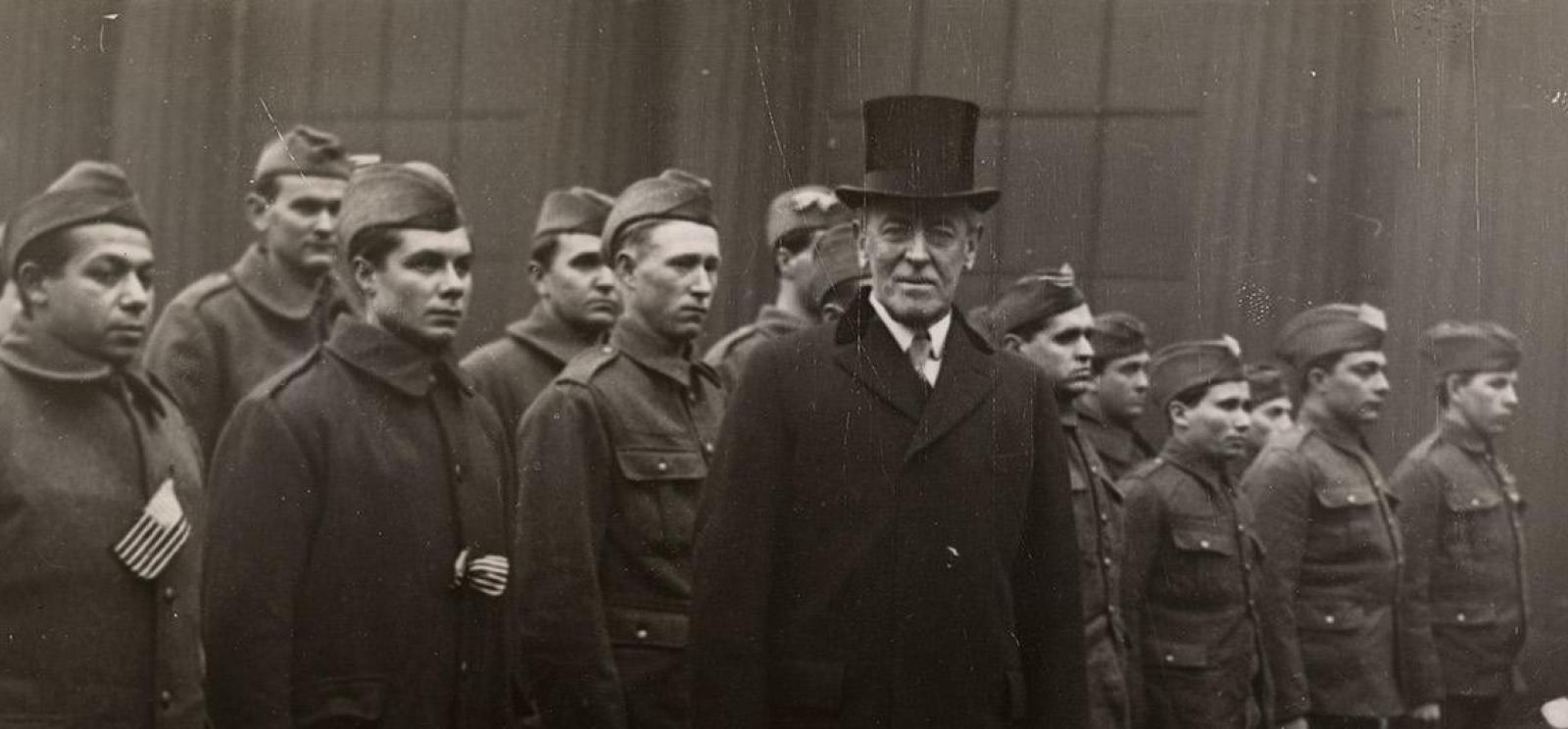
An editorial from Fraina on the entry of the U.S.s’ ‘liberal’ imperialism into the world arena as Woodrow Wilson offers ’14 points’ to make peace at the end of the First World War.
‘The ‘14 Points’’ by Louis C. Fraina from Revolutionary Age. Vol. 2 No. 2. July 12, 1919.
IT is indisputable that the peace imposed upon Germany is not in accord with the “14 points” formulated by President Wilson. The projected terms, which Germany accepted as a basis for peace in concluding the armistice, have been violated in practically every particular. This fact has aroused the scorn and invective of even ordinary bourgeois liberals, who lament bitterly Wilson’s “treason to his ideals.” But the invective and the sarcasm invoked by the collapse of the “14 points”, while justifiable, by no means touch the heart of the problem.
The liberal petty bourgeois democracy, while compelled to accept Imperialism, struggles in a tragi-comic way against the consequences and “excesses” of Imperialism. It willingly acquiesces in the waging of a predatory war, comforting itself with illusions; and then it protests against a predatory peace, confronting itself with the illusion that a “just peace” is realizable under the conditions of Imperialism. The petty bourgeois democracy protests against these “excesses” of Imperialism, while rejecting the revolutionary struggle against Imperialism. The consequences are unavoidable reaction.
The collapse of the “14 points” is not a study in the malignancy of an individual, but a study in the malignancy of social conditions under Capitalism.
Under imperialism, governments are necessarily imperialistic,–that is to say, organized for international conquest and spoilation. An imperialistic government waging a victorious war must necessarily conclude an imperialistic peace, unless the Socialist proletariat intervenes.
The fact that Imperialism necessarily threatens the independence of nations provides an excellent opportunity for developing a “liberal” ideology for an imperialistic war. This fact was used to the utmost by the European belligerents. The position of the United States made it particularly easy to develop the ideology of a war for democracy, since this country had no territorial interests at stake, making it difficult to connect Imperialism without entry into war. Out of this circumstance arose the conception of the United States as a disinterested factor in the war and the fraudulent ideology of the “14 points.”
But the United States did have a direct Imperialistic interest in the war, although this interest was not territorial aggrandizement.
Imperialism is a struggle for world power, a struggle as to which particular national finance-capital shall control the world. The issue in the war was world power. In the case of the European nations this issue assumed an immediately territorial character. But in the case of the United States it did not: it assumed a completely financial character. The war had aggrandized American Capital, until it practically dominated the trade and the investment markets of the world; it had ceased being a debtor nation and become a creditor nation, possessing enormous resources of surplus capital. American Capitalism had invested heavily in a prospective victory for the Allies. A German victory would have practically wiped out this investment and smashed the power of American finance-capital to secure world domination.
At the Peace Conference, it was necessary, in order to protect the investments and the potential world power of the United States, to conserve the financial and territorial interests of the Allies in order that the Allies might pay. Moreover, the world was divided financially and territorially among the victors, the United States securing financial recognition and recognition of the Monroe Doctrine. The “14 points” accordingly necessarily had to be thrust into that garbage can of diplomacy which contains so many “ideals.”
Then there was democracy. Democracy was conceived as the basis of the “14 points”; indeed, the “14 points” were “to make the world safe for democracy.” In this again was involved the whole character of the war and the political tendency of Imperialism.
Democracy and Imperialism exclude each other. It excludes bourgeois democracy, that traditional democracy which is the carrier of the bourgeois struggle against feudalism and the political expression of the competitive epoch of Capitalism. The centralization of industry and capital produces a centralization of the power of government; Imperialism transforms political democracy into a factor a government promoting Imperialism and centralization that negates the old democracy of bourgeois society.
Under these conditions the old liberal slogans of democracy come to possess a new meaning. The older democracy implied national independence; the democracy of Imperialism annihilates the independence of nations. The older democracy implied an actual functioning of the parliamentary system; Imperialistic democracy breaks down the system and places practically all power in an executive autocracy. Democracy having been perverted by Imperialism, it becomes a part of Imperialism and the necessary factor in waging a predatory war. This circumstance alone would necessarily produce a collapse of the “14 points,” since their basis (in the minds of those seduced by their ideology) lies in a conception of democracy which no longer functions in the Imperialistic epoch of Capitalism.
Another assumption of the “14 points” in contradiction with the actual forces prevailing in the world of Capitalism consists in the concept of realising national independence for the small peoples of Europe.
The war was not a war for national independence, except in the case of Serbia. But the moment the war actually started, Serbia’s independence disappeared as a factor, and Imperialism dominated, with the small nations as pawns. Belgium itself (as Holland) is rampantly imperialistic.
Oppressed nationalities, such as Poland, have secured “independence.” But they are not independent, being vassals of international finance-capital.
Moreover, the real struggle in these nationalities is a social struggle–the struggle of the masses to end Capitalism and class rule. This was true before the war–the political revolutions in Mexico and China developed economic aspects, assumed the character of social revolution. This social revolutionary tendency conquered in Russia, and is trying to conquer in other nations.
National independence breaks down–either under the domination of Imperialism, or under the impact of the international proletarian revolution. The ideology of the “14 points” necessarily promote Imperialism and reaction.
The final futility of the “14 points” is the alliance between France, Great Britain and Italy–which is the final proof of the futility of the League of Nations.
As against the corrupt ideology of the “14 points” and bourgeois democracy, the proletariat must oppose the aggressive struggle for Socialism.
The Revolutionary Age (not to be confused with the 1930s Lovestone group paper of the same name) was a weekly first for the Socialist Party’s Boston Local begun in November, 1918. Under the editorship of early US Communist Louis C. Fraina, and writers like Scott Nearing and John Reed, the paper became the national organ of the SP’s Left Wing Section, embracing the Bolshevik Revolution and a new International. In June 1919, the paper moved to New York City and became the most important publication of the developing communist movement. In August, 1919, it changed its name to ‘The Communist’ (one of a dozen or more so-named papers at the time) as a paper of the newly formed Communist Party of America and ran until 1921.
PDF of full issue: https://www.marxists.org/history/usa/pubs/revolutionaryage/v2n02-jul-12-1919.pdf
 Revolution's Newsstand