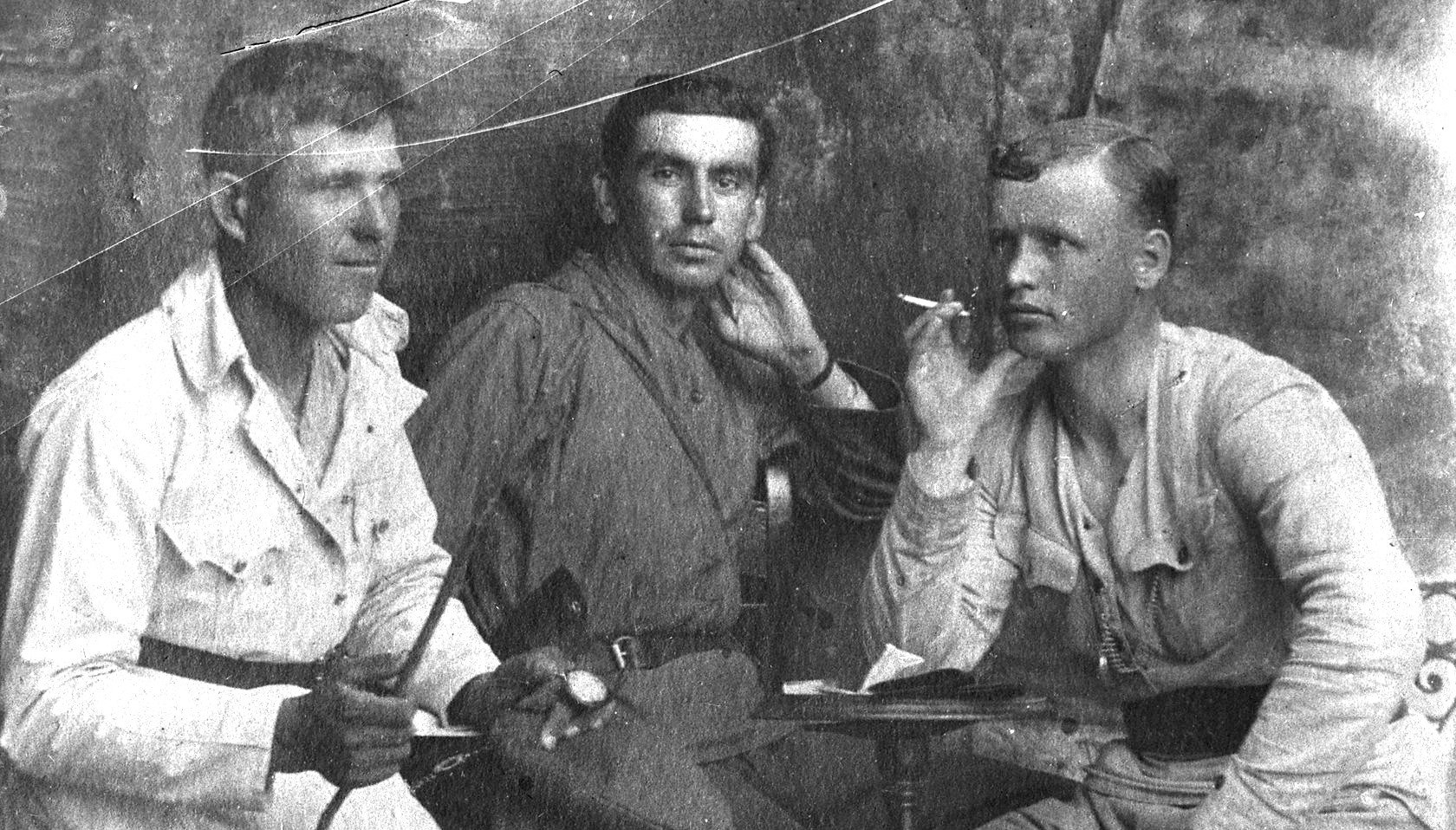
The story of those among the hundreds of thousands of Central Power prisoners held in Russia who sided with the Bolsheviks in the Revolution and fought with them in the Civil War.
‘The Prisoners of War and the Russian Revolution’ by Josef Grün from International Press Correspondence. Vol. 4 No. 21. March 20, 1924.
With the entry of the Communist International on its sixth year, it seems opportune to call to mind the work achieved by some of the modest and little-known pioneers of the Third International. We refer here to the numerous prisoners of war in Russia, who, in the most critical days for the revolution, rallied to the proletarian cause and helped to establish and consolidate the Soviet Power and who, ever since their return to their own countries, have worked persistently for the diffusion of the ideas of the Third International.
The world war, introducing as it did among the peoples of different races, entire masses of prisoners of war, has in some respects brought about results similar to the epoch of the great migration of peoples. This before all was the case in Czarist Russia, where 1,500,000 prisoners of war from the Austro-Hungarian Empire, some hundred of thousand of prisoners coming from Hohenzollern Germany, and many thousands of Bulgarians and Turks, lived for several years dispersed throughout the vast territory of Russia. Up to the overthrow of Czarism, they were interned in concentration camps or were engaged in agriculture, in the factories, in the mines, in the construction of railroads, etc., subjected to frequent ill-treatment and continuous exploitation. The Kerensky period brought them at first some alleviation; but beginning from the new offensive of the Russian Army, which Kerensky attempted on the orders of the Entente imperialists, and especially after the defeat of the Bolsheviki in June, the treatment of the prisoners of War again became worse. The “republican” government sought by every means to prevent fraternization between the revolutionary Russian workers and the foreign workers, whose minds became continually more susceptible to revolutionary propaganda.
After the October Revolution, the situation suddenly changed. The foreign proletarians, the “prisoners of war”, were treated as brothers by the Soviets and by the Factory Councils. Economic and political organizations of prisoners of war were formed in all parts of Russia. Owing to their international character although the German and the Hungarian elements predominated numerically and to their revolutionary tendencies, which became continually more marked, they formed a most striking contrast to the legions which had been formed previously by the Kerensky Government from the prisoners of war of Slav, Italian and Roumanian nationality for the reinforcement of the Russian Army.
The first Conference of Delegates of internationalist Prisoners of War took place from the 14th to the 18th April 1918 at Moscow, and decided to unite all the organizations in the “Federation of Foreign International Socialist Revolutionary Workers and Peasants”. A Central Committee was elected which continued to carry on its functions until the 30th of September of the same year, when this organization could be transformed into the “International Federation of the Foreign Groups of the Russian Communist Party”. The Central Committee directed the activities of the local organizations, several of which constituted District Federations, and published a number of weekly and bi-weekly papers in the chief languages spoken by the prisoners of war. The Central German organ “Die Weltrevolution” (“The World Revolution”) took the place of the paper “Der Völkerfrieden” (“The Peoples’ Peace”) previously published by Karl Radek for distribution among the soldiers of the enemy front. All these publications were written, printed and distributed in the midst of the greatest difficulties, frequently in the face of the enemy, frequently when subject to his direct blows. It is not without interest to mention here the German paper for the Ural district edited by the author of this article, the first number of which appeared on the 2nd June 1918, before the foundation of the Communist International and already, as the first of all Communist German publications, bore the title: “Die Dritte Internationale” (“The Third International”).
It was not long before the organizations of the revolutionary prisoners of war had occasion to prove their devotion to the proletarian revolution. When, in June 1918, the Czecho-Slovakian Legions rallied to the counter-revolution and seized the railroads communicating between Russia and Siberia, from the Volga to the Ob, great numbers of the revolutionary prisoners of war took up arms to defend the Soviet Power. They formed International Battalions or International Auxiliary Legions, which played an heroic part in the campaigns of the Red Army. Their losses were very heavy. When captured by the enemy, they rarely received quarter. Ex-prisoners of war also carried out the dangerous task of carrying propaganda into the very ranks of the enemy, partly into the National Legions allied with the Whites, partly into the armies of occupation of the Central Powers. It goes without saying that many of our agitators paid for their revolutionary courage with their lives.
After the crushing of the Central Powers, these prisoners of war were confronted with a new duty. While a great number of their fellow countrymen were exchanged and returned home safely, those of our comrades who had taken an active part in the Russian revolutionary movement were very often obliged to adopt illegal means in order to return home and continue their work of propaganda. Others ex-prisoners of war, shut out from Europe by the counter-revolution and compelled to remain in Siberia, fought there for a long time in the red formations, thereby contributing to the definite liberation of Siberia from the regime of white terror.
Besides the military aid which the prisoners of war afforded to the Soviet Power, they also carried out exceedingly useful propaganda work among the Russian population, in the first place among the proletarian and semi-proletarian elements of the country. Finally, contact with the Russian formed a valuable experience for the peasants who constituted the mass of the prisoners of war. The agricultural labourer, formerly limited to his native village and with a mental outlook equally restricted, now, having been mobilized and led to the slaughter by the Central Powers, after having seen the Russian Revolution and having lived in its midst, brought to his native home, either consciously or unconsciously, the message of the Russian Revolution. Surely, not one of these obscure tillers of the soil has forgotten that the Russian Revolution has given the land to those who render it fertile by their labour.
Many a doughty Communist fighter, who has taken part in the foundation of sections of the Third International, received his training as a soldier of the Revolution in the ranks of the former organizations of prisoners of war in Russia. This is before all the case in the countries once constituting the Austro-Hungarian Monarchy.
The anniversary of the foundation of the Communist International, as well as the International Red Relief Day, which latter is dedicated to the memory of the fighters for the first proletarian state, the Paris Commune, and also to the fighters of the present Proletarian World Revolution languishing in the prisons and being persecuted as refugees, serve to call to mind the sacrifices rendered by numerous comrades for the cause of the Soviet Power and thereby to the cause of the Communist International.
International Press Correspondence, widely known as”Inprecorr” was published by the Executive Committee of the Communist International (ECCI) regularly in German and English, occasionally in many other languages, beginning in 1921 and lasting in English until 1938. Inprecorr’s role was to supply translated articles to the English-speaking press of the International from the Comintern’s different sections, as well as news and statements from the ECCI. Many ‘Daily Worker’ and ‘Communist’ articles originated in Inprecorr, and it also published articles by American comrades for use in other countries. It was published at least weekly, and often thrice weekly. Inprecorr is an invaluable English-language source on the history of the Communist International and its sections.
PDF of full issue: https://www.marxists.org/history/international/comintern/inprecor/1924/v04n21-mar-20-1924-inprecor.pdf
 Revolution's Newsstand