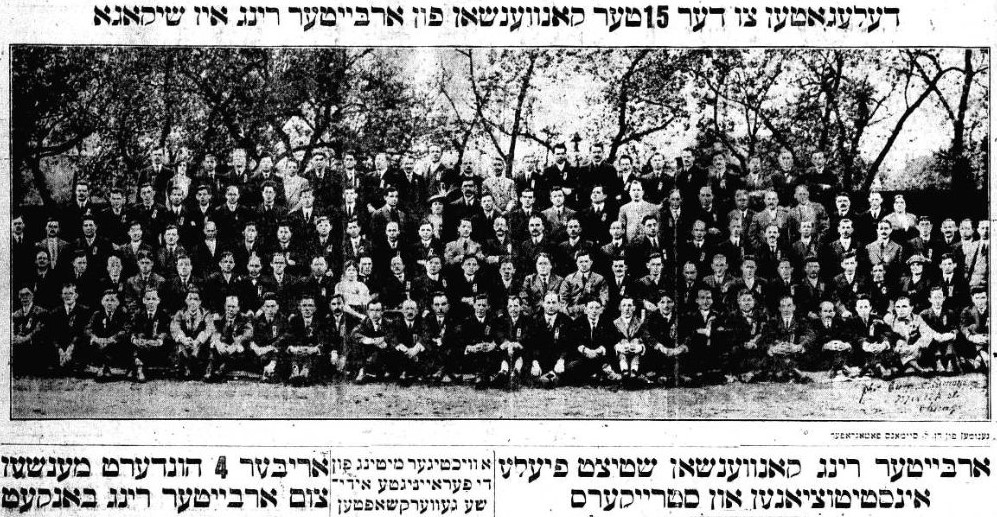
While it would not be until 1912 that Jewish Federation of the Socialist Party was formally organized, preferring to join the Party and its bodies directly, there did exist a ‘Jewish Agitational Bureau’ that sought to disseminate Socialist ideas in the Yiddish language. Here, Abe Cahan and his ‘Forward’ easily survive a left-wing challenge at 280 delegates gather in 1906.
‘Jewish Socialists Meet’ from The Worker (New York). Vol. 15 No. 50. March 10, 1906.
An Important Conference Held In New York Last Saturday and Sunday.
The conference of delegates from the Jewish-speaking branches of the Socialist Party and progressive labor organizations in sympathy with the party took place on Saturday and Sunday, Mar. 3 and 4. Ninety-six organizations were represented at this conference with a delegation of about 280. The conference was a very enthusiastic one and it surpassed all expectations. The purpose of this conference was to devise ways and means of strengthening the branches of the Socialist Party in the Jewish-speaking districts and discuss the general situation of the Jewish Socialist movement. H.L. Slobodin was chairman of the first session, Chas. Lane vice-chairman and U. Solomon and A. Held secretaries. An attempt to bring the unity question into this conference was promptly defeated by the delegates, who decided that it could not be discussed by this conference.
The reading of the report on organization brought forth a lively discussion participated in by a score of comrades. Comrade Solomon in his report depicted the present condition of the party branches in the East Side, and pointed out that only by endeavoring to build up a well-disciplined organization can they have more success in their propaganda. Nowhere in in the city is there such a good field for a party organization as in the lower East Side. Here we have hundreds of organizations claiming to be Socialists or in sympathy with the Socialist Party and yet our organization is not making great progress.
On the discussion which followed the reading of the report several comrades disagreed with the report of the Organizer and his recommendation. Some were of the opinion that only by having one large branch of all the Jewish-speaking Socialists will we succeed in getting a large number of them to be active in the organization.
Others were of the opinion that the dues should be abolished or reduced to five cents, while others insisted that the various independent clubs or even Socialist unions should be made branches of the party and allowed to retain their present names. All these recommendations were referred to the committee on resolutions.
At this point the conference adjourned to meet again next morning at 9 a.m.: and the committee was requested to hire a larger hall.
The second session of the conference took place on Sunday morning, with J. Milch as chairman and M. Gillis as vice-chairman.
A committee on resolutions was elected.
The report on literature was read by K. Rosenberg, who dwelt both on the necessity of having general propaganda leaflets and small pamphlets. This work was more or less neglected by our comrades and this is really one of our reasons why our organisation does grow in proportion with the increase of Socialist sentiment in the Jewish districts. Several comrades spoke on this subject and all deplored the fact that we have somewhat neglected this work. Especially the delegates representing out-of-town organizations complained that they could not get any literature and urged the conference to take steps to raise a fund of $1,000 for the purpose of printing such Socialist literature.
The question of speakers gave rise to a similar discussion. The lack of speakers is felt all over and in some places they had to pay an exorbitant price when they wanted to get a Jewish speaker. The speakers should be placed under the direction of a committee which should make it its business to supply out-of-town as well as local organizations with speakers. A school for Jewish speakers should be organized at once so as to develop new talent. All the recommendations were referred to the committee.
On the question of trade unionism a lengthy discussion took place, most of the comrades deploring the fact that very little attention is paid in Socialist conventions to this very important question. The sentiment prevailing in this conference was that the Socialists should continue to join their trade organizations and not alone help in building them up but also use them for propaganda purposes. The question of the I.W.W. did not come up very much for discussion and one could hardly find any sympathizers with it in this conference. A resolution was finally adopted calling on all the Jewish Socialists to join the unions of their crafts and endeavor to make Socialist propaganda.
The next question to be taken up by the conference was that of the Jewish party press. Comrade Milch read his report on this question, in which he pointed out how a Jewish Socialist daily paper should be edited and what its relations should be towards the organizations of the Socialists.
Not less than 96 delegates were on the list to discuss this question. Most of the speakers who disagreed with the present conduct of “Forward” complained that the paper is not socialistic enough, that it caters more to the public in general at the sacrifice even of giving good Socialist articles. Abe Caban, the editor of “Forward”, was the target of attack and many seem to consider that he had estranged the sympathies of a great number of Jewish writers. On the other hand the large number of the supporters of the present policy of “Forward” refuted all the accusations and showed the conference that “Forward” as it is edited to-day is a good uncompromising Socialist Party paper. It is up to the party members to join its association so as to control it. So far but few party members have joined it. Being late it was decided to close the debate, altho there were still about 65 speakers on the lists. Comrade Cahan was granted the floor to answer all the attacks against him personally and against the editorial policy of “Forward”. He delivered a long speech and took up all the accusations made, and judging from the applause received the majority of the delegates agreed with his utterances. Various recommendations on press were made and referred to the committee on resolutions.
The committee on resolutions recommended the adoption of resolutions against the intended murder of the Western Federation of Miners’ officials and urging all the organizations represented in the conference to work with the Moyer-Haywood Conference of the Socialist Party; Calling upon the delegates to join the Socialist Party and agitate for it in their organizations; Against a Jewish section and recommending that the Socialist Party branches in each city, should have joint meetings as often as they desire; That a committee of seven be elected by the conference to act as its temporary executive committee, this committee to work in conjunction with the First Agitation Committee and make arrangements to carry out the resolutions of this committee and also look into the advisability of calling a convention of all the Jewish Socialist organizations of the United States; Calling upon all the Jewish organizations to stop work on May Day: Calling upon all the Jewish Socialist writers to lay aside all their personal grievances and become contributors to the papers published by the Forward Federation and make them the best Socialist papers in the Jewish language.
U. Solomon, J. Milch, Dr. K. Fornberg, J. Weintraub, J. Bergman, J. Levenson and Max Pine were elected as the temporary Executive Committee.
About midnight the conference adjourned. The conference was very harmonious and instructive for our East Side comrades. All of the organizations represented are known to be in absolute sympathy with the present policy of the Socialist Party and the Jewish organizations of the Socialist Party will greatly benefit by it. About 40 of the delegates present who were not party members signed their applications that night and a great many more members will join later on. It is up to our Jewish districts to keep this matter of organization constantly in mind and we will soon see again a good party organization on the East Side.
The Worker, and its predecessor The People, emerged from the 1899 split in the Socialist Labor Party of America led by Henry Slobodin and Morris Hillquit, who published their own edition of the SLP’s paper in Springfield, Massachusetts. Their ‘The People’ had the same banner, format, and numbering as their rival De Leon’s. The new group emerged as the Social Democratic Party and with a Chicago group of the same name these two Social Democratic Parties would become the Socialist Party of America at a 1901 conference. That same year the paper’s name was changed from The People to The Worker with publishing moved to New York City. The Worker continued as a weekly until December 1908 when it was folded into the socialist daily, The New York Call.
PDF of full issue: https://www.marxists.org/history/usa/pubs/the-people-the-worker/060310-worker-v15n50.pdf
 Revolution's Newsstand