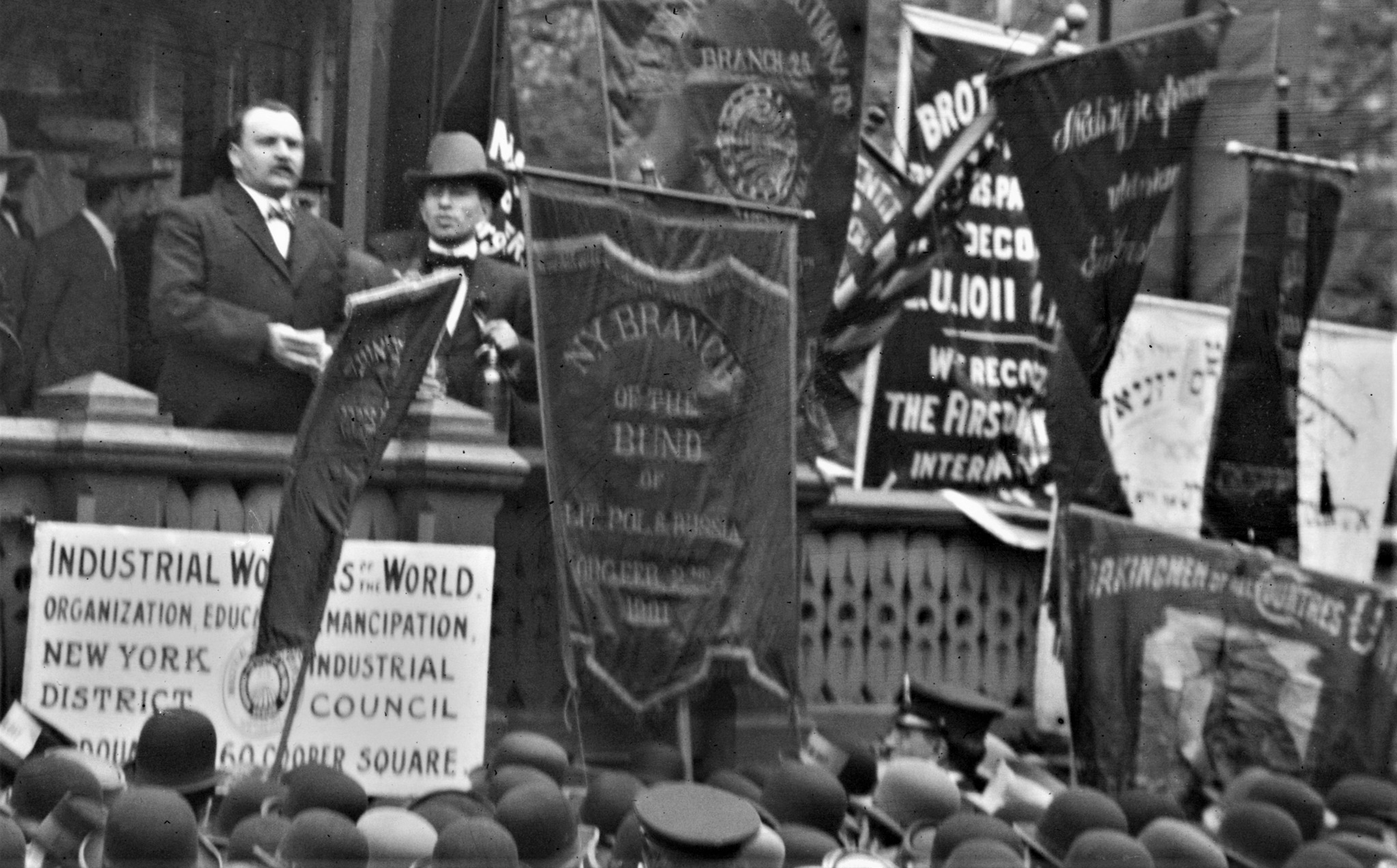
Connolly, here an organizer for the I.W.W.’s New York City Propaganda League, reports on work including in the Brunesville section of Brooklyn where a strike at a Teddy bear maker was complicated by a Socialist employer, and a discussion of the building trades and real wages.
‘Notes from New York’ by James Connolly from Industrial Union Bulletin. Vol. 1 No. 44. December 28, 1907.
We have in the outskirts of Brooklyn. a place called Brunensville, which has given us of late quite a number of interesting experiences. Local 95 had there a branch of cornice workers organized under the old Sherman regime. by Wade Shurtleff. These people had not the first idea of industrial unionism and resisted all efforts to teach them. One standing complaint of theirs was the lowness of our initiation fee, and to circumvent this they adopted at scheme which in my opinion gave points to the slickest A.F. of L. fakers. This was called the examination fee.
Every applicant for membership had to deposit $3 as fee for the trouble to the branch of examining him as to his capacity at the trade. If he did not pass, his fee was retained by the branch, and he was told his application was laid over till a future meeting, when he could try again. If he was passed, his fee was retained and that was the last he saw of it. The officers saw it a little longer, and the saloonkeeper longest of all.
In addition to this they instituted at system of grading their membership into first, second and third class workmen, with corresponding rates of pay. As this branch had a larger membership that the most active and loyal branch, the fact of their unclean methods constituted a serious danger to the local, and unfortunately when the local appealed to the third National Convention for an action in the form of a ruling that might have helped to control them, certain interests or prejudice operated to prevent that ruling being given. As a result Local 95 had to take the drastic action of expelling the branch. But before being expelled they hid or destroyed their financial secretary’s books and all books such as might give a hint as to their financial indebtedness to the local.
We lost them, but we also lost the odium of their actions.
At another time we held a meeting for painters in the same district, in order to explain to them the principles and purposes of the I.W.W. There is a union in the place, and all its officers attended in order to intimidate the rank and file. I have seldom heard more foolish questions and more extraordinary rambling statements than those made by these gentry.
One question put to me is typical: “Is it not a fact that at the second convention of the I.W.W. Gompers and De Leon stayed in the one hotel” I answered that I did not care if they had slept in the one bed. We were not concerned about men, but about principles, and if he could not show something against our principles he would do well to drop such childish talk.
The meeting ended without any practical result. But some time afterwards a small independent union of Teddy bear makers had a strike in this locality, and as they were very friendly to the I.W.W. and our speakers had been addressing them, one of these painter officials rushed around to the boss to urge him to hold out, and then from the boss came around to tell the strikers that he had caught an I.W.W. man scabbing upon the strikers.
Fortunately an I.W.W. man was on the ground, and he got to work upon the faker, with the result that he went away a much humiliated man.
This Teddy bear strike was also instructive. The employer was a member of the Vorwaerts Publishing Association, and also of the S.P. This was in itself a complication, but we could all realize that any employer, even if a Socialist, will have trouble with his employes. But in this case the strike was caused by the fact that the employer, although a progressing and active Socialist, had fired a number of his hands for their activity in forming a union. Perhaps no action could more clearly emphasize the difference between the I.W.W. and the principles of pure and simple political Socialism than this act. The I.W.W. stands for the economic organization and for the political as the reflex thereof the pure and simple political Socialist fires his employes for belonging to an economic organization. But that it was not the mere isolated act of an individual was proven by the circumstance that when a committee of the strikers brought a letter to the editor of the Vorwaerts, giving an account of the affair, that gentleman refused to publish it.
It is time the honest rank and file of the S.P. did something to clear the name of their party from the smirch these unclean actions cast upon it. Things are looking ominous for the pure and simplers in the building trades of this city. The Bricklayers and Masons International Union has had to report to its members that the bosses refused to sign the new contract for two years, as was customary, and would only sign it for a period of one year. Also one of the bosses is reported to have told the committee from the union that if they, the bosses, choose to force a strike they could fill every job in New But York City with non-union men, the committee, knowing the statement to be true, made no reply.
Wages are left untouched by the new agreement, but all other concessions are ruthlessly swept aside. Needless to say the R. and M.I.U. took it lying down. Also are the carpenters in trouble. The bosses have so far absolutely refused to sign the agreement with the Brotherhood of Carpenters, and as it expires on 31st of December it is expected that the Brotherhood will call out its men on the first day of the year. The bosses wish to enforce a reduction of fifty cents per day.
Everywhere in the building trades it is evident that the unions have reached their zenith their power of resistance is now so little that the fakers are even afraid in most cases to make the bluff of a fight. But to the industrial unionist it is pathetic to see the thousands of honest workers being led to the slaughter by criminal or ignorant leaders, while even in their direst extremity those leaders repudiate and denounce the only practicable proposal by which a fight could be made, viz., the industrial unionizing of their trade. As it is, whilst the carpenters fight the other crafts will work–and sympathize.
We have all heard so much about the strong and impregnable position of the building trades, especially in New York, that we have almost come to believe in it, and it requires no little courage to declare that the benefit to the workers of that industry is more apparent than real. The workers in the building industry like to consider themselves as the aristocrats of the labor world, and are proud to inform us that their superior position is due to their devotion to pure and simple unionism.
Quite recently I had a brush with a delegation from the Board of Walking Delegates, and to the query of one of them as to what we were after anyway. I gave them a short exposition of industrial unionism. He retorted: “Bah! you are only an experiment, only an experiment: that’s all!” I answered that that we were only an experiment was in a sense true, but the same could not be said of him and his co-delegates. They were not an experiment; they were a realized fact, and a nice mess they had made of it. There was not a more slave-driven body of workers in the United States than the same building trades whom they represented: not a body of men more bullied and harassed at their work or treated less like free men.
To this their only answer was: “Well, they get the money for their work, if they do work hard.” Ever since then I have been anxious to collect statistical data on the real wages paid in the building trades, as I, in common with others, had a suspicion that when loss of time from bad weather conditions was deducted the “big wages” of the building trades would shrink to very modest proportions. Now here comes the issue of the “Carpenter” for December, 1907, with some statistics on the very point in question. As this is essentially official matter, gathered by a pure and simple union, and published in their official organ, the figures are doubly valuable to us in our propaganda. They also shed a strong light upon the “great victories” of pure and simpledom.
I quote: “Beginning in the earlier part of the year L.U. 309, New York City, has been collecting data covering a period of six months ending September 4, 1907, showing members in and out of employment, time in and out of employment, weekly wages and hours, average weekly earnings and trade conditions in general. The very interesting and valuable data so gathered has been compiled by the Local Union and shows the prevailing conditions in total figures as follows: Out of a total membership of over 1,200, 914 members have filled out the blank forms and answered the various questions: 619 members out of the 914 were enjoying the Saturday half-holiday and worked forty-four hours per week. The average weekly wages received per member amounted to $10.16. Of the 885 members answering the respective questions 26 worked full time, or all the twenty-six weeks of the period covered by the researches: 671 members lost from one to twenty-five weeks, and eight members were out of work during the entire period.”
Thus the claim of my friend, the walking delegate, that the men “get the money for their work” is seen to have a very slim foundation. An average wage of $19.16 for highly skilled tradesmen as an excuse to submit to be overworked and slave driven worse than ante-bellum negroes is in itself conclusive proof that the pure and simple form of organization is a complete failure for the purposes of the workers. It is a far cry from $5 per day, the standard wage of the Brotherhood of Carpenters, to $19.16 per week, the average wage, as shown by the figures of their own union. And be it noted also that these six months for which the figures stand include the four summer months of May, June, July and August–the busiest season of the year. If for this busy season the pure and simple union can only give such a deplorable showing, what would the figures be for the other six months, which include the winter? Obviously the average wage for that period would be lower still.
As indicated in my notes of last week this Brotherhood of Carpenters has failed to get the bosses to sign the agreement for 1908, and consequently is preparing for a strike at the beginning of the year. Now on this point two things are to be noted, and I would most earnestly desire to press them upon such of our brothers in the pure and simple building trades as may have the good fortune to read this: First, that they are being called upon to strike in the worst period of the year, when thousands of the men will be idle necessarily as a result of climatic conditions. Second, that this unfortunate tactical mistake has been forced upon the workers as a result of the trade union contract with the bosses.
In other words, the trade union contract compels the men to give the bosses warning for months before they strike and is fixed so that it expires at the slackest period of the year, when the market will be filled with hungry unemployed. This is what is euphemistically called “great leadership.” Much better might we apply to the workers in the building trades the term applied to another army and say that “they are lions led by asses.”
But this is not the worst. The worst lies in the known fact that whilst the carpenters are on strike all the other building trades will continue working for the bosses against whom the carpenters have struck.
Surely it does not need the wisdom of a Solomon to see that if all the workers in that industry were united in one union, and that union refused to sign a contract, but instead hided its time and at the opening of the busy season, or at its height, presented to the bosses the collective demands of all the workers, with the intimation that refusal to accede to any one of these demands would mean a strike of the entire body, then the chances of victory would be a million times greater than they are under the present criminally stupid division of forces.
But the workers will learn that lesson ere long, and when they learn it and act upon it you will see a smile upon the Milesian countenance of
JAMES CONNOLLY.
The Industrial Union Bulletin, and the Industrial Worker were newspapers published by the Industrial Workers of the World (IWW) from 1907 until 1913. First printed in Joliet, Illinois, IUB incorporated The Voice of Labor, the newspaper of the American Labor Union which had joined the IWW, and another IWW affiliate, International Metal Worker.The Trautmann-DeLeon faction issued its weekly from March 1907. Soon after, De Leon would be expelled and Trautmann would continue IUB until March 1909. It was edited by A. S. Edwards. 1909, production moved to Spokane, Washington and became The Industrial Worker, “the voice of revolutionary industrial unionism.”
PDF of full issue: https://www.marxists.org/…/iub/v1n44-dec-28-1907-iub.pdf
 Revolution's Newsstand