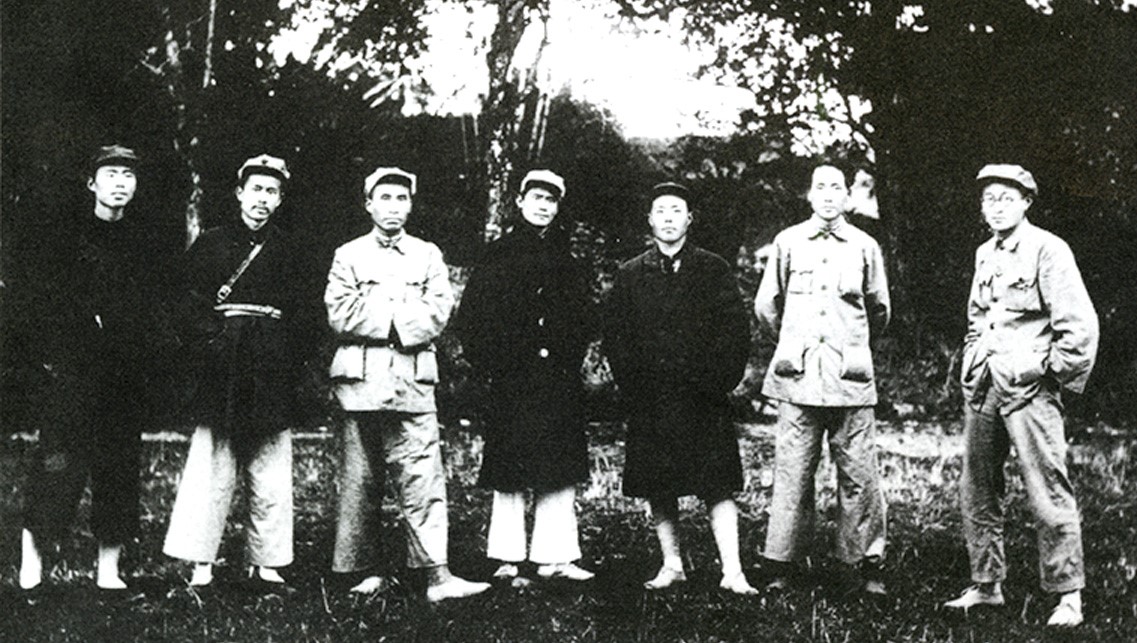
The Jiangxi Soviet, the capital and largest of Chinese soviet, was established in 1931 and held out until 1934 when its defeat led to the Long March.
‘The Soviet District of North-East Kiangsi’ from International Press Correspondence. Vol. 12 No. 26. June 9, 1932.
(Soviet Correspondence from Ko-Yuän in North-East Kiangsi. March 1932.) The Soviet territory in North-East Kiangsi, to-day comprises more than 20 districts.
After having defeated the third campaign of the Kuomintang against the Soviet districts last year, the Red Army also succeeded in recapturing the lost districts. In addition, new victories have been achieved in the Spring of this year. Thus at the end of February, three new Soviet districts were set up in the Kuang-Fung region (North-East of Kiangsi) and three further districts in the region between Djen-Yang and Pu-Zen. From here the Soviet Power has been extended in the direction of Djen-Ngau. The advance of the Red Army has been particularly successful in Fukien. The town of Chunganhs was captured and the Wuyi mountains, an extremely important strategical point, occupied, so that the Kuomintang troops have lost a strong basis. In the Te-Schin region (Kiangsi) the 6th Soviet district has been recaptured and a new Soviet district (the 10th) has been organised. In the course of a month the Soviet territory in North Kiangsi has increased by 200 square Li (a Li is about a third of an English mile)/
As a result of this extension of our Soviet district our aim, the uniting of the various Soviet districts into a coordinated Soviet territory, has been partly realised. Particularly important is the linking up of the Soviet district in North-East Kiangsi with the Soviet district in the North of Fukien, which was achieved by setting up a military guard to cover the connecting routes. The connection between the Soviet district in North-East Kiangsi and the Central Soviet district in Kiangsi was established by the partisan fights, so that a united Soviet district in Kiangsi is approaching realisation.
In spite of their repeated defeats, the troops of the Kuomintang reaction have not yet abandoned their hopes of annihilating the Soviet districts and are constantly carrying out fresh attacks. When the 9th, 79th and 53rd divisions of the Kuomintang army, after the defeat of the third campaign against the Central Soviet district, retreated to Anhwei and Chekiang, they attacked the centre of our Soviet district of Ko-Yuän. In other places they also attacked the agricultural population, set fire to the houses, seized the grain and killed civilians. In spite of this furious attack on our Soviet district, the Kuomintang army was repulsed by our heroic 10th Red Army supported by the Soviet population. Finally, the Red Army together with the local partisan troops inflicted an annihilating defeat on the Kuomintang army, which lost more than 1000 killed and wounded. The scattered remnants of the defeated Kuomintang army were driven over the frontiers of the province.
As a result of the constant defeats the Kuomintang troops were compelled to apply new methods in their fight. The 55th, 18th and 4th divisions of the Kuomintang army and the local “security detachments” of the Kuomintang are permanently stationed round our Soviet district. In addition to the numerous robber attacks upon the Soviet population, these troops are engaged in consolidating their position by erecting fortresses at distances of 30-40 Li from each other. The Kuomintang troops are now endeavouring to blockade the Soviet districts. In order to weaken the morale of the Soviet population they spread the rumour that the “fortresses mean the death of the Communist bandits”. It is true, the fortresses mean a threat to the Red Army, which is still weak from the military-technical point of view, but in recent times it has succeeded in destroying not only some of the newly erected fortresses (near Wan Yian) but also some of the old ones (for instance in Yü- Kiang).
Under the former Le-Li-San leadership we made various mistakes in our agrarian policy. Thus for instance, the division of the land was not carried out in the interests of the poor peasants and land workers. The confidence of the middle peasants in the Soviets was also shaken by such mistakes. The correction of these mistakes consolidated and strengthened the confidence of the broad masses into the Soviet power.
As a result of the agrarian revolution a clear class differentiation is taking place in the village, and the class struggle is assuming sharper forms. The big peasants, who always liked to make themselves out to be middle or even poor peasants, were exposed by the toiling population. The result of this new correct agrarian policy was expressed in the fighting enthusiasm with which the poor peasant population repulsed the attacks of the enemy.
The Provisional Central Government of Soviet China has also proceeded to carry out the labour legislation adopted by the Soviet Congress. Wages have been considerably increased, the eight-hour day has been realised by the workers’ collectives and also the agricultural workers have partly won the eight-hour day.
The trade unions of our Soviet district now comprise 14,198 members, of whom 8764 are artisans, 4191 agricultural workers, 371 water transport workers, 505 unskilled workers, 303 miners and 64 commercial clerks. The trade unions are exerting all their forces in order to win a greater number of agricultural and industrial workers by a correct representation of the interests of their members.
Since the news of the Japanese attack on Manchuria reached our Soviet district the anti-imperialist and anti-Kuomintang mood of our Soviet population has greatly increased. In a very short time the membership of the League against Imperialism rose to 160,000. In February the League Against Imperialism held a delegate conference of the whole Soviet district. It was decided to fight, under the leadership of the Soviets, against imperialism, against the Kuomintang, and for the development of the agrarian revolution. In addition, the Congress adopted a programme of action of the anti-imperialist movement.
The news of the Japanese robber-attack on Shanghai greatly enhanced the fighting spirit of the Soviet population. Everywhere protest demonstrations of the workers and peasants took place. The toiling population of our Soviet district pledges itself to continue the fight with all its forces until final victory against the Japanese robber-attacks, against the partitioning of China by the imperialists, for the support of the heroic struggles of the Shanghai workers, for the defence of the Chinese Soviet districts and of the Soviet Union!
International Press Correspondence, widely known as”Inprecorr” was published by the Executive Committee of the Communist International (ECCI) regularly in German and English, occasionally in many other languages, beginning in 1921 and lasting in English until 1938. Inprecorr’s role was to supply translated articles to the English-speaking press of the International from the Comintern’s different sections, as well as news and statements from the ECCI. Many ‘Daily Worker’ and ‘Communist’ articles originated in Inprecorr, and it also published articles by American comrades for use in other countries. It was published at least weekly, and often thrice weekly. Inprecorr is an invaluable English-language source on the history of the Communist International and its sections.
PDF of full issue: https://www.marxists.org/history/international/comintern/inprecor/1932/v12n26-jun-09-1932-Inprecor-op.pdf
 Revolution's Newsstand