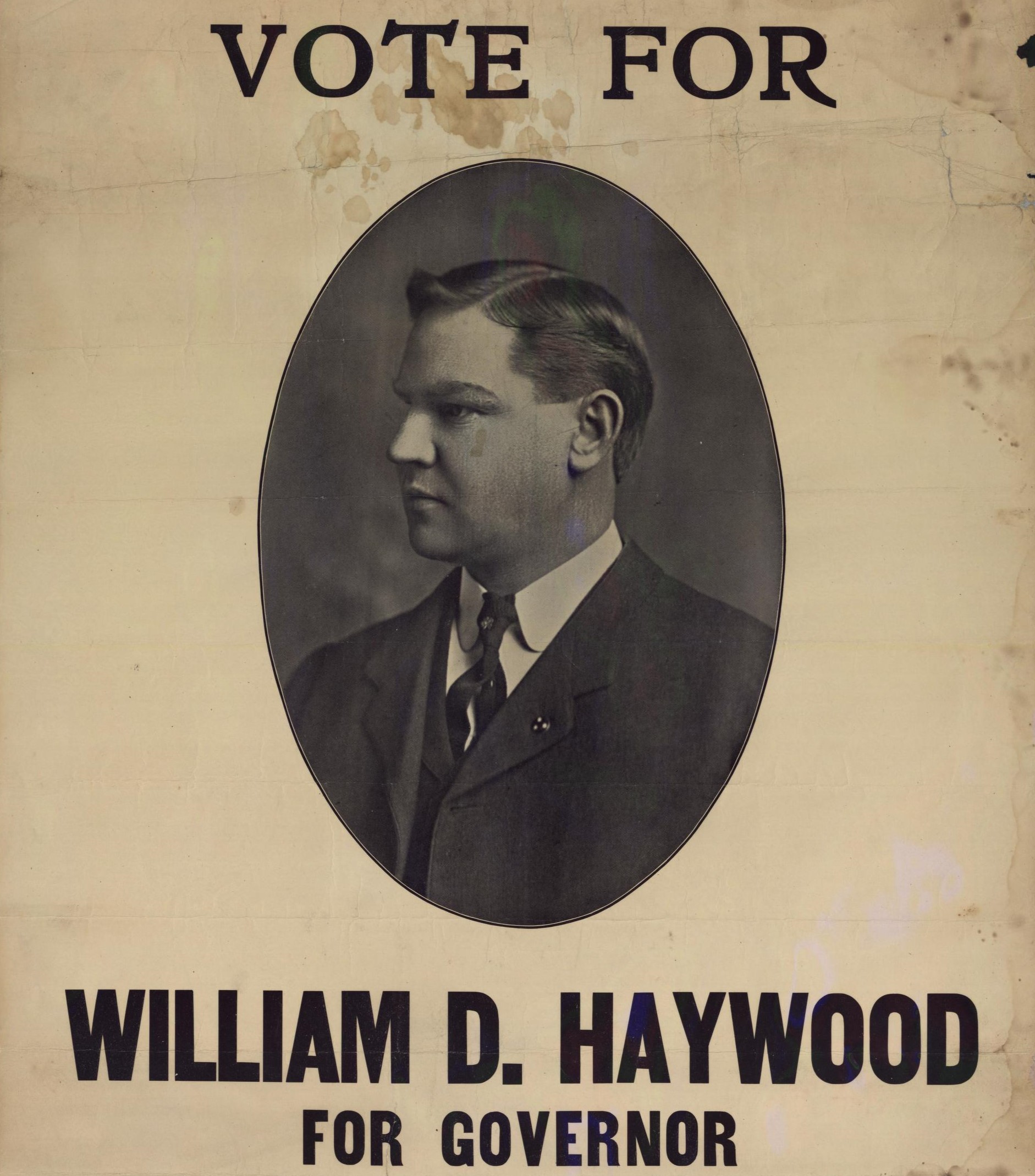
In jail awaiting trial on the ridiculous charge of murdering the former governor of Idaho, Haywood missed the historic second conference of the I.W.W., but sent this letter to the convened.
‘To the Convention of the Industrial Workers of the World’ by William D. Haywood from The Worker (New York). Vol. 16 No. 27. October 6, 1906.
From Prison He Writes to the Convention in Chicago.
Following is a copy of the greeting sent by Comrade Haywood to the delegates to the second annual convention of the I.W.W. being held in Chicago:
ADA COUNTY JAIL, BOISE, Idaho, Sept. 17, 1906.
To the Officers and Delegates of the Second Annual Convention of the Industrial Workers of the World.
Comrades and Fellow Workers: While you have been in convention to-day, I have devoted the hours to a careful review of the proceedings of the initial convention of the I.W.W. and of the conference that issued the manifesto leading up to the formation of the organization, which has inspired and rekindled the smouldering fire of ambition and hope in the breasts of the working class of this continent.
With ever increasing volume the workers thruout the country are resounding the pean of economic freedom, which rang out so clear in the manifesto. It is a document that should be perpetuated, by reading it at each recurring convention of the Industrial Workers of the World. With its salient truth as a corner stone, with our preamble as a guiding star, no matter which way we go, which way we build, every fort will strengthen and augment the battlements and forces of the working class.
What magnificent results have been accomplished in a brief fifteen months. The organization has been on a continuous march onward and upward. There has never been a retreat or a backward step. Thruout the West there has been a number of strikes of a more or less serious nature, but in every instance a victory has been recorded for the Industrial Workers of the World. The Department of Mining Industry, the Western Federation of Miners, was never in more flourishing condition. The membership is rapidly increasing, but better than aught else is the fact that we are coming to a closer, keener realization of the ultimate purpose of the I.W.W. and while we may not be as scientific in our endeavors, still in our rough and tumble way we will manage to keep in the van of organized labor. And when the day of emancipation comes the miner will be at his post to furnish material for the Workers of the World. We are beginning to recognize our importance as the primary element in the development of civilization. From the raw material that we produce, the coal, iron, lead, copper, zinc, cobalt and tin, is made and perfected the tools and instruments of the artisan and scientist. The miner has been the steppingstone of human achievement from the age of the stone implement, the plow of a crooked stick, the breach clout garb, to the inventions and innovations of modern society. We have depleted the storehouse of mother earth for others’ benefit at a frightful cost to ourselves. The hazardous nature of our occupation under the system of capitalism is more merciless than the carnage of war. We demand a complete and proper recognition of our service to society, a full equivalent for the product of our toil. This we can secure not only to ourselves but the entire working class by an industrial government. To quote from my letter to Fourteenth Annual Convention of the Western Federation of Miners: “Organized industrially, united politically, Labor will assume grace and dignity, horny hands and busy brain will be the badges of distinction and honor. All humanity will be free from bondage. A fraternal brotherhood imbued with the spirit of independence and freedom, tempered with sentiments of justice and love of order: such will be the Co-operative Commonwealth, the goal the aspiration of the Industrial Workers of the World.”
This is the spirit and the letter of the Manifesto and the Preamble, the corner stone and guiding star. There can be no more splendid incentive for energetic work. The first year’s accomplishment is grand. But we can do better. Let us redouble our efforts. Every man, every woman, can help to organize. Organize the working class for industrial liberty. May I suggest that it would be a good plan to elect at this convention a committee on constitution composed of one from each department to frame provisions and such suggestions as the requirements of the organization are sure to develop during the ensuing year. Experience teaches us that changes and amendments initiated in convention without previous careful deliberation are not always good. A general discussion of necessary rules would enable such a committee to submit a report of stability and permanent advantage. I have written more than I intended. My purpose in writing at all at this time was not to make suggestions, but to extend to the officers, to the delegates, and thru them to their respective unions, our profound thanks for the splendid support tendered us in our hour of tribulation.
Stone walls do not a prison make,
Nor iron bars a cage.
Our hearts are with you. A little temporary confinement can neither break our health or spirit. Justice must prevail and we will be with you in the Third Annual Convention of the I.W.W.
I am yours for the right to work for ourselves, when and where we please.
(Signed) WM. D. HAYWOOD.
The Worker, and its predecessor The People, emerged from the 1899 split in the Socialist Labor Party of America led by Henry Slobodin and Morris Hillquit, who published their own edition of the SLP’s paper in Springfield, Massachusetts. Their ‘The People’ had the same banner, format, and numbering as their rival De Leon’s. The new group emerged as the Social Democratic Party and with a Chicago group of the same name these two Social Democratic Parties would become the Socialist Party of America at a 1901 conference. That same year the paper’s name was changed from The People to The Worker with publishing moved to New York City. The Worker continued as a weekly until December 1908 when it was folded into the socialist daily, The New York Call.
PDF of full issue: https://www.marxists.org/history/usa/pubs/the-people-the-worker/061006-worker-v16n27.pdf
 Revolution's Newsstand