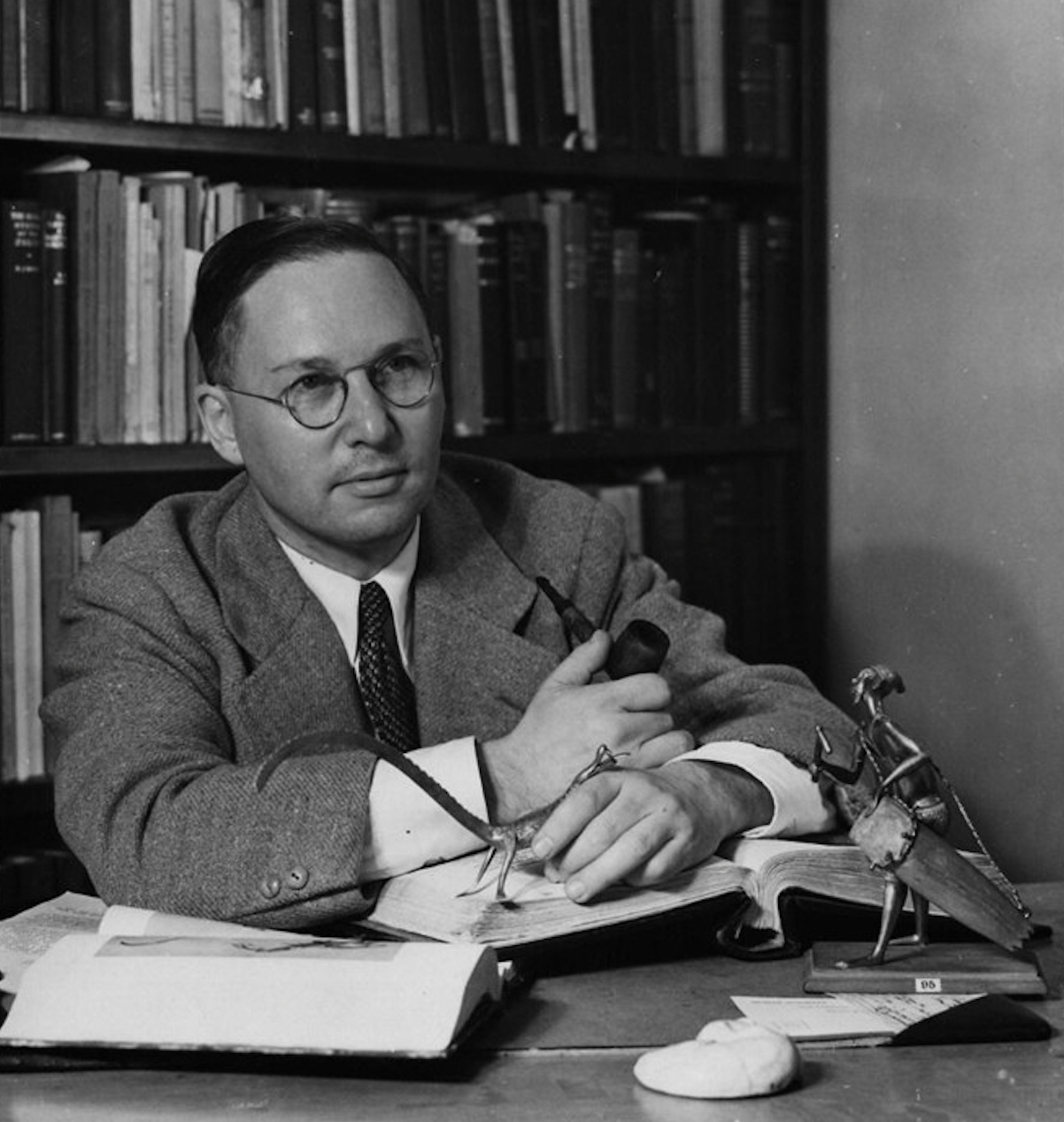
Is it biology, language, culture, history, geography? Melville Herskovits, so associated, and controversially, with bringing ‘African-American’ studies about, interrogates his own, Jewish, identity in this very modern, one-hundred-year-old, searching essay from Modern Quarterly.
‘When Is a Jew a Jew?’ by Melville J. Herskovits from Modern Quarterly. Vol. 4 No. 2. June-September, 1927.
I HAVE often wondered just what, exactly, constitutes a Jew. I call myself one. Yet neither in training, in tradition, in religious beliefs, nor in culture am I what might be termed a person any more Jewish than any other American born and reared in a typical Middle Western milieu. And yet, when I hear the name bandied about with so much ease, and with the common assurance that naming a thing constitutes a statement of all its implications, I sometimes wonder just how one would go about constructing a definition that would hold perhaps a very small bit of water. What this means, of course, is trying to find some sort of Jewish least common denominator,–the largest classification or the most general trait which can be thought of as characterizing all Jews. Because, today, I do not believe such a definition exists,—in my case, I have not found one which satisfies me. For me, the word Jew falls into the category of things of which one says, “I know what they are, but I can’t tell anyone else just how I know it.”
And so, in constructing this least common denominator, it might be well to make a list of things people say are characteristic of Jews, and what Jews say characterize themselves, and see to what extent they may be applicable to all Jews. And perhaps, if something common to all of these characteristics seems to come from them, we may be in a fair way to starting our definition. What, then, are Jews said to be, that is, all Jews? They are, of course, the chosen people. It was one of their earliest assertions about themselves. They are a race, it is claimed, and some say a nation. Still others say they are a people, although this may be regarded as a sort of variant of the two other. They are also considered as a cultural stock,—that is, they have a common culture which comes out of a common historical background. Then we have the less tangible definitions,–Jews are people who, for example, are characteristically idealistic, or they are characteristically radical, or studious, or what-not; and perhaps the latest definition of the word I have heard was at a recent Menorah dinner in New York, where a speaker declared that the outstanding trait of the Jew is that every member of the Jewish group is descended from a hero. But more of that later.
What of all these assertions, made by all sorts of people, Jews and non-Jews, rabbis and non-rabbis, students of the problem who have given years to it, enthusiasts of one cause or other, and so on without end? None of them satisfy me, and I feel that I have fairly definite grounds for my dissatisfaction. Let us see how justified my reactions to them are: let us take these assertions one by one, and examine them as to their validity.
We have all heard the chosen-people story in whatever sort of equivalent of religious school we were taught, or perhaps even earlier in our homes. It is one of the stories that peoples like to tell of themselves, and we Jews are encouraged in believing it by the undoubtedly long historical record of narrow escapes from extinction we have gone through, and through the persuasive arguments, in this American culture, of the non-Jewish persons who believe literally in their Bible. I first encountered this sort of thing when I was in high school, and the elderly woman who used to tell me how fortunate I was in being a Jew, because God had me under his special protection, made an impression on me that I have never forgotten. I do remember, however, being somewhat puzzled, since I was at the time first encountering the anti-Semitic prejudice which is prevalent in many of our Middle Western cities. But the theory of the chosen people is not an unfamiliar one to ethnologists, since it is encountered in many primitive tribes, who always feel that they are the most important of all of the peoples with whom they are acquainted, and who bring forward mythical or folk-loristic sanction for their belief. This idea of defining the Jew, therefore, may perhaps be dismissed without further consideration, except one of appreciation for the bit of excellent story-telling with which it is presented in divine sources, and an understanding of the importance it has played in bolstering the self-respect of Jews in more naïve days when persecution took on less refined forms.
The assertion that the Jews are a race, or at least, a racial type, is very widespread, both among Jews and non-Jews. It takes the form of the assumption that there is either a racial “type,” which may be distinguished physically, or this definition is enlarged by the statement that in addition there is a series of temperamental traits which go with these physical ones. The typical Jew is generally supposed to be short, dark, with curly black hair and dark eyes, and his physiognomy is supposed to be swarthy and to have the distinctively “Semitic” or Jewish nose. Now, no one can deny that there are Jews who fit this description. But, after even a cursory survey no one will fail to admit that there are perhaps as many Jews who do not fit it as there are who do. Studies of the physical anthropology of Jews have been made from time to time, and they almost always tend to show that the Jews in a given geographical area resemble most closely the non-Jewish people who live in that region. And it apparently does not make a great deal of difference what these traits may be,–head form or hair color or stature or what-not. East European Jews look like East Europeans; German Jews are like Germans, and American Jews are about as heterogenous in type for the practical purposes of making it easier for us to classify them as the general American population. This talk about there being a Jewish type, I believe, comes from our tendency to stereotype groups in our minds. Thus, we are surprised when we go to Sweden and see there short, dark, brown-eyed Swedes, who, we learn on inquiry, come from families who have been living in Scandinavia for generations, just as it gives us a shock to go to Italy and learn that there are numerous blond, blue-eyed Italians. No one will deny that there are more blond Swedes than there are blond Italians, and in so far as this is true we may speak of a type. But when we try to apply this to Jews, we find that we get nowhere. I have seen many an Armenian child, for example, who looks so much what we think the typical Jewish child should look, that one feels his name should be something quite other than the Armenian one by which his mother calls him, while the Turkish and Berber profiles so resemble what we conceive the Jew to be like that we feel they should be Jews! No, the term “race,” I am afraid, is of no more assistance in making our definition, than that of chosen people. If likeness of traits has anything at all to do with genetic relationships, I should say that the evidence from anthropometric sources show emphatically that the Jews are not a racial unit. Granted an eastern Mediterranean race from which the Jew came, we have so many distinctly north European and Slavic types among the group we designate as Jewish that it is the opposite view which is by far the more plausible. Certainly the numerous blond, blue and hazel-eyed Jews argue, to be conservative, an exceedingly strong infusion of non-Jewish blood, granting that there was a Jewish physical type to begin with, nor do such individuals fail to point to the fact that many of us number nameless crusaders among our ancestry. It is almost axiomatic, in the study of the intercourse of peoples, that no two groups will come in contact with each other without mixing both physically and culturally. The cultural element we may consider later, but the physical mixture which has taken place is almost obvious. When we find that caste lines as strong as those which exist in India do not prevent sexual relationship between members of the various castes, or that the taboos on intimacies of this kind between White and Negro in this country did not prevent it, how can we argue that no mixtures occurred between the Jews and their various types of non-Jewish neighbors? I do not believe we can do so, and I feel that the assertion that the Jews are racial type belongs in our mythology along with the earlier story that we are the chosen people.
The nationalistic definition has come into vogue along with the Zionist movement, and we are now informed by many that it is as the Jewish nation that we have survived and will survive, and that we may be thought of as one in the congress of nations. Aside from the obvious fact that, in the sense that a nation is a self-governing political unit, we are not and have not been such since the days of the final destruction of Jerusalem, and that since then we have never had the geographical anchor which is usually associated with the idea of nationality, it must be confessed that today, even granting that Palestine is a Jewish country, there are so many more Jews living outside it than in it that it would be folly even to consider using the term when a definition is being sought. No, I do not believe that we are a nation, and, unless there is an exceedingly strong turning away from the existing allegiances of Jews living in various parts of the world to that particular part of the world where they happen to have been born, and where they happen to have lived their lives, I do not feel that the term will ever have great significance in the connection in which we are trying to employ it here. Patriotism, after all, is an earnest of nationality, and one may only look over the rosters of the armies which fought the numerous wars engaged in by the several countries in which Jews have lived to see how voluntarily they become nationals of the country in which they live. Nor is it strange. Jews, like everyone else, react to the patterns of behavior to which they have been conditioned, and this holds in a social sense no less than in a personal. And the Jew who lives in a country adopts its mores, and becomes a part of its citizenry to the extent to which he is permitted; indeed, we have nowhere the spectacle of Jew as Jew refusing to take privileges of citizenship when it is offered, but rather we find him begging for it when it is denied. And why not? After all, when I am asked by a foreigner what I am, I will answer “American.” And so does every other American Jew, for to do otherwise is but meaningless. And if we try to solve the difficulty by calling the Jews a people rather than a race, or a nation, I am completely at a loss as to what is meant, and, I think, an attempt of definition is still more befuddled rather than clarified.
Are we a linguistic group? Historically, certainly, there is Hebrew. But do we use it as, for example, Flemish is used by the Flemings of Belgium? Have we retained it in the face of oppression as is the case with the many American Indian tribes? Or do we insist that we use it in our homes and not give way to alien tongues which our neighbors speak, as was the case with the Czechs and the Poles in pre-war Austria and Russia? I do not believe this to be the case. Indeed, we find it a common phenomenon that Hebrew is not understood at all by Jews, and even where a sense of Jewishness is strongest the language spoken is the bastard German, Yiddish, rather than Hebrew. It is true that there is a renaissance of Hebrew in Palestine, and this is all to the good, but what value has it in attempting to define the word Jew? Jews are not a people with one language. Broadly speaking, their lingua franca may be termed Yiddish, but if you happen to go to the Jews of Constantinople, or anywhere along the Eastern littoral of the Mediterranean with your Yiddish, you will be as much at a loss in getting something to eat as though you were equipped with a language of the South Sea Islands. And Hebrew, I venture to guess, would stand you in no better stead unless it were in Palestine. Nor is it likely that Hebrew, which, after all, is the logical language for us to speak if we are to have a language common to us as any kind of a unit, will be generally used by Jews. We are too busy with the everyday problems of existence, and if a Jew is going to learn another language, he will generally learn one that can help him solve problems of travel, or foreign business, or science: and he will learn German or French or English or Italian rather than what may, by a stretch of the imagination, be called his ancestral tongue. And so we cannot include a linguistic element in our definition, come what may.
One of the terms most often employed in defining Jews is that of religion. Particularly is this true of our non-Jewish fellow citizens, who often refer to us as a “church,” or as a compactly united religious organization. To any Jew, this is obviously untenable. Not only do we have in this country orthodox and reform styles in Judaism, but there are the more fundamental differences between the Sephardic and Ashkenasic types of worship and belief. Further than this, no one denies that the independence of the various synagogues and their leaders from any kind of central control has had the effect of making us a people with all sorts of differential embroideries on whatever common fundamental beliefs we may have had at one time. And still again, we have the very fundamental implication in Judaism from the earliest days that the best thing a man can do is to think for himself. Now, it is a truism that thinking for oneself is not the best way to encourage unity of religious belief. As the great example to the contrary, we have the Catholic Church, which has prospered and held itself so long and so completely a religious entity by a method which is the exact opposite. No one would hesitate, of course, to define the term Catholic. In every Catholic church entitled to the name, at the same time, on a given day, the same rite is being observed in the same way, the same words are being said by the priests in the same fashion and with identical ceremonies. It might almost be said that, as far as religious beliefs are concerned, the thoughts of one Catholic are identical with those of every other, no matter what his race or civilization. The word Catholic is a complete definition,–is the word Jew? For answer, we need only conjure up the images of the Russian-Polish synagogues, and then of the Sephardic, and then the American Reform temples, in contrast. By and large, every Jew settles his beliefs for himself, and not only that, but he is encouraged to do so. The pattern of individual thinking is deep in the traditions of whatever religious organization there may be among the Jews, and it has had the effect of making a great many Jews think for themselves religiously. I am not affiliated with any sort of a Jewish religious organization, nor do I hold the beliefs commonly regarded as religious at all. Does this make me any the less a Jew? I do not believe that it would be said so. Indeed, as a student at the Hebrew Union College, troubled about some of the larger theological concepts implied in membership in the rabbinate, I questioned to some of the older students the propriety of continuing as a prospective rabbi when I held these beliefs, which differed with the traditional beliefs of Judaism and particularly with the opinions of them held by members of the faculty, especially the president, a noted theologian. Imagine my intense surprise, when I was advised, “Suppose you do differ with them? Why can’t you interpret these traditions to suit your own beliefs? Can’t you pray to the Social Force, and call that God in your own mind? I don’t believe in a personal God any more than you, but that’s the way I look at it. No one can tell me, as a Jew, what I must believe. And if I differ from what has been believed, so much the worse for the beliefs.” I cite this as a striking example of the extent to which Jews cannot be defined as those persons professing a definite series of dogmas, especially since this particular student is at present a member of the American Reform rabbinate. It is notorious, the extent to which Jews tend to accept agnostic and atheistic beliefs. Or creeds of an ethical or therapeutic nature. And yet no one calls the professing agnostic who has been reared as a Jew anything but Jewish, just as no one calls the leader of the Ethical Culture Society and perhaps the majority of his followers anything but Jews. I am afraid that this element of our definition must, like those preceding it, be cast aside.
We come now, on our list, to the assertion that we have a common culture, arising out of a common historical background. That this is the most plausible of any of the terms which are used to define Jews cannot be denied. Certainly there is the biblical tradition, and, to those of us who are not completely acculturated to the cultures of the countries in which we happen to live, that of the rabbinical schools and their talmudic learning. Nor has the tradition which this culture engendered been lost. It is the tradition of learning, and it is seen in the endeavors of Jews the world over to get the best kind of an education they can, by the sacrifices which they make for this education, and by the often brilliant intellectual results they attain after they have got it. But that this is characteristic of all Jews no Judaiophile would maintain for an instant. The Jew is quite as interested in the cloak and suit trade as he is in learning, and for every earnest Jewish student in our American universities I will match you with another as typically acculturated to the prevalent country-club university pattern as any scion of six generations of Harvard men. What then of our culture, whatever there may be of it? It certainly cannot be maintained that it comes from Palestine and the Maccabean and pre-Maccabean kingdom. Of that we have only tradition. And to this has been added a wealth of cultural (religio-ceremonial) practices that speak for themselves along that line. The late Professor Gotthard Deutsch used to trace, in his classes, the rise during the Middle Ages of various elements of the Passover rites, and he maintained with vigor that the use of candles in the Jewish ceremonial is directly derived from the Catholic neighbors of our forebears. For as it is easy to mix blood streams of different peoples, it is even easier to mingle cultural streams. The phenomenon of the diffusion of culture is well known and accepted without serious question, and peoples are not long in contact without there being evidences of this contact in their cultural practices. As Jews, we do not have, for example, distinctive dress, unless in a period of extreme anti-semitism a distinctive dress is made compulsory. The ceremonialism is the strongest evidence for cultural unity, and yet the extent to which this varies from type to type of Jew is notorious. Language has already been discussed. What else remains? From the point of view of material culture, we do things as the peoples among whom we happen to be living do them, and we use the same implements in doing them as they use. Is there any distinctive Jewish type of architecture as you find, let me say, in Italy? Is there a distinctive Jewish type of farming, where the Jew farms? Or of commercial practices, where he is a business man? The Jew has ever taken on the color of the culture in which he lives, and far from identifying himself with his own typical culture (whatever there may be of it) he usually tries to become as completely acculturated as is possible to the culture in which he finds himself. How many Jews are there who protest against the Americanization movement, once you get outside New York City, where it never has attained great importance? Of course, you may tell me that this is an example of protective coloration, and I should not deny it. I should only reply that it has been attained so thoroughly that whatever traces there may have been of something distinctive have gone by the board. But there are other elements to a common cultural possession, and these are not to be disposed of so easily, I grant. Perhaps they are not to be disposed of at all. One of them is the tradition of being a Jew, the feeling which is ground into every Jew from the time he is old enough to realize that he is somebody different from the people about him. This, too, may be called, if you will, historical sense, for, essentially, all Jews have much the same historical tradition of reaction from persecution and from the feeling that they are different from their neighbors. That this is something very real to every Jew one cannot deny, but it is not for us to define the Jew in terms of it. I have had occasion, in the past few years, to work among Negroes. And the more closely I have come to know them, the more and more I have come to see the same typical reactions among them,–reactions which I had before felt were typically Jewish. I do not know the Gypsies, but I sometimes wonder if they do not exhibit the same typical reactions. What we have, therefore, is really the response to a pressure from without, the reaction of a group which is set aside in the attitudes of their fellow-men as different, or inferior, or something to be disdained. It is nothing Jewish, it is essentially human. But in so far as Jews feel it, they are alike. And I doubt if there are many Jews who do not feel it to some degree. But I venture to say that were the cause for it, the attitude of the non-Jews, removed, these so-called “typical” Jewish reactions would not take long in disappearing.
Finally, we come to the less tangible definitions of the Jews. I feel that these may be subsumed under the head of compensations to these discriminatory reactions on the part of the various peoples with whom the Jews live. Could anything be more expressive of this compensatory mechanism at work than the statement which I have mentioned above, that every Jew is descended from a hero? And this, because the Jews in the Middle Ages endured persecution and succeeded in escaping it eventually! There is no people who do not look back to the golden days of heroism with pride and identify themselves with the heroes of those days, to the resulting pleasurable expansion of their egoes. If we substitute the name of any other people for the word Jew in the definition given above, we can imagine any member of that people making the statement. Do not the Greeks point to their golden days? What is Fascism saying today in Italy? Do not the Swedes point out that Russian culture is derived from their own? Or, for that matter, what do the proponents of the Nordic superiority theory largely base their claims upon if not the heroic achievements of the early raiding North Europeans? The statement, of course, is not worth being taken into consideration seriously as far as definitions go, but I mention it to show to what extremes this compensatory identification may take us. It is a naïve exhibit of this sort which is often the most enlightening. And similar to it is the assertion that all Jews are idealists. This is a favorite rabbinical pronouncement, and we often hear in our Reform pulpits, at least, that it is the idealism of the Jew which makes him distinct. Again, what people do not say the same? And, particularly, what people who have known oppression and who are not able to identify themselves with a dominant group? Are the great Jewish exploiters idealists? Or the Jewish trade unions, with particular reference to their leaders? And as for the numerous revolutionists, undoubted idealists who are and who have been Jews, what more natural than to find members of an oppressed group the most ready to attempt to remedy matters? I am not disparaging, in any sense, the accomplishments and the sufferings of these rebels.–I only object to their being singled out among the great mass of Jews who live lives similar to the lives of common, ordinary people among whom they find themselves, and being held up as the type characizing all Jews. There are many Jews who have lived,–and died,– for causes they considered just. So have many non-Jews. I cannot see that there is anything particularly Jewish about it. We take pride in them (unless we disagree with them, in which case we join our non-Jewish neighbors who also disagree in heaping shame on them and cheer their imprisonment), and this again is the phenomenon of compensatory identification at work.
What are we, then, to do with this definition? Can we construct one that will fit the facts? For my part, I have serious doubts. I fail to see anything particularly unique in the Jew as Jew. And yet, there is the great imponderable fact that there have been and are Jews, and they do feel themselves Jews when they are far removed from everything which might possibly be construed as “typically” Jewish, that they feel perhaps somewhat more at home among persons called Jews than with others who are not called this,…and it is this last that may give us a clue. After all, a name is a very potent thing. If you call a man by a name, you fix him immediately as the thing you call him, unless he shows very clearly that the name does not apply in his case. Might we not, therefore, say that every Jew has one thing in common with every other Jew,–the name of Jew? If he answers to it,–if he calls himself Jewish, then he takes the name for himself. If others call him that, then he is identified by them with the Jewish group, and is so identified no matter what protests he may make, or what time element may separate him from those who accepted the name. We speak jokingly of Episcopal Jews, of Christian Science Jews, of Ethical Culture Jews. The name sticks, no matter where they turn. Do we not claim Disraeli and Heine as Jews, in spite of their conversions? But suppose, on the other hand, a man is a German Jew, a Turkish Jew, a Polish Jew, an American Jew? He is a Jew, none the less. He may speak the language of the country, dress as the other nationals dress, act as they act. But he is yet a Jew. And the great fact remains that there are all of these people who feel themselves Jews.
To me, it is one of the most fascinating puzzles imaginable. There is, essentially, when we analyze the situation, nothing on which one may put his finger. And yet the fact remains. Down thru the ages there have been Jews, as there are today. And I wonder if a more satisfactory definition can be given than the simple one of: “A Jew is a person who calls himself a Jew, or who is called Jewish by others.”
Modern Quarterly began in 1923 by V. F. Calverton. Calverton, born George Goetz (1900–1940), a radical writer, literary critic and publisher. Based in Baltimore, Modern Quarterly was an unaligned socialist discussion magazine, and dominated by its editor. Calverton’s interest in and support for Black liberation opened the pages of MQ to a host of the most important Black writers and debates of the 1920s and 30s, enough to make it an important historic US left journal. In addition, MQ covered sexual topics rarely openly discussed as well as the arts and literature, and had considerable attention from left intellectuals in the 1920s and early 1930s. From 1933 until Calverton’s early death from alcoholism in 1940 Modern Quarterly continued as The Modern Monthly. Increasingly involved in bitter polemics with the Communist Party-aligned writers, Modern Monthly became more overtly ‘Anti-Stalinist’ in the mid-1930s Calverton, very much an iconoclast and often accused of dilettantism, also opposed entry into World War Two which put him and his journal at odds with much of left and progressive thinking of the later 1930s, further leading to the journal’s isolation.
PDF of full issue: https://hdl.handle.net/2027/iau.31858045478306
 Revolution's Newsstand