
15,000 workers of Lawrence, Massachusetts march to the graves of their strike dead, Italian immigrant Anna LoPizzo and Syrian immigrant John Ramey, on Memorial Day, 1912.
‘Lawrence Honors Martyrs’ from Solidarity. Vol. 3 No. 24. June 8, 1912.
Lawrence, Mass. May 31. Capitalist reaction received a stunning blow here yesterday.
Despite the attempt to suppress the I.W.W. by arresting and threatening its leaders with death and imprisonment on various charges, a most inspiring funeral demonstration was held by the organization in honor of John Ramy and Anna La Pizza, the two martyrs of the recent great textile strike. Fifteen thousand paraders were in line. All nationalities were represented, as were also the workers of Lowell, Haverhill and other nearby industrial centers.
Along the line of march great throngs were gathered, conspicuous among whom were men and women wearing I.W.W. buttons and flying I.W.W. colors. Keeping pace with the march, on the sidewalks, went women and children carrying baskets of flowers. Appropriate music was well rendered by the various bands, composed exclusively of I.W.W. members. The parade was somewhat of an impromptu character, having been arranged on short notice and was hampered by threatening weather. Because of these factors, the parade was all the more inspiring.
The demonstration wended its way through the principal streets of the city to the Immaculate Conception cemetery situated on a bluff on the outskirts of Lawrence, overlooking the various mill properties which were once the places of toil of the victims in whose honor the demonstration was held. At the cemetery, there were no speakers. As William E. Trautmann well said, “There is no need for them. The demonstration speaks for itself.” It truly did. The long road leading up to the bluff was jammed with bareheaded men, women and children.
Led by bands playing appropriate marches, each division entered the cemetery and filed slowly past the graves of John Ramy and Anna La Pizza. Each division carried beautiful wreaths, adorned with rich, scarlet ribbons, inscribed in gold letters with the following mottoes:
“In Memory of Our Fellow Workers. The I.W.W. Polish Branch;” “To Anna La Pizza. Italian Branch, I.W.W.” “In Memory of Our Fellow Worker, John Ramy. Franco-Belgium Branch;” “To the I.W.W. Victims of the Strike, 1912. Syrian Branch, I.W.W.,” etc. These tributes were reverently placed on the last resting place of the Syrian boy and the Italian girl.
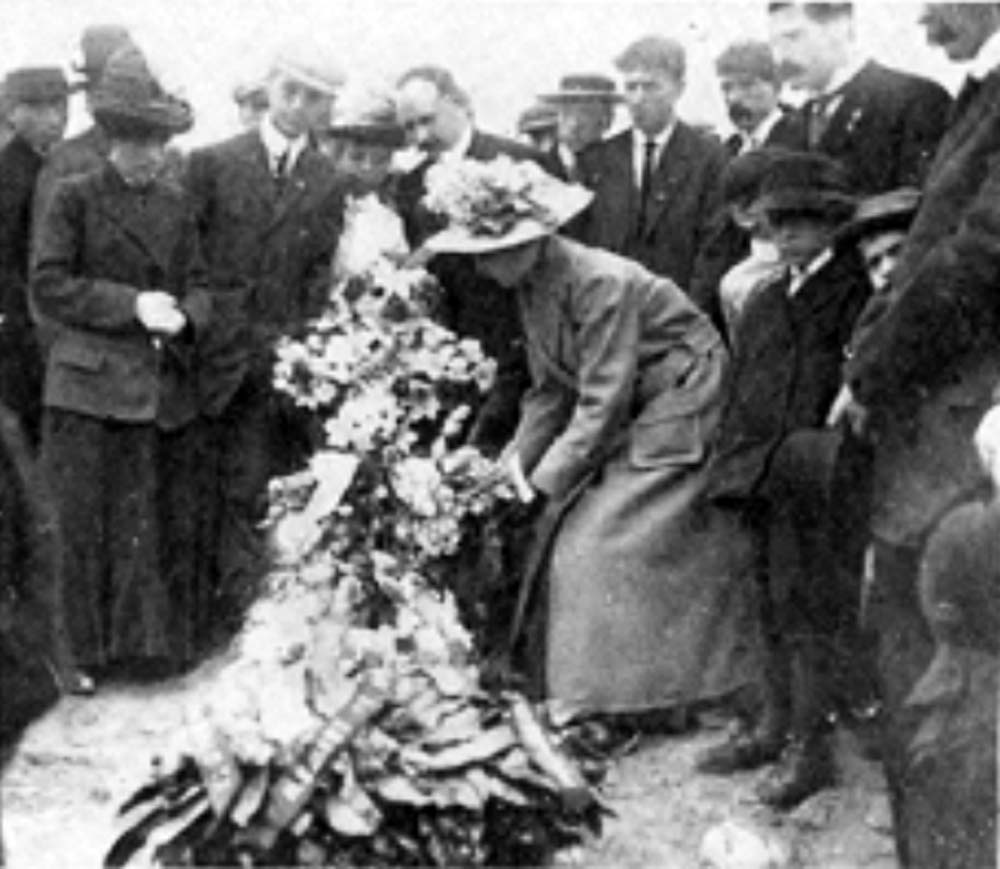
After these simple ceremonies, the indomitable tribute bearers dispersed to their many humble tenements in the great textile mill town, rejoicing over the solidarity once more displayed by the working class.
The demonstrations made a deep impression. The new industrial army, with its hopes of emancipation, had appropriated and utilized the day devoted to the old army of destruction, with its wage slaves and wage slavery. The Lawrence Telegram today reports the demonstration under the heading: “I.W.W. Turns Out Strong.” The Boston Globe made a feature article of it, with photographs.
It was most orderly, no police being present during the parade, and in spite of one or two protests on the part of patriotic and religious organizations which tried to create disturbance. To their discomfiture the demonstration was peaceful, a defiance of the master class, and an inspiration to the workers who were fortunate enough to be present to witness it.
The most widely read of I.W.W. newspapers, Solidarity was published by the Industrial Workers of the World from 1909 until 1917. First produced in New Castle, Pennsylvania, and born during the McKees Rocks strike, Solidarity later moved to Cleveland, Ohio until 1917 then spent its last months in Chicago. With a circulation of around 12,000 and a readership many times that, Solidarity was instrumental in defining the Wobbly world-view at the height of their influence in the working class. It was edited over its life by A.M. Stirton, H.A. Goff, Ben H. Williams, Ralph Chaplin who also provided much of the paper’s color, and others. Like nearly all the left press it fell victim to federal repression in 1917.
PDF of full issue: https://www.marxists.org/history/usa/pubs/solidarity-iww/1912/v03n24-w128-jun-08-1912-Solidarity.pdf
 Revolution's Newsstand