
The advent of digital media was not the first transformation of the printing industry. A fantastic look at the change mechanization, linotype, and commercialization made in the early 20th century and some salient proposals for a workers’ response.
‘The Evolution of the Printing Industry’ by T.F.G. Doughtery from Industrial Worker. Vol. 1 (new). No. 5. May 13, 1916.
“There ought to be another paper in this town” is a remark frequently heard in almost any city when group of printers are discussing the rapidly-increasing number of unemployed workers in the printing industry. One would think that newspapers were established for the purpose of giving employment to printers or to afford pleasure to the population of a community. Such is not the case. Newspapers are conducted for the profit of those who own them.
When a newspaper fails to realize profits for the owners it sooner or later gives up the ghost, notwithstanding the virtuous and sanctimonious statement that the “first duty of a newspaper is to the public.” No matter how badly printers may need employment, nor how much pleasure readers may take in a perisal mise. Despite the identity of interests alleged to exist between the workers and the employers, the workers have no proprietary rights in the newspaper industry, and the owners sell out or close up, the workers having nothing to do or say in the matter.
More Capital Now Needed.
Years ago it did not require a great deal of capital to start a newspaper, owing to the methods of production then in vogue. For instance, the city of Seattle today, has a population of more than three hundred thousand and has three daily newspapers–two afternoon and one morning. Twenty-five years ago in a city this size there probably would be from five to seven daily papers. Under methods of production then prevailing each of these would employ a composing-room daily regular force of from thirty to eighty (depending upon size of type used) for an all hand-set eight- or ten-page daily paper, with a sixteen to twenty-four-page Sunday issue. This is exclusive of extras and subs. In those days relatively more subs were supported on daily papers than at present.
The press-room and stereotype facilities, though better developed at that time than in the composing room, were not equal to the large and frequent issues of today.
There were a large number of small advertisers, rates were lower, and, as the field was large in comparison to means of production, each paper could cover but a small portion of the territory, consequently there was great duplication of ads.
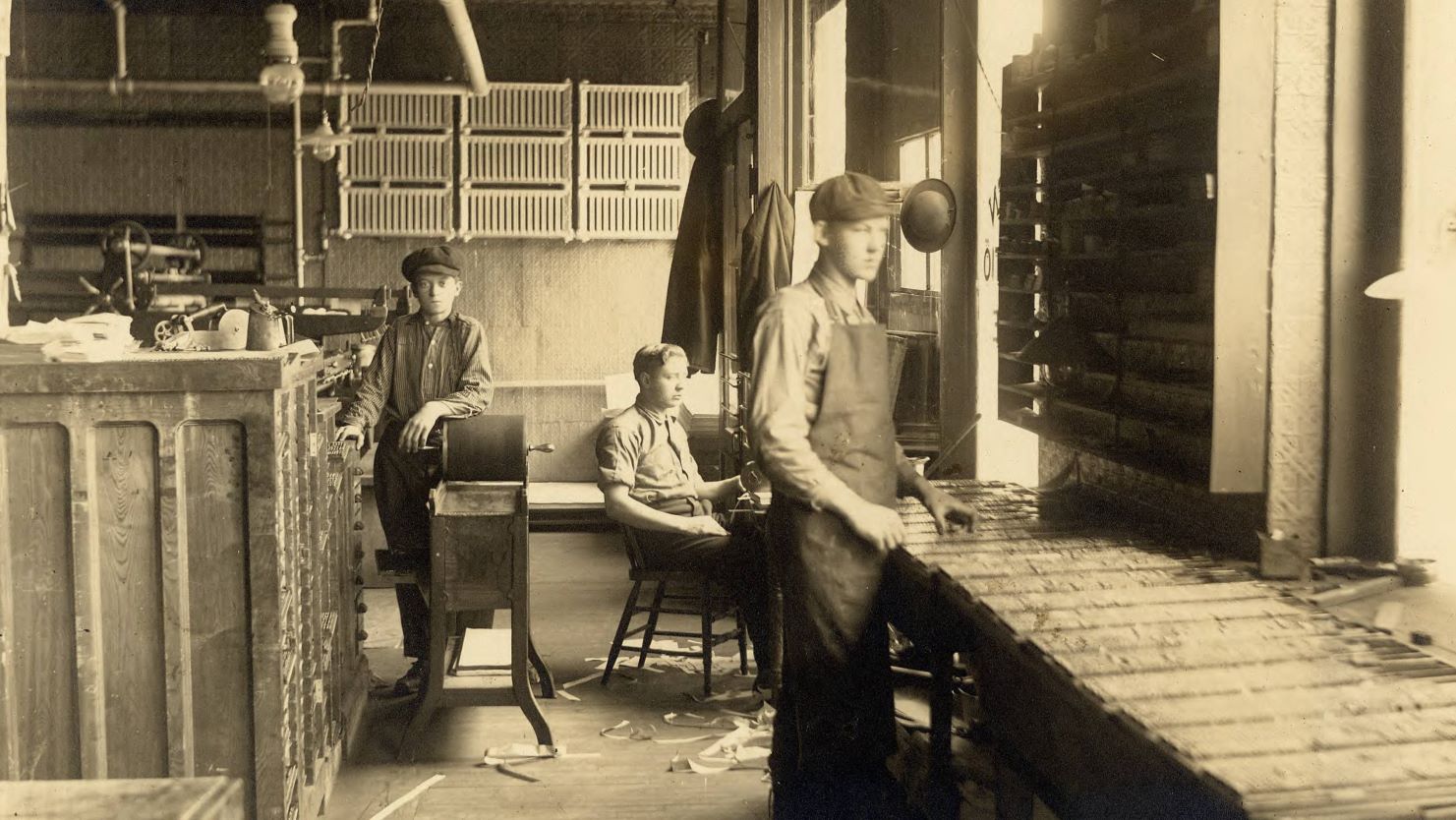
Newspaper production today is wholly different. With few exceptions papers are owned by stock companies or represent great corporations. The editor is a hired “hand,” who receives a “salary” distinguished from wages. Increase in the size of newspapers and news service has developed a division of labor by departments under direction of straw bosses, otherwise called editors, few of whom are graduates of the composing room.
Machines Displacing Labor.
The composing room looks like a machine shop and sounds like a boiler factory; new methods are used in stereotyping, and larger and faster presses occupy press rooms. Many other factors combined with machinery and new processes have developed the newspaper from its former state to a great industry requiring large capital to start, even in a small way. With present methods of production the field has been so narrowed that a city of three hundred thousand population does not support more than three or four daily papers.
Due to development of machinery and other methods, newspapers that vary in size from twelve to thirty-two pages daily, with Sunday issues of from forty to eighty pages are produced by a relatively smaller force than was necessary under methods of years ago.
Development of the linotype is more and more doing away with hand-set type, and the typecaster is being installed to minimize, if possible, distribution.
Present means of production permit of larger papers and greater issues on short notice at frequent intervals. Due to these changed conditions, we find a small number of large newspapers and a small number of large advertisers. There is not the duplication of ads that formerly prevailed, and, due to high rates, other methods of advertising have been developed. Papers with the largest circulation get the bulk of business.
In Seattle, for instance, one afternoon paper claims a daily average circulation of seventy thousand, the other about fifty-five thousand, while the morning paper is, said to have forty thousand, making a total average circulation of one hundred and sixty-five thousand.
Years ago, especially in large cities, the morning paper was the leader. The afternoon paper has become an all-day paper; it is read by the workingman after his day’s work (if he has any) and by his wife, who carefully peruses the department-store ads in search of “bargains” in hope of spreading the man’s wages over as great an amount of the means of subsistence as possible. The morning paper draws its patronage mainly from those who have time to read at or after breakfast, and who do not have to chase “bargains” or scan the “want” columns for jobs. The all-day paper gets the circulation and the ads. Many morning papers are, to a great degree, dependent for existence on Sunday issues. While newspapers have increased in size, their number, in proportion to population, has relatively decreased, absolutely, so in many cities. Papers unable to persist, suspend or are combined with stronger competitors.
Maximum Product; Minimum Expense.
Machinery that displaces human labor in all departments is developed more and more; the “liberal” use of “cuts” and “scare heads “saves” composition; “efficiency” and every possible means of speeding up workers are resorted to. Maximum product at minimum expense is the slogan.
It might startle our conservatives to know the number of workers thrown out of employment in the last few years owing to development of machinery, new processes, speeding up, and by suspensions and consolidations of newspapers.
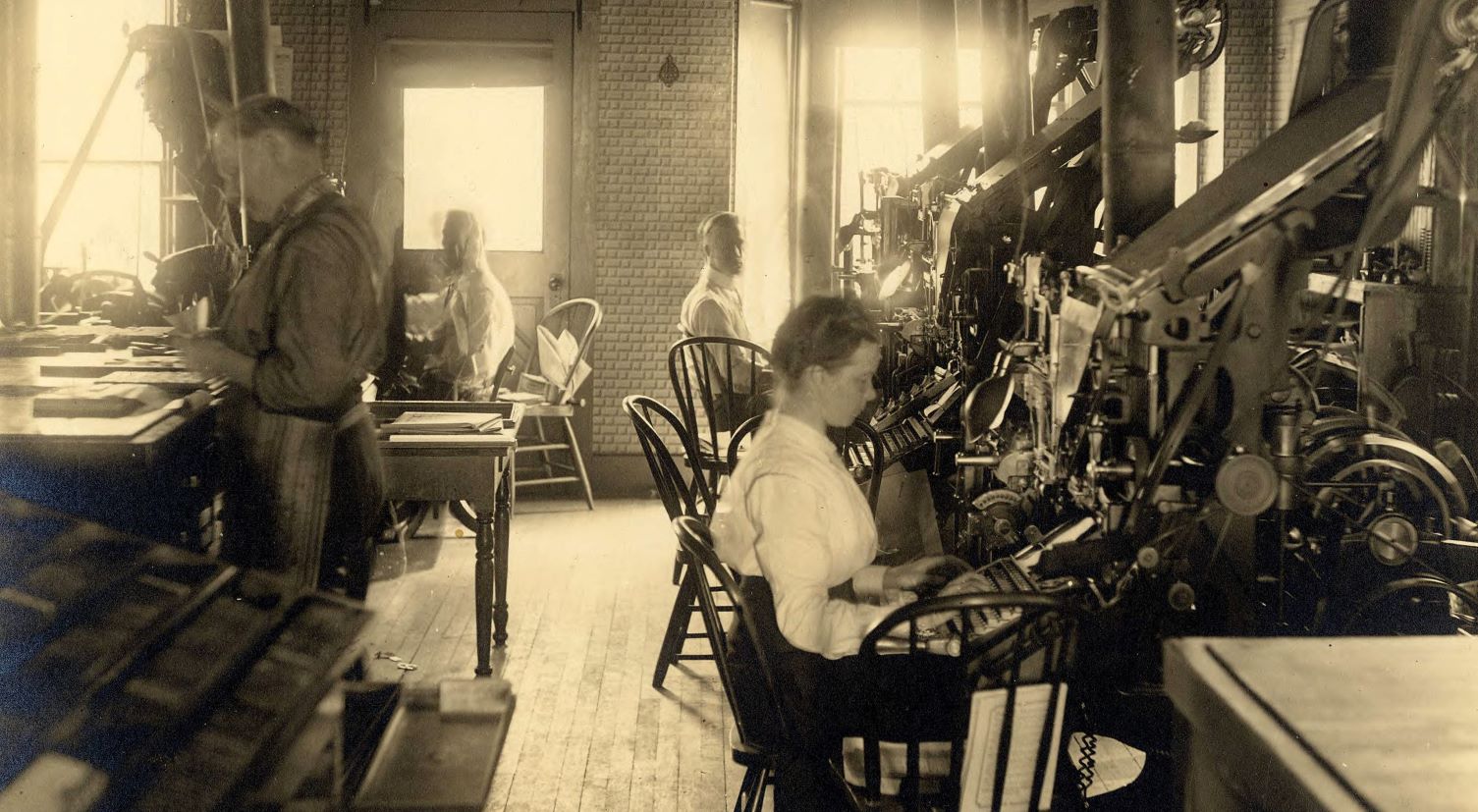
In the job and commercial branch of the printing industry there is a centralizing and decentralizing tendency, due to a new form of division of labor. Alongside of the big book and job office with its up-to-date equipment if machinery, new processes and “efficiency” experts, there is the linotype trade shop and an increasing number of small job offices.
With the advent of the linotype into the job branch, offices that formerly were equipped to produce large amounts of “straight” matter, hand composition, dispense with this, turning over all such work to the linotype trade shop. A smaller amount of capital is thus required to equip a job office, the result being that a larger number come into existence, many of these being one-man shops started by journeymen in an individual attempt to solve unemployment. With the introduction into the job office of the quick-change, multi-magazine linotype, not only is the “straight”-matter hand compositor eliminated, but the display-job compositor, who heretofore considered his position immune from the inroads of the “iron man,” is liable to find his “field of endeavor” limited.
Linotype trade shops are increasing in number, and, in order to offset increased wages and falling prices resulting from fierce competition, squeeze from the workers the greatest possible product. Linotype trade shops, in early stages of their development, were established in large or fair-sized cities, securing a great deal of work from smaller cities and country towns. Machines are being rapidly installed in small city or country offices, develop their own operators, do their own work and secure composition from larger cities and towns. This is especially noticeable since the intertype was placed on the market.
The development of the hand and rotary multigraph and other office equipment is doing away with a large amount of printing that was formerly produced in job offices. Then there is the “printer” who equips himself or herself with a small stock of type, a press and a book of instructions, and prints cards and other small work, evidently to the satisfaction of an increasing number of customers.
In the book-and-job branch of the printing industry there is vastly more printing produced than formerly by relatively fewer workers, whose number is growing smaller. Under the present economic system of production for profit, those industrial capitalists who produce their commodities cheapest, all other factors being equal or nearly so, get the market. Therefore the tendency is to simplify methods of production, either by division of labor, development of machinery or new processes, which results in greater displacement of workers and cheaper forms of human-labor power, to say nothing of speeding up by the bonus system and piece work, and the “salutary” effect of large numbers of unemployed.
Thus the “steady” job becomes more unstable, with a constantly-increasing number of non-job holders, who hang on by their eyebrows on three, two, one or no days a week.
These are the conditions that confront all workers in the printing industry. What are they going to do about it? How long can they stand it, especially those wholly or partly unemployed?
A Remedy.
Are we going to continue and quarreling among ourselves, like a pack of hungry dogs, over a bone that is becoming more bare of meat, or shall: we strive through our direct economic action to put more meat on the bone, with a more equal division of meat among all workers?
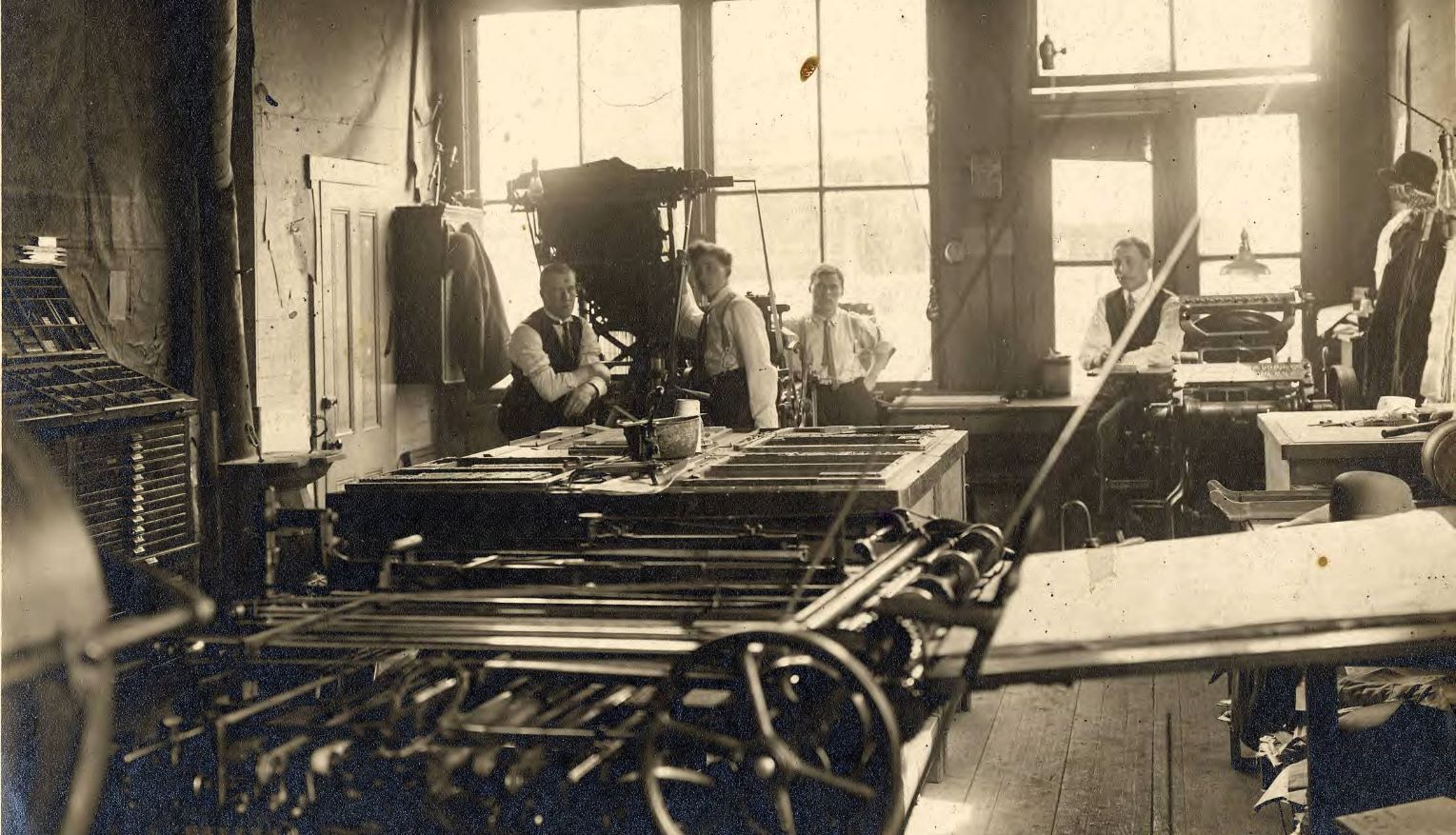
Rotation of work or a five-day week would be a great temporary benefit, but, with industrial development constantly at work, sooner or later there would be more workers among whom to rotate a decreasing amount of work; the five-day law, for the same reason, would eventually resolve itself into a four-day law, etc.
I maintain the only remedy for present and future unemployment is to shorten the workday, abolish piece work, and prohibit bonuses as incentives to speed, with over-time heavily penalized and rotated when worked.
Many members claim that what I advocate is impractical, because we would have to fight the employer. If the workers thought one-fourth as much of their own interests as they do about the boss, it would not take us long to solve our problems. Well, we will have to fight the employer if we attempt to put into effect a five-day week or rotation of work, and, while I recognize the great temporary benefit of either of these, I claim it will be better for us to immediately fight for that which will be of permanent good to the largest number of workers.
Workers Making and Enforcing Laws.
The way to get the shorter workday is for the workers in the printing industry, or any other industry, to pass a law in their unions, and enforce it on the job, by working the number of hours they have determined upon and then quitting.
Printing is a social product. No one person is a printer; that individual stage has passed. For example, a newspaper is not the product of one worker; it is the result of the applied labor power of all workers necessary in its production–it is a social product. All workers are necessary to the employer.
We must change our form of organization from trade or according to the tool used or department in which we work, and organize along the lines of the product–that is, industrially and endeavor to realize the fact that we are an integral part of the working class.
In the meantime, the member who has situation should have some consideration for the member who is on the outside of the job. The member who has a job owes that job, and the conditions under which he works, to the anion, and not, as many seem to think, solely to his own individual ability. Times change, and we must endeavor to conform to these changes.
Are we necessary to each other? We are.
The Industrial Union Bulletin, and the Industrial Worker were newspapers published by the Industrial Workers of the World (IWW) from 1907 until 1913. First printed in Joliet, Illinois, IUB incorporated The Voice of Labor, the newspaper of the American Labor Union which had joined the IWW, and another IWW affiliate, International Metal Worker.The Trautmann-DeLeon faction issued its weekly from March 1907. Soon after, De Leon would be expelled and Trautmann would continue IUB until March 1909. It was edited by A. S. Edwards. 1909, production moved to Spokane, Washington and became The Industrial Worker, “the voice of revolutionary industrial unionism.”
PDF of full issue: http://iw.applefritter.com/Industrial%20Worker/1916/1916%205%2013%20IW.pdf
 Revolution's Newsstand