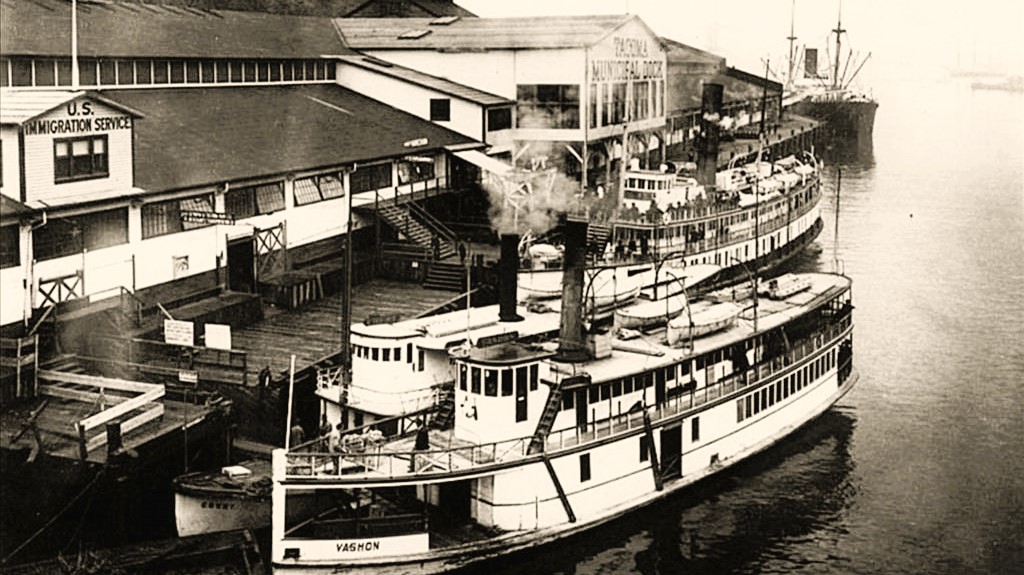
A worker writes of conditions on the ‘Mosquito Fleet’ of small boats that plied the Puget Sound ferrying people and products.
‘’Morning Star’ a Hell Ship’ from Industrial Worker. Vol. 1 (new) No. 27. October 14, 1916.
Life on one of the Mosquito Fleet Under Craft Union Shows Necessity for Class Unionism in Marine Transportation.
The slavery of the workers on the small boats plying the inland waters on the Pacific Coast has not yet been, to my knowledge, touched upon in the Industrial Worker. It is a very galling and trying kind of slavery, and one which must be met by the workers engaged in this part of the marine transportation industry and solved through class organization.
Some time ago I shipped aboard the Morning Star, a small tramp freighter owned and controlled by the Frank Waterhouse interests. I went aboard at 8 p.m. contrary to the wishes of the captain and mate, but at the request of the Puget Sound Steamboatmen’s Union. The chief officer, called by the men “Roaring Mandy” had shipped a man off the dock who was behind in his dues. This was contrary to an agreement with the union.
The difficulty was straightened out and I went down to the foc’sl, spread out my blankets on a bunk and rolled in. I rolled right out again, as there were thousands of bed bugs crawling all over me on tours of investigation; every few seconds one of them would taste, to see whether I was good to eat. I decided that it would take all of them all night to find out that I was not, and, for this reason, I decided it was my move. I went out on the main deck and found there some six of the crew, who could not stand the torture on the bunks.
At 9:30 next morning we landed at Vancouver. Roaring Mandy let out a yell and we started unloading and loading. The worker on the Morning Star is expected to do more work than a longshoreman, and stand more abuse than a mule. We finally got through after working 12 hours straight, trucking up and down a gang plank, at a pitch that called for every ounce of strength and endurance.
Hired by the Month; Fired by the Day.
When we got back to Seattle next morning we unloaded 1,250 sacks of brewers grain and 200 boxes of tea. We had been hired at $50 a month, but after we had swept up the deck and everything was in ship shape, the captain found that he would not need the slaves for 24 hours and decided that he would fire the workers and hire another gang of union men next morning. We found out, what the union already knew, that this boat hired its men by the month, and fired them by the day.
After the 24 hours the Morning Star again sent to the P.S.S.U. for eleven deck hands. The union furnished the men and we got down at 7 a.m. and started with our days work, which was that day eighteen hours, as we were running around to the various docks putting on cargo. We were then ready for sea; Mandy had ceased his roaring; and we headed for Anacortes where we loaded 800 cases of salmon, Mandy assisting us with his roar. We were then ready for Vancouver. We got in there at 8:30 Sunday night. Did we lay off as a compromise with our tired bones and one of the commandments? We did not. There was 23 hours work ahead of us peddling the cargo to the various docks, and we had to drill up and down a gangplank, sometimes at a great angle. Some of us wished we had Mandy’s job and could just roar and call the men who did the work filthy names. We, however, quit at midnight and had a number of skirmishes with the bed bugs till breakfast at six. After this supposed rest of five hours we started work and worked straight till 11, that night, with a rest of a few minutes to eat.
Instead of praise for the long hours we were working the captain called us down for having the nerve to quit midnight the night before.
After we had stopped at Anacortes and taken on more salmon we returned to Seattle Tuesday evening. All the men quit there but two, as they did not want to do more work than any longshoreman would do for three times the money, and with abuse that no man could stand being handed to them.
The Morning Star is not to blame for the way they handle the men, but it would seem that the A.F. of L. union to which the men belong should get better conditions for its men.
What the Morning Star and every other boat in the Mosquito fleet on Puget Sound needs to make the conditions human is the I.W.W. form of organization in the marine transport industry of the Pacific Coast. The workers are being taught this on the Morning Star and other hell ships.
The Industrial Union Bulletin, and the Industrial Worker were newspapers published by the Industrial Workers of the World (IWW) from 1907 until 1913. First printed in Joliet, Illinois, IUB incorporated The Voice of Labor, the newspaper of the American Labor Union which had joined the IWW, and another IWW affiliate, International Metal Worker.The Trautmann-DeLeon faction issued its weekly from March 1907. Soon after, De Leon would be expelled and Trautmann would continue IUB until March 1909. It was edited by A. S. Edwards. 1909, production moved to Spokane, Washington and became The Industrial Worker, “the voice of revolutionary industrial unionism.”
PDF of full issue: http://iw.applefritter.com/Industrial%20Worker/1916/1916%2010%2014%20IW.pdf
 Revolution's Newsstand