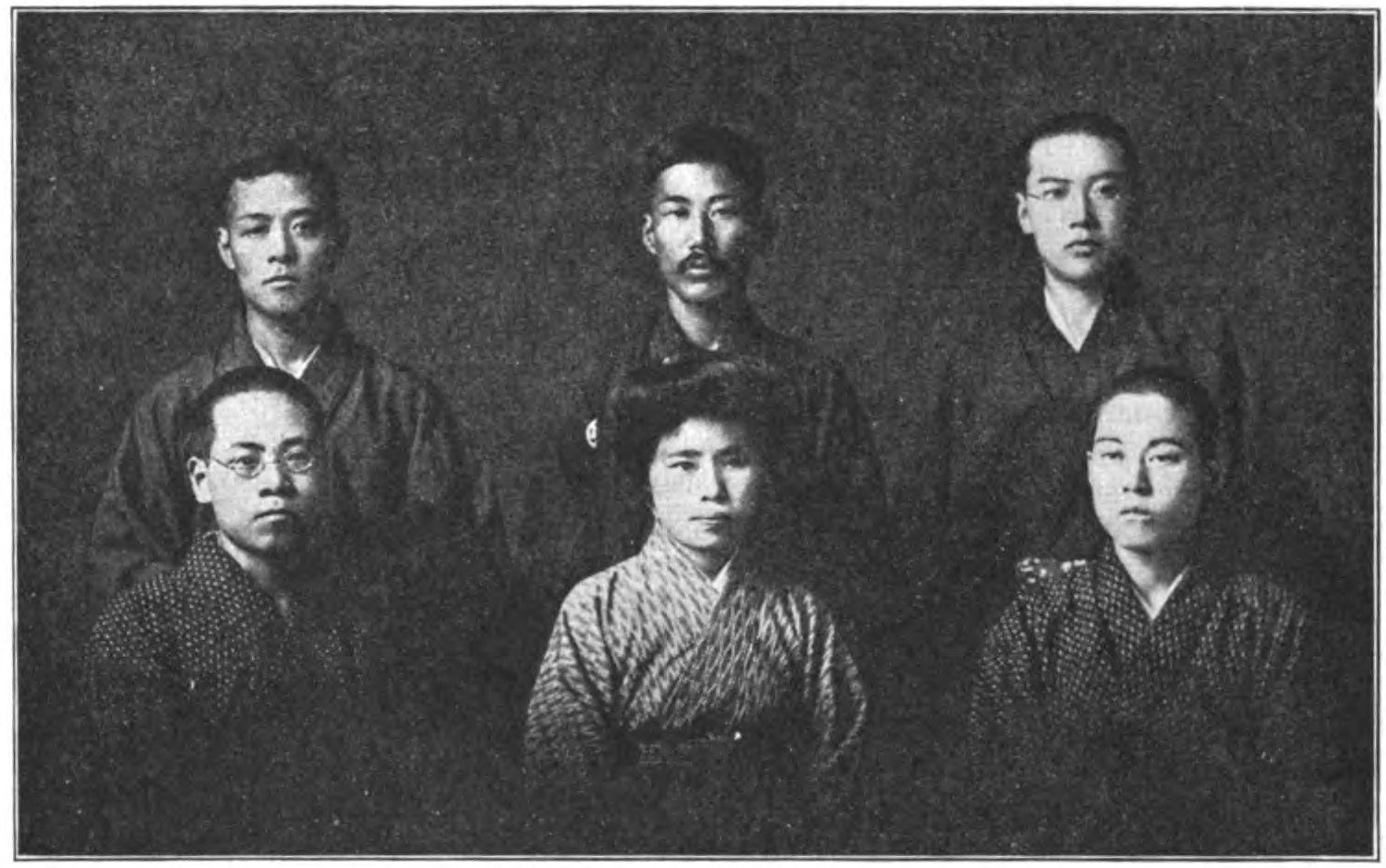
A British Socialist journeys through Osaka and sees the ghosts of Lancashire’s ‘dark satanic mills’ as he visits the city’s booming textile factories in this perceptive essay.
‘Osaka, Japan’s Price for Capitalism’ by G.L. Harding from International Socialist Review. Vol. 14 No. 11. May, 1914.
SAKA is a city of 1,270,000 population a little smaller than Philadelphia, or one and one-half times as large as Glasgow. It is the fourteenth largest city in the world and the largest manufacturing center between America and Western Europe. The population of Philadelphia is spread over an area of 129 square miles, but that of Osaka, which has no sky scrapers and no tall tenements, occupies just twenty-five square miles.
Osaka is the Chicago of the East. Its mercantile district, stretching for three miles along the narrow Yodogawa river, is a forest of belching chimneys which have smutted off the bloom of one of the fairest and loveliest cities of Japan in a single generation. Forty years ago Osaka, always the economic as well as the geographical center of the Japanese empire, was a busy hive of craft industry, but with no modern machinery and an abhorrence of foreign methods inherited from its foundation 2,500 years ago. Today in the cotton industry alone Osaka has two million spindles, half as many as Manchester itself, the greatest manufacturing city in the world.
There are over 7,000 registered factories in Osaka. There are, beside a score of cotton mills, plants for the manufacture of boots and shoes, brushes, celluloid, carpets, trolley wire, cement, aerated water, toys and gas engines. There are tanneries, grain warehouses and chemical works. There are the great car shops where the rolling stock of the Osaka street car system is made and repaired, manufactories of safes, sporting goods, artificial flowers and lager beer, and ship yards and dock and harbor works, the most elaborate in the Far East.
In this city and its immediate surroundings a quarter of a million working people live the life of the new industrialism in Japan. It happens that travelers from Europe and America frequently pass through here. That is merely because Osaka is on the main line between Kobe and Yokohama. There is nothing to see in Osaka. At Kyoto, twenty-seven miles away, the incredible temples and feudal glories of old Japan attract multitudes. The serenity of Kyoto bathes you in the mild, opiate charm of the “unchanging East.” The delicate airs of the Geisha girls, the bronzed, sturdy picturesqueness of the temple attendants, the courtly politeness of the tourist-preying shopkeepers all court the inevitable saying of the foreigner in Japan: “Why, these Japanese merely play at life.”
But beyond Kyoto’s cherry-blossomed horizon is Osaka, vast, dingy and common-place, where the “unchanging East” has reproduced Western industrialism in the space of one generation. The religion and the aesthetic ideals of a nation are unforgettably enshrined in Kyoto, as all the world knows. But he whose heart stirs with the present will find his temples in Osaka. At Kyoto the silence is of the dead; but the temples of Osaka hum with living devotees. Here, as nowhere else in Japan, is worshiped the power of modern capitalism. Here, in Osaka, rises ceaselessly the economic tide of the most industrious nation on earth, the tide of economic supremacy which the Japanese plan shall sweep ultimately over all Asia–and shall it stop then? The illimitable future of Japan rests here. Osaka is its capital in the present, and its perfect symbol for the future.
The center of Osaka’s industrial power is the textile industry, and it was among the cotton mills, therefore, that I studied that power. The Chamber of Commerce makes this easy for even a moderately accredited traveler, and my appointment to visit the mill, my introductions to the manager and my many inquiries were seen to and “managed” most courteously by one of their efficient representatives. He was very naïve, and he answered promptly everything I asked him—and his statistics compared almost exactly with those furnished me later on in Tokyo by the Socialists. He was of the system, but he had bureaucracy’s lying methods yet to learn.
He took me first to a great spinning mill on the outskirts of the city, and from the rooms where great machines clawed to pieces the bales of raw cotton straight through to the final process of pressing the spun yarn and packing it for export, we followed every fascinating detail of the amazingly ingenious machines with which Anglo-Saxon brains have revolutionized the history of the world. Almost without exception the overhead machinery, the engine machinery and the endless rows of ring spindles came from Bolton or Oldham, England.
Throughout this mill there are 2,200 women workers, and their wages, as given me by the manager, range all the way from 8 cents to 30 cents a day, striking a general average for the few workers who live at home at just 20 cents a day, and for the majority who “live in” at 15 cents a day. They have a holiday twice a month, not so much to give them a rest as to afford the manager a chance to change the night shift. Six to six are the unvarying hours where there are two shifts. Where there is only one, as in dozens of the smaller factories here, the hours run from fourteen to sixteen, allowing an average of nine hours, as the manager smilingly informed me, “for rest and recreation.”
The women themselves would have given your Kyoto traveler the acid test of how the Japanese people of today really “play at living.” Where the Chinese workers have all they can do to handle a thousand spindles between fifteen of them, in the mills I visited in Osaka five girls had this stint against the average of a little less than three in Lancashire itself. Whatever the average, speeding-up was written across every wan face here and sunk deep into every pair of preoccupied, incurious eyes. I stood a long time in Shanghai watching the mad race of the winding girls to keep one set of spools full and another empty, requiring fifty or sixty changes a minute. In Osaka there was no such contest; the machines there hopelessly outdistanced the human brain. The girls were always behind the machine, whenever and wherever I saw them. In the winding room the rack was full of unwound spools, and the girls picked them out here and there with lack-luster eyes and replaced them with full bobbins from a pile in the next rack which also was always ahead of them.
In the spindle room whole rows of bobbins were running full of thread. Here, too, it was not only the spinners who were not up to time. Little black-eyed tots staggered along the aisles with great trays full of empty bobbins with which to feed the hungry machines. They seemed to be the busiest of all, these bits of children. I counted scores of them everywhere. Some rooms, where the operations were simpler, employed only children, boys and girls indiscriminately of between eight and ten. I shall never forget one room where I stayed a long time and where extremely complicated machines prepared the thread for weaving. Through a series of steel frames along the wall these children picked out the threads with a triangular instrument which caught them in a slot; then they were jammed down with a crash. Fifty, frames crashed steadily along, setting the pace, but for all of this merciless treadmill the room was full of shrill little voices, and fresh laughter which rose above the machinery. Through the doors and down the corridor you could still hear these little voices, like blessed souls rising by virtue of their innocence above the inferno of their life.

Let me take refuge for a moment in statistics. Dr. Kuwado, a member of the Japanese Senate, sets the number of child workers in Japan (under 14 years of age) at over 100,000, over 70,000 of whom are little girls who receive on an average 8 cents a day. For this they serve on night shifts or work fourteen to sixteen hours with the rest and get two days off each month just the same as adult workers. Two hundred and fifty thousand more are between 14 and 20, and in all the 700,000 odd women factory workers comprise fully three-quarters of Japan’s factory population. There are no laws for their protection, none whatsoever, and in some trades the manufacturers practice as the common way of business, excesses never equaled in the world’s economic history–save in the country where the riches of the cotton trade were first manifested to the world. In some industries, notably that of match making, the number of little girls under ten run as high as 20 per cent, and government statistics themselves admit the total of these wretched babies among the greater industries to be nearly 10 per cent of the whole industrial army.
I visited four separate weaving sheds in Osaka and found in each one conditions measurably worse even than in China, but out of the multitude of things I observed with my own eyes, and verified afterwards by inquiry and statistics, I have only room to tell a few here. I held my watch and found the shuttle flying in each case between 180 and 200 trips a minute, or more than three per second. Here, as in the spinning rooms, the young, country-bred girls could not keep the pace. Accidents were frequent. A little girl I watched in the biggest mill broke her thread eight times during the five minutes I stood there, and each time she kissed the lint-covered shuttle in the approved Western fashion and sucked the snapped thread through again. Self-closing doors and a temperature of 80 and 85 made the rooms stiflingly close. The total ventilation came from a small hole in the dusty skylight, and the gas and electric lights were invariably much too dim for the work. Even had the devil-driven pace relaxed, the deafening shuttles made all human contact impossible.
Here, day in and day out, thousands of women and little children in Osaka spend their whole lives. In Japan it is no exaggeration to say that these helpless people are, in the full and literal sense of the term, wage slaves. Out of the 400,000 women textile workers in Japan it is estimated that over three-quarters of them are brought from the country districts. The people in the cities know the mills and shun them for their lives. In Japan there is what might quite fairly be called a cadet system on a large scale for recruiting labor for the factories. Smooth-tongued agents, skillful with women, sign up the daughters of the peasants from one end of Japan to another–and once signed for, no physical power can give the girl her freedom till her time has been served. They sign for three years, and for three years they are literally “locked in” at the factory. If they wish to go out for any purpose whatever beyond the factory gates, an armed watchman goes with them and sees that they come back. If they escape, the master has every arm of the law at his disposal, just as did the owners of negro slaves. He metes out his own punishment; the girl is virtually, by reason of her indenture, his property. Naturally, she is as often his property for pleasure as for pain–and for neither has she nor her people the slightest redress.
Girls do escape, however, and it is eloquent of the system in general that although many fail, twenty-five out of a hundred indentured girls do succeed in escaping from the factories. And what wonder! In the sickening, steamy atmosphere of the mills the girls lose, according to a government report, as much as one and one-half pounds a week in weight. Their fresh country faces lose their ruddy color and take on the ominous flush pink of the consumptive Stilted official reports confess that out of those who leave the factory after their three years, at least 30 per cent are already consumptive. What of those who stay on, year after year? I saw their beds in several mills, and all I had ever heard was as nothing beside the living proof. Sometimes a single quilt covers three; and the quilt cannot be washed, for three more use it at the next shift.
You take off your shoes to go into these dormitories, as in any other Japanese dwelling. Sometimes there is a garden in the back, with the single-stemmed flowers in rows which the Japanese love. The nicer dwellings are clean. But the average ones are squalid barracks, a vile travesty on everything Japanese. Prostitution is by no means unknown among them. If not actually brothels, every one of them is inevitably an active recruiting house. At the “model” dormitory of the Temma mill, the biggest in Osaka, I asked my guide the meaning of a little shop just outside the front door. “Oh,” he said, “the girls buy all their things there.” He admitted when the manager had gone that behind the tasteful showcases of feminine necessities and gay little knick-knacks lurked the insidious extortion of the “truck” system in all its Western thoroughness. Liberal use of the charge account, and a scale of exorbitant prices usually are sufficient to keep the scanty wage money of the unsuspecting girls permanently in the hands of the company. The reason why most of the girls do not return home is simply because they haven’t any money to get there. They have been wage slaves for three years-except for the wage part.
In this emergency there is but one resource, and in Osaka it is an obvious one. In this city there are over 1,900 licensed houses of prostitution–more than there are licensed saloons in Philadelphia. There are over 50,000 licensed immoral women in Osaka, and almost as many again who avoid the official count and carry on their trade intermittently, such as the more complaisant type of Geisha and the green country girls who make up the sweated labor in thousands of shops and stores. In other words, there is one immoral woman in Osaka to every nineteen seducible men. This trade is no mere temptation in Japan; it is the simple, unavoidable necessity of brute convention for every stray woman in the land. And under capitalism the pitiful sweepings of womanhood from the factories cause commercialized vice to grow year by year like a rank weed.
This is but one small chapter in the industrial present of Osaka. It is but one chapter in the conspiracy of a nation against her people. In Osaka rebellion lurks always beneath the surface. The people are silent and inert outwardly. But the mob in Tokyo has proved itself as dangerous on occasion as the mobs of Paris. They have only the other day thrown out a corrupt ministry by the sheer force of public censure. The center of the discontent is a rottenness not in mere politics, but in the industrialism which merely plays with politics in Japan. Japanese constitutional liberty is a sham because Japanese economic freedom is a sham. So Kotoku perceived, and the movement he dreamed of would have united the workers in solid trade unions, not the reformers in plausible political parties. That is what the martyrs of 1911 died for; to them the emperor was an abject and sententious jest, precisely as the king is in England today.
The soul of the people of Japan is deep. It knows of the ruthless killing off of the trade union and Socialist movements only instinctively in that it knows that the death its oppressors. Every contact with the of these things has left it defenseless against West confirms this knowledge, and every breath of the larger freedom which comes from China clarifies the inward vision in which its victims regard the shambles of Osaka. Osaka is the witness before the world of the price the Japanese people are paying for Westernization. And the people who pay this price with the flesh of their own children, though they be asleep today, must awake in a near tomorrow. They must awake to strength, before their race is swept away in the holocaust of greed which has come to them with the Christian capitalism of the West.
The International Socialist Review (ISR) was published monthly in Chicago from 1900 until 1918 by Charles H. Kerr and critically loyal to the Socialist Party of America. It is one of the essential publications in U.S. left history. During the editorship of A.M. Simons it was largely theoretical and moderate. In 1908, Charles H. Kerr took over as editor with strong influence from Mary E Marcy. The magazine became the foremost proponent of the SP’s left wing growing to tens of thousands of subscribers. It remained revolutionary in outlook and anti-militarist during World War One. It liberally used photographs and images, with news, theory, arts and organizing in its pages. It articles, reports and essays are an invaluable record of the U.S. class struggle and the development of Marxism in the decades before the Soviet experience. It was closed down in government repression in 1918.
PDF of full issue: https://www.marxists.org/history/usa/pubs/isr/v14n11-may-1914-ISR-riaz-GR-ocr.pdf
 Revolution's Newsstand