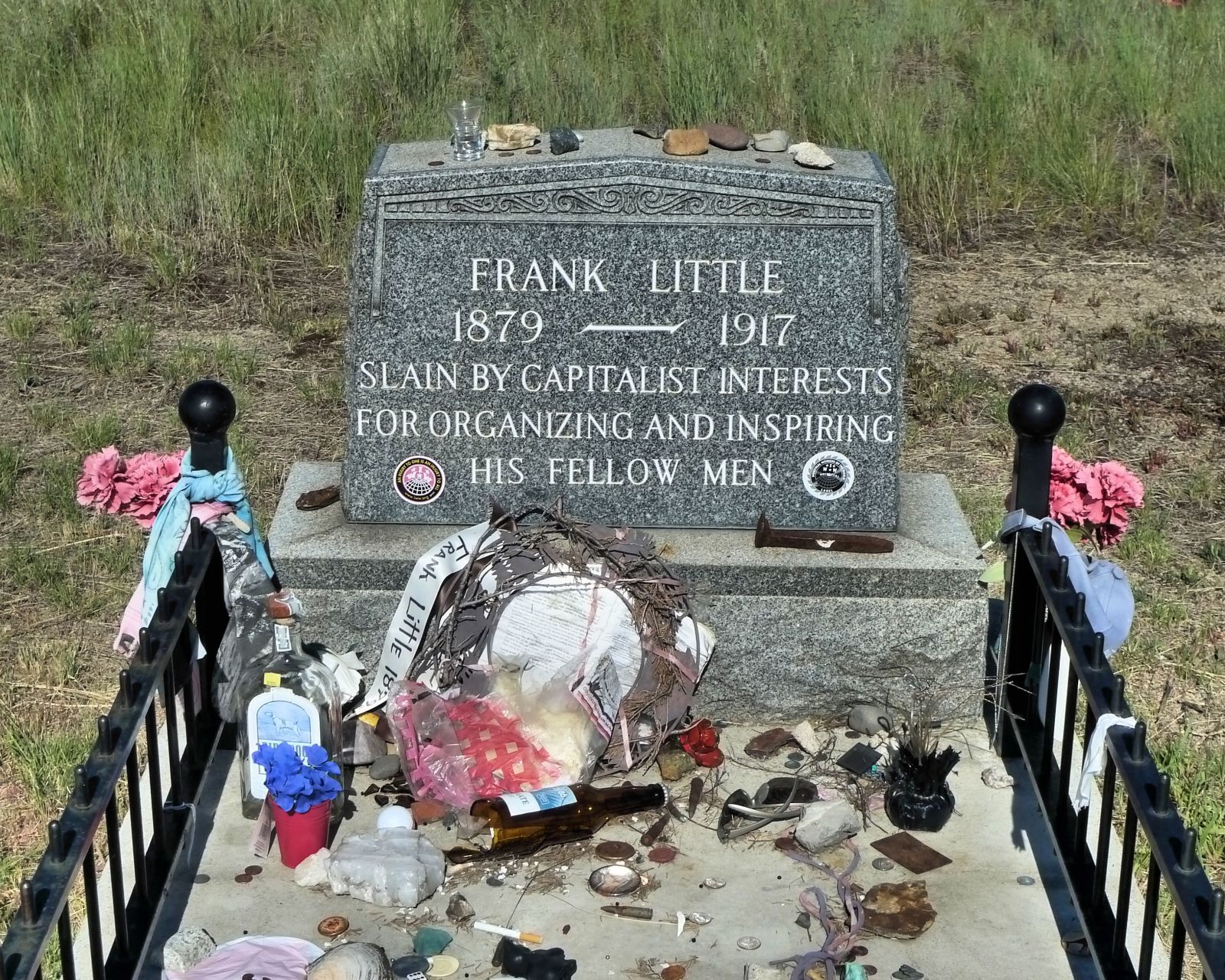
A rare article from Frank Little where we get a taste of his organizing vernacular as he pleads the plight of the hobo and appeals for migratory workers to join the newly-formed Agricultural Workers Organization.
‘Life and Prospects of the Blanket Stiff’ by Frank H. Little from Solidarity. Vol. 7 No. 318. February 12, 1916.
California Agricultural Workers Among the Worst Exploited. What They May Do for Themselves Through the A.W.O.
Porterville, Calif, Jan. 30. The agricultural workers of California are the worst exploited of any. You can see one steady line of slaves this time of year, tramping the highway, begging for the right to work to earn enough to buy a little grub, take it down to the jungles on the river or beside an irrigation ditch, then cook it up in old tin cans which their masters have thrown away. The capitalist papers slur them, speaking of them as tramps and hoboes. When the harvest is on, those of them who will work get $1.75 to $2.00 per day, and the farmers want you to do your own cooking. Those who will accept these conditions without kicking are good, industrious workers.
But any who have the nerve to kick for more wages or shorter hours are I.W.W.’s, and should be thrown into prison or run out of the country.
The slaves of California are compelled to carry their beds on their backs. So, when you see one tramping along the road he generally has a load on his back that the average prospector would be ashamed to put on a jackass. In fact, most of the Jackasses would have sense enough to kick it off.
The fruit and grain growers are organized, and the main object of their organization is to force the workers to sell their labor power for whatever the employers are a mind to pay. The slave will sit around the jungles or pool halls, cursing the farmer for the small wages and long hours.
Now, workingmen and women, you have no kick coming against the employer, for he is looking out for his material interest, and that is to force you to work for as small wages and as long hours–to make as much out of your hide as possible. And for that he is organizing. The more men and women out of work, the easier it is for him to reduce wages
Your interest is to make the boss pay as much wages as possible. Your interest is to work as few hours and to do as little work as possible. Force the boss to put more men and women on the job. As the army of the unemployed decreases, your labor power will increase in value. And remember, after you have worked few years at the speed the boss wanted; after you have put in a few years tramping over the country, packing your blankets from place to place looking for work, sleeping out in the jungles hungry half the time–you will soon become old. After you reach the age of 40 to 45 years, the boss knows you are not able to do the work and will not give you work-like a piece of worn-out machinery you are then thrown on the junk pile.
So it is to your interest to store up your energy for old age. This can only be done through organization by organizing all the men and women working in the agricultural industry, regardless of race, creed, color or nationality: forming One Big Union of all the workers that is based upon the class struggle and considers the interest of the workers only. An organization whose object is to force the boss to pay more wages, grant shorter hours and better working conditions.
The Agricultural Workers’ Organization of the I.W.W. which was formed in Sacramento, Calif, Dec. 12, 1915, will carry on an active campaign of organization this coming spring and summer, in the hay, grain and fruit harvest, in the packing houses and canneries. The object is to make every job a “local” of the A.W.O., regardless of where the secretary is located. The A.W.O. is built from the bottom up, and is ruled in the same way. The members working on the job constitute the organization. It is they who know what they want; know when the time is ripe for action. The A.W.O. puts no restrictions on its membership–the members do not have to ask the consent of any committee. It is up to them to decide when and how to act. All strikes for better conditions are “legal.” Use any tactics that will win. The only question to consider is, what will win for the workers, then give the boss hell.
Now, workers, don’t say it can’t be done: for all that is necessary is as action on the part of the workers. The members of the A.W.O. in the harvest fields of Oklahoma, Kansas, Nebraska and the Dakotas raised wages and shortened hours, put thousands of dollars into the workers’ pockets, and have a strong organization with which to go into the harvest this summer. What they did in the east and north can be done in the west. Be a booster: don’t knock. Do it yourself: don’t leave it for George. Don’t blame the boss for your miserable conditions: the workers get just what they deserve. If they haven’t the nerve to organize for better conditions, they don’t deserve anything.
All together, for a powerful A.W.O., for more wages, shorter hours. Force the farmer to furnish you a good bed to sleep on Give it boost–One Big Union of all the workers of the Agricultural Industry—men and women–fall in line.
The A.F. of L. says they are going to organize the migratory workers. On the night of Jan. 6 after Matthew A. Schmidt of Los Angeles was convicted, I attended the meeting of the Fresno Labor Council (A.F.L). A man by the name e Glass Monigor of the Fresno Republican, one of the dirtiest, slimiest papers in the west, was chairman. When I accused organized labor of aiding to convict him, and showed where a general strike would have forced the capitalists to turn him loose, I was informed that the A.F. of L. was organized to build-up industry and to paralyse it; that in the case of every man who was convicted his own fault, because he was a criminal; that they furnished money to hire lawyers to defend him and that was all they could do. Oh, hell!
F. H. LITTLE
The most widely read of I.W.W. newspapers, Solidarity was published by the Industrial Workers of the World from 1909 until 1917. First produced in New Castle, Pennsylvania, and born during the McKees Rocks strike, Solidarity later moved to Cleveland, Ohio until 1917 then spent its last months in Chicago. With a circulation of around 12,000 and a readership many times that, Solidarity was instrumental in defining the Wobbly world-view at the height of their influence in the working class. It was edited over its life by A.M. Stirton, H.A. Goff, Ben H. Williams, Ralph Chaplin who also provided much of the paper’s color, and others. Like nearly all the left press it fell victim to federal repression in 1917.
PDF of full issue: https://www.marxists.org/history/usa/pubs/solidarity-iww/1916/v7-w318-feb-12-1916-solidarity.pdf
 Revolution's Newsstand