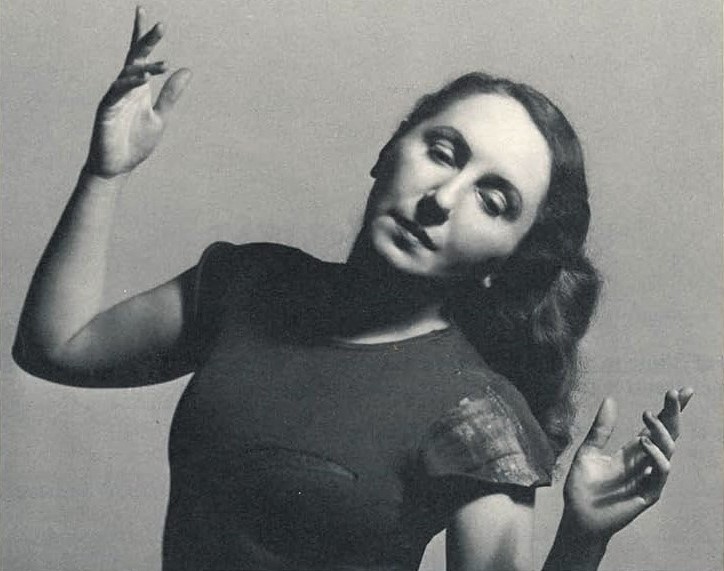
Blanche Evan, a leading figure of radical dance and later a pioneer of dance as therapy, asks the big questions raised where art and politics meet.
‘Open Letter to Workers’ Dance Groups’ by Blanche Evan from New Theatre. Vol. 1 No. 5. April, 1934.
The Revolutionary Dance movement is without question vital and important, and there is every reason to believe that it will eventually assert itself in the non-political field of dance activity in America. The recent dance program given at City College, at which all the revolutionary dance groups in and near New York appeared, has brought several issues to the fore, which I, as representative of many politically sympathetic, professional dancers, would like to have discussed.
What is the aim of the proletarian dance? Is it to proselytize? Does it wish to state the problems of the proletariat, or solve them as well? Is it to renew the enthusiasm of convinced class-conscious people? Is it to afford a method of entertainment to them that will yet be within the realm of their deepest convictions? Does it wish to create an art form that has a single and definite ideology, or does it wish to establish a form of propaganda that uses the dance as its medium? Of course, there is no reason to limit the proletarian dance to any one of these objectives; but it seems to me that when composing a revolutionary dance, one of the first considerations should be its ultimate purpose, since that purpose must mould the form of the dance.
If a dance attempts to convert, it must try to reach an audience outside its own circle. Accordingly, the political issue must be kept in the background, and the dance must carry its message by a more emotional ideology. By doing this, a place is made immediately on programs that would not consent to the appearance of such dances, were the political statement made too obtrusive. Might it not be advantageous to form an “Innocents” dance organization that would create within the workers’ ideology, but that would direct its efforts to reaching outside audiences?
The Joos interview of the New Theatre ended with a regret that Joos had stated his problem, but had offered no solution. In America, we are still lacking in awareness of these problems. Might it not be of value to spend energy in presenting the worker’s difficulties as such, as often and to as many different audiences as possible? It is done in literature; why not in the dance? It is obvious that had Joos ended his “Green Table” in formal propaganda fashion, he would never have been permitted to play on Broadway at all, and thousands of people would have been denied witnessing this effective statement of the horrors of war.
From the viewpoint of the pure, political propagandist, the criticism of the ending of the “Green Table” is open to question. No one can deny the importance of the dramatic in any propaganda work. Could a final scene shooting down the politicians, even figuratively, have been more effective than the biting satire, the contrast of the preceding scenes of the effects of war with unconcernedness of the Green Table diplomats? Granted that there is but one solution to the workers’ problem, does it not rather weaken than strengthen every dance, by ending it with the symbolic singing of the Internationale? The audience might be carried away by the dramatic mistreatment of the Negro in the dance called “Southern Holiday”; and psychologically, it might be much more effective to leave him mistreated, than to see his problem solved so easily by the onrush of red coated dancers.
Our third question leads us back to the City College performance. Why did the Duncan Group, which despite its somewhat technical immaturity, and lack of that sophistication which, for instance, the Theatre Union Groups possessed receive the biggest ovation of the evening? Was it despite these reasons, or because of them? Technical immaturity is nothing to boast of but simplicity of form and directness of statement seem best suited for said purpose.
Was it not also, because on a program of woe and struggle, it gave the proletarian an idea of the joy that might await him in the future? This is not pure entertainment. It is propaganda of a different sort. It lifts the worker for the moment into a better and freer world that is still very much his own world. The worker needs relaxation. The dance seems, of all arts, best suited to give it to him.
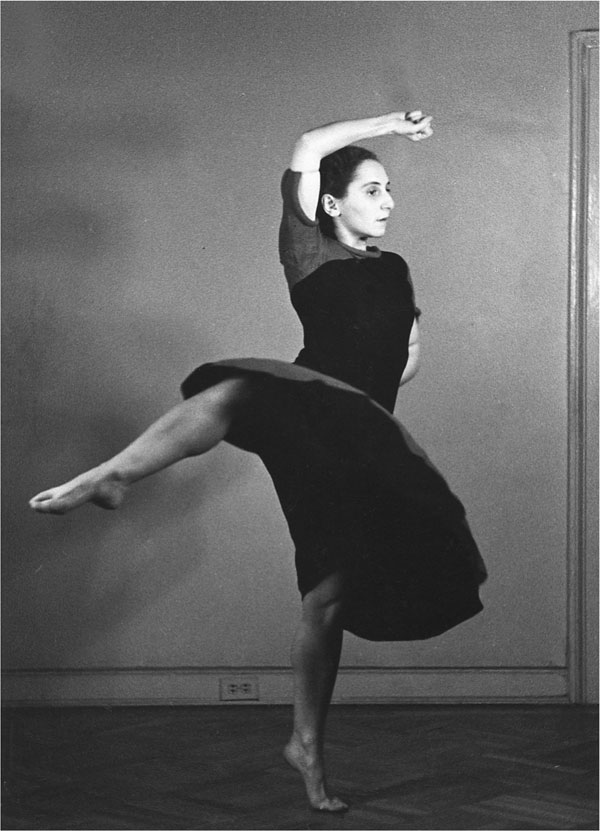
Apparently, the policy of the groups is divided: to create dances that find their inspiration in the problems of the worker, or to create propaganda that uses the dance as its medium. In the latter case, the dancers still commit themselves to follow a certain procedure, and to recognize the limitations implied in the activity of “the dance.” It is platitudinous to say that the dance is movement of the body; that what then is expressed, is done so, and is projected through body movement.
This is not the purist speaking. One usually finds that remaining within the medium produces a better result than going outside it. The surrealist movement in painting, in which painters pasted on their canvases everything from glass to orange skins, had a short life; whereas, the true innovators, who discovered different means of using paints and brushes, have had a lasting significance. The revolutionary dancer, if she wishes to broaden the possibilities of expression in her medium, can do a great deal in broadening the possibilities of movement within the body, and within space, by means of theatrical use of platforms, levels, etc.
An idea in itself, may be a very powerful one; but if it is not an idea that can express itself in movement, if it is not a dance idea, or rather a danceable idea, it does not belong in dance propaganda, but might be more effective in literary, pantomimic, or spoken form. An idea like “The Blue Eagle,” one of the New Dance Group’s offerings, is first of all a broad topic, an intellectual idea, involving numerous problems of politics, economy, nationalism, internationalism. It has within it many motives for the legitimate theatre or for the agitprop groups. The N.R A. signs, carried by two of the dancers, in helping to minimized even the possibility fortify the intellectual concept, of regarding the idea of N.R.A. as symbolic–if that’s what the group wished its audience to do.
The dance propagandists might succeed in creating more effective and more inspiring dances if they held more consideration for the medium which they have chosen to employ.
BLANCHE EVAN
The New Theater continued Workers Theater. Workers Theater began in New York City in 1931 as the publication of The Workers Laboratory Theater collective, an agitprop group associated with Workers International Relief, becoming the League of Workers Theaters, section of the International Union of Revolutionary Theater of the Comintern. The rough production values of the first years were replaced by a color magazine as it became primarily associated with the New Theater. It contains a wealth of left cultural history and ideas. Published roughly monthly were Workers Theater from April 1931-July/Aug 1933, New Theater from Sept/Oct 1933-November 1937, New Theater and Film from April and March of 1937, (only two issues).
PDF of full issue: https://www.marxists.org/history/usa/pubs/workers-theatre/v1n05-[not-v3]-apr-1934-New-Theatre.pdf
 Revolution's Newsstand