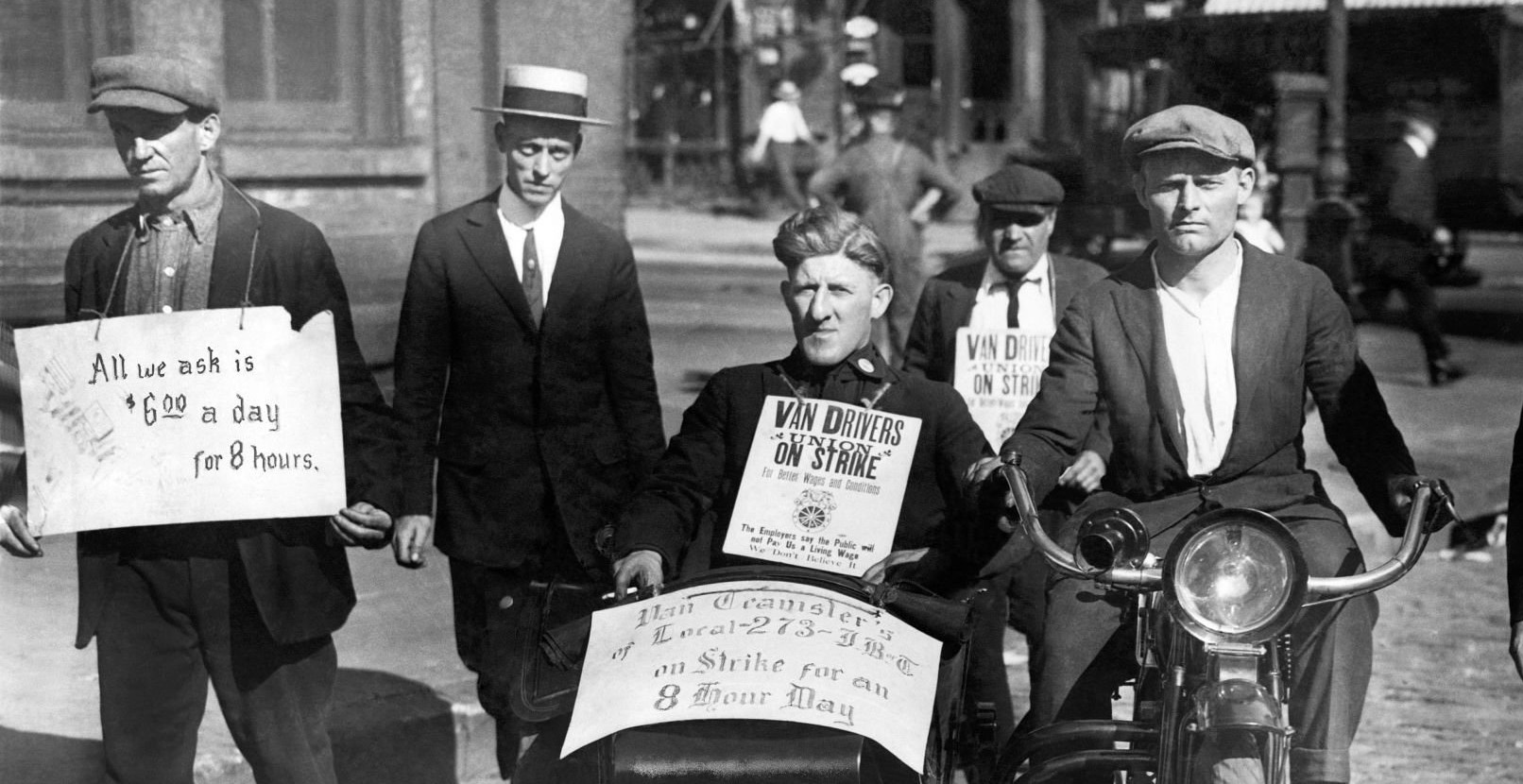
Pat Quinlan on the victorious 1927 New York City drivers’ strike.
‘The Gotham Teamsters Win’ by Patrick Quinlan from Labor Age. Vol. 16 No. 10. October, 1927.
Rough and Ready Walkout Brings Success
On Tuesday night, September 6, the International Brotherhood of Teamsters, Chauffeurs, Stablemen and Helpers, Locals 282 and 807, met at the Beethoven Hall, Manhattan, in response to a special call sent out from the headquarters by the New York executive board to discuss the scale of wages to be paid to certain chauffeurs and drivers who operate double teams and five-ton trucks for the coming year.
After one of the liveliest, longest and biggest meetings in the history of that famous old rendezvous for unions a strike was voted for at two in the morning.
One accustomed to meetings of the garment and clothing workers and to the meetings of railroad unions and building trades, where a certain amount of homogeneity obtains owing to usage and tradition, the character of the industries or trades, could not fail to be impressed by the appearance of the men that made up the teamsters’ and chauffeurs’ meeting, as well as by what one observed and heard in the talk and discussion.
There were color, physique, hardness, diversity and with all, a devil-may-care free and easy way about them that one sees in Western States union meetings. The meeting as a whole had a rough and ready efficiency full of pep and go that the high hatters of other unions would do well to emulate. Although the teamsters are not classified as being among the “aristocrats of labor”
there was a large and impressive line-up of cars of various brands and makes outside the hall on Fourth Street and on the Bowery. There were men in overalls and jumpers of the check, and the black and white kind only used by teamsters and freight handlers. While the smock and the overall were plentiful there was also a fair number dolled up as if for a party.
No Race or Color Line
The union evidently has no race nor color lines for I saw men of many races and creeds there, including several negroes or colored men. Such is the pen picture of the men and the meeting.
Like a bolt from the blue the strike broke on the heads of the business interests of Greater New York on Wednesday morning, September 7. Not a man reported for work at the stables and garages of the United States Trucking Company, the Truckmen’s Bureau and one or two others, all told doing 75% of the trucking business of the Port of New York, which includes Brooklyn, Jersey City, Hoboken, Manhattan and Staten Island. The great Bush Terminal of Brooklyn was blocked with incoming and outgoing freight; the U.S. Trucking Company dominated by Al Smith, the alleged friend of labor and the poor, Governor of New York and aspirant for the Presidency on the Democratic ticket, was tied as tight as a drum. The trucks that deliver the huge newsprint rolls to the great dailies were kept indoors and the few that rashly ventured out with paper rolls for the NEW YORK TRIBUNE got badly mauled in defiance of a large and elaborate police convoy. The great green motor vans that deliver cash and paper to Wall Street and the down town banks rested in the garages while solemn dignified bankers and business men scowled and grumbled.
Bosses Sleep
What happened is that the boss truckmen and companies were caught in their own chloroform or sleep. They failed to do anything when the new scale was placed before them by the union’s representatives three weeks before. They put it off and put it off and thinking procrastination would somehow ease them out and avoid the direct question, “Shall wages be raised $5 per week?” And the second one, “Shall the work day be 8 hours?” did not enter their sleepy craniums at all.
On Wednesday afternoon there were panicky calls on the union phone at the strike headquarters, 73 Varick Street, for information and for more particulars. The Bush Terminal of Brooklyn settled directly with the men who got their course approved by the union as did twenty independent truckmen. The Bush Terminal managers to save their respectable faces from a calling down by the Chamber of Commerce and Rotary Club lords of big business, told the reporters and others who made enquiries that “we settled privately on the basis of an old agreement.”
On Thursday morning Nelson & Co., an old downtown firm, gave way, but Al Smith’s firm and the Truckmen’s Bureau still shouted fight and used all kinds of threatening words. More police protection was demanded and the public was told that trucks would be brought in from New Jersey and from up the state and by the eternal they were going to run their own business. They did make a counter proposition offering a half-day on Saturday with the old scale of wages renewed. But the men told the officers “there was nothing doing” and the officers with Vice-President M. J. Cashal as the spokesman said they had no power to negotiate anything but the proposed scale of $45 ‘per week and the 8 hours a day.
Telling the Tale
The strikers hired autos and trucks and with huge signs tacked on them “telling the world” that THE UNITED STATES TRUCKING COMPANY Is ON STRIKE, drove through the down town streets and through West and South streets where the docks are located.
Violence was reported here and there and the strikers in one or two cases convinced interested parties that they meant business by their direct action methods and conduct.
Al Smith’s friends began to claim that they were being made the goat of by the strike. But since the Truckmen’s Bureau was also on the firing line and talking loudly and bravely, their wail was not taken seriously anywhere.
Friday evening saw politics and diplomacy working feverishly to save the face of the boss truckmen. Joseph P. Ryan, president of the Longshoremen’s union and president of the Central Trades and Labor Council of Greater New York, an old friend of Tammany Leader Culkin, and through him of Al Smith, got a bunch of strikers together and with one MacCormack of the U.S. Trucking Co., they hammered out an agreement conceding the wage demand on one hand and withdrawing the 8-hour day on the other. The Truckmen’s Bureau got wind of it and jumped on the bandwagon and settled on the same terms a little later the same night. Next morning most if not all of the strikers went to their stables and garages and took their trucks out.
The Settlement a Victory
The rank and file were not pleased with the performance of the officers, who came in for some severe criticism. Still it is hard to see what they could do under the circumstances. It was largely a rank and file affair from the beginning, with all the enthusiasm and directness of men who knew what they wanted and how to get it. They are, it is true, a bit angry and some of them tried to organize the men independently of the union and have the strike reopened and the battle fought all over again.
The success of the strike is in part due to the character of the work and the business. Some things cannot wait and a way must be found to meet the situation. There was only one way and that is to surrender to the strikers which was done by the companies with their faces saved for them by Joseph Ryan.
Labor Age was a left-labor monthly magazine with origins in Socialist Review, journal of the Intercollegiate Socialist Society. Published by the Labor Publication Society from 1921-1933 aligned with the League for Industrial Democracy of left-wing trade unionists across industries. During 1929-33 the magazine was affiliated with the Conference for Progressive Labor Action (CPLA) led by A. J. Muste. James Maurer, Harry W. Laidler, and Louis Budenz were also writers. The orientation of the magazine was industrial unionism, planning, nationalization, and was illustrated with photos and cartoons. With its stress on worker education, social unionism and rank and file activism, it is one of the essential journals of the radical US labor socialist movement of its time.
PDF of full issue: https://www.marxists.org/history/usa/pubs/laborage/v16n10-oct-1927-LA.pdf
 Revolution's Newsstand