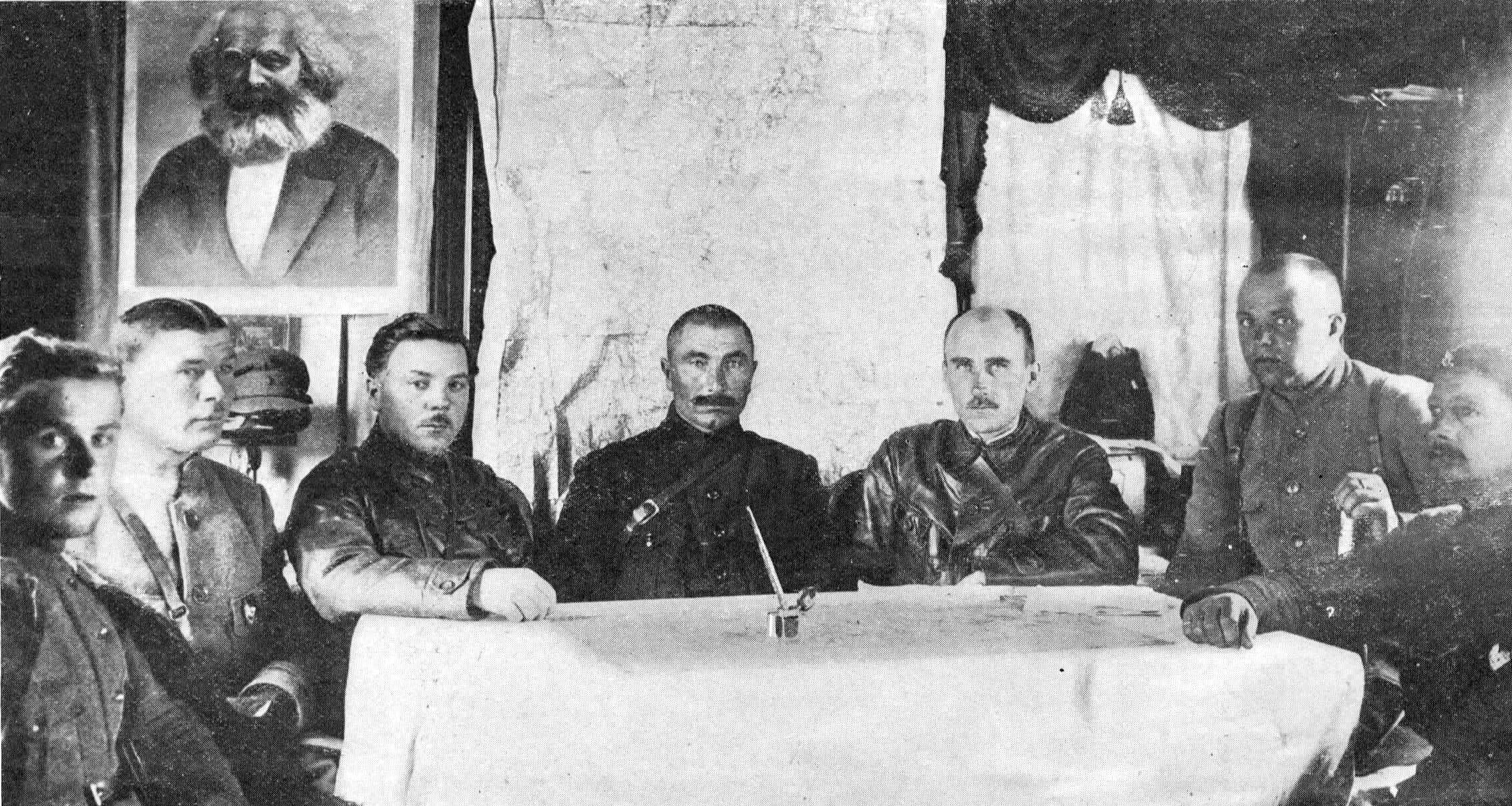
A vignette of the Red Cavalry and its commander, Semyon Budyonny.
‘The Magnetic Corps: The Red Cavalry’ by Samuel Rafelovich from Soviet Russia (New York). Vol. 4 No. 9. February 26, 1921.
“Proletarians to Horse!”—Leon Trotsky.
All the way from Uzman-Sobakhina and Voronezh to Mykop against Oenikin, from Tytnev in a remarkably swift ride to Zhitomir and Berdichev, up to the gates of Lemberg against the Poles, and now the new blow against the moribund baron (Wrangel)—is this not a brilliant, an astonishing progress on the part of the first Cavalry Army, all in one year?
Whatever may be the future lot of this army of horsemen, there is no doubt that the victorious, creative activity of the Red Army has found in the activity of this cavalry body a brilliant expression of the military strength which arose like a phoenix from its ashes, hurling thunderbolts and menacing…
Something has happened that must really seem remarkable in the eyes of the certificated generals.
The sergeant of the Nizhni-Novgorod Dragoon Regiment, Budenny, has not read Sakharov’s History of the Cavalry, nor has he studied the tactics of cavalry according to Dragomirov; he has not buried himself in the deeds of Seidlitz or Stuart, and has surely not gone back to the days of Alexander of Macedonia or Hannibal, who was the most famous cavalry leader in the history of warfare — and yet in his operations he carries out in the most brilliant manner the best technical rules of cavalry warfare.
The technical resources of our cavalry are, particularly in the matter of intelligence service, very modest, at present even very deficient, and yet there is no doubt that Budenny fully controls his army. The enemy had artillery of long range, tanks, airplanes, and in our cavalry army there are a number of regiments which at the time of the suppression of the counter-revolution in the south did not even have rifles. The rifles were superfluous.
In full order of march, with sabres drawn, our fighters threw themselves upon the armored trains, and lord knows how they did it — conquered them. They dismounted, crept up to the invulnerable tanks and blew them up with hand grenades.
Budenny knew very well the power of his sabres, twirled his mustache and pursued his opponent, simultaneously cutting off his retreat.
I should like to report to the reader a meeting I had with Budenny.
It was exactly a year ago, November 17, after the notable battle for the conquest of the extremely important railroad center at the station of Kastornaya, where Mamontov, Shkurov, and Postavsky, were completely destroyed. I set out to meet Budenny at the village of Nizhni Olshanka.
My nerves were somewhat strained by the unusual conditions of the cavalry campaign. In my ears there still rang an artillery cannonade, and I still heard the rattle of the machine guns with impudent persistence. I had made 45 versts on horse that day in spite of the slippery ice and the severe frost. I handed Budenny the green flag of the notorious Shkurov “Wolf Division”, which had just been cut down by our young cavalry division, arriving from the north in its occupation of Kastornaya, Budenny smiled and turned to his assistant:
“Syemchko! Take this rag and show it to the comrades on the staff.”
Not another word. As if the occupation of such a strongly fortified point, — and besides the little Olyn River had first to be forced, which was defended by several thousand infantry, and by picked officer regiments—had been a mere bagatelle.
Later I understood that it was impossible to astonish Budenny and his men, with whom heroic deeds had become every day matters.
It is late at night…The command for the cavalry corps is being worked out; all those standing around except the men on guard, are sleeping the deepest sleep. You can sleep thus only at the front when you are obliged to refresh your exhausted organism thirsting for relaxation, in the short period of two or three hours. Especially your brain needs this. None of them could have been awakened by any noise however great. It seemed as if sound had ceased for them, and only a peculiar force of habit makes them wake up at the proper time in order to ride on until a fortunate accident may permit them, three or four days later, again to go to sleep for a few hours, tightly wrapped in their cloaks, with their caps on their heads…Comrade Pograbyev, head of the Corps Staff enters the room and reports directly:
“General Olagai’s corps has been thrown against the cavalry from the Tsaritsin front.” Our conversation is interrupted. Budenny listens calmly, again twirls his mustache, as is his habit and observes:
“Well, we shall be able to dispose of him. But do you know who this Olagai is? He was the Commandant of my train troop—the time I was in the Nizhni-Novgorod Dragoon Regiment.”
Going to sleep I still observed him walking off stealthily in order not to awaken anyone, to his Staff in order to work there. Next morning he again set out for the line of battle.
The Red Cavalry Army has passed through a campaign unparalleled in history in the course of this single year; if you include all the skirmishes, marches, regroupings, shiftings of front, it will make a distance of 6,000 versts. Honor and praise to the Cavalry Army; honor and praise to its leader, Comrade Budenny!
Soviet Russia began in the summer of 1919, published by the Bureau of Information of Soviet Russia and replaced The Weekly Bulletin of the Bureau of Information of Soviet Russia. In lieu of an Embassy the Russian Soviet Government Bureau was the official voice of the Soviets in the US. Soviet Russia was published as the official organ of the RSGB until February 1922 when Soviet Russia became to the official organ of The Friends of Soviet Russia, becoming Soviet Russia Pictorial in 1923. There is no better US-published source for information on the Soviet state at this time, and includes official statements, articles by prominent Bolsheviks, data on the Soviet economy, weekly reports on the wars for survival the Soviets were engaged in, as well as efforts to in the US to lift the blockade and begin trade with the emerging Soviet Union.
PDF of full issue: https://www.marxists.org/history/usa/pubs/srp/v4-5-soviet-russia%20Jan-Dec%201921.pdf
 Revolution's Newsstand