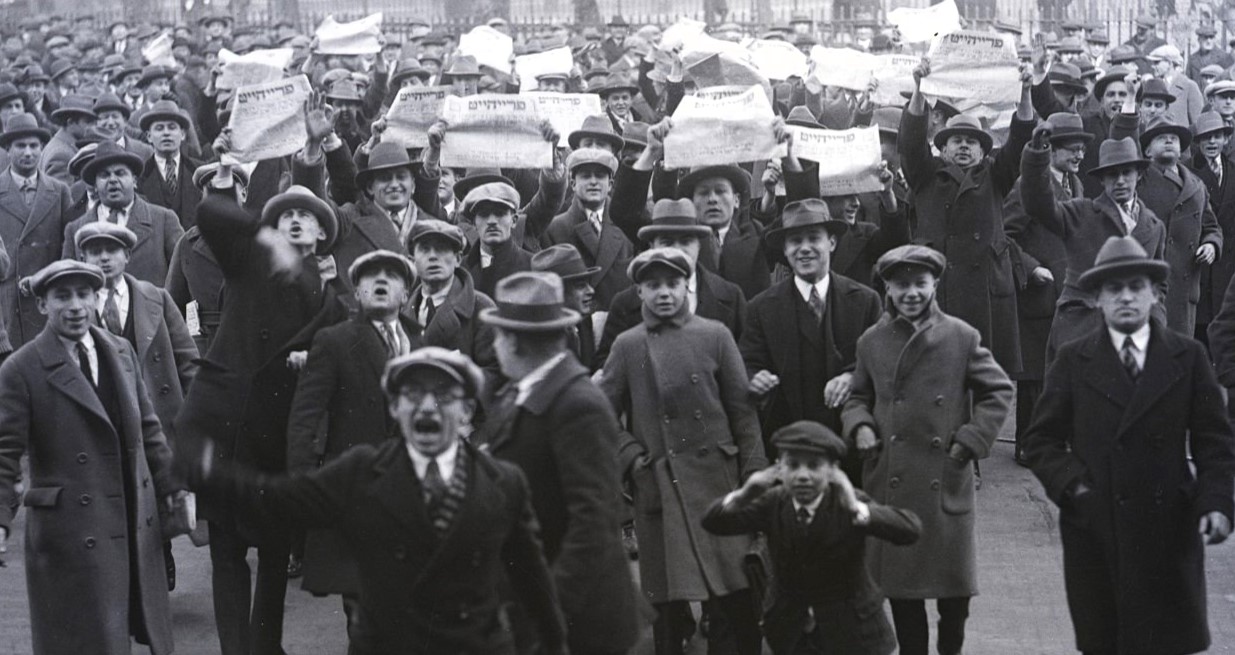
Cicely Applebaum on the massive, largely victorious, strike of New York furriers for a 40-hour week, and the right to live.
‘40 For Furs: Background of the Workers’ Victory’ by Cicely Applebaum from Labor Age. Vol. 15 No. 7. July, 1926.
VICTORY!
SCORE another win for the Organized Labor forces. After an intense struggle, the furriers of New York have gained the forty-hour week. It was not secured in its entirety–for forty-four hours are still allowed in the four extra-busy months of the winter. It was not won without putting aside, for the present, other demands included in the strike crisis: such as an unemployment fund. It was accompanied, however, by the beginnings of the re-organization of the industry, which Labor will continue to push forward. Sub-contractors are to be limited in number, and also apprentices are out for two years.
It is a flaming example to the unorganized, of what can be won through effective unionization. Miss Applebaum’s article, written before the issue was decided, gives the story of Why the Strike and What its winning means.
IT’S a curious thing!
The chief is sitting in his oak panelled office before his steel desk which looks like genuine mahogany, staring through the thin glass vase with its single rose and swearing softly because he can’t go out to play golf for an hour. Not that he has anything to do but one must give an example of diligence.
In walks a representative of the workers–with a horrible demand–a shorter work week. The outraged chief jumps up. “You workers think life’s just a long loaf. You think men can earn without working.” Laziness, shiftlessness, “devil will find mischief for idle hands to do” are the keynotes of his speech. He talks fast and well, until his watch points to five minutes of three. Righteous indignation still gleaming in his eye, he jumps up, murmuring something about “an important engagement”. As he accompanies the representative of the workers out of the office, he says virtuously “You think over what I said–you can’t get anywhere with so much idleness.” And he walks down to his car, patting himself on the back for his virtuous good sense and stretching his toes in anticipation of a good round on the links.
It’s queer, isn’t it? And it happens every time. Leisure is one of those things good only for the employing class. Every time the workday gets shorter, a blow is struck against morality, for hard work is one of the highest virtues that is, for the other fellow.
Morality is being attacked again now–and this is a monstrous blow. The workers, it seems, don’t want to work on Saturdays. As if week end holidays weren’t the prerogative of the Country Club set. Curiously enough, a respectable collection of labor organizations think that the extra half day of leisure won’t undermine the foundations of society. The furriers, twelve thousand strong, every furrier in the trade in New York City, are striking this particular blow. Marching up and down the streets where they work, picketing the shops where they spend all the sunny hours, good natured despite the police raids which have brought 600 of them to the courts; determined, in spite of the length of the strike which began on February 16, to win that extra half-day of leisure. On the lapel of each of the young men and women who walk through the streets of the fur center is a “40-hour week” button which quite literally indicates their feelings in the matter. The 40-hour week will be won.
Health Vs. Greed
They are striking for health, for very life the extra half-day of leisure is absolutely necessary for workers exposed to poisonous dusts and dyes during their working hours. They are striking for a longer period of employment. They are striking for more leisure in which to become more enlightened members of their union, their political party, their class.
The dressmakers of New York, the painters and some printers who are already working only forty hours & week cordially approve the campaign the furriers have begun. The Westchester County building trades have expressed their desire for the shorter working week. The Amalgamated Clothing Workers at their recent Toronto Convention declared their approval of it. And the movement for the forty-hour five-day week has been endorsed by President Green of the American Federation of Labor, by the New York City Central Trades and Labor Council, the State Federation of Labor of New York, California, Minnesota and Pennsylvania. Workers all over the country disagree with the employers’ theory about the harmfulness of leisure for workers.

In the fur industry there can be no doubt that the theory is all wrong. For workers in an industry carried on under such unhealthy conditions must have more leisure than they do. The dust and poisons in the fur dye they come in contact with are responsible for an alarming prevalence of occupational diseases. An examination of a representative group of furriers conducted for the Furriers’ Union by the Union Health Center in 1926, showed that 14.5% of the workers were suffering from bronchitis, 53.9% from acute irritations of the nose, throat, and air passages. This was an alarming increase over the condition in 1915 which were already bad enough. An examination of 542 furriers conducted then by the New York City Health Department showed 5.9% of the furriers to be suffering from bronchitis, and 29.7% from acute irritations of the nose and throat.
Longer working hours in the fur trade mean shorter working years, also. In 1915, 10% of the workers were 50 years old or more; in 1926 only 4% of the workers were so old. In 1915, 72% were under forty years old; in 1926, 85% of the workers were young men. The fur workers are being thrown on the economic scrap heap years before their time. Before they reach fifty, with not enough money saved up to live in idleness, the workers broken in health by their trade are thrown out upon the world to earn a meager living in some occupation for which they have not been trained. Shorter hours will change that monstrous condition. Shorter hours are according to the Workers’ Health Bureau “an absolute safeguard necessary to enable workers to gain a little strength to offset the effects of harmful conditions.”
The furriers hope that shorter hours will help to solve another of their difficulties, a difficulty which they share with all the needle trades-unsteady employment. The work of the fur industry is concentrated in a few busy months when the workers lose health and strength working long hours under the unhealthy conditions prevalent. During the other months of the year, they are seeking work and worrying about their inability to earn any money. The seasonal fluctuation in employment in the industry is enormous. In October, 1923, for instance, 11,762 furriers were employed; by January of the next year only 6,065 had work to do. In the medical examination of the workers just concluded, 12.5% of those examined were found to be suffering from “distinct neurasthenia”, a condition which may very likely be attributed to the nerve strain and worry undergone during the periods of unemployment.
The workers hope that decreasing the working hours all the year round, in the busy season as well as the dull times, will spread out the period in which employment can be procured. They hope to reduce somewhat the seasonal fluctuation in employment. If reduced working hours do bring about more regular employment, as there is reason to believe it will, the workers’ health conditions should show a decided improvement, since that neurasthenic condition resulting, most likely, from worry over unemployment, would be present less frequently.
Leisure Makes Life
But more leisure is not only a material need of the fur workers. It is also their spiritual goal. Insufficient leisure bars them and their fellow workers in every industry from a cultivation of the higher things of life–from literature and art and music, from an understanding of the society in which we live, the forces that move it, and the place of the workers in it. They will have time to learn how to change that society so that all may live more happily in it. In the additional time away from the unhealthy and mentally deadening workshop, they will be able to become stronger, broader men and women, of more use to society, and more interesting to themselves. Life will be richer and more pleasurable to them and they will return the riches to life.
The furriers are determined that a forty-hour week shall come. The spirit to win shows itself clearly at every union meeting. Although their strike has been going on since February 15, there are no signs of weakening. Indeed, they have rejected peace offers the employers that do not meet their terms. At the end of May, for instance, the employers offered terms of settlement which did not include the 40-hour week for the whole year. The workers were absolutely unhesitating in their refusal to accept the 40-hour week for the dull months. The forty-hour week was not to be compromised.
They have rallied to their support workers from all over the country. Everywhere, workers are listening to and heeding the gospel of the shorter work-week. For workers in every industry the shorter work-week is a pleasing prospect. More leisure means more health, more steady employment, more culture. The furriers have probably begun a new movement for less work, to follow the movement for the eight-hour day, almost completely established.
The chief in his oak-panelled office is probably due to have a bad hour thinking about the disappearance of the exclusively aristocratic week-end. In self defense, he will probably have to take Friday off after this. He will mutter something about “what is this world coming to?” But the worker, planning for a two-day holiday at the end of the week, won’t be paying much attention to him.
Labor Age was a left-labor monthly magazine with origins in Socialist Review, journal of the Intercollegiate Socialist Society. Published by the Labor Publication Society from 1921-1933 aligned with the League for Industrial Democracy of left-wing trade unionists across industries. During 1929-33 the magazine was affiliated with the Conference for Progressive Labor Action (CPLA) led by A. J. Muste. James Maurer, Harry W. Laidler, and Louis Budenz were also writers. The orientation of the magazine was industrial unionism, planning, nationalization, and was illustrated with photos and cartoons. With its stress on worker education, social unionism and rank and file activism, it is one of the essential journals of the radical US labor socialist movement of its time.
PDF of full issue: https://www.marxists.org/history/usa/pubs/laborage/v15n07-jul-1926-LA.pdf
 Revolution's Newsstand