In this letter Liebknecht takes a close look at the physical and social situation of the Saxony proletariat, particularly its handloom-weavers, Bismark’s support for the new French ‘republic,’ German relations with Austria and Russia, as well as the latest election results, in which he lost his seat.
‘Letter from Leipzig, XIII’ by Wilhelm Liebknecht from Workingman’s Advocate (Chicago). Vol. 7 Nos. 36 & 37. May 13 & 20, 1871.
Leipzig, March 19, 1871.
To the Editor of the WORKINGMAN’S ADVOCATE:
Today I shall give the following extracts from Dr. Michaelis’ pamphlet on the sanitary condition of the industrial population of Saxony:
“The food of our Saxonian workingmen’s families consists of potatoes, bread, butter, so-called coffee, and sometimes a little sausage and cheese; in (Prussian) Silesia they drink less coffee, and have water boiled with bread, flour or potatoes, instead of seasoned only with salt–otherwise the food is the same. Meat is served only on feast days, and then not regularly. These kinds of nourishment which in themselves are not unwholesome, produce a pernicious effect by their exclusive use. With the exception of the sausage, cheese and butter, the common food of the working classes is of vegetable origin; but on vegetable produce alone man cannot live, and the sausage, cheese and butter, which are eaten in very small quantities, are not by far sufficient to make up for the want of a nitrogenous meat diet. It is very difficult to discover the average quantity of meat consumed by the different classes and groups of the population. However there exists no doubt that in our industrial districts the quantity is much smaller than in the towns1 and agricultural districts. According to my observations and researches the annual consumption of food in the industrial district (of the Erzgebirge the Ore Mountains) is for each grown person as follows: Potatoes 500-600 pounds; bread 250-300 pounds; meat from 8-9 pounds. In Silesia the quantity of potatoes consumed annually is still larger (about 700 pounds) while that of meat is less by two pounds (6-7), the consumption of bread being pretty equal. With regard to the so-called coffee it must be mentioned that it is a compound of adulterated ingredients, containing very little real coffee, and having a tendency to weaken the digestive faculties. It is obvious that with such a scanty diet the state of health cannot be a favorable one.” The mortality amongst the children of the industrial poor is something frightful; general statistical numbers the author is unable to give, but from the fact that the average length of life of these classes is but half of the average length for the whole of Germany, it must be concluded that the majority of the children die shortly after their birth. The lodgings are unwholesome, the families are crowded together, and there is no proper ventilation, especially in winter when, to save the warmth, no window is opened and the contrast between the hot air of the rooms and the cold air of the atmosphere is apt to lay the seed of all kinds of diseases, of the respiratory organs, rheumatism, etc.
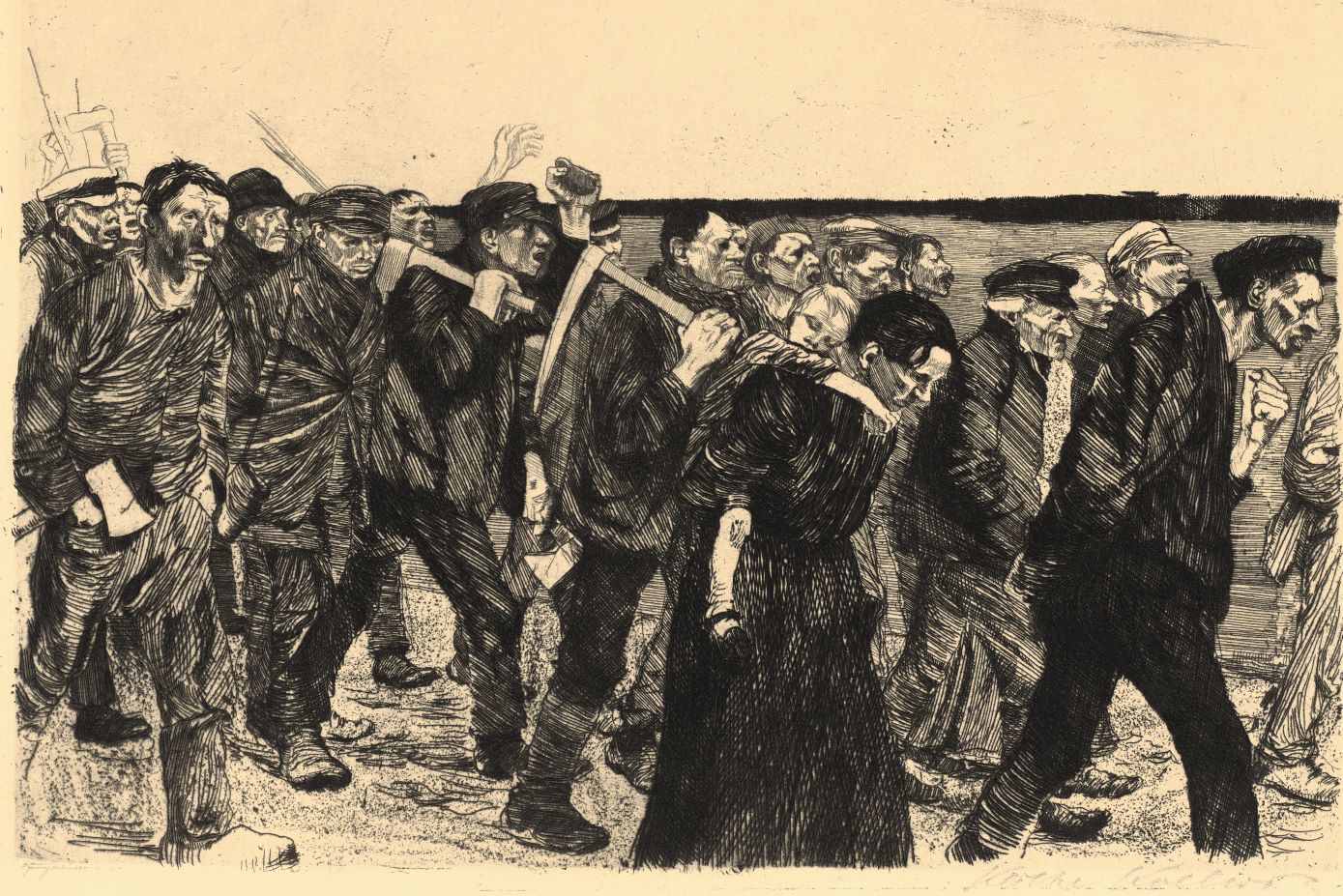
The wages are very low; the lace makers are happy if they get 1 thaler 10 groschen ($1 or 4 shillings English) a week; often they have less, and every year has its bad times when they have nothing at all. The weavers have when times are good from 1 thaler 10 groschen to 2 thalers ($1.00-1.50 or 4-6 shillings); in bad times, which are becoming the rule more and more, they starve downright like the lace makers. The miners are somewhat better situated; their wages are not much higher than those of the weavers, from 1 thaler, 20 groschen to 2 thalers 10 ($1.25 to 1.75 or 5 shillings to 7 shillings) but then their work is more regular. The poorer a man is the better an object of prey is he. Our Saxonian weavers are chiefly beset by the parasitical race of middlemen (Factors in their local denomination) who advance the working men the yarn to weave with, and take the finished cloth from them to the merchants. Not satisfied with pocketing a part of the wretched wages paid by the merchants as a renumeration for the trouble and risk they have in advancing the raw material and in delivering the manufactured article, these middlemen contrive to extort large sums over and above, by imposing exorbitant fines for real or imaginary faults in the work done, which fines must be paid unless the poor victims choose to lose their work altogether and be starved to death. Lately some associations of weavers have been founded in the Erzgebirge, which are in direct communication with the merchants and so avoid the middlemen. But the merchants as a body look unfavorably on these associations and prefer employing the middlemen, and from that reason the benefit derived is out of proportion with the magnitude of the evil, the associated workmen being a trifling minority compared to those who are forced to keep and enrich the middlemen. Besides it must not be forgotten that even if the associations become general, a radical improvement would not be effected; the wages would soon fall to the level of the rate actually paid the workmen now, and the sole change would be that the difference, instead of going into the pockets of the middlemen, would find its way into the pockets of the merchants. The whole trade is doomed; the handloom cannot stand against the powerloom. In England it has been driven out of the field already, in Germany it is now undergoing the same fate. The process is a slow one; of all creatures, man has the greatest powers of endurance. It is impossible to say exactly where the starving point is. For one man it is a little higher, and for the other a little lower; and with our surplus population there are always plenty of tough people, difficult to be starved to death. In England the process lasted for fully three generations and still some solitary handloom weavers are struggling there. In Germany the war was begun more than thirty years ago, and it is the second generation that is now involved in the crisis. Is the car of Juggernaut to be driven on over these helpless hundred thousands? Or is it to be stopped? Emigrate the weavers neither can nor will. What could they do in the United States or in Canada with their weak limbs, unfit for any field work? To enter other trades may do for a few, but not for the immense majority. There are only two issues lying before us: Either these hundred thousands of handloom weavers are left to their fate or they will be gradually improved out of the world; or the government must interfere in their behalf. There is no third solution. Private charity, and the action of municipal bodies are like a drop on a heated stone. Unless the government, backed by the resources of the country, comes to the rescue, there is no hope. Up to this day nothing worth speaking of has been done on the part of the government either in Saxony or in any other German State. Done to help the weavers, I mean. For one government, that of Prussia, to wit, has certainly done something, nay a great deal in the case of the weavers, and the blue beans (musket balls) which the kind Prussian Government fed the starving Silesian weavers with in 1845 will always be remembered as a proof that the Hohenzollern dynasty had even so far back a prophetic consciousness of its being destined to the championship of the German Bourgeoisie. Except for this unsuccessful lead and powder cure (unsuccessful because the old musket–the needleguns not being in practice yet–was not of such miraculous effectiveness as to blow all the weavers into eternity), the Prussian Government has not done anything. It is true, six or seven years ago, when Mr. Bismarck was very popular with the middle classes, he once started the Red Spectre in Silesia, just to frighten the rebellious burghers into submission, and had a deputation of weavers fitted out and presented to the king, but beyond a few socialistic articles in the government papers, and some thousand thalers invested in a cooperative society for the benefit of a needy government agent, and as a bribe to a dozen or so of honest workmen, nothing substantial has come from the terrified Bourgeoisie quickly resigning every thought of independent Liberalism, and the bugbear could be dismissed again.
II.
In Saxony the Government has made inquiries into the state of the weavers, has provided a little pecuniary help in some extreme cases, has promoted straw plaiting, to procure employment for starving weavers–and that is all as good as nothing, straw plaiting has proved a complete failure and is even more hopeless than weaving. Small palliatives are of no use here; what we want is government action on the largest scale. One million of human lives are to be saved. When the class of nobility was supplanted in France, Disraeli, the English Tory, says in his remarkable novel Sybil, “they did not amount in number to one-third of the English handloom-weavers, yet all Europe went to war to avenge their wrongs, every State subscribed to maintain them in their adversity, and when they were restored to their own country, their own land supplied them with an immense indemnity. Who cares for the handloom-weavers? Yet they have lost their estates. Who raises a voice for them? Yet they are at least as innocent as the nobility of France. They sink amongst no sight except their own. And if they meet with sympathy–what then? Sympathy is the solace of the poor–but for the rich there is compensation.” This was written in 1845. The English handloom weavers have been happily disposed of since, without compensation or indemnity. Shall the same wholesale murder be committed or rather completed upon our German handloom weavers?
A very characteristic change has, since about a fortnight, taken place in the language of our official and officious organs, concerning the French Republic. After having covered it with obloquy for more than five months, and having proved for the thousandth time, that it cannot exist and deserves not to exist, they have suddenly made the discovery, that not only the Republic is the fittest form of government for France, but that it is also the one best in accordance with the interests of Prussia.2 Yes, Mr. Bismarck’s own paper, the North German Gazette, talks in quite an enthusiastic strain of the blessings which republican institutions bring to those nations, whose character and disposition they suit (of course not the Germans “who owe their national greatness to their princes,”) and calls it an exploded idea, to think the establishment of a Republic in France would endanger the Monarchies of Europe. Well, if this is an exploded idea, it must have exploded but a very short time ago. When on the fifth of September last the news of the proclamation of the Republic reached the Prussian headquarters, the idea was not exploded yet, as the two hundred thousand Frenchmen and Germans killed and maimed between that day and the capitulation of Paris will attest. And when, as late as in the middle of January, Count Bismarck made a final effort to restore Bonaparte on the French throne by convocation of the old Corps Législatif, or by the Assembly of Notables, to be deputed by the Bonaparte general councils–the idea was not yet exploded either. Nor is it today. That which is exploded is the Sedan, the plan of Napoleon’s restoration. And so the Prussian statesmen were obliged to make a virtue of necessity. Of Bonaparte there is hardly a word said anymore in our government papers–the subject is too delicate–but, and this is notable, they are writing much against the pretensions of the Orleans family. The Orleans, we are told, would be a real danger for Germany; to render themselves popular, they would madly pursue the policy of revenge, while the Republic, caring more for the welfare of the people, might be expected to be in favor of peace. Why the sudden rage against the Orleans, of whom nobody has been thinking, and whose name has not been pronounced in Germany since the capitulation of Paris? Just for that reason their name must be pronounced, rendered familiar to the public ear. Bonaparte having proved impossible, his predecessors on the throne of France present themselves to Mr. Bismarck as the best instruments of his policy; and under the existing circumstances the only way to bring the Orleans candidature on the tapis is to combat it. The stratagem is not a novel one, neither in political nor in business nor even in literary life. Has not, for instance, Mr. Winckelmann, the greatest of German antiquarians, established his fame by writing a fierce anonymous critique of his first work, which had not met with any success, and then by refuting this anonymous critique in a long essay, not anonymous?
Exactly the opposite course our press bureau scribes are commanded to pursue with regard to the new Austrian ministry; they must praise it–this being the surest means of rendering them suspect. The trick caused much merriment at Vienna, where they begin to understand the Prussian ways by and by. As for those ministers, they have not yet fulfilled any of the hopes raised by their nomination amongst the Austrian patriots; who wish for an energetic anti-Bismarckian policy. The new ministers are evidently at a loss, what parties or elements to lean upon. The middle class is against them, and will never be for them, because they have supplanted its own ministry. Of the working classes they are afraid, though they wish to keep good friendship with them. The clerical and feudal party is making the most tender advances, but if they were accepted the ministry would draw down a storm of indignation, by which it would soon be swept away. In this perplexing situation, it seems, the new ministry will try the national dodge and create for their use a “national Austrian policy” rather a difficult task that, Austria being altogether one of the strongest practical contradictions to the national principle, quite as strong a one as Switzerland and the United States, only with this difference, that in these two republics liberty has provided a cement for the various nationalities, which is not to be found in the Habsburgian Monarchy.
The telegram, in which King-Emperor William announced the peace to his cousin the Czar, and the latter’s answer have shown, to the most skeptical, the truths of the rumors long rife of a Prusso-Russian alliance. How these two documents could be published is a riddle to me; it is either some indiscretion, or the “intoxication of success” must have rendered the King-Emperor careless of the consequences. So much is sure: the two telegrams have produced the very worst effect, and the Prussian press bureau has received orders to demonstrate that they were mere formalities. Formalities forsooth! Governments of England, Austria and France had ample opportunities, during the last peace negotiations, to convince themselves that the Prusso-Russian alliance is no mere formality, but a hard and ugly fact, to which the defeat of the Neutrals, in their attempts of preventing the humiliation of France, is mainly due–a chapter, yet shrouded in mystery, which, however, is to be hoped, will not last forever. At all events a chapter not conducive to the honor of diplomacy; proving it to be a miserable, cowardly sham, a thing that is either nothing or the servile lackey of the brutal master, the sword. Off with it into history’s lumber room.
The result of the elections is: in Prussia the Bismarckian candidates have been chosen nearly everywhere; and in the dependent States too, I think, there will not be twenty real opposition members in the new Reichstag, fewer than in the old one. This is the first fruit of our victories. Our party has two seats, and will probably get a third one. Liebknecht has been overcome by a coalition of the Liberals (National and Progressionists) and the Particularists, combined with a strong pressure from the authorities. Their unlawful influence has been set in motion, as can be substantiated in many instances; we have protested against this election, as well as against another one in which we were beaten by the same means. The absence of our imprisoned friends has been felt much during the elections; if we had been able to use our whole strength we should doubtlessly have conquered eight seats at the lowest. However, we have no reason to be dissatisfied; though we have not gained any seats yet we have gained in the number of votes given for our candidates, which at this election was more than three times as high as at the last election.
NOTES
1. Dr. Michaelis speaks here only of the largest towns, none of which in Germany has yet a predominantingly industrial character.
2. This argument, which I find in the Gazette of the Cross (the most fashionable and reactionary of Prussian newspapers), is an involuntary acknowledgement of the superiority of Republican institutions, which is all the more valuable for being involuntary. It ought to be recommended to the attention of your President Ulysses S. Grant (note by Liebknecht). In many ways the Kreuzzeitung was the voice of Bismarck.
The Chicago Workingman’s Advocate in 1864 by the Chicago Typographical Union during a strike against the Chicago Times. An essential publication in the history of the U.S. workers’ movement, the Advocate though editor Andrew Cameron became the voice National Labor Union after the Civil War. It’s pages were often the first place the work of Marx, Engels, and the International were printed in English in the U.S. It lasted through 1874 with the demise of the N.L.U.
PDF of issue 1: https://chroniclingamerica.loc.gov/lccn/sn89077510/1871-05-13/ed-1/seq-1/
PDF of issue 2: https://chroniclingamerica.loc.gov/lccn/sn89077510/1871-05-20/ed-1/seq-2/
 Revolution's Newsstand