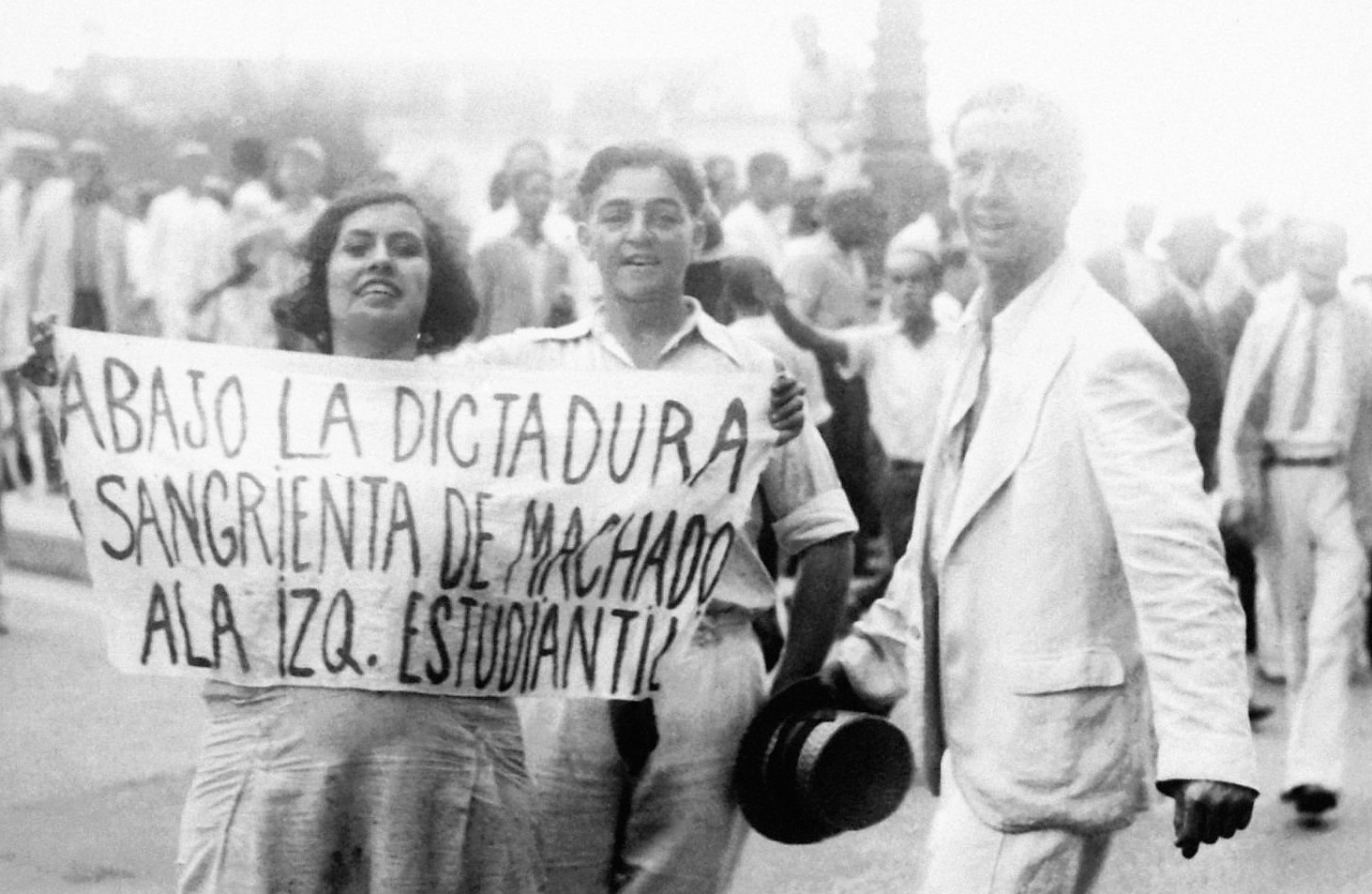
An informative history of the revolutionary student movement in Cuba from 1925 until the events of 1933, in which a revolt brought down the rule of the dictator Machado–and brought to power Fulgencio Batista.
‘The Cuban Student Movement’ by Walter Relis from Student Review (N.S.L.). Vol. 3 No. 4. April, 1934.
The revolutionary movement in Cuba began in 1925 with the advent of Machado to power. In that year, Julio Antonio Mella, several workers and intellectuals, organized the first cells of the Communist Party of Cuba. Mella was already recognized as one of the leaders of the university students. He was outstanding in physical appearance. His more than six-foot lithe broad body enabled him to become the university’s leading oarsman and basketball player. Already, although he was only in his early twenties, he had won renown as one of Cuba’s outstanding orators, and in spite of his revolutionary convictions, the admiration of the Conservatives.
The success of Machado in the presidential elections and his accession to office in May, 1925, was in the greatest part due to his position as the general manager of the American and Foreign Power and Light Company (subsidiary in Cuba of the General Electric, controlled by Morgan), which had by this time obtained control over practically all Cuban public utilities. Machado immediately began a program of public “beautification.” Elaborate public buildings and roadways were constructed at a tremendous cost, although public education was pitifully neglected. Student opposition to the regime was aroused when Machado arbitrarily prolonged his presidential term to six years by means of the Prorogue Law (1927), passed with little trouble by his obedient Congress. The agitation against this measure by the Student Directory of 1927 did not succeed. Seventy students who were expelled were either sympathetic to or members of the Directory.
For three years there was no strong open manifestation of student opposition to the Machado dictatorship. Leadership is precious and necessary to a militant movement. Once it is removed, it is difficult to replace. In the fall of 1930, discontent among the university students reached a high level. It was decided to hold a demonstration against the oppressive government the day before school opened. On Sept. 29, 1930, 2,000 students, some of them from the secondary Havana schools, massed in protest. Police attacked immediately with pistol fire. One student, Trejofi was killed. Tremendous indignation rose among the students who had led the struggle, replaced the Directory of 1927.
Utilizing the election in November as an excuse, Machado postponed the opening of the university till Nov. 7. (General elections for members of the Congress, etc., took place at this time because the change in the electoral laws, effected by the previously mentioned Prorogue Law of 1927.) When Nov. 7, the day of the opening, arrived, it was announced that the opening of the university would be postponed until December. Meanwhile many of the exiled members of the 1927 Directory had returned. The few years abroad had given them an opportunity to study the position of Cuba as a semi-colonial region under the domination of the United States. On their return they attempted to persuade the newly born Directorate that the struggle must be waged against “El Imperialismo Yanqui’” as well as Machado. In no small part they succeeded, but the Directorate as a whole did not accept this position. There developed a split in the Directory itself. One group was called the “Ala Direcha” (Right Wing) and the other, which recognized the necessity for immediate struggle against imperialist subjugation, called itself the “Ala Izquierda” (left wing).
In December, Machado called the Directorate, which had now received the approval of an open assembly at the University, to the Palace. He accepted two demands of the students: To concede autonomy to the university, and legality to a federation of students. The Directory demanded in addition that he retire from office—this, Machado flatly refused to do.
During the same eventful month the “Ala Izquierda Estudiantil” was organized by those students who sympathized with and led the left wing. They believed that to lead the students along the line proposed by the Directorate would be incorrect, would tend to create illusions, which in the end would bring disaster to the student body, that in order to combat native and foreign oppression, students would have to rely on the leadership of the working class, since that class was all-decisive in such a terrific struggle.
The struggles of the students not only in the university but in the Institute and Normal School of Havana, prompted Machado to issue a military decree closing the three schools. Schools were opened at the end of each semester for examinations. Strikes were declared against taking the examinations, and the Directory came out for a general strike effective until Machado abdicated. Strikes in a number of schools were forced upon the students by acts of terror (planting bombs in the school buildings, etc.)
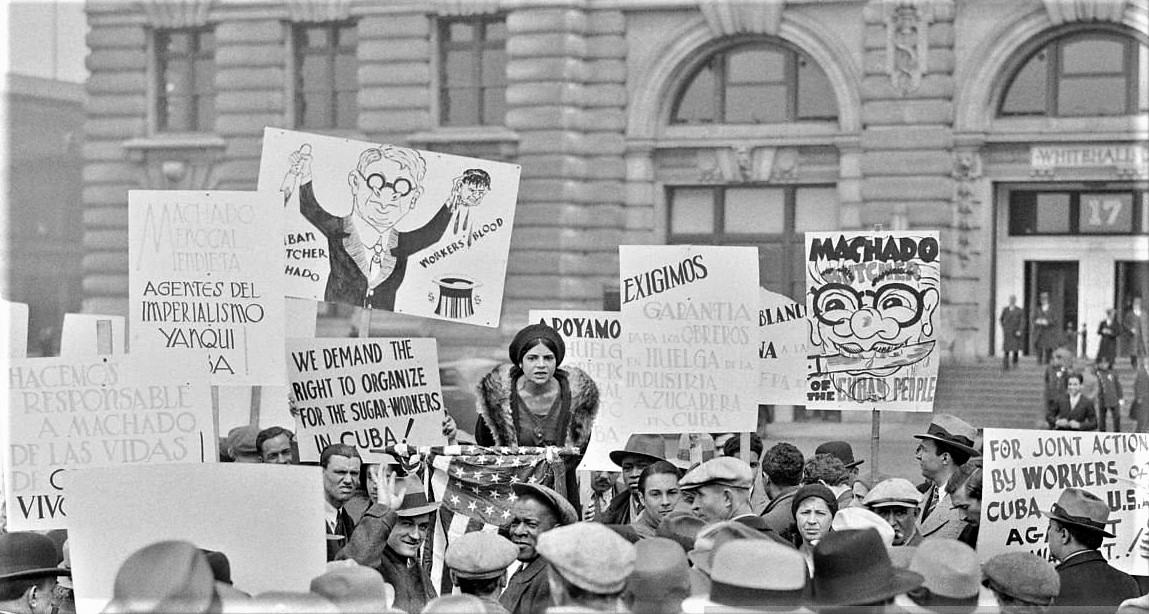
The “Ala Izquierda” proposed to struggle for the opening of the schools, declaring that strikes should be called only when they were the desire of the students, and that an unlimited strike would only play into the hands of Machado, because it would not allow the students to come together and organize its activities.
As a result of its illegal position and the effective spy system, it was necessary for the left wing, as for all revolutionary organizations and the bourgeois opposition groups, the A.B.C., to adopt a cellular form of organization. Each cell had approximately five members. Any more would make meetings almost impossible because of the vigilance of the secret police. Contact between a group of cells and the leading body was established by an individual who carried the decision of the central committee to the cells, and related back to the central committee the conditions and desires of the particular cells. Demonstrations were prepared and kept secret until the moment the demonstrators appeared on the street. On January 10, 1931, Mella Day (Commemoration of the day Mella was assassinated in Mexico City about forty members of the “Ala Izquierda” appeared suddenly in the San Juan De Dios Park, Havana, with revolvers in hand. One student mounted a stone bench and spoke against Machado and Yankee Imperialism. In a few moments the police and Porristas (Machado’s hired assassins) arrived and commenced to fire. The demonstrators retreated in orderly fashion answering shot for shot.
Between 1931 and 1932 most of the leaders of’ the Left Wing were in prison; and the leadership of the organization was practically taken over by one Villereal, who while he had power, perverted the entire program and purpose of the “Ala Izquierda.” He made no attempt and indeed refused to permit the organization to lead the students in the struggle for their economic and academic demands, such as the opening of the schools. In addition he neglected to do organizational work among the students of the Institutos and other secondary schools. A committee was formed within the “Ala Izquierda” for reorganization and the removal of Villereal from the leadership.
By 1933 a revolutionary crisis was maturing in Cuba. The people were uniting in their hatred against Machado, and with the accentuation of this hatred, a strong antiimperialist feeling began. Imperialism in the United States became fearful lest open mass revolt break out in Cuba. Even a strictly localized revolt was feared for such a rising might entail the destruction of many of its own properties.
Sumner Welles was dispatched by President Roosevelt in order to mediate the difficulties of the bourgeois groups at least. These groups accepted the mediation invitation with the exception of the Directorate, which neither declined nor accepted. The revolutionary organizations (The National Confederation of Labor had 200,000 members) were not invited.
With the coming of Welles, terror subsided to an extent, and many revolutionary working class leaders were released from prison. While mediation was taking place a general strike under the leadership of the National Confederation of Labor was being prepared. At the beginning of August, the strike broke out and paralyzed the Island. Several sugar mills were taken over by the workers. Begun as an economic struggle, the strike became a political action against Machado. In the middle of August, Machado fled the island and left his terror system in collapse. Many of his notorious assassins and supporters were lynched on the streets and their houses destroyed.
For a period, and for the first time, several of the revolutionary organizations came partly in the open. On August 25 all the left wing student groups in Havana (at the time there were only a handful in the interior), met at the university and voted to expel Villereal. In addition they made plans to organize groups throughout the Interior of the Island and put forth slogans such as: “Matricula Gratis” (free tuition), for the immediate demands of the students. Cespedes, who succeeded Machado, did not stay in power long because of the growing discontent. A group of opportunists (Batista and several other petty officers from the Army and Navy), Grau San Martin, a professor in the university, Carbo, the newspaper editor, and several members of the Student Directory, utilized this discontent. Liberal doses of demagogy helped to manipulate a successful coup d’etat against the already tottering Cespedes government. The directorate members immediately secured sinecures for themselves. One became police chief, another, head of the fire department, and various others took positions in the police force. In this way the Directory completely isolated itself from the student body. Its members became part of the oppressive Grau government, and aroused the animosity of their fellow-students. It was a member of the Directory, Labourdette, who sent police to fire and disrupt student demonstrations; arrests of students and workers continued under his direction.
The Grau government did not receive recognition from Washington because the United States Government considered it too weak to protect the interests of American capital. In fact it is well known that the A.B.C. received full support from Ambassador Welles in its attempt, on November 7, to overthrow the Grau government. Grau and Batiste made every effort, however, to convince American imperialism that they could very well guard its interests. On September 29, an enormous demonstration in Havana to receive the ashes of Mella from Mexico, was attacked by detachments of the Army which turned machine guns on the demonstrators. There were several deaths and many casualties. A company of twenty-five fully equipped soldiers was stationed in each sugar mill to prevent interference with its operations. In the early part of November, the “Ala Izquierda’’ held its first National Convention. By this time groups had been established in most of the large schools and its membership had increased from 400 to approximately 3,000 (in the short period of three months). Emphasis was placed at the convention on leading the struggles of the students for their economic demands. Villereal’s expulsion was confirmed. The Conference voted to support and work for a Workers’ and Peasants’ Cuban government. The most difficult problem which faced the conference was that of “examined” and “non-examined” students. In many schools strikes had been declared by the students during Machado’s regime. Some students had broken the strike by taking examinations at the end of each semester, and thus received credit which the strikers had not. These students were called “examined.” At the time of the conference serious clashes were taking place between “examined” and “non-examined” students. The latter in some cases refused to permit the former to attend classes or attain credit for examinations taken under Machado. It was decided by the conference that in all schools where a strike had occurred under Machado, examinations taken in violation of the strike were to be considered void. However, the students who took them were to be permitted to attend classes. Wherever no strikes had been declared, all examinations were to receive full credit. All those who led attacks against “non-examined” students are to be summarily expelled from the student ranks by the students themselves. At a recent student demonstration (February 6) against the Mendieta-Batista government, as a result of which a worker and a student were killed and six others wounded by the police, student speakers were applauded when they mentioned solidarity with the working class and support of the General Strike. (It is interesting to note that most of the speakers were members of the “Ala Izquierda” and that no member of the Right dared show his face). In answer to the killings a general student strike was declared for forty-eight hours. In large letters painted on the university steps were “Caffery Commanded It”, “Martinez Saenz (leader of the A.B.C. and member of the Mendieta cabinet) is a traitor,” “We demand the shooting of the assassins Mendieta and Batista.” The following appeared on the sidewalks in front of the Institute of Havana; “Down with the Green Porra.” (Green is the color of the flag of the A.B.C. The Porra was the assassin organization of Machado.)

Since the conference the “Ala Izquierda” has completely taken over the leadership of the Cuban students. In this period it has gained 2,000 additional members.
The “Ala Izquierda” has also drawn itself much closer to the working class. It has been active in the support of the Woolworth strikers in Havana, and has sent several of its members into the Interior to act as organizers and agitators for the revolutionary trade unions. It is now actively assisting the working class in preparing for a decisive struggle against Mendieta and his imperialist supporters for the establishment of the first Workers’ and Peasants’ government in the Western Hemisphere.
Emerging from the 1931 free speech struggle at City College of New York, the National Student League was founded in early 1932 during a rising student movement by Communist Party activists. The N.S.L. organized from High School on and would be the main C.P.-led student organization through the early 1930s. Publishing ‘Student Review’, the League grew to thousands of members and had a focus on anti-imperialism/anti-militarism, student welfare, workers’ organizing, and free speech. Eventually with the Popular Front the N.S.L. would merge with its main competitor, the Socialist Party’s Student League for Industrial Democracy in 1935 to form the American Student Union.
PDF of original issue: https://archive.org/download/student-review_1934-04_3_4/student-review_1934-04_3_4.pdf
 Revolution's Newsstand