
Still in his mid-20s, and just beginning his acting career in the plays of Eugene O’Neill, this early article by Robeson thinking about his future as an actor, given his extraordinary life, is delightful to read.
‘An Actor’s Wanderings and Hopes’ by Paul Robeson from The Messenger. Vol. 7 No. 1. January, 1925.
About 1915, from a rather secluded spot in New Jersey–Somerville to be exact–I read of the interesting debut of Negroes upon the serious dramatic stage of America. Of the four plays by Ridgely Torrence, one, “Simon the Cyrenian,” was of unusual interest. Just a short time before, I, as the “Pastor’s” son and Sunday School superintendent, had talked at great length about just that man and had pointed out many obvious lessons. Some five years later, after being literally dragged into rehearsal by Mrs. Dora Cole Norman, the honored president and very fine directress of the Colored Players’ Guild, I thrust my 215-pound frame upon the small stage of the Y.W.C.A. in the role of that same Simon. At the end, I was congratulated and greatly encouraged by Mr. Torrence, Mr. K. McGowan, Mrs. Hapgood and others, but the “Law” called, and in the mazes of various John Does vs. Richard Roes, I soon forgot my stage experience.
Fate, however, was still conspiring to draw me away from the learned profession, and in the middle of the year I was offered a part in Miss M. Hoyt Wiborg’s “Taboo,” a play of “Voodooism.” After a short run here, “Taboo” was taken to England, where I had the privilege of playing all summer with Mrs. Patrick Campbell. A most interesting experience this, and I received more encouragement from this noted actress.
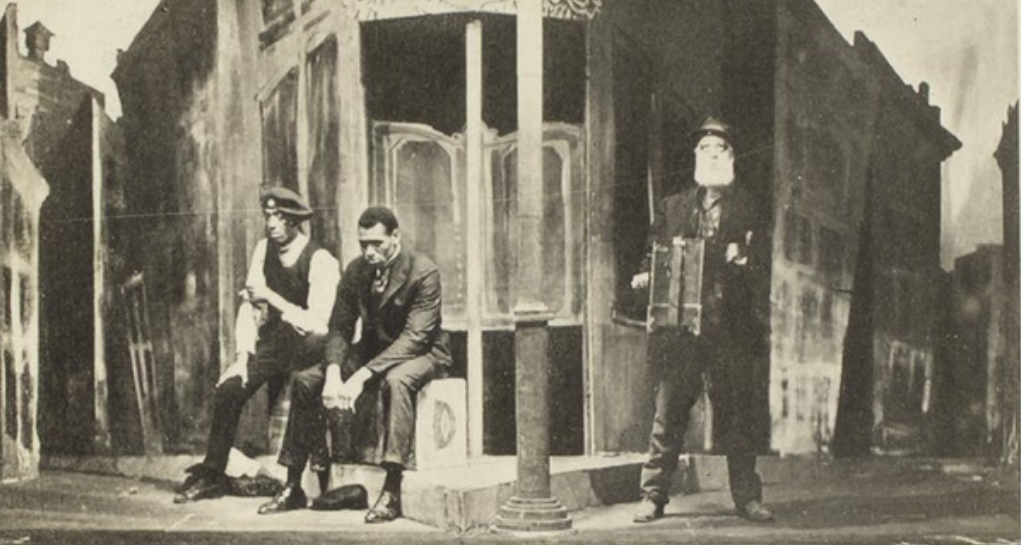
Coming back I worked for a time in a law office still the old urge–then came “Emperor Jones” and “All God’s Chillun Got Wings.” I managed to get in two weeks of “Roseanne”–which I enjoyed immensely. A very fine play I think–and if ever it is revived there awaits a marvelous “Roseanne” in Rose McClendon. Now I’m back again to “Brutus Jones” the “Emperor,” and perfectly happy. It’s been most thrilling–this acting. So much so, that I’m going to keep on trying to do it.
What are the opportunities? Just what I will make them. As I have met people in various circles I find they are pulling for me. Especially my friends at the Provincetown. I honestly feel that my future depends mostly upon myself. My courage in fighting over the rough places that are bound to come–my eagerness to work and learn–my constant realization that I have always a few steps more to go–perhaps never realizing the desired perfection–but plugging away.
I’ve heard this cry of “the chance” all of my life. But I’ve heard of Aldridge and seen Burleigh, Hayes, Gilpin and Williams. In the field of musical comedy I’ve seen Sissle and Blake, Miller and Lyles, and now Florence Mills, who, I believe, is in a class by herself. So I have plenty of hope.
True–plays are not easy to get, but they come from most unexpected sources. Before they appeared, who saw an “Emperor Jones” and “All God’s Chillun Got Wings”–a “Roseanne.” And there is an “Othello” when I am ready. And if I reach the continent, which I hope to do some day, I may play any role.
I am unable to comprehend whether they be Negro or otherwise. Perhaps that may come to pass in America. Of course, it is all uncertain. But, tell me, pray, what is life?
One of the great measures of a people is its culture, its artistic stature. Above all things, we boast that the only true artistic contributions of America are Negro in origin. We boast of the culture of ancient Africa. Surely in any discussion of art or culture, music, the drama and its interpretation must be included. So today Roland Hayes is infinitely more of a racial asset than many who “talk” at great length. Thousands of people hear him, see him, are moved by him, and are brought to a clearer understanding of human values. If I can do something of a like nature, I shall be happy, I shall be happy. My early experiences give me much hope.
We who start on this rather untrodden way need all the support and encouragement we can possibly get. I approach the future in a happy and rather adventuresome spirit. For it is within my power to make this unknown trail a somewhat beaten path.
The Messenger was founded and published in New York City by A. Phillip Randolph and Chandler Owen in 1917 after they both joined the Socialist Party of America. The Messenger opposed World War I, conscription and supported the Bolshevik Revolution, though it remained loyal to the Socialist Party when the left split in 1919. It sought to promote a labor-orientated Black leadership, “New Crowd Negroes,” as explicitly opposed to the positions of both WEB DuBois and Booker T Washington at the time. Both Owen and Randolph were arrested under the Espionage Act in an attempt to disrupt The Messenger. Eventually, The Messenger became less political and more trade union focused. After the departure of and Owen, the focus again shifted to arts and culture. The Messenger ceased publishing in 1928. Its early issues contain invaluable articles on the early Black left.
PDF of full issue: https://www.marxists.org/history/usa/pubs/messenger/v7n01-jan-1925-Messenger-riaz-cov.pdf
 Revolution's Newsstand