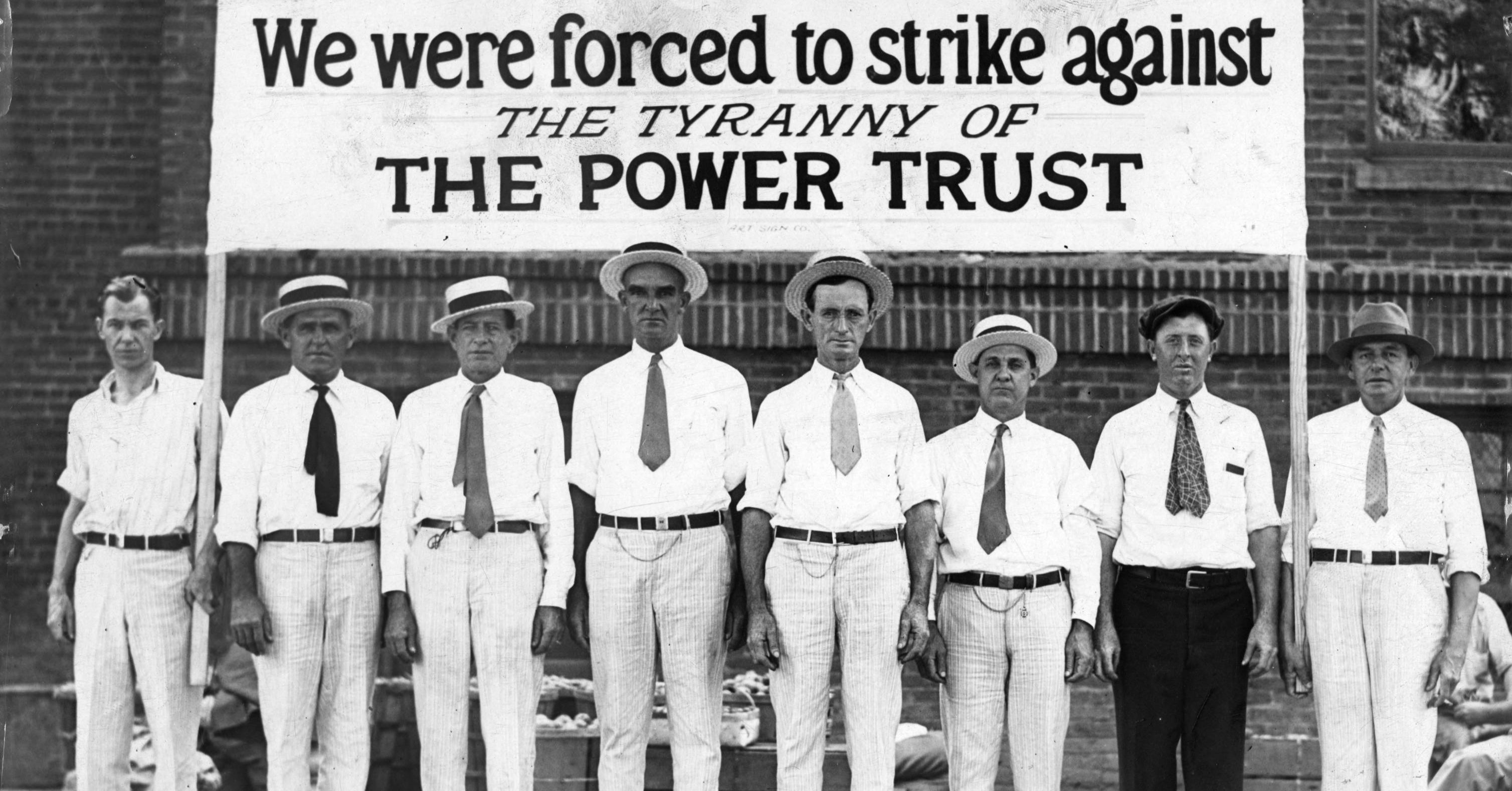
Jack Burton on the divided unions and lack of organization among the one million workers connected to the essential electrical industry.
‘Electrical Workers, Unite!’ by Jack Burton from Labor Herald. Vol. 2 No. 5. July, 1923.
THERE are well over 1,000,000 workers employed in connection with the electrical industry in the United States. In the employ of the commercial and private telegraph companies, according to the Commercial Telegraphers Journal, November 1921, there are 350,000. More than 500,000 workers are engaged in operating the telephone and telegraph corporations. There are 250,000 employed in the electrical factories, principally the Bell and General Electric Companies, not included in the previous figures. There are hundreds of thousands engaged in maintenance work in industrial establishments; and in addition are the electrical workers in the building industry, theatrical industry, and mining and steel industries. All sections of this great body of workers, scattered over many industries, are vitally interested in the problems affecting electrical workers as a whole.
The bringing together of the now organized electrical workers is highly necessary if this great field is ever to be unionized. Why is it that today no effective work is being done to organize the workers of the Bell Company, the telegraph companies, the light and power plants, and the big electrical shops, when labor is so scarce and the industry is busy and growing? Overnight a new industry has sprung up, outside the folds of labor organization, the radio industry. In two years over 4,000,000 radio sets have been installed, valued at something more than $200,000,000. The Bell Company, in changing to the automatic system, is spending millions of dollars and working its factories night and day. Under the Federal Power Act–pet bill of the corporations–construction work on hydro- and super-power plants is being pushed. The time was never so favorable for the building up of a great and powerful union.
But little or nothing is being done. It is questionable if the officers now directing our union could have done a better job toward keeping the workers divided and unorganized if they had tried to do so.
In all the unions containing electrical workers, there is not more than 10% of the number that could and should be organized. This small minority that is in the unions is split up in an illogical and confusing manner that brings no order or strength into the situation. In addition to the International Brotherhood of Electrical Workers, there are the Commercial Telegraphers, Railway Telegraphers, Railway-Signalmen, Theatrical Stage Employees, Electrical Railways, Miners, Butcher Workmen, Engineers, Elevator Constructors, and others, which are in whole or in part composed of electrical workers. Inside the I.B.E.W. there is no system that brings out our potential power.
The biggest problem of organization is, how to get all the electrical workers organized and working together, at the same time that they are united in close solidarity with the other workers in their particular industry. This double solidarity–between all electrical workers of all industries, and between the electrical and other workers in the same industry–demands the formation, through amalgamation and reorganization, of one union for all electrical workers, which is subdivided into industrial departments affiliated to the other unions in each industry.
There is no desire to interfere, in proposing to unite all electrical workers in this manner, with the development of industrial unions which include the electrical workers in the different industries. Thus in the railroad industry, where the demand for amalgamation of all the railroad unions into one body covering the entire industry has won over the vast majority of the workers, the electrical workers would go along just the same as the other unions in the railroad field. Within our Electrical Workers’ Union we would have a railroad industrial department which would also be affiliated to the amalgamated railroad union. In such a case the dues would be split two ways, and the strike actions would be controlled by the railroad industrial union. But at the same time these electrical workers would be in the closest relation with the electrical workers in the other industries through our Electrical Workers’ Union.
The same process would be followed in the other industries. There would thus be a telephone and telegraph department, light and power department, steel industry department, packinghouse department, and so on. Each department would be manned by officials elected by and responsible to the electrical workers in that particular industry. This will make it possible to develop a national program, and will prevent officials from playing the corporation game in which, in the past, small groups of organized workers have been used as buffers to prevent effective organization of the unorganized. Each department would have autonomy within the electrical workers’ union, for the purpose of working in the closest connection with other unions in the same industry and, when possible, uniting with them in forming industrial unions therein.
İn each important industrial center there should also be formed District Councils, composed of all locals of electrical workers in all industries in that District. This will serve to bring about solidarity between sister locals, and prevent members from going from one industry to another and scabbing upon one another. Today electricians are working on jobs vacated by their striking brothers in the railroad industry. Such outrageous conditions must be eliminated; and the District Councils are the best means.
Along with these organizational measures of reconstructing our union, we electrical workers must fight for the establishment of a universal card and initiation fee. This will aid in ousting the dishonest officials who peddle permits and cards, for their own personal gain. Such peddling is often done while members of sister locals are on strike or out of work. An international officer of the I.B.E.W. is now serving a prison sentence for grand larceny, for appropriating funds in connection with such permits and insurance.
Progressive and energetic leadership is required to put these reforms into effect. We are now burdened with many officials who go along with the outgrown and obsolete policies, and even actually work along the lines of the employers. In the building trades of Chicago, for example, the Building Trades’ Council is split. The majority of the workers are opposing the Citizens’ Committee, which is trying to make Chicago an “open shop” town, and which is made up of the chief labor baiters of the city. Meanwhile a group of unions is going along with the Citizens’ Committee and have their members working under police and gunmen protection–under the leadership of the chief official of Electrical Workers’ Local No. 134. And in the service of the big telephone and telegraph corporations, where thousands of workers are looking for a chance to organize, the union is actually standing in the way and by its inaction preventing anything from being done. This reactionary officialdom has assistance from high places; the indictment against some of them, growing out of the exposures before the Dailey Commission, have all been quashed. In another case an official was able to secure two 30-day repreives on a sentence, to carry him over his convention and re-election, and then receive a pardon after serving four months. Such flagrant connivance with the employers must be rooted out of our Union.
The United Brotherhood of Electrical Workers will soon hold an International Convention. Every militant electrical worker should get busy and raise these issues in his local union. Each union should go on record for the establishment of industrial departments, for district councils, for a universal card and initiation fee, for organization of the unorganized, and for amalgamation with the other trades in the various industries. And then delegates should be elected who are pledged to fight for these vital and necessary measures. A united and militant campaign for these progressive proposals will put them into effect in our organization, and at the same time will bring out the fighting leadership which our union must have if it is to go forward. Against the “open shop” drive of the employers we must, on pain of destruction, reorganize our forces and increase our power. These are the measures that will do the trick. Let every electrical worker get busy at once.
The Labor Herald was the monthly publication of the Trade Union Educational League (TUEL), in immensely important link between the IWW of the 1910s and the CIO of the 1930s. It was begun by veteran labor organizer and Communist leader William Z. Foster in 1920 as an attempt to unite militants within various unions while continuing the industrial unionism tradition of the IWW, though it was opposed to “dual unionism” and favored the formation of a Labor Party. Although it would become financially supported by the Communist International and Communist Party of America, it remained autonomous, was a network and not a membership organization, and included many radicals outside the Communist Party. In 1924 Labor Herald was folded into Workers Monthly, an explicitly Party organ and in 1927 ‘Labor Unity’ became the organ of a now CP dominated TUEL. In 1929 and the turn towards Red Unions in the Third Period, TUEL was wound up and replaced by the Trade Union Unity League, a section of the Red International of Labor Unions (Profitern) and continued to publish Labor Unity until 1935. Labor Herald remains an important labor-orientated journal by revolutionaries in US left history and would be referenced by activists, along with TUEL, along after it’s heyday.
PDF of full issue: https://www.marxists.org/history/usa/pubs/laborherald/v2n05-jul-1923.pdf
 Revolution's Newsstand