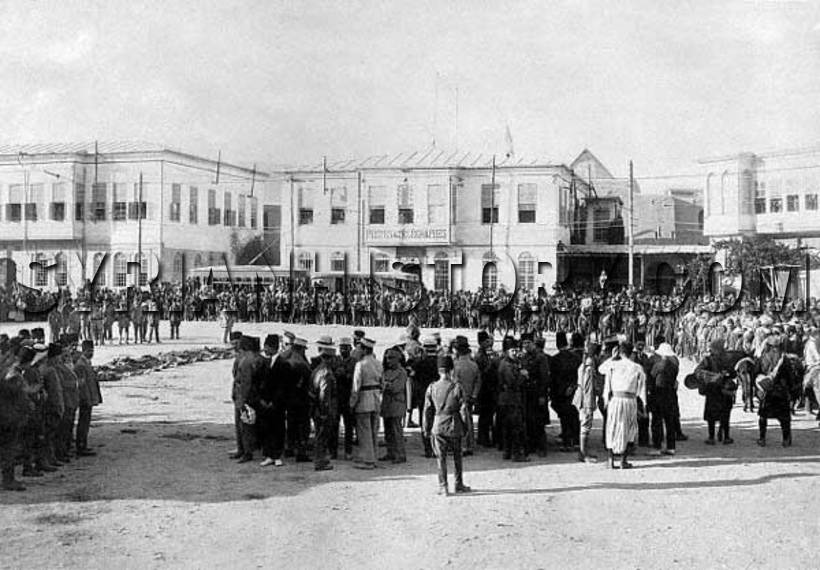
Imperialist repression following the defeat of 1925’s Great Syrian Revolt against France’s mandatory rule.
‘Imperialist Vengeance in Syria’ by Joseph Berger from International Press Correspondence. Vol. 7 No. 64. November 17, 1927.
Since the Syrian rebellion was suppressed by military force, the French Generals have been wreaking a brutal vengeance on all those who are in any way suspected of revolutionary actions or sentiments. As regards such active revolutionaries as have fallen into the hands of the French, they are without exception condemned either to death or to many years’ incarceration. The court-martials proceed summarily in their treatment of the prisoners, and five or six death-sentences on one day are no rare occurrence. The executions are performed in public, by means of hanging, close to the gates of the cities, Damascus, Aleppo, Homs, or that “hub of French culture in the Levant”, Beirut.
In this connection, moreover, the ruthless nature of the campaign of vengeance greatly exceeds what is known in the imperialist jargon as “political expediency”. The arrests and executions in Syria are carried out for the purpose of satisfying the desire for vengeance of the “glorious” French generals, of gratifying the petty private aspirations of certain colonial officials, and of keeping the population in a permanent state of terror. The French press is most cynical in its reports on these acts of French justice. It is no rarity to come upon reports such as the following, quoted from “La Syrie”, the organ of the French High Commissioner: “On the…5th of the month in the morning, the awakening population of Aleppo could remark at the city gate three persons dangling between heaven and earth. A closer inspection showed them to be three rebels, whose nefarious practices had thus been cut short.” And so on, in the same strain.
Those that are condemned to incarceration are slowly tormented to death. Months after the pacification of Syria was proclaimed as an accomplished fact, hundreds of nationalists and revolutionary workers are still pining in the prisons in compulsory exile, and so forth. Far from being made the object of an amnesty these prisoners have rather seen their lot aggravated by more stringent measures. The imperialist Mandatory Power, however, is not content with the victims languishing behind bolts and bars. Every denunciation and every act of arbitrary violence increases the number of its victims. Thus, in the little Drusian town of Rasheya, no fewer than 73 peasants were recently arrested on the denunciatory assertion of some neighbours to the effect that they had sympathised with the Drusians at the time when that tribe was advancing.
Punitive expeditions are meanwhile scouring the country. They have not only orders to nip in the bud any attempt at insurrection, to disarm the population, and to collect with force of arms the taxes inflicted on the poor population; they also collect extraordinary contributions which were levied from the towns and villages at the time of the rebellion and on the punctual and complete payment of which the French High Commissioner, deaf to all entreaties for postponement or remission, rigidly insists.
Meantime, on the heels of the bloodthirsty generals, the French capitalists are penetrating the country. The impoverished peasantry furnishes cheap labour for the cotton plantations leased by French concessionaries; French industrial products are foisted on the population, while the country is separated from its neighbours by insurmountable customs barriers. Ponsot, the French High Commissioner, who, silent and smiling, conducts the policy of oppression, is to remain at his post until the French economic programme has been fully realised.
In such circumstances it is a matter of course that the political aspirations of the population should remain wholly disregarded. In the place of the promised “constitution”, there is at present a tendency towards a restriction of such pseudo-democratic institutions as hitherto obtained. The ruler of Syria is the French puppet Ahmed Bek Nami, an incapable feudal lord who is engaged in filling his own pockets and those of his colleagues, without troubling about the weal of the population, by whom he is heartily detested. In the Jebel Drus and in the Alaouit district, again, there are French governors. Steps are now being taken for the establishment, along the eastern frontier of Syria, of a miniature State for the Bedouines of Deir-èz-Zor, so that the unhappy country of Syria may be the more thoroughly dismembered and mutilated.
The inhabitants of the Lebanon district, meanwhile, who, in return for their fidelity during the rising, were presented by de Jouvenel, the predecessor of Ponsot, with a republican form of government, together with a President, two Chambers, a Ministry, etc., have now again been deprived of these baubels. The Lebanon constitution, now barely one year old, must be “revised”, reformed, and in fact abolished. Its place is taken even here, in a country at all times favoured and privileged by the French by the tutelage of the French Republic.
The French leave no means untried to drive the Syrian population to desperation. They rely on the fact that, in view of the reaction prevailing throughout the world, their united front with the British, the demoralisation which they manage by means of their secret agents to bring into the ranks of the nationalist leaders, in view, in a word, of the permanent system of terrorism, no power can be forthcoming to hinder them in the realisation of their designs.
International Press Correspondence, widely known as”Inprecorr” was published by the Executive Committee of the Communist International (ECCI) regularly in German and English, occasionally in many other languages, beginning in 1921 and lasting in English until 1938. Inprecorr’s role was to supply translated articles to the English-speaking press of the International from the Comintern’s different sections, as well as news and statements from the ECCI. Many ‘Daily Worker’ and ‘Communist’ articles originated in Inprecorr, and it also published articles by American comrades for use in other countries. It was published at least weekly, and often thrice weekly.
PDF of full issue: https://www.marxists.org/history/international/comintern/inprecor/1927/v07n64-nov-17-1927-inprecor-op.pdf
 Revolution's Newsstand