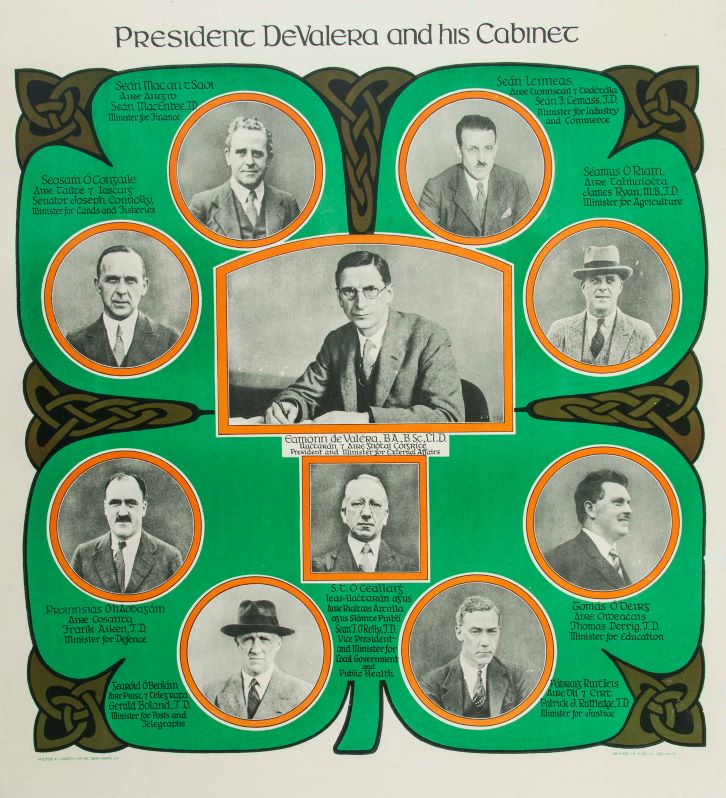
Brian O’Neill on the crisis faced by Ireland’s first Fianna Fail government, a minority formed ten years after the Civil War with support from the Irish Labour Party.
‘Ireland’s Crisis Sharpens’ by Brian O’Neill from New Masses. Vol. 11 No. 2. April 10, 1934.
DUBLIN.
“Ireland is still the sacra insula, whose sufferings must in no way be confused with the vulgar class struggle of the rest of the sinful world.”
ENGELS’ wittily profound characterization still holds good for the Irish petit bourgeoisie and some of the intellectuals of the Celtic Twilight. But an Ireland in which finance capital declares for Fascism, the poor farmers begin to ponder the price fall and ask questions about Soviet collective farming, and the advanced workers launch their Communist Party–this Ireland clearly is not perched on the clouds aloof from the great world questions of today.
The “Irish question” of late has again thrust itself upon the stage of international politics. British imperialism thought it had settled the Irish question in 1922, when the native bourgeoisie, capitalizing the epic battle of the Irish Republican Army, betrayed the independence cause and received a handout in the form of their Free State, their own fiscal system, etc. But though the Republican resistance was flattened out in the Civil War that followed the Treaty, and the Cosgrave Government was able to reign for ten years by strong-arm methods, the Irish question was only reshaping itself.
Cosgrave was the Irish Machado–the subservient guardian of British interests in Ireland. These interests dictated the maintenance of the country as farmyard of England, with its infant industries denied the possibility of expansion. Inevitably the aspiring manufacturers, whose protection hopes had been dashed, turned away from Cosgrave and sought new forms of political expression.
DeValera’s evolution from the insurgent Republican chief of 1923 into the leader of the new political party, Fianna Fail, founded in 1927, showed the way the wind was blowing. Formerly he had refused to enter the Dail; now he and his Party took their seats, declaring that the necessary Oath of Allegiance to King George was but an “empty formula.” The fledgling manufacturers flung their weight behind him, and in 1932, on the crest of an anti-imperialist wave, he rode to power, and replaced Cosgrave as head of the Free State Government.
Anti-imperialism was deValera’s chief card: also he promised relief for the farmers, work for the proletarians, tariffs for the industrialists.
The Free State was paying yearly £3,250,000 in land annuities. These land annuities need some little explanation. Following the great Land League struggles of the eighties, Britain, in order to stave off agrarian revolution, legislated for petty proprietorship. The tenants were to buy out their holdings at a fixed price, the Government floated a loan to raise the sums payable to the landlords, and the farmers paid the purchase sum in annuity form to the Government. Since the Treaty the Cosgrave Government had dutifully collected the annuities and handed them over to Britain. These new annuities were but the old rent writ large–a typically bourgeois “solution” of the agrarian problem. As Lenin said scornfully:
“The Irish peasant pays millions in tribute, and for many years will continue to pay as a reward to the English landlords for having robbed him for centuries and reduced him to permanent famine. The English Liberal bourgeoisie have forced the Irish peasants to express their thanks for this to the landlords in good money.”
DeValera withheld the annuities from Britain. He collected them as usual from the farmer, but declaring with perfect truth that England had no right to them, and that in any case Ireland could no longer afford such an annual drain, he put them into his own treasury. This, and such later measures as the abolition of the Oath of Allegiance, had not, long to wait for a truly imperialist answer. Britain declared an economic blockade of Ireland; a crushing tariff was placed on all Free State produce entering England.
How has the crisis affected Ireland? The Free State has a somewhat special economic position. It is primarily an agricultural country. Secondly, it had its own niche in British imperialism’s economy; it was as Marx said, “the sheep-walk and cattle pasture” of industrialized Britain. The crisis in Ireland therefore is fundamentally a crisis of agriculture, and of one branch of agriculture–livestock rearing.
The agrarian crisis broke first in the wheat lands, passing later to the steer countries. So Ireland was still on the outer rim of the vortex as late as 1930. Cosgrave was boasting that his beneficent rule had insulated Ireland from the crisis. In his last months of office he awoke from his prosperity pipedreams a very sick man. And deValera came in with the crisis raging and gathering strength.
British imperialism’s blockade therefore is not the sole cause of the desperate plight of Irish agriculture. But the British tariffs have blown the crisis to white heat. Irish exports have dwindled to nothingness, as a few figures portray.
Trade has fallen as follows:
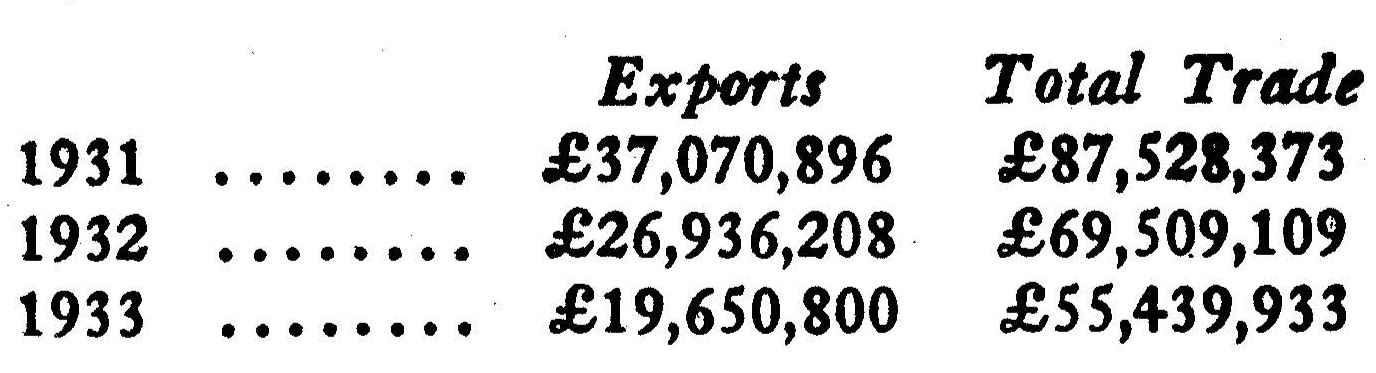
Agricultural exports alone have fallen from £27,835,365 in 1931 to £13,177,165 in 1933. And the agricultural price index (taking 1914 as 100) has fallen from 130 in 1930 to 84 in 1933.
It is on this basis of the country’s chief industry in smithereens that deValera imposes his crackerjack policy of fostered industrial development leading towards a self-sufficing Ireland. The bourgeois press likes to depict deValera as a Gaelic mystic,
A soul by force of sorrows high
Uplifted to the purest sky
Of undisturbed humanity.
But despite the dope-peddlars, not all his quandom knight-errantry can conceal the class basis of deValera’s policy.
In agriculture since 1932 he has paid near $20,000,000 in bounties on agricultural exports as a makeweight against the British tariffs. This sum has gone into the pockets of the ranchers and exporters. The small farmers and laborers have gained nothing. He has reduced the annuities by a total of $16,000,000 in the current financial year. The small farmer has gained, say, $12 or so a year by that; it meant thousands of dollars to the ranchers and big farmers. He has developed beet and wheat growing schemes. So far as they have produced any results at all, the middle farmer alone has benefitted. The small farmer was shut out. The thousands of poor farmers in the country are in a desperate position. The agricultural laborers are working at coolie rates–often for 60 cents a week with food and shelter or $2.40 a week without food. They must pay rent and keep a family on that latter princely amount.
In industry, deValera has continued the Cosgraveite attack on wages in the main sections railroad workers, etc. But what of his vaunted industrial development? DeValera has shown that a capitalist Ireland cannot free itself from industrial dependence. True, he has provided tariff protection and State credits to inspire the development of pigmy garment–and candy–factories and light industry making general articles of consumption. But for the means of production the Free State is as dependent as ever.
Profit hunters have crawled like beetles into stables and disused buildings, dubbed these places factories, installed a few girls and boys at anything from $1.16 to $3.56 a week, and presented themselves for admiration to deValera’s recent “Convention of Irish Industry.” Well may one of these cockroach capitalists, J.J. Walsh (former Cosgraveite Minister) say: “The policy of the present government has made the whole future of manufacturers here full of promise.”
Profits for a handful of eager manufacturers, shameless exploitation of child and girl labor–these are the realities of deValera’s industrial policy. And the unemployment figures go up month by month, touching 100,000 at the beginning of February this year.
In the fifth year of the capitalist crisis, deValera’s “Christian social” way out turns out to be a futile attempt to build the system that is dying all over the world!
Political relations sharpen in the country as the economic crisis grows. News stories and photos have acquainted American readers with General O’Duffy, ex-Police Commissioner, cavorting around the Irish countryside in a blueshirt and with black beret taut above his moonface. But, loud-mouthed Handy Andy though he be, the significance of this buffoon is this: finance capital in Ireland, unlike its compeers in some other countries, is not building its terror force apart from its recognized organs and, as it were, without the stamp of open official approval; but, after some little hesitation, has declared officially and in toto for Fascism.
Consider the background of O’Duffy’s rise to notoriety. Gosgrave’s party, Cumann na nGaedheal, was almost wiped out by popular anti-imperialist anger in the elections of January, 1933. Meantime, two other mushroom growths had sprung up. The ranchers and big farmers, feeling the pinch of Britain’s punitive duties, had formed a Centre Party. An important section of Cosgrave’s camp followers, ex-Free State army men, fearing for their pensions under a deValera Government, grouped themselves into an Army Comrades Association. Yielding to mass pressure, deValera dismissed O’Duffy (for ten years Cosgrave’s police hack and a savage enemy of the revolutionary movement). At once the ex-cop was offered and accepted the presidency of the A.C.A.
Under O’Duffy’s leadership the A.C.A. became the “National Guard,” blue-bloused, with military ranks, and adopting the Fascist salute. The “National Guard” was banned. Then came the climax. At a semi-secret discussion the “National Guard,” the Centre Party and Cumann na nGaedheal fused to form the United Ireland Party. Cosgrave was pushed into the background, so was MacDermot, the Centre leader, and the filibuster O’Duffy emerged as the national leader of the united forces of imperialist capital. The banned “National Guard” became a section of the United Ireland Party under the name of the “Young Ireland Association.” The Government put a ban on this section of the United Ireland Party, but again it changed its name and is now known as the “League of Youth.”
The new Fascist program of the United Ireland Party was short and sweet:
1. Surrender to British imperialism, make the Free State safe for the Empire, and thus restore the cattle market.
2. Suppress the Communist Party, the Irish Republican Army, and make strikes illegal.
3. Abolish parliamentary government and substitute the “Corporate State.”
With magnificent instinct, the masses, almost without leadership, responded to this imperialist challenge. No Blueshirt dared show his face on the streets of Dublin. In the rural areas the masses rose and thrashed the Fascists wherever they attempted to hold a meeting. It was the fury of the workers and farmers that drove back O’Duffy and his hapless storm troops and forced them to take refuge in the “constitutional” United Ireland Party.
And where was deValera in all this? DeValera’s police clubbed the workers as they stormed against the Blueshirts. DeValera’s armored cars and troops ringed O’Duffy’s platform with steel and ensured that his meetings would be held. Cosgrave’s Coercion Act was reinforced, ostensibly against the Fascists, but in reality, placing the State forces between the people and the Fascists. By this maneuver, deValera hoped to divert the issue from an open struggle between the masses and Fascism to a “struggle” between O’Duffy and the State apparatus–a State apparatus which the Fascists had themselves forged and manned, and whose political affiliations were known to all.
With what result? Today, under a “Republican” Government, over fifty anti-imperialists are in Free State prisons for actions against the Fascists. And the “illegal” Blueshirts have less than half a dozen in jail, are parading in military formation and under police protection, and by their victories in the courts are demonstrating to deValera that they own “his” legal apparatus. To salt the jest, the Blueshirts’ paper appears weekly without hindrance; An Phoblacht, the I.R.A. organ, is seized every second week!
In this situation, it might be thought that the groups to the left of deValera–the Irish Republican Army and the Labour Party–would be stirred to anti-Fascist activity. Not so.
The last Labour Party conference, under left-wing pressure, denounced Fascism and even called for a united front of all bodies against the menace. Since then it has not stirred a finger. Irish social democracy is certainly not unique!
Of the Irish Republican Army, but a ghost of the once great revolutionary force, an even sorrier tale is to be told. Among the rank and file are to be found some of the best and most devoted young fighters, impatient to take up the struggle against Fascism; in the present leadership is a fixed determination to avoid any mass struggle that will bring them into conflict with deValera. True, An Phoblacht is compelled to speak sharply to deValera, and even, in this latter hour, benignly to warn the workers that Fascism means the destruction of Trade Unions. But the deed wars with the word.
In the past year Communists have been expelled from the I.R.A., and the youthful Communist Party of Ireland attacked in the Republican press. Irish Republican Army men are forbidden to engage in any political activity; leading figures are not permitted to speak or write. In every possible way active Republicans are manacled, muzzled and held out of the struggle.
The Communist Party of Ireland–founded only last June at a semi-secret congress held under terror conditions, but attended by delegates from all the four provinces–alone has led a consistent campaign against the growth of Fascism.
Thousands of leaflets have been distributed and the meaning of Fascism taken to rural areas where the word was once unknown. Under its leadership a Labour League Against Fascism has been set up, with Mrs. H. Sheehy-Skeffington, widow of the Socialist murdered in 1916, as president, and Jim Larkin, Jr., and R.J. Connolly, son of James Connolly, as vice-president (a combination that is capturing the imagination of workers who remember the great days of 1913).
Still small in numbers, the Irish Communist Party has unfurled the banner of James Connolly, proclaiming with him that “only the Irish working class is the incorruptible inheritor of the fight for freedom in Ireland”; and is daily gaining strength and influence for the great tasks that confront it in the struggle for the Workers’ and Farmers’ Republic of a free, united Ireland.
The New Masses was the continuation of Workers Monthly which began publishing in 1924 as a merger of the ‘Liberator’, the Trade Union Educational League magazine ‘Labor Herald’, and Friends of Soviet Russia’s monthly ‘Soviet Russia Pictorial’ as an explicitly Communist Party publication, but drawing in a wide range of contributors and sympathizers. In 1927 Workers Monthly ceased and The New Masses began. A major left cultural magazine of the late 1920s and early 1940s, the early editors of The New Masses included Hugo Gellert, John F. Sloan, Max Eastman, Mike Gold, and Joseph Freeman. Writers included William Carlos Williams, Theodore Dreiser, John Dos Passos, Upton Sinclair, Richard Wright, Ralph Ellison, Dorothy Parker, Dorothy Day, John Breecher, Langston Hughes, Eugene O’Neill, Rex Stout and Ernest Hemingway. Artists included Hugo Gellert, Stuart Davis, Boardman Robinson, Wanda Gag, William Gropper and Otto Soglow. Over time, the New Masses became narrower politically and the articles more commentary than comment. However, particularly in it first years, New Masses was the epitome of the era’s finest revolutionary cultural and artistic traditions.
PDF of full issue: https://www.marxists.org/history/usa/pubs/new-masses/1934/v11n02-apr-10-1934-NM.pdf
 Revolution's Newsstand