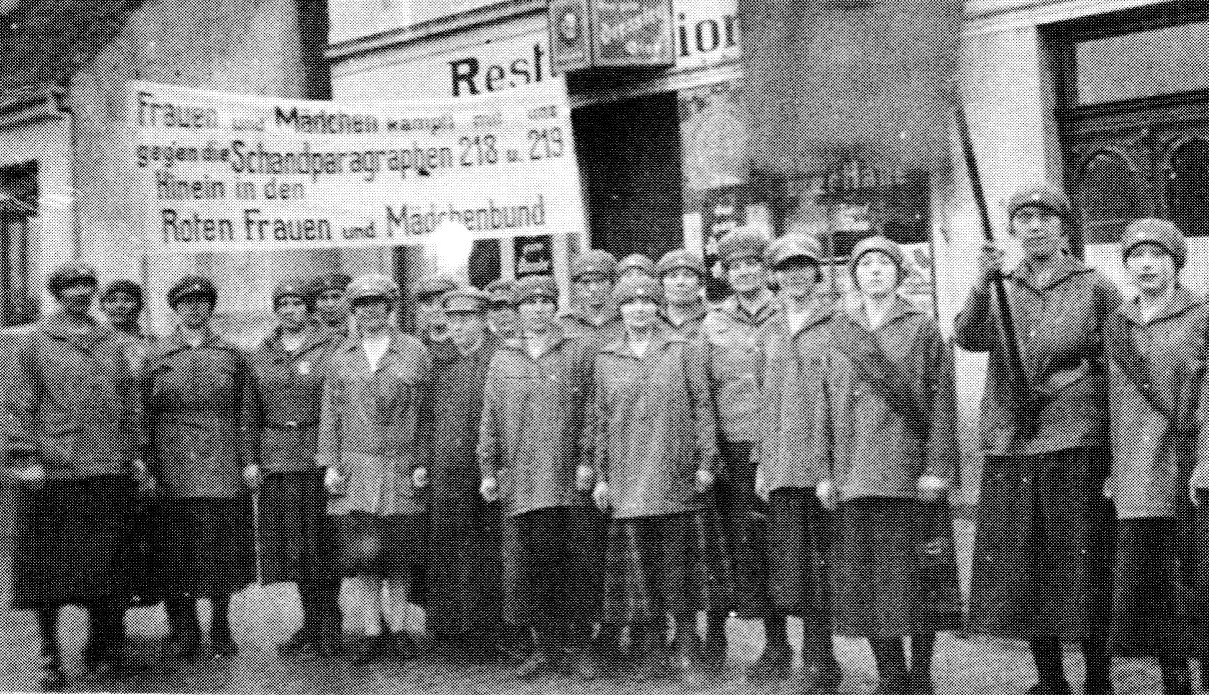
A leader of the Roter Frauen und Mädchenbund, the women’s Red Front Fighters of German Communism, tells of its formation and a activities.
‘The Red Women’s and Girls’ League in Germany’ by Lene Overlach from International Press Correspondence. Vol. 6 No. 25. April 1, 1926.
The Red Front Fighters’ League is on the march! It personifies the growing activity of the German proletariat as an answer to the intensified economic crisis and the increasing encroachment of the employers. It personifies the self-consciousness and the fighting power and joyousness of the awakening German proletariat. It is the response to the formation of a vague “republican organisation”, the “Reichsbanner”, “Red Black and Gold”, which is at present undergoing a process of rapid disintegration.
The disciplined class-conscious behaviour of the Red Front Fighters League (Roter Frontkämpferbund, R.F.B.), its Red demonstrations and fetes attracted the attention of broad masses of the proletariat and, of course, also of proletarian women. A large number of women who had up to that time been indifferent, took part enthusiastically in the demonstrations and fetes organised by the R.F.B. These women joined the R.F.B. as members and tried to imitate their comrades in every respect; they wore the coats and caps of the Red Front Fighters and joined in their processions, in which however some women, physically weakened by undernourishment and overstrained by excessive work, could not keep up. A further obstacle to the rapid increase of women members was the circumstance that many women had not yet the courage to appear in the streets in uniform, to march in processions and to undergo physical strain.
In Germany, millions of women still live within the limits of their narrow households, take no interest in politics and even regard it as something venturesome to attend a public meeting. This however does not destroy the fact that imperialism itself, in employing women as cheap labour in the process of production, is helping to create the preliminary conditions which attract women into politics.
Inspired by the desire to overcome the difficulties described, the R.F.B. in May 1925 decided to gather together the women members of the R.F.B. in a Red Women’s League, which could more easily than the Red Front Fighters League use its influence to persuade indifferent woman to join. In accordance with this resolution, the women members were detached from the R.F.B. and women’s groups were formed, which were called the Red Women’s League. By the end of November 1925, these groups were so far developed that a National Conference could be called to found the Red Women’s League. In Berlin, this historical conference was followed by the formation of a league which called itself the Red Women and Girls’ League (the League of Comrade Clara Proletarian Women and Girls of Germany). Zetkin was elected as its first president, and a National Committee of 7 comrades was formed.
This Conference for the foundation of the Red Women’s and Girls’ League was based on the fighting enthusiasm of the delegates and their confidence that the League which had sprung out of the prevailing distress, would become a fighting league of the masses of exploited and oppressed women, a firm bulwark in the fight of the proletariat for emancipation. Its development in the subsequent two months alone shows that the League is successfully advancing towards this aim.
The consequences of the capitalist economic crisis are a burden which weighs very heavily on the broad strata of the proletariat and the middle class–Thirteen and a half million persons, unemployed with wives and children, and besides these millions of disabled ex-service mien, orphans and persons drawing disablement and old age pensions are suffering hunger and want. Every day more factories close their doors, and their workers of both sexes are heartlessly thrown on to the street.
German big capital, in its attempts to save itself from complete ruin at the cost of the working population, is once more most mercilessly exploiting and oppressing the women, as being that part of proletariat which is politically most untrained.–In the large towns, placards can be seen outside the factories, “Women Workers Wanted”, whilst at the same time, thousands of dismissed male workers are pouring out of the gates. The employers as a rule offer these women only a quarter of men’s wages and, for this miserable pittance, they demand even more work from them than from the men.
Proletarian families with their children are living in the most terrible hovels, in attics where the rain pours in, in musty cellars, even on open spaces and rubbish dumps. A new tenants’ law, which provides for a five-fold increase of rents, the abolition of any form of tenant protection is being discussed in the “Reichstag”, and threatens families who are already in distress, with further intensification of their misery.
A reactionary Government is offering a helping hand to large capitalists, Junkers and to declared and secret monarchists, in plundering the working masses. The Kaisers, Kings and ruling princes who fled in 1918, are rapaciously grabbing at the property of the people. They are claiming 2 milliards of gold They marks, thousands of acres of land, mansions and castles.—They must be paid for by taxation extorted from the masses.
The Red Women’s and Girls’ League, born out of the necessity of the times, is undertaking today, what no political party has hitherto succeeded in doing in sufficient measure, that is, shaking the broad masses of women out of the complete passivity which they have hitherto maintained and mobilising them for the fight. The League is well aware that in doing this, it is only fulfilling a small part of the tasks demanded by the proletariat’s fight for freedom.
The Red Women’s and Girls’ League makes it its task to get hold of the broad masses of indifferent proletarian women, without distinction of party or creed, and to train them in politics, both theoretically by lectures, courses etc. and practically by inducing them to take part in all the activities of the working class. The League not only carries on the fight in questions specially concerning women, such as the social welfare of mothers and children and the abolition of the shameful paragraphs prohibiting artificial abortion, it also takes an active share in all the questions of the proletarian class war. One of its chief activities is the organisation of the campaign against imperialist wars and the destruction of all pacifist illusions among the women by explaining the true nature of imperialism, through the daily events of world politics.
Or January 27th, on the occasion of the demonstrations in favour the expropriation of the former ruling houses and of increased support for the unemployed, the League summoned the women throughout Germany to join in the demonstration. Even though in many towns the number of women who demonstrated was still only small, they at least roused great interest even among the women who stood at the street corners or gazed out of the windows, through their banners bearing the special demands of Women: “The Castles of the Ex-Princes as Training Homes for Our Children!” “The lands of the Fugitive Princes for the Small Peasants and Settlers!”
The League also took a leading part in the fight against the recent intensification of usurious claims for rent and against unemployment. This does not mean that the League already embraces large numbers of women, but it does mean that, though still relatively small, the League is developing a maximum of activity. Young women comrades, still almost untrained politically, who have never previously come to the fore in public, are speaking at public meetings of proletarian organisations and, in simple words, proclaim the necessity of the cooperation of the women.
In the evening meetings of the groups, political lectures are given and the fundamental questions of the class war are expounded through the method of questions and answers.–At the same time training in practical organisation is being undertaken. The group leader distributes the work.—How proud and conscious of her responsibility a member of the League feels who, a few weeks after joining, is given a function–the collection of subscription from five comrades, the duty of regularly inviting them to meetings and entertainments and of enlightening them. They enthusiastically collect money, they sing in the courtyards and, after a short address, they collect money, for the Red Help for instance, and try to win new members for the League.
Thus, through practical detail work and political education, women functionaries are being trained who are the pillars of our women’s organisation and important auxiliary troops in the fight of the whole of the proletariat for its emancipation.
International Press Correspondence, widely known as”Inprecorr” was published by the Executive Committee of the Communist International (ECCI) regularly in German and English, occasionally in many other languages, beginning in 1921 and lasting in English until 1938. Inprecorr’s role was to supply translated articles to the English-speaking press of the International from the Comintern’s different sections, as well as news and statements from the ECCI. Many ‘Daily Worker’ and ‘Communist’ articles originated in Inprecorr, and it also published articles by American comrades for use in other countries. It was published at least weekly, and often thrice weekly.
PDF of full issue: https://www.marxists.org/history/international/comintern/inprecor/1926/v06n25-apr-01-1926-Inprecor.pdf
 Revolution's Newsstand