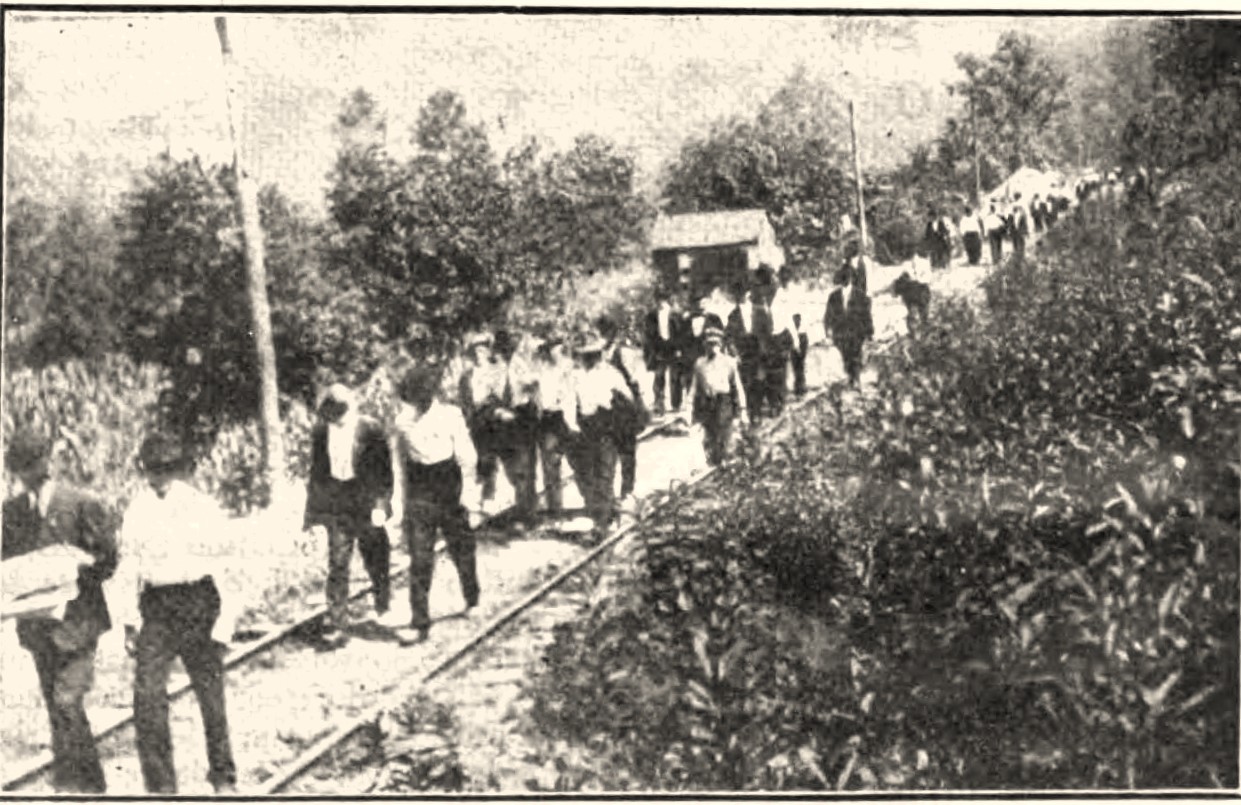
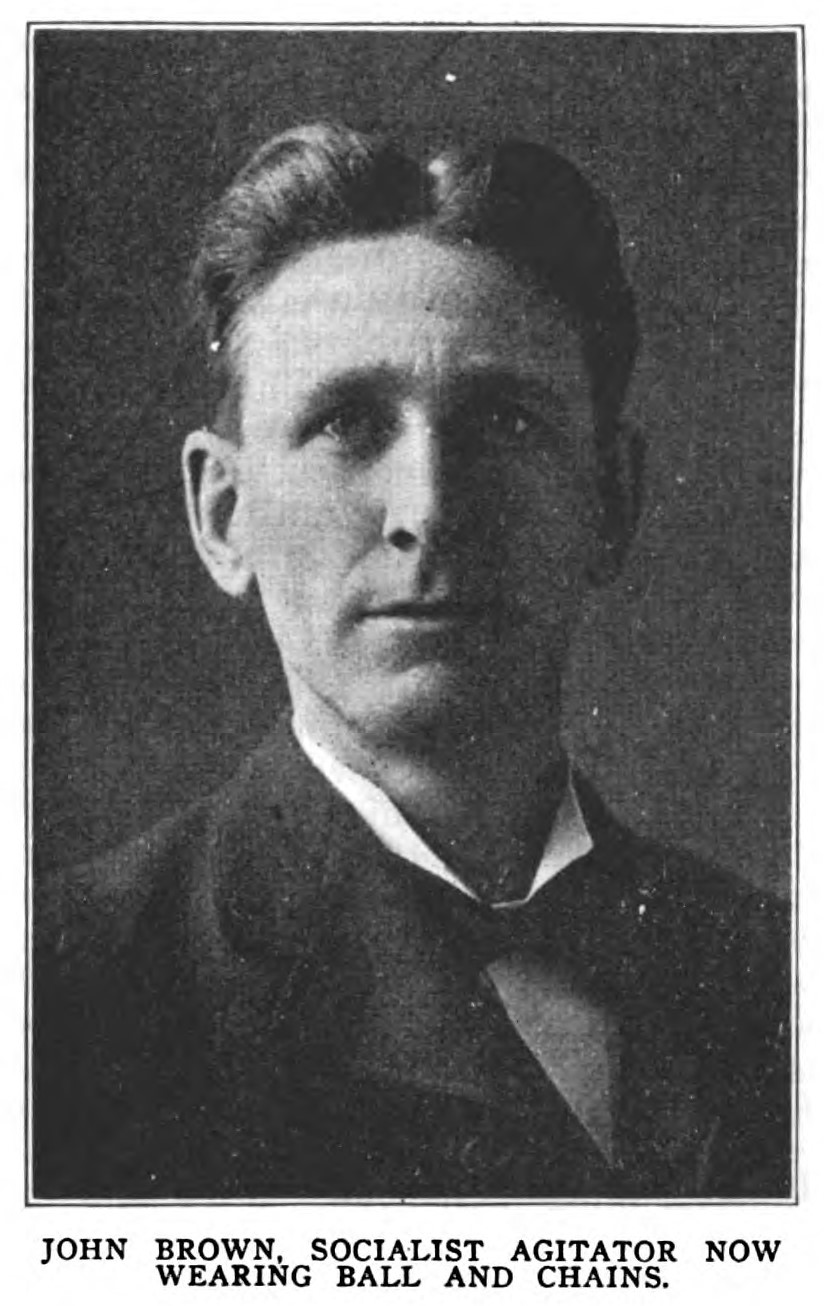
A superlative background given in the midst of the bloody 1912 Paint/Cabin Creek coal strike in West Virginia’s Kanawha Valley by a heroic leader of the Socialist Party in that state.
‘This is War and War is Hell’ by John W. Brown from Coming Nation. No. 109. October 12, 1912.
“GOD walks on sea and land, but the devil reigns in the coal fields of West Virginia.” This was uttered by Gen. C.D. Elliott and the reference was to the civil war now going on in the Kanawha valley where the coal miners and the coal barons have grappled in a life and death struggle which can only end in the surrender of either one of the contending forces. “And the devil is greed,” says General Elliott. Greed personified in a handful of mercenary plutocrats who know no more, care no more for the rights of humanity than do the lean dogs who lick their grimy hands.
The details of this terrible struggle do not differ from that which could be written of all the other coal fields, and forms but another page in the development of American capitalism.
A Long Story of Stealing
First comes the usual questionable and fraudulent land titles, then corrupt legislation, then the usurpation of the courts and finally the general debauchery and degradation of the whole body politic. The Moloch of capitalism is never satisfied. It has no heart, no soul, no conscience. It has but one object, one purpose, and that is to make profit. It stands with open mouth crying, “give, give,” and the people of West Virginia have given, given and given again, first their lands, then their labor, and now the insatiable beast demands the half starved babes. The present strike in the Paint Creek and Cabin Creek districts has a shadowy background reaching back some ten years or more.
In 1902 the coal miners of West Virginia organized under the auspices of the United Mine Workers of America. Immediately following, the coal barons began their present fight against the union and a general strike followed. During this strike of 1902, Judge Jackson and Judge Keller issued their nefarious injunctions which if obeyed by the miners would have been nothing short of wholesale suicide. Naturally, the miners refused to bow to these injunctions and there followed a reign of rapine and legalized murder such as is seldom found in the pages of human history. Among which is recorded what is now known as the Stanford city massacre.
An American Pogrom
Dan Cunningham, at that time a United States deputy marshall armed with injunction and eviction papers and preceded by an army of professional murderers went to Stanford city in the night and at daylight made a murderous attack upon the helpless and defenseless miners, murdering them as they slept. Unarmed, old age, fathers and mothers, youths and even suckling babes were shot down like wild beasts and not even the prayers of pregnant mothers could prevail against this thirst for human blood. There is always a point beyond which lies desperation and revolt. This point was reached during the strike of 1902 and for the time being both the federal authorities and the coal barons were baffled. But not for long. The Baldwin-Felts detective agency, an organization composed of ex-convicts and professional strike-breakers entered the field and agreed by contract to break the strike and from that day until this there has existed in West Virginia, a state of guerrilla warfare that beggars either pen or tongue to portray.
Preparing Defenseless Victims
A law was passed through the legislature prohibiting the citizens from carrying arms under a penalty of six months in jail and a fine of from $50 to $500. The legislature having disarmed the miners, the professional murderers were given a free hand to carry on their reign of terror. Machine guns were mounted in Fayette and Raleigh counties and manned by the hired assassins of the coal barons and many are the grewsome stories told by those who had to live within the reach of their death dealing breath. During this reign of terror what’s known as the New River, the Norfolk and Western and the Fairmound fields lost in the fight with the coal barons and only the Kanawha fields were able to withstand the siege. Cabin Creek was one of the districts that was out in the strike in 1902. Their victory carried with it the “check-off system,” a “check weighman” and a general recognition of the union. In the fall of 1904, the coal barons of Cabin Creek, of which Charley Cobell, notorious for his brutality to the miners is the head, refused any longer to acknowledge the check-off system, thus violating the contract agreed and signed by a joint committee composed of representatives of both the miners’ unions and the operators.
The miners went on strike again. The Baldwin thugs were rushed to the scene. Judge Burdett, who for a number of years had been retained by the miners as their legal adviser was in the fall of 1904 elected judge of the circuit court largely by the vote of the miners.
As a reward for his election he rendered what is known as the “master and servant decision.” This decision was to the effect that a miner who rented a house from the coal baron was no longer to be considered in the eyes of the law as a tenant and the coal baron as a landlord, but that their relation should be that of “master and servant.”
Under this decision the miner, as soon as he was discharged, was dispossessed from his home. If he chose to leave the company he worked for by his own volition, he was immediately ordered out of his home and in the event of his not obeying this edict he was thrown out by hired assassins who were commissioned by the governor as “railroad detectives,” deputized by the sheriff and county court as deputy sheriffs, drawing their filthy lucre from the coal barons and adding to the fame of the notorious Baldwin-Felts strike-breaking agency and to the everlasting shame and degradation to the state.
Hunting Evicted Tenants
During this strike of 1904-5, on Cabin Creek, the miners were dispossessed by the wholesale. Wives and mothers, invalids and babes and what few scraps of furniture belonged to them were thrown out over night while the denfenceless miners were made to walk, and in many cases wade the creek its entire length of twenty miles to Kanawha river and freedom beyond Czar Cobell’s zone.
At this time, A.B. Littlepage, then state senator, was engaged by the miners’ union as their attorney. Littlepage was instructed by the miners’ union to bring suit against the coal barons for damages done to property when their hired assassins threw them out on the highway. In a “test case” the miners got a judgment of $1,500. There were seventy-five cases in all to be brought. Littlepage represented to the miners that the cases would be appealed to the higher court and the chances were strongly in favor of the higher court reversing the decision. Therefore, he, as their counsel, advised them to compromise and settle for whatever they could get. Littlepage engineered this compromise and settled for $125 in each case. Littlepage, then, to show his sincere interest in the case, and, notwithstanding he was hired by the miners as their attorney, and was receiving a handsome fee for his service, deducted almost one-half of the $125 as a special fee for service rendered in collecting the bill.
As a further reward for service rendered, the coal miners of the Kanawha valley elected Littlepage to congress in the fall of 1910 and thus closed the scene of another act on the great stage where “all men are actors and each in his time plays many parts.”
The curtain rises now on the spring of 1912. The stage setting is the same with the exception that the contamination has spread to Paint Creek and other fields in the Kanawha district. Under the reign of the Baldwin-Felts detective agency of professional strike-breakers, every right and guarantee of citizenship has been trampled under foot. On April, 18th, a general strike was called throughout the union mines of District No. 17 of the U.M.W. of A. for the purpose of establishing what is known as the Cleveland scale of 1912.
Making and Breaking Contracts
On May 1st, a compromise was reached in which the miners agreed to accept one-half of the Cleveland scale and the recognition of their union. This was accepted by a joint commission composed of representatives of the operators and the miners’ union.
On May 2d, the Paint Creek Collier Co., one of the parties to the contract, repudiated the agreement, thereby forcing their men either to scab or go on strike. The men chose the latter and on the 8th of May the first detachment of “Baldwin guards” was sent to Paint Creek and following their arrival there, a reign of terror was established which has no parallel outside of barbarous Mexico or darkest Russia.
A chronicle of the crimes committed by these licensed and merciless cutthroats would fill a volume in itself. On June the 5th, eight of them were indicted before a grand jury and held for murder in the first degree, and were released on a bond of $3,000 each. A wholesale merchant and beneficiary of the coal barons acted as their bondsman.
The miners at Mucklow, Burnwell and several other camps were dispossessed under the “master and servant” decision of Judge Burdett. The miners made application for an injunction to restrain the operators from evicting them but Judge Burdett after a week or more of judicial jugglery refused to issue the order, notwithstanding such an order had been granted in Fayette county which is in the same mining district.
Battle for Tented “Homes”
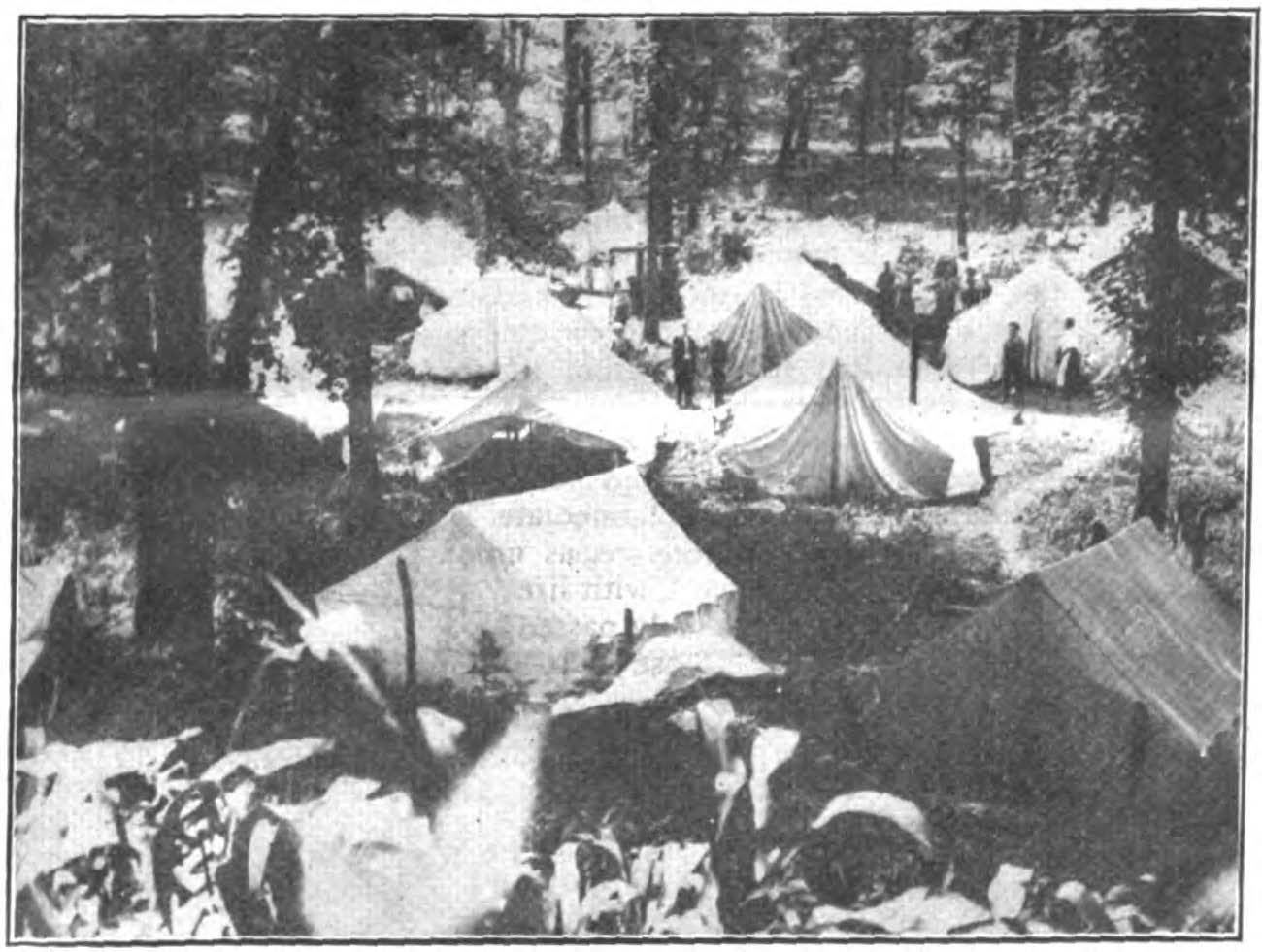
The dispossessed miners secured tents and settled at Holly Grove at the mouth of Paint Creek. The coal barons and their hired assassins determined to break the union spirit and to drive the union men out of the district and opened fire on the tents at Holly Grove, July 25th. This was more than human endurance could stand and to this last outrage the miners retaliated and fought back with such weapons as they had and for two days the battle raged in and around Mucklow and just how many lives were lost will never be known.
About this time “Mother Jones,” the avenging Nemesis of the miners, appeared on the scene and with her came a new hope, a new courage and a new consciousness to the coal miners. There is something powerful about this old gray haired woman. When the coal barons hear her name they tremble. Barehanded and alone, Mother Jones walked up to the mouth of the gatling guns on Cabin Creek and demanded of the hireling that turned the crank that she be allowed to see her boys. Mother saw her boys and held a mass meeting in the Cabin Creek district and organized the miners and on August 7th the miners of Cabin Creek walked out on strike with their brothers of Paint Creek.
On August 29th a Baldwin guard drunk and disorderly shot a man by the name of Hodge at Dry Branch. This precipitated a general fight in which Hines, the instigator, was killed and several others wounded. On September 1st, Governor Glasscock ordered out the militia and declared martial law and just what the end will be it is hard to say at this time.
Governor Glasscock, in an interview with the newspaper reporters a few days ago admitted that he is not the governor of West Virginia, that the government of the state is controlled by an “infernal legislative lobby” and an “invisible power.”
Progressive Governor and “Invisible” Power
This invisible power is wielded by Clarence M. Watson, United States senator from West Virginia. He is the power behind the throne that makes the laws of West Virginia; that kills every bill aimed to restore to the miners something of their rights. He, Watson, represents that “invisible power” that has maintained the guard system as its ally and dragged the state of West Virginia to the verge of a civil war and is the one man more than all others who is responsible for the conditions that exist in West Virginia.
Senator Watson is West Virginia’s uncrowned plutocratic king who carries his crown in his pocket. His gilded palace is at Fairmount, but his sway is co-extensive with the state.
Senatorial Slave Drivers
The Cincinnati Post after an investigation of the conditions said that: “He is master of men and millions.”

Until he became United States senator he was president of the Consolidated Coal company, of Fairmount, the largest corporation of the kind in West Virginia. He employs 15,000 non-union men. He is master of 100,000 acres of coal land. He makes dividends on $12,000,000 worth of stock. He employs a private army of mine guards. He has besides a retinue of dukes who do the more “respectable work” of the lobby at the state capitol. His prime minister is William E. Chilton, also a United States senator from West Virginia. Chilton is the sole owner and manager of the Charleston Gazette. He is the most prominent corporation lawyer in the state. He lives in Charleston. His firm represents traction, coal, oil and gas and railroads as well, and his proud boast is that his law firm represents four-fifths of the corporate interests of the state, the interests that at times need certain legislation and at other times are anxious that certain bills be killed.
Republicans and Democrats Together
Chilton’s law partner is W.M. McCarkle, Democrat leader of the State senate. On the other hand, the Republican leader of the senate is Wm. Hatfield. a coal operator and at present republican candidate for governor of the state. Behind Watson are the coal barons allied as “The West Virginia Coal Operators association.” This association refuses to recognize the righteousness of the union and collective bargaining, yet exact to themselves the right to organize themselves for collective strike-breaking.
This in short is the line-up in the greatest industrial battle West Virginia ever saw, and while the battle rages children are starving in the mine camps, some are living in tents while others again have been driven from their homes entirely. Their cries are echoed in the thunderous din from all over the state demanding that the governor shall call a special session of the legislature to correct the evils in the mining industry, to abolish the guard system; to establish minimum wage; to establish just liability laws; to abolish the black list; to abolish the “fellow-servant” law and the “master and servant” judge-made law and to put into effect the initiative and referendum by which the people will be able to take the law making power out of the hands of the coal barons and their hirelings.
Investigating to See if Hell is Hot
At this writing, September 25th, a commission appointed by the governor to investigate the situation is taking evidence. This commission is composed of a Catholic bishop, a military captain and a politician. Many are the grewsome stories told the commission by the miners, their wives and children and while nobody believes there will be any permanent good come out of such a commission, yet the world is learning of the horrors that surround the daily lives and homes of the 70,000 coal miners and their families of West Virginia.
The evidence submitted and sworn to relates how babies were born in the woods amid showers of bullets. Notable is the testimony of John Estep and his family who were fleeing from the guards and took shelter in an old shack where a baby was born on the bare floor. This baby was born while bullets were flying and the red law of the coal barons and their allies reigned supreme.
Killing Unborn Babes
The most heart rending testimony was that given by Mrs. Taney Sevillis, who told how her baby was born dead after the brutal mine guards fired bullets through her house. This poor mother terrified, fled for safety to the home of Mrs. Waters, the wife of the mine foreman. Mrs. Waters, in testifying before the commission, said: “She was as white as a ghost She when she ran into my house fell on her knees before me and made the sign of the cross. ‘Oh save me, save me, my baby, my baby, my poor baby,’ she cried, and I took her in and a month later the baby was born dead. The doctor said it had been dead several weeks.”
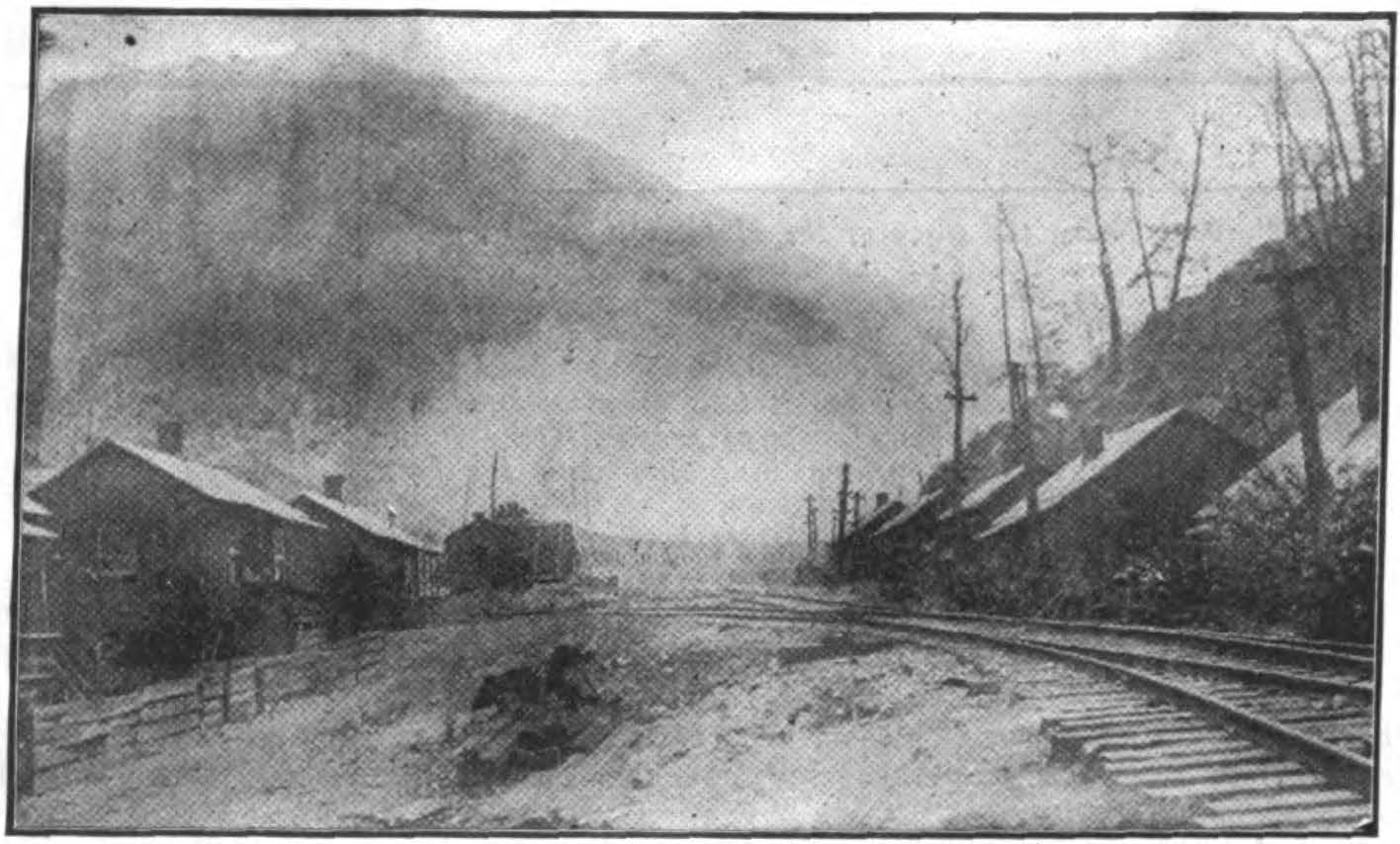
Mrs. Charles Fish, the wife of a miner, testified to how she and sixty-three others, men and women and children, had hid from the guards in a cellar for twenty-four hours after they had been driven from their homes by the fiendish guards, and how at length they filed over the hills, hungry, dirty, unkempt and sick from their long fast in the dark cellar. She told how she was beaten and choked by the guards when she informed the strike-breakers at the railway station that there was a strike on at that place to which they were being shipped.
The prices charged the miners at the “Pluck-me-stores” which are owned by the coal barons and the difference between these prices and the price of the same article in Charleston furnish another chapter in the evidence being taken. Potatoes which sell in Charleston for 85 cents per bushel are sold to the miners for $2.60.
Arbuckle Coffee which can be bought anywhere for 25 cents per pound costs the miner 40 cents. Flour, sugar, bacon, beans and everything else which goes to make up a miner’s diet is sold on the same basis.
When one stops to consider that the miners on Paint Creek and Cabin Creek are mining coal for 19 cents per ton less than the miners get in union fields; that in union fields 2,000 pounds constitutes a ton while in the non-union fields the coal barons exact 2,240 pounds for a ton, and not only that, but in the non-union fields they do not even weigh the coal; on the contrary, the miner has to load a car which is supposed to hold 2,240 pounds, but which in fact holds anywhere from 2,500 to 3,000 pounds, the wonder is not that the miners have revolted against such inhuman conditions; the wonder is that they have stood it as long as they have. However, the revolt is on and not only the miners but the people as a whole are aroused.
It is too early at this time to say just what the result will be. The governor called a meeting of the business men of the state in Charleston, Saturday, September 21st. This meeting was dominated by the hirelings of the coal barons. A whole day was spent wrangling over the adoption of a resolution which was formed to eliminate the representatives of the miners’ union from the conference. They then adjourned without even considering or taking up the matter for which the conference was called, which was to devise remedial legislation that would prevent any such recurrence in the future, ignoring entirely the civil war now raging throughout the Kanawha Valley.
On Monday evening, September 23d, a citizens’ meeting was held in Charleston at which Jno. P. White, international president of the U.M.W. of A., and Frank Hayes, first vice president, spoke. Arrangements were made at this meeting for a state-wide convention of labor to be held at Charleston on October 10th. What the results of this convention will be it is impossible to say at this time. One thought, however, is burning its way into the minds of the people of West Virginia and that is that the miners have a just cause and will not surrender it, for they are fighting to wipe out the stigma of industrial slavery that now hangs like a cloud over the fair name of the state. Most of the coal miners are natives of the state. In these hills they were born, their fathers and their father’s fathers before them. They love their native hills, even though the politicians have sold them into bondage. Long have they waited and patiently for the politicians to do something for them, but to no avail. Ground down beneath oppression’s iron heel till the good in him is crushed and driven back like the “beast of burden” described by Olive Schreiner the thought has now occurred to him that he must arise himself.
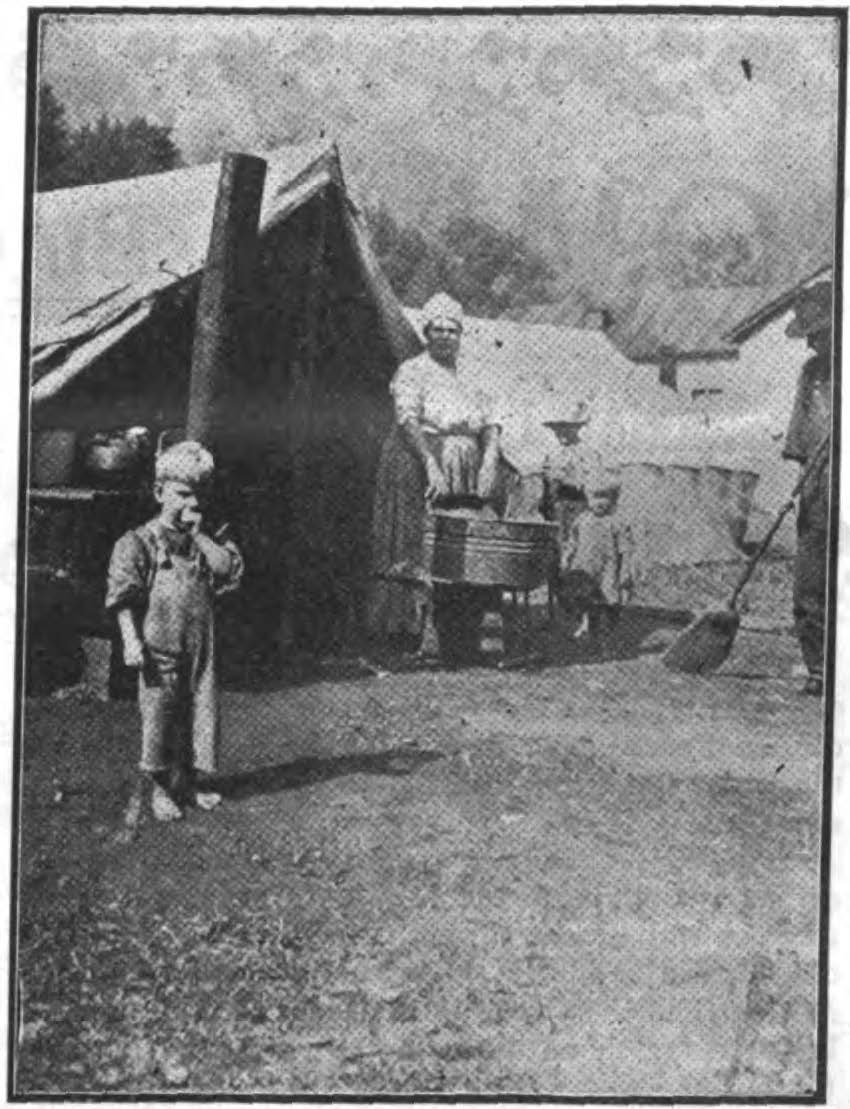
The child of John Estep born on the bare floor of the miserable shack in the woods has its Bethlehem. There was a star of hope hanging over West Virginia just then which gave promise of a brighter dawn when all can join in a joyous shout hailing the advent of a new era where man and man shall brothers be. This hope is in the growing consciousness and solidarity of the working class of West Virginia who see now in the miners’ fight their fight, and that the right of the miner to eat bread is more scarce than are the claims of the coal barons to interest and dividends on watered stock.
The Coming Nation was a weekly publication by Appeal to Reason’s Julius Wayland and Fred D. Warren produced in Girard, Kansas. Edited by A.M. Simons and Charles Edward Russell, it was heavily illustrated with a decided focus on women and children. The Coming Nation was the descendant of Progressive Woman and The Socialist Woman which folded into the publication. The Socialist Woman was a monthly magazine edited by Josephine Conger-Kaneko from 1907 with this aim: “The Socialist Woman exists for the sole purpose of bringing women into touch with the Socialist idea. We intend to make this paper a forum for the discussion of problems that lie closest to women’s lives, from the Socialist standpoint”. In 1908, Conger-Kaneko and her husband Japanese socialist Kiichi Kaneko moved to Girard, Kansas home of Appeal to Reason, which would print Socialist Woman. In 1909 it was renamed The Progressive Woman, and The Coming Nation in 1913. Its contributors included Socialist Party activist Kate Richards O’Hare, Alice Stone Blackwell, Eugene V. Debs, Ella Wheeler Wilcox, and others. A treat of the journal was the For Kiddies in Socialist Homes column by Elizabeth Vincent.The Progressive Woman lasted until 1916.
PDF of full issue: https://books.google.com/books/download/The_Coming_Nation.pdf?id=j8MsAQAAMAAJ&output=pdf
 Revolution's Newsstand