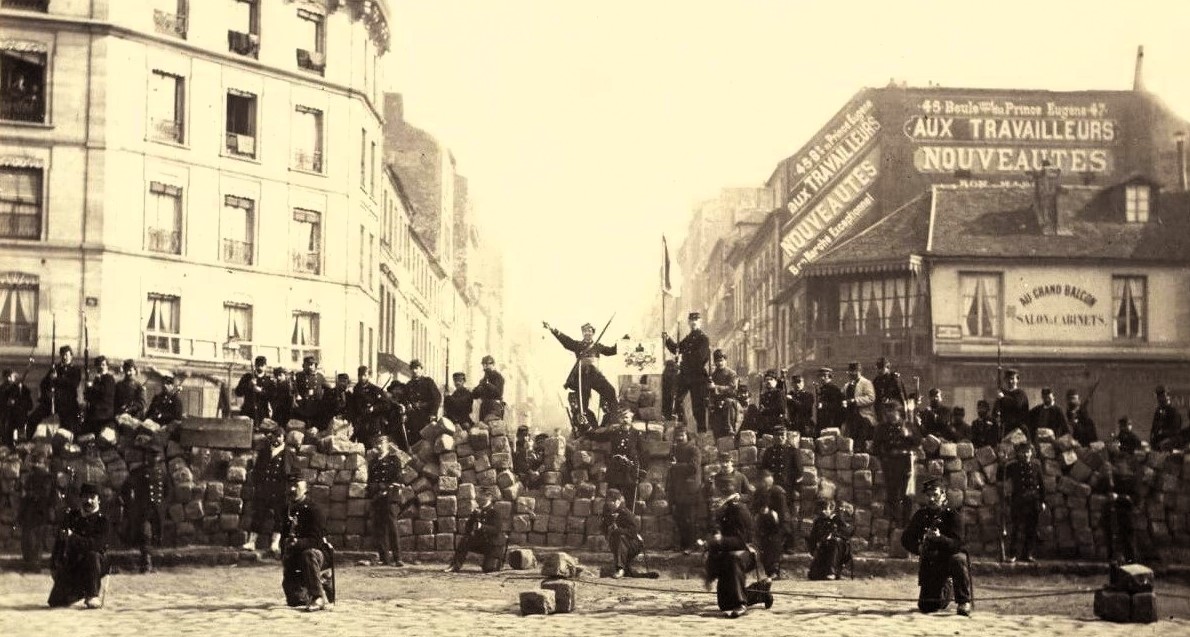
An important letter as the Civil War in France begins, Liebknecht delivers a speech for universal suffrage in the Berlin and is arrested along with Bebel and sentenced to three months. Given the delay in Liebknecht getting news, writing his thoughts, sending them to the U.S., and them being printed is a delay of over two months.
‘Letter from Leipzig, XVI’ by Wilhelm Liebknecht from Workingman’s Advocate (Chicago). Vol. 7 Nos. 41 & 42. June 17 & 25, 1871.
Leipzig, April 5, 1871.
To the Editor of the WORKINGMAN’S ADVOCATE:
Sad news from France! I am not in a position to overlook the events clearly and to discern the causes which have produced the present crisis, and I am not able, therefore, to pronounce an opinion founded on the whole sway of the facts; but it cannot be doubted that the outbreak of civil war is a great misfortune for France, and that any attempt to establish a Socialist Republic must be hopeless under existing circumstances, with the Prussians at the gates of Paris, and after the country has, in the last elections, with such overwhelming majority, declared against all radical tendencies and experiments. But far be it from me to condemn the men who have planted the red flag on the Hôtel de Ville (town hall) of the French capital. Some of the leaders are known to me, and their character and their principles are above suspicion; what they have done they have done from a conviction that it was indispensable for the commonweal. They may have erred, but their honesty is not to be questioned. And not their honesty alone; their understanding, too. Tolain, one of them, spoke at the Basel Congress on the state of affairs in France with a clearness and a common sense that really filled me with admiration. Such a man cannot have plunged into an enterprise of wanton folly.
From all this I must conclude that the newspaper reports concerning the Parisian outbreak are without exception undeserving of belief, either giving only fragments of the truth, or misrepresenting and distorting it altogether. Each and every newspaper report from France–it is needful to recall–which now enters the German press, and at least ninety-nine out of every hundred which enter the foreign press, have either passed through the French branch office of the Prussian Press Bureau, or are written by men under its influence. And something else must be kept in mind; a people having undergone what the French have during the last eight months, and being, I will not say driven to the extremity of despair, but thrown into a whirlpool of maddening, conflicting passions; shame, rage, thirst for revenge, and the consciousness of momentary impotence–a people enduring the most intense mental and physical suffering pain, and half delirious from over excitement, is not to be judged by the rules of common, normal life. We must appreciate the situation and the frame of mind in which the Frenchmen are, or we shall judge wrongly and unjustly. One word more: this shooting of two generals by the Insurgents has caused a yell of rage and a torrent of denunciations against the Paris workmen in particular, and the Socialists and International in general. With regard to this unfortunate affair it must not be forgotten, that the act was committed by a comparatively small number of National Guards, and that the leaders as well as the insurrectionary authorities had nothing whatever to do with it; besides it is established fact, that the two generals were caught, so to speak, in flagrante, when they were on the point of organizing a horrible butchery, and their doom was sealed by the discovery, that one of them was that infamous Thomas, who played such a knavish part in the history of the Ateliers Nationaux (National Workshops) of 1848, and was fore- most in bringing on the fearful June Massacres (1848), in which 12,000 Paris workmen were killed and wounded–not to mention the thousands of prisoners shot after the fight, and the 15,000 transported to Algeria or to Cayenne, to die there on the “dry guillotines.” As you may imagine, this Thomas was most unpopular amongst French Proletarians, he was hated fiercely by thousands; that this hatred burst forth on his being recognized in the moment he endeavored to arrange another massacre, is but natural; that his unhappy colleague was involved in the catastrophe, nobody will wonder at who has ever seen an assemblage of infuriated men. On the contrary it is astonishing that more acts of the same kind were not committed.
But this will not prevent our Bismarckian press from rendering the whole body of Insurgents responsible for the shooting of the two generals, and from preaching a crusade against the International Workingmen’s Association, which is represented as having manufactured this insurrection. It is of no use telling these scribes that insurrections have happened at Paris before the International Workingmen’s Association was thought of; they will not listen to truth, nor will their employers; for the International Workingmen’s Association is a terrible. bugbear to them, because it embodies the spirit of modern Democracy all over the world; because it is the prophetic indication of the coming social and political world–the sketch of the future–the Memento Mori of ruling, abuse, oppression and privilege! The awe in which the governing classes, with their immense array of capital and literary power, stand of the International Workingmen’s Association, whose funds are not large enough to pay a dozen of soldiers, is clearly the result of a bad conscience, and certainly the most glorious, though involuntary testimonial in favor of our principles. Since the beginning of the late war the attacks on the International Workingmen’s Association, till then periodical, have become permanent. It was the Internationals that had forced the French Emperor to seek his safety in war; it was the Internationals that forced France to continue the war after Sedan; it was the Internationals that murdered Prim (literally true); it was the Internationals that destroyed John Bull’s good opinion of Prussia–in short, anything and everything not to the taste of our privileged is the work of this miraculous Association, which, in the imagination of its frightened accusers must be provided with divine attributes of omnipotence and omnipresence.
II.
Well, a handful of Germans living in Zürich, who have retained their old love for the rod they were beaten with at home, wanted to celebrate the successes of the said rod; they were warned; the sentiments of the town population were pointed out to them; they were told that the intended drinking feast was likely to be regarded as an insult and a provocation by the numerous French officers present at Zürich–the thirty patriots were deaf to the voices of reason, they would have their drinking match, and what was to be foreseen came to pass–blows instead of beer and beery speeches. Had the affair ended here it would only be a matter for laughter; but in consequence of the stupid behavior of the local authorities, a common brawl was magnified into a riot, that cost several lives, and may cost the cantonal government serious trouble yet. Now, would you believe that from the day the first telegram appeared up to this hour, our middle-class and Junker Press is laying the blame for the Zürich riots to the charge of the International Workingmen’s Association, which of course (and the official investigation has proved it) is as innocent of them as a newborn babe? Some papers carried the infamy so far as to throw the moral responsibility on the imprisoned social democrats of Leipzig and Brunswick, whose trial cannot be delayed much longer, if it is to take place at all–and against whom the jurymen are to be stirred up in time.
The events at Paris have somewhat ruffled the temper of the Prussian government. It is true, they have given rise to a faint hope, that after all it might be possible to restore our dear friend Bonaparte, but in showing the possibility of a sudden revulsion in France, they have also brought home, in a manner not to be understood, the disagreeable fact that the glorious peace, for which we had to pay a few hundred thousand lives, rests on a foundation not more solid than quicksand and may be swallowed up in a twinkling to make room for fresh war. Material guarantees to enforce the treaty? Fiddlesticks! France is too large to be permanently occupied even if Prussia had four times as many soldiers as she really has; and so things must run their fatal course. Let them talk at Berlin of Peace and prosperity, we are already under the cold shadow which the coming war casts before it. History has its stern immovable logic, and though kings and emperors may be above grammar and written law, they are not above reason and the eternal law that rules the development of mankind.
The total result of the elections is unknown. Here in Saxony we have not gained a new seat at the second poll (our candidate was beaten by a few hundred votes) but an expected victory has been won at Frankfort on the Main, where Mr. Sonnemann, the candidate of the United Democrats, was elected against Mr. Rothschild, the chief of the famous Gold Dynasty, and as servile as he is rich. So we have two Social Democrats in the Reichstag, and one Democrat (Mr. Sonnemann) who has accepted the Eisenach Program, with the exception of the paragraph demanding public credit for cooperative societies, though he does not object to “State help” on principle. Add to these three members twenty particularists from Bavaria and Hanover, and you have the whole opposition. The remaining three hundred will go through thick and thin with Mr. Bismarck. It is notable that Prussia proper does not send a single opposition member–a fact that must rather startle the admirers of Mr. Bismarck’s universal suffrage. In a speech which Mr. Liebknecht delivered at a meeting in Berlin, in May, 1869, he thus characterized the Bismarckian gifts:
“In the absolutistic state universal suffrage can only be the plaything or the tool of absolutism.
“When Bonaparte had murdered the whole French Republic he proclaimed universal suffrage.
“When Count Bismarck had achieved the victory of Prussian Junkerdom, and when through his successes in 1866 he had finally conquered middle-class liberalism, and torn Germany to pieces, he did what his prototype had done fifteen years before he proclaimed universal suffrage.
“In both cases the proclamation of universal suffrage sealed the triumph of despotism. This fact, alone, ought to open the eyes of those enthusiasts who consider universal suffrage the panacea for all political and social diseases.
“To enter into the motives of Bonaparte is not the place here. As for Count Bismarck his reasons are obvious.
“The three-class suffrage,1 undemocratic and even anti-democratic as it is, has at the same time an anti-feudal character, because it gives the majority of the representation to the middle classes, who, though always ready to make common cause with absolutism against the workmen, against democracy, are yet no friends of the absolutistic State, as they want to see certain liberal reforms introduced. The liberal chamber, the result of the three-class suffrage, was in the way of the Junker government; a counterpoise had to be created, and this was found in universal suffrage.
“How few are mentally and physically independent in this Prussian Police-State, in this state of systematic drilling of mind and body? Does not the rural population alone, which blindly obeys, and must obey the authorities–does it not form fully two-thirds of the whole population? On this Count Bismarck’s plan was built. And he had not miscalculated. By means of universal suffrage he swept away the opposition of the middle classes, and acquired a Reichstag majority so docile, as the three-class suffrage could never have furnished him with.
“Not to serve democracy, but to serve absolutism, universal suffrage has been given to us. It is under the most complete control of the government–here in Prussia still more than in France, where the people have undergone better political schooling, where they look back on three revolutions and stand at the threshold of the fourth. It may be said with absolute certainty, that in Prussia no candidate can be elected for the Reichstag whose election is seriously disagreeable to the government. I remind you of the last election in Hanover, how the program and placards of the obnoxious candidate were confiscated, thousand of obstacles thrown in his way. And this was only an inconvenient candidate, not a dangerous one. Had the government thought necessary to make use of its whole power–of course I mean lawful use, for intelligent absolutism mostly wears the cloak of law–it would easily have prevented the election of Ewald. Let us suppose a candidate appears whom the government wishes to keep out of the Reichstag; the newspapers recommending him are confiscated lawfully; his placards are confiscated lawfully; the meetings of the electors are forbidden lawfully; or, the meetings are allowed but dissolved afterwards lawfully; the persons advocating his election are arrested lawfully; the candidate is sent to prison lawfully.”4
Enough. So Prussia was three years ago. So Prussia is today, and so Prussia will be as long as she exists. And this Prussia is now trying to mold the other German States after her fashion.
To complete the picture and to give it the finishing touch, I must tell you that for this speech Mr. Liebknecht has been sentenced to three month’s imprisonment in Prussia, and is still under accusation in Saxony for the same offense. Send your Bismarck worshippers over to Germany–they will soon be cured of their queer disease.
P.S. March 28th. This afternoon Messrs. Bebel, Liebknecht and Hepner were set at liberty. They had to give their word of honor not to leave the district of Leipzig without permission while the cause is pending. As the judicial inquiry has been absolutely resultless, and has not brought home to the accused the slightest fact, which has not been read in the Volksstaat by many thousand people, the public accuser included, it is more than probable that the affair will be dropped. During their imprisonment our friends were treated most humanely–this must be acknowledged–but strange times there are, in which three innocent men can be sent to jail for three months and a half without having any means to get redress for the wrong done them! It is to be hoped that our Brunswick friends will now get free too.
NOTES
1. While other governments withhold the franchise from the working classes in a more er less direct form, the Prussian government left them the suffrage after the wreck of the Democratic Constitution of 1848; but with a Jesuitism worthy of our Protestant Paraguay, it invented a mechanism, which dissolved the workingman’s vote into smoke! The process is as simple as can be; the whole body of the electors (and there are very few male persons over twenty-five years excluded), are divided into three classes, according to the rate of the direct axes paid. In the first class the wealthiest are put–so many as are paying one-third of all the direct taxes paid; the second class contains the well-to-do people, who pay the other third; and the last class is crammed with the small tradesmen, farmers and workmen, who between them pay the last third of the direct taxation. Each of those three classes have to choose a like number–not of deputies–for then the mass of the people would at least have one-third of the representation–but of deputy electors, who have to meet (those of the three classes together) and to elect the deputy by simple majority, so that the deputy-electors chosen by three millions of poor, are doubly put-voted by those chosen by five hundred and fifty thousand rich. This is the celebrated three class suffrage, which for the middle-class as the double advantage of giving them the majority of the representation, and of being a brake against democracy. Its being in the interest of the middle-class, induced Mr. Bismarck to reject it for the Reichstag, and will perhaps induce him, to abolish it for the Prussian chamber too.
2. In Hanover where Prussians are hated much more intensely than before the annexation, the enemies of the new order of things, did not participate in the two elections of 1867, which in consequence of that were miserable minority elections (by two per cent of the population.) But the particularists soon saw, that abstention was rather a dangerous policy, and, when u the beginning of 1868 a seat became vacant, they put forward a candidate of their own: Professor Ewald, the most celebrated of our Orientalists and a staunch adherent of the Guelphs; he was elected with great majority. (By the by he has been re-elected for this Reichstag). A Germann Emperor, Sigismund I think, on being made aware of a gross blunder he had been guilty of in delivering a Latin speech (not written by him), replied: The Emperor is above grammar.
The Chicago Workingman’s Advocate in 1864 by the Chicago Typographical Union during a strike against the Chicago Times. An essential publication in the history of the U.S. workers’ movement, the Advocate though editor Andrew Cameron became the voice National Labor Union after the Civil War. It’s pages were often the first place the work of Marx, Engels, and the International were printed in English in the U.S. It lasted through 1874 with the demise of the N.L.U.
PDF of issue: https://chroniclingamerica.loc.gov/lccn/sn89077510/1871-06-17/ed-1/seq-1/
PDF of issue 2: https://chroniclingamerica.loc.gov/lccn/sn89077510/1871-06-24/ed-1/seq-1/
 Revolution's Newsstand