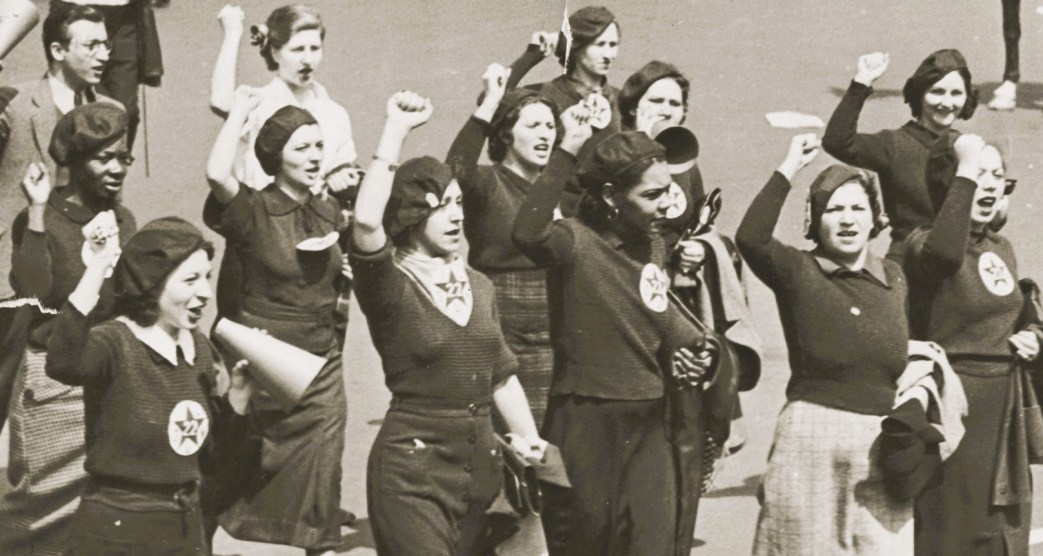
Foster explains the rebellion amongst the large, left wing New York City locals of the I.L.G.W.U. when their leadership was removed by the Sigman bureaucracy in one of the great internal union struggles of the U.S. labor movement.
‘The Ladies Garment Workers Awaken’ by William Z. Foster from Workers Monthly. Vol. 4 No. 10. August, 1925.
THE time was, a number of years ago, when the needle trades unions were in the vanguard of the trade union movement of the United States. They really stood for progress, and at all conventions of the American Federation of Labor they were to be found in the bloc of organizations lined up against the reactionary Gompers’ machine. They were an eye-sore to the arch traitor, Gompers, and he was never more happy than when attacking them viciously.
But such a situation is now merely a matter of history. The leadership of the needle trades unions, which one at least partially reflected the revolutionary spirit of the rank and file, has now become practically indistinguishable from the leadership of other trade unions. Officially the needle unions stand for few or no policies in advance of those of the bulk of organized labor. They have repudiated every semblance of militancy in their attitude towards the employers, and they are just as ardent advocates of class collaboration as are the most hide-bound A.F. of L organizations. They have thrown overboard amalgamation and now stand squarely for craft unionism, having repudiated the campaign for industrial unionism they carried on in the A.F. of L. for many years. When Sigman, President of the International Ladies Garment Workers, presented Samuel Gompers with a bronze bust at the recent convention of the A.F. of L., his act was symbolical of the complete surrender made by Sigman and other needle trades bureaucrats to the policies and leadership of such men as Gompers.
The complete degeneration of the leadership of the needle trades unions has kept pace with the decay of the Socialist Party, to which most of these leaders are or were affiliated. When the S.P. lost the left wing in 1919 it lost practically all its vital elements. The organization rapidly deteriorated. Now there is no work of reaction too contemptible for it to endorse. The Socialist leadership in the needle trades unions reflects this degeneration. Where once these leaders, getting some sort of discipline from the S.P., maintained at least a superficial pretense of honesty and of desire to protect the workers’ interests, now they, for the most part, have disintegrated and descended into mere cliques of hungry bureaucrats willing to betray the workers’ interests openly and brazenly in order to curry favor with the employers and to hang on to their own fat sinecures in the unions.
This break-up of the leadership in the needle trades is one of the most pronounced features of the union situation in the industry. In all of the unions the reactionaries find themselves in two or more rival camps, making war upon each other for the control of the unions, and carrying on a fight against each other from which every semblance of revolutionary idealism is totally absent. The one-time discipline of the Socialist Party, now hopelessly corrupt, is powerless to hold in line in one uniform bureaucracy all these discordant and job-hungry elements. In the Fur Workers, the Ladies Garment Workers, and the Amalgamated Clothing Workers the crumbling of the official machine is far advanced. There is a more far-reaching and greedy scrambling for jobs and control going on now among the reactionary needle trades leadership than in any other set of unions in the United States.
The rapid swing of the needle trades leadership to the right, which has taken place during the past few years and which has wrought havoc with the wages and working conditions in the industry, was bound sooner or later to produce an upheaval of protest among the exploited rank and file. The many years of radical propaganda carried on among needle workers have not been lost. These workers have not the sheep-like timidity that is to be found among the workers in other industries. They will not submit without violent protest to the treachery and betrayals of their leaders. The present situation in the needle industry, with the rank and file in revolt against the leadership, was inevitable.
The depth and extent of this revolt is as yet unrealized by organized labor as a whole. In the Fur Workers the thousands of members in New York have demonstrated their opposition to the growing corruption and reaction among the needle trades leadership by overthrowing Kauffman’s machine in the Joint Board of New York and electing the militant left-winger, Gold, as the head of this Board which forms the backbone of the whole organization. In the Amalgamated Clothing Workers, a similar movement is developing as the Hillman machine moves towards the right. In this organization the development of the rank and file protest is somewhat slower because of the gesture to the left made by Hillman a couple of years ago.
Sigman’s War Against the Left Wing.
But it is in the International Ladies’ Garment Workers that the revolt is taking on its most pronounced form. Following in the footsteps of Schlesinger, the present President of the International Ladies’ Garment Workers, sowed dragon’s teeth in his organization by betraying the workers in every movement they have made for better conditions since he took office. He further prepared the ground for revolt by the bitter persecution which he levelled against the left-wing militants in the Trade Union Educational League who dared to raise their voices against his treacherous policies.
Not content with betraying the economic interests of the union membership, and with exercising the most terrific oppression against the honest and progressive elements in the union, the bureaucrats fell out with each other and waged a most destructive and contemptible warfare against each other for control of the union treasury and the overpaid jobs as union officials. Sigman and Breslau, the heads of the two warring cliques in the bureaucracy, are as alike as two peas in a pod, and their mad scramble for control is ruinous to the organization.
The upshot of these conditions, the betrayal of the workers’ economic interests, the war against the left wing, and the break-up of the old bureaucracy, was bound to be an explosion. When Sigman and Perlstein, attempted to gain an advantage over Breslau by capturing the three big local unions, Nos. 2, 9, and 22, by arbitrarily removing their executive boards, they touched the match to the great heap of tinder they had piled up. They soon became confronted with. It was a conflagration which threatens to consume them. It was pushing the rank and file beyond the last limit of endurance, and they revolted en masse.
Rank and File Aroused.
The story of this revolt, one of the most spectacular and significant in the history of the American labor movement, need not be repeated. The spontaneous outpouring of thousands of rank and file members to the great mass meetings to protest against the insufferable policies of Sigman & Co., the raids of the administration gangsters to capture the union headquarters, the defense of these headquarters by the rank and file, the enormous meeting at the Yankee Stadium, where 30,000 to 40,000 needle workers gathered to protest against betrayal by their leaders and to organize themselves to defend their interests, the farcical trial staged by the Sigman administration in a desperate effort to discredit the leaders of the left wing and to find some faint plausibility for their brutal expulsions–all these things have received the widest publicity, and striking though they may be, they will be followed in all probability by events even more significant than those that have happened so far.
It is characteristic of the right-wing program of betrayal in every union that the reactionaries seek to cover up and justify their ruinous policies by concentrating an attack upon the left wing and by trying to convince the workers that the danger they have to confront is from the left and not from the right. In the present situation, the Sigman bureaucrats are following this policy with classic orthodoxy. They viewed with alarm the growing strength of the left wing. They awaited only a favorable opportunity to deliver a heavy blow at this left wing. They thought they saw their opportunity in connection with the May Day meetings, and they struck their blow by sweeping out of office 77 members of the executive boards of these three local unions which constitute not only 60 per cent of the International in New York, but also its very best proletarian elements.
In their eagerness to strike at the Communist militants, trade union bureaucrats have in many other unions raised the charge that the Workers Party and the Trade Union Educational League have been, in the first case in opposition to trade unionism generally, and in the second place a dual union, and upon the basis of such charges they have either expelled members outright from the union or have deprived them of their rights to sit as delegates in Central Labor Councils. But in no case was there such flimsy pretext seized upon as in the case of these suspended executive boards. Once again, even as he did in the case of beginning the expulsion policy in general, Sigman takes the lead in proceeding to extremes to make war upon the revolutionary elements in his organization.
In the New York Times which is pleased to give Sigman and his agents ample space in which to spread their poison against the best members of the organization, Sigman’s tool, Feinberg, charges the 77 suspended officials with having violated the Constitution by the commission of the following “crime”:
“On May 1st, 1925, the Executive Board of Local 22, and the Secretary-Treasurer of the local, called and organized a public meeting under the guise of a May Day demonstration, which, upon the invitation of the Executive Board and the Secretary-Treasurer of the local was addressed by avowed enemies and opponents of the International Ladies’ Garment Workers’ Union; the speakers who were invited to address the meeting were members of organizations opposed to all the settled principles of trade unionism, and particularly those of the International Ladies’ Garment Workers’ Union, and the American Federation of Labor with which it is affiliated, i.e., the Workers Party, the Communist Party, and the so-called Trade Union Educational League. The speakers so invited advocated at the meeting methods of violence and dictatorship which were widely reported in the public press and conveyed the false impression that the International Ladies’ Garment Workers’ Union and its locals were committed to the aims and methods of Communism and were calculated to impair the standing, reputation, and usefulness of the organization.”

The officials of Locals 2 and 9 were similarly charged, with the exception that Local 22 committed the additional “crime” of financing the meeting. The fact that Communists have spoken at hundreds of meetings of the International Ladies’ Garment Workers, that they have been officially invited to speak at the conventions of that organization, and that these things were done for years with the knowledge if not the willing consent of the officialdom, were conveniently ignored by Sigman in his eagerness to set up a “red scare” in his organization and thus to break up the growing opposition to his control and policies.
Movement Far-Reaching.
But the workers are not deceived by this maneuver. Their grievances are too deep and burning and their intelligence too well developed to allow this dragging of the red herring across the trail to be successful. They refuse to be stampeded into a “red” hunt. They understand that the men and women being victimized in this latest maneuver of Sigman’s are the ones who have led the battle for their demands. They know that insistence upon these demands, insistence that the union follow a fighting policy, is the real reason for the expulsion of these militants, Ample demonstration of this fact is the loyal manner in which the masses have rallied to their support.
The movement now agitating the needle workers in the Ladies’ Garment industry is bound to produce profound changes in the International Ladies Garment Workers Union. But this movement runs certain dangers. One is that its leaders should make the mistake or minimizing the importance of the economic demands of the workers and to concentrate the fight one-sidedly upon the elimination of “Brindellism” from the union. This course would inevitably result in losing the support of the masses, who want their burning grievances in the shops adjusted. In this situation the way to success is to keep ever to the forefront the demands of the workers against the bosses, as well as the fight against the latter’s corrupt agents, the Sigman bureaucracy.
Another danger that this healthy movement of revolt runs, is that of dual unionism. The bureaucrats will split the organization if they think that thereby they can get rid of the left wing. This danger is further accentuated by the natural resentment of the rank and file at the persecutions and betrayals of the Sigman bureaucracy, and by the inevitable tendency of the discontented masses to break away from the corrupt leadership and to demand a new union. But so far the rebellious workers have been able to successfully avoid this danger. They have effectively resisted the efforts of the bureaucrats to force a definite split, and likewise they have held in check those ill-advised elements in their own ranks who would yield to a tendency to split.
The left wing is the advocate and champion of the solidarity of the workers. It must resist the splitting tendency of the bureaucrats. In no situation is this more evident than in New York. If the bureaucrats are absolutely determined to split, then of course they cannot be prevented. But the left wing can and must fight so resolutely against such a split that, if it develops, the entire blame will rest upon the shoulders of the bureaucrats, and so plainly will this be evident that the masses of workers in the industry will understand it.
A New Era in the Clothing Industry.
The present revolt of the masses of workers in the International Ladies’ Garment Workers, the Amalgamated Clothing Workers, and the Fur Workers against the tactics and policies of the leadership in these organizations marks the beginning of a new era in the clothing industry as a whole. Today the unions are organized on a craft basis and manned by reactionaries who follow policies of class collaboration. The consequence is that the organizations are unable to maintain a grip upon the industry and to win even the most modest concessions for the workers. The industry is slipping from under their influence and is rapidly becoming an “open shop” industry. The conquests won by the needle workers through long years of struggle are being lost one after another.
But the great revolt now taking place in the needle trades foretells a fundamental change in the situation. The workers are demanding and will have a fighting policy of class struggle. They will put at their head men who understand that the workers can gain their demands, not by a policy of surrender to the employers, but by one of militant struggle against these employers. They will insist that the present weak and demoralized craft unions in the needle trades be combined into one powerful industrial union organized on a shop committee basis. They will insist that the unions embark upon an active campaign to build a mass party of the workers, a Labor Party. The needle trades unions are in the first stages of a renaissance.
The Workers Monthly began publishing in 1924 as a merger of the ‘Liberator’, the Trade Union Educational League magazine ‘Labor Herald’, and Friends of Soviet Russia’s monthly ‘Soviet Russia Pictorial’ as an explicitly Party publication. In 1927 Workers Monthly ceased and the Communist Party began publishing The Communist as its theoretical magazine. Editors included Earl Browder and Max Bedacht as the magazine continued the Liberator’s use of graphics and art.
PDF of full issue: https://www.marxists.org/history/usa/culture/pubs/wm/1925/v4n10-aug-1925.pdf
 Revolution's Newsstand