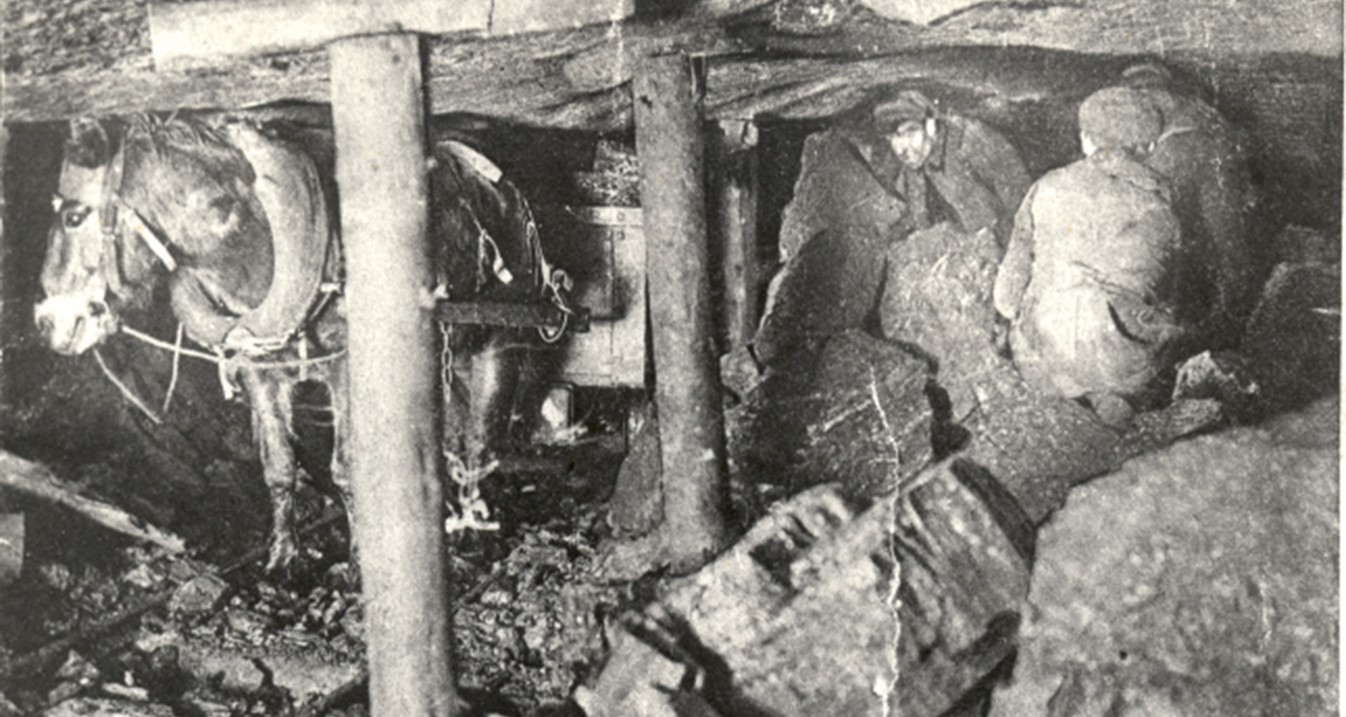
Canadian C.P. organizer Tom Bell was sent to the Maritime Provinces to organize during the mass coal strikes there led by the U.S.-based United Mine Workers and offers a detailed look at the struggle in this militant section of the Canadian working class.
‘Among the Coal Miners of Canada’ by Tom Bell from Labor Herald. Vol. 3 No. 5. July, 1924.
THE coal diggers of District 18, U.M.W., have been on strike since April 1st, fighting against a wage cut of $1.17 a day. They are receiving no financial support from the International and have appealed to the labor movement of Canada for money to continue the fight against the operators.
In Nova Scotia the miners have just finished a rank and file convention which demanded the restoration of district autonomy and immediate district elections. It also adopted a policy on the fifty-cent weekly levy placed by Lewis on the men to pay the debts contracted during the strike last January. To explain the situation in the light of these events is the purpose of this article.
Last July the miners of Cape Breton Island, comprising half the miners of District 26, U.M.W., rushed to the assistance of the striking steel workers of Sydney, N.S., by striking in protest over the use of troops by the government against the steel workers. Unsupported by the labor movement, with the exception of the Drumheller sub-district of District 18, faced by the full strength of the British Empire Steel Corporation, the provincial and federal governments with troops and mounted police, and ordered back to work by the reactionary Lewis administration, the miners were forced to abandon the strike. This allowed the steel workers to be beaten. Thus the miners of Nova Scotia had a real demonstration of the function of the capitalist state.
Lewis the Real Strikebreaker
During this strike the Lewis administration acted as a strike breaking agency. At the request of the corporation Lewis deposed the officers of the district, cancelled the district charter and appointed a “provisional government” of men who had been rejected in the previous district election, such as Dalrymple and Houston. The miners were ordered back to work under threat of expulsion from the union.
Knowing the history of Kansas district and District 18, the militants decided that to save their ranks from disruption and to prevent a “reorganization” of locals under Lewis’ dictatorship, the best thing to do was to return to work. This was done, and since then the militants have been in the front of the campaign to prevent a split. All attempts at building dual unions have come to naught owing to the leadership of the rank and file militants having benefitted by the experiences of the mines of District 18, who attempted to organize a dual union in 1919.
The provisional appointees of Lewis confidently predicted that when the contract expired under which the miners then were working, the corporation would raise wages to the 1921 standard, because those who would negotiate with the corporation were recognized as “fair and reasonable” men–not “reds” and advocates of the Red International of Labor Unions, as some of the deposed officers had been.
On January 15, last, the contract expired and the corporation posted notice of a 20 per cent cut in wages. This took place after the Lewis appointees had negotiated for nearly two months, and so flabbergasted the appointees that they were at loss what action to take. However, the miners settled the matter by quitting the job. Later on the “provisional government,” afraid to declare a strike outright, compromised between their cowardice and their fear of the miners by declaring a “suspension of work.” This was in reality, of course, a strike, but they were fearful of that term lest they lose their reputations as solid conservatives.
Lewis Breaks His Promise
The miners were informed that the policy of Lewis–“no reduction under the 1921 rates” would be applied to the district, and to carry it out the International would support the district to the limit. But in February a contract was signed which, while giving the datal laborers an increase of ten cents a day, and the contract miners an increase of about seven per cent, had an elaborate set of rules and regulations which bound the miners to the corporation like so many chattel slaves.
Prohibition of quitting work in order to force the management to adjust a grievance, forcing the pit committees to supply miners to take the places of those who quit because of grievance, placing the “working force” at the complete disposal of the management, and setting up arbitration machinery with “impartial chairmen”–these were some of the shackles the Lewis administration placed on the miners in the interests of the corporation.
Ignoring his own brave phrase of “no reductions” Lewis resorted to threats of expulsion to get the miners back to work. To sugar-coat the pill, the Lewis appointees promised the miners that a referendum vote would be taken on the contract. Not that this would alter the contract, since that had been ratified by the International, but to attempt to place responsibility for its acceptance on the miners. But in the referendum, the contract was overwhelmingly buried by adverse votes of the outraged miners.
During the “suspension of work” over $100,000 was spent on relief, and the miners understood that this money had been donated by the International to aid them, since Lewis had declared at the Indianapolis convention that the strike in Nova Scotia would be fully supported by the administration. But at the last International Board meeting Lewis repudiated the debts contracted in Nova Scotia and those who had given the relief were censured.
At the end of April the locals were notified that the provisional officers of the district had made arrangement with the operators that fifty cents weekly would be deducted from each miner’s wages until the debts had been paid. This arbitrary method naturally created unrest and the miners viewed it as another instance of the high-handed methods of the Lewis appointees. It was ostensibly to discuss this question that the rank and file convention was called on May 15th.
The Convention Decisions
The call for the rank and file convention was issued by Stellerton Local. This is one of very few locals in Pictou County which have never been reconciled to the progressive policies adopted by the miners of Cape Breton Island. But today these locals, under leadership of men who apparently long for a purely Canadian union, are doing their best to create a split from the U.M.W. The so-called “revolutionary” One Big Union is spreading literature among them.
The levy to pay the debts contracted during the strike was seized as the issue upon which to call the rank and file convention. While there is a sentiment for “national unionism” among the miners of Pictou County, it is vague, and they have been unable to foist it upon the miners as a whole because the majority, on Cape Breton Island, are advocates of the policy of the Miners’ Progressive movement and heartily subscribe to the anti-secession policy.
Representation at the convention was not complete. Seven locals aggregating about 3,000 members were not represented. About 9,000 of the 12,000 in the district were represented. The main points of discussion were the payment of the debts, the restoration of district autonomy, immediate election of district officers, and appointment of a Committee of Action to demand of the corporation that the levies be paid to the local union secretaries instead of the district secretary. On the question of the debts it was decided after opposition from the Pictou County delegates that the miners would pay the debts but that the corporation should hand the money to the local union secretaries. Failing this, the Committee of Action would apply to the courts for an injunction preventing the corporation deducting the money from the miners’ wages. The utility of this policy cannot readily be seen, unless it is understood to be a compromise between those who would refuse to pay the levy for the purpose of getting Lewis to cancel the local charters, thus furnishing an excuse for the start of a dual union–and those on the other hand who are determined to stay inside the union and conduct the fight against Lewis from the inside, the only place it can be waged.
It is a farce to talk of the miners securing an injunction against the corporation in the courts of Nova Scotia since they are manned by hirelings of the Corporation. The essence of the stand taken on the debts is that there is a struggle being waged between the class conscious militants and the confused, vague “national unionists” who want a dual union because they cannot see how they are going to trim Lewis otherwise than by running away from him.
The Lesson of District 18
The demands for the restoration of the district autonomy and immediate elections are the positive results of the convention. The majority of the delegates opposed any split in the union. It was demonstrated that the militants still have leadership of the rank and file and that they are conducting the struggle against the dictatorship of Lewis on lines laid down by the Progressive Miners in the union as a whole. The rank and file convention was the first skirmish between the progressive majority and the conservative minority of District 26.
The miners of District 18, U.M.W., comprising the mines in Alberta and eastern British Columbia, went through a split starting with the organization of the O.B.U. in 1919. The result was the establishment of a “provisional government” by Czar Lewis, and the miners were in the curious position of being outside the U.M.W. but paying dues to it through the check-off. The situation lasted until 1922, when the miners again began to take an active part in the U.M.W. locals. After the strike of that year, district elections were held in December and a great campaign was waged for the election of militants to offices.
The present president of the district, Sherman, was a great militant in those days. Because of that he was elected to his position by a big majority. Today Sherman is one of the puppets of Lewis. He has demonstrated that he was insincere in his pre-election militancy. He revoked the charters of locals in Drumheller that dared strike in sympathy with Nova Scotia last July. He has expelled militants, had them blacklisted by the operators, and has denounced those who elected him to office. He is of the same stuff as Capellini, who expressed murderous hatred toward the militants at the Indianapolis convention.
Lewis Lied at Indianapolis
In December, 1922, the contract containing the 1921 standard of wages was renewed until April of this year. At the time of the O.B.U. split the operators granted a “war bonus” of $1.17 a day as a demonstration of the willingness to co-operate with the U.M.W. When negotiations began this year, the operators demanded that the “war bonus” be abolished, in return for which they would sign a contract for one year. To secure this reduction of wages, the operators used the excuse that they wanted to capture the Ontario market. The representatives of the miners rejected this, with the result that a strike began on April 1st. The officialdom of the district is demanding no reduction in wages and a three-year contract similar to the Jacksonville agreement, Lewis’ “peace program”–at the expense of the miners.
At Indianapolis when Lewis was arguing for an acceptance of the three-year contract, he stated that his main purpose was that this long term contract would free the hands of the administration to aid the outlying fields maintain their wage standard. That this was merely a convenient argument to enable him to carry out the instruction of the Republican Party (which did not want the embarrassment of a coal strike in a presidential year) is demonstrated by the fact that when Sherman asked for strike relief, he was told that the International could give no relief, and that only a small loan was available.
This has increased the antagonism of the rank and file against Lewis, because they are without money, the stores have stopped relief, and in some camps the miners’ families are being evicted from the shacks owing Abandoned by to non-payment of rent. their International they are appealing to the labor movement of Canada, particularly to the Nova Scotia miners, whom they financed last summer during the arrests there, for funds to continue the strike and preserve their wage standard.
The district officials in this situation have adopted the ruinous policy of signing up agreements with individual bosses. Nothing will so quickly split the ranks of the miners as this. If the operators only get sufficient miners at work to assure them a steady supply of coal for their railway customers, they would be in a position to keep the rest of the miners out until they were starved into submission. Then would come the turn of those who were sent back to work under the separate agreement.
It has been advocated that the miners should bring out the maintenance men to bring greater pressure on the operators. Even if the district officials would do this (and it can be safely predicted that Sherman and his crew would not do so), it is doubtful if this would do more than afford the operators an excuse to bring troops into the district and thus increase the pressure on the miners. The only hope of victory for the miners of District 18, is that the workers of Canada will rally to their support and aid them with money to continue the struggle.
Both Canadian Districts Persecuted
Both Canadian districts of the U.M.W. have felt the heavy hand of the Lewis administration. District 18 has gone through a split and this experience has forced them to see the barrenness of the dual union policy. District 26 has thus far been spared the tragedy of a split, owing to the untiring efforts of the rank and file militants. If their policy is continued the ranks of the miners will remain solid and they will be a valuable section in the struggle of the whole rank and file of the U.M.W. against Lewis. The recent victories in Kansas and Illinois where the rank and file triumphed over the reactionary machine should demonstrate to the miners of Nova Scotia the necessity of continuing the clear policy of the Miners’ Progressive movement. Only if the class conscious militants abdicate the leadership of the rank and file, will there be a split in Nova Scotia. The miners of District 18 will have to get support to win their strike and keep their wages intact, and it is up to the Canadian labor movement to supply that. At the end of this year district elections will take place there, and the rank and file will correct their blunder of placing false militants in office by snowing under Sherman and his gang.
The Labor Herald was the monthly publication of the Trade Union Educational League (TUEL), in immensely important link between the IWW of the 1910s and the CIO of the 1930s. It was begun by veteran labor organizer and Communist leader William Z. Foster in 1920 as an attempt to unite militants within various unions while continuing the industrial unionism tradition of the IWW, though it was opposed to “dual unionism” and favored the formation of a Labor Party. Although it would become financially supported by the Communist International and Communist Party of America, it remained autonomous, was a network and not a membership organization, and included many radicals outside the Communist Party. In 1924 Labor Herald was folded into Workers Monthly, an explicitly Party organ and in 1927 ‘Labor Unity’ became the organ of a now CP dominated TUEL. In 1929 and the turn towards Red Unions in the Third Period, TUEL was wound up and replaced by the Trade Union Unity League, a section of the Red International of Labor Unions (Profitern) and continued to publish Labor Unity until 1935. Labor Herald remains an important labor-orientated journal by revolutionaries in US left history and would be referenced by activists, along with TUEL, along after it’s heyday.
PDF of full issue: https://www.marxists.org/history/usa/pubs/laborherald/v3n05-jul-1924.pdf
 Revolution's Newsstand