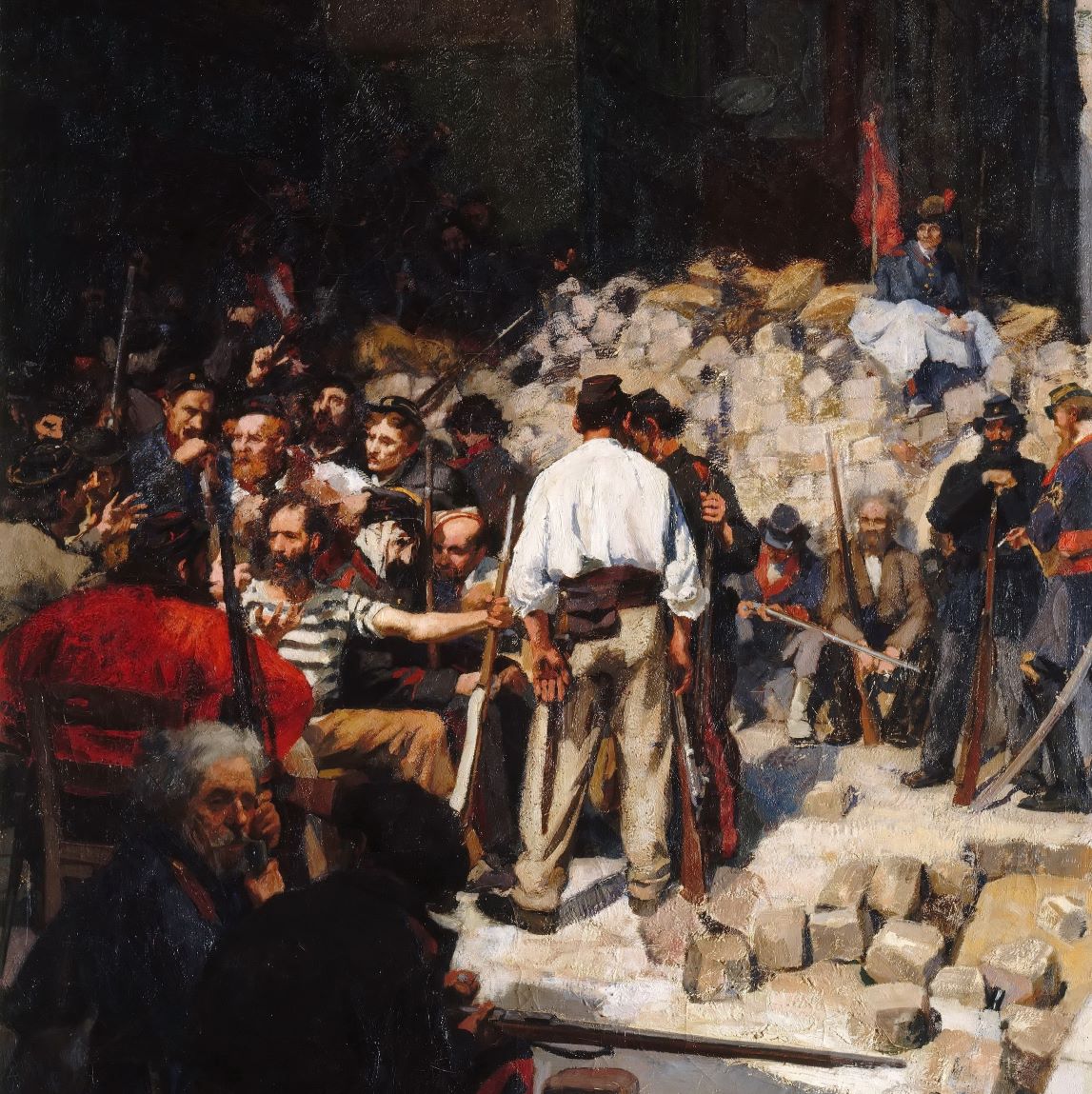
Liebknecht reports the fall of the Commune.
‘Letter from Leipzig, XVII’ by Wilhelm Liebknecht from Workingman’s Advocate (Chicago). Vol. 7 Nos. 43. July 1, 1871.
Leipzig, June 8, 1871
To the Editor of the WORKINGMAN’S ADVOCATE:
Vae Victis. The Commune has been conquered–the Commune has been in the wrong. And not only in the wrong but into the bargain loaded with all crimes, enormities and infamies which the frightened and depraved imagination of the victors can create. All infamies, with one exception–cowardice. That the Parisians fought like heroes, or like “devils,” as a shuddering correspondent expressed himself, is acknowledged even by the most embittered and unscrupulous enemies. And I can boldly affirm the tribute paid to the courage of the Communalists or Communists is the only true thing said about the Commune. It will be some time before we know the whole truth. Under the most favorable circumstance it is very difficult to find out the truth of complicated events. And now the circumstances are as unfavorable as possible. Everything is done by those in power to hide, to distort the truth, the voice of the victims is stifled, many of the most important witnesses are killed–killed, no doubt, in more than one case, with a view of getting a dangerous witness out of the way. Nevertheless rays of light are penetrating the thick cloud of lies and slanders, and though we are not yet able to establish the truth, still it is in our power already to tear the web of falsehood, which the frantic victors, aided by a hireling press have thrown over the dead body of the Commune.
Two facts are fully substantiated at this moment:
First, the burning of Paris has never taken place. It was a pious lie of the party of order. There have been several conflagrations, and a few public and perhaps a hundred private buildings were destroyed, but this happened in the regular course of military action, and to a smaller extent comparatively than in most sieges of the late war. Mr. Seingurlet, a well known blue Republican, a vehement antagonist of this socialistic movement, writes from Paris to the Frankfurt Gazette, under the 30th of May, two days after the last remnants of the Communalists were overcome: “Altogether the statements concerning the destruction of property in Paris must be greatly reduced, as I can assure from my own personal observations. The quarters that have suffered most are far from offering such a desolate aspect of havoc and ruin as the Faubourg National, the Faubourg des Pierres, and the Broglie at Strassburg.”
So the bombardment of Strassburg, which our Teutonic patriots in Germany and in the United States considered a most glorious achievement, has caused comparatively more destruction to property–for which alone those people care–than the two months’ siege and bombardment of, and eight days of street fighting in, Paris! What do you say to that, you slanderers of the Commune?
The other fact, raised beyond every doubt, is:
The petroleum bombs that have caused such a tremendous shriek of indignation have not been used by the Communalists, but the Versaillese. A letter of one of the chiefs of the Commune, who wrote to me three days before the Prussians opened the gates of Paris to Mr. Thier’s’ bandits, alias the “army of order,” completely settles this point. It complains of the numberless barbarities of the Versaillese, of their murdering of the wounded and the prisoners, violating and killing the nurses of the ambulances and amongst other infamies, of the practice of throwing petroleum bombs into the town. This letter, the writer of which I am afraid has lost his life on the barricades, was published in the Volksstaat of May the 24th. You know now who were the incendiaries. The only crime committed by the Parisians was, that they did not allow themselves to be slaughtered like a herd of sheep. Of course, if they had had the kindness to offer their throats to be cut quietly, then the Versaillese would not have been obliged to throw petroleum bombs and other incendiary missiles, and the horrible street fights would have been avoided, which caused the destruction of so much property. The loss of life would have been the same, if not greater, but what does the life of proletarians signify? Victorious capital will find fresh hands without a farthing’s loss, through the killing of the old hands–but the buildings burned or demolished by shot and shell represent so many millions of francs, which are lost to the proprietors of victorious capital! What does French capital care for Français (Frenchmen), its God is the Franc. Let the former be annihilated if only the latter rules supreme! To capital, man is nothing, money all.
Enough for today. I will only mention still, that I have reason to believe that several of the leaders of the Commune have escaped and are in security now–so far at least as the Versaillese are concerned. Amongst those saved I am told, is my brave and noble-minded friend–Vallaint.”
The most important event I have to report to you from Germany is the Congress of the Weavers, held during the Whitsuntide holy days at Glauchau, a thriving industrial town of Saxony. The Congress was visited by 151 delegates. representing 134 towns and manufacturing villages. It may fairly be asserted that the whole weaving population of Germany was represented in this Congress, the beneficial results of which cannot be too highly estimated. For the first time delegates of the different Trades Unions, that until now had embattled
one another fiercely, to the great joy of the common enemy, assembled under the same roof and for the same purpose: to take common steps for the amelioration of their common lot. The principal resolutions taken after mature deliberation, were the following:
1. The Congress recognized the necessity of international organization.
2. The united German Weavers chose a leading place (Vorort) where, by the weavers living there, an executive committee consisting of five persons is to be elected, who have to transact the necessary business, to collect materials for a statistic of wages, to regulate the wages movement, etc.
3. The committee has to convoke a Weavers’ Congress every year. In addition, resolutions were carried in favor of the ten hours’ movement (in Germany the work in most branches lasts from 12 to 14 and 16 hours) against the middlemen (factors) of whose pernicious doings I wrote to you a few months ago, against the “strike fever” raging now in Germany, and driving the workmen into strikes, not at all prepared beforehand, and therefore ending in defeats; against the work of children, in favor of a demand for the same rate of wages to be paid to women and men; in favor of courts of arbitration, composed in like number of workmen and masters, etc., etc. The next Congress will be in Berlin, and the executive committee that has to function till then, will be elected by the Social Democratic Weavers of the two sister towns–Glauchau and Meerane.
The big swindler Strousberg seems rather near the felon’s jail. The attempts of his high-born friends to hush up the monster frauds have proved unsuccessful, and according to this morning’s papers the Romanian government has began proceedings against him in the Berlin Criminal Court for embezzlement and malversation of funds. The Prussian courts of justice will not be overly severe in this matter, and I dare say Prince Bismarck’s great friend will be left a chance to retrieve his fortune on your side of the water. You may prepare for the illustrious guest, and I hope you will treat him with all the honor due to such a classic representative of the empire of pious morality, founded by the Prussian Junkers on the blood-stained battlefields of France.
The Chicago Workingman’s Advocate in 1864 by the Chicago Typographical Union during a strike against the Chicago Times. An essential publication in the history of the U.S. workers’ movement, the Advocate though editor Andrew Cameron became the voice National Labor Union after the Civil War. It’s pages were often the first place the work of Marx, Engels, and the International were printed in English in the U.S. It lasted through 1874 with the demise of the N.L.U.
PDF of issue: https://chroniclingamerica.loc.gov/lccn/sn89077510/1871-07-01/ed-1/seq-1/
 Revolution's Newsstand