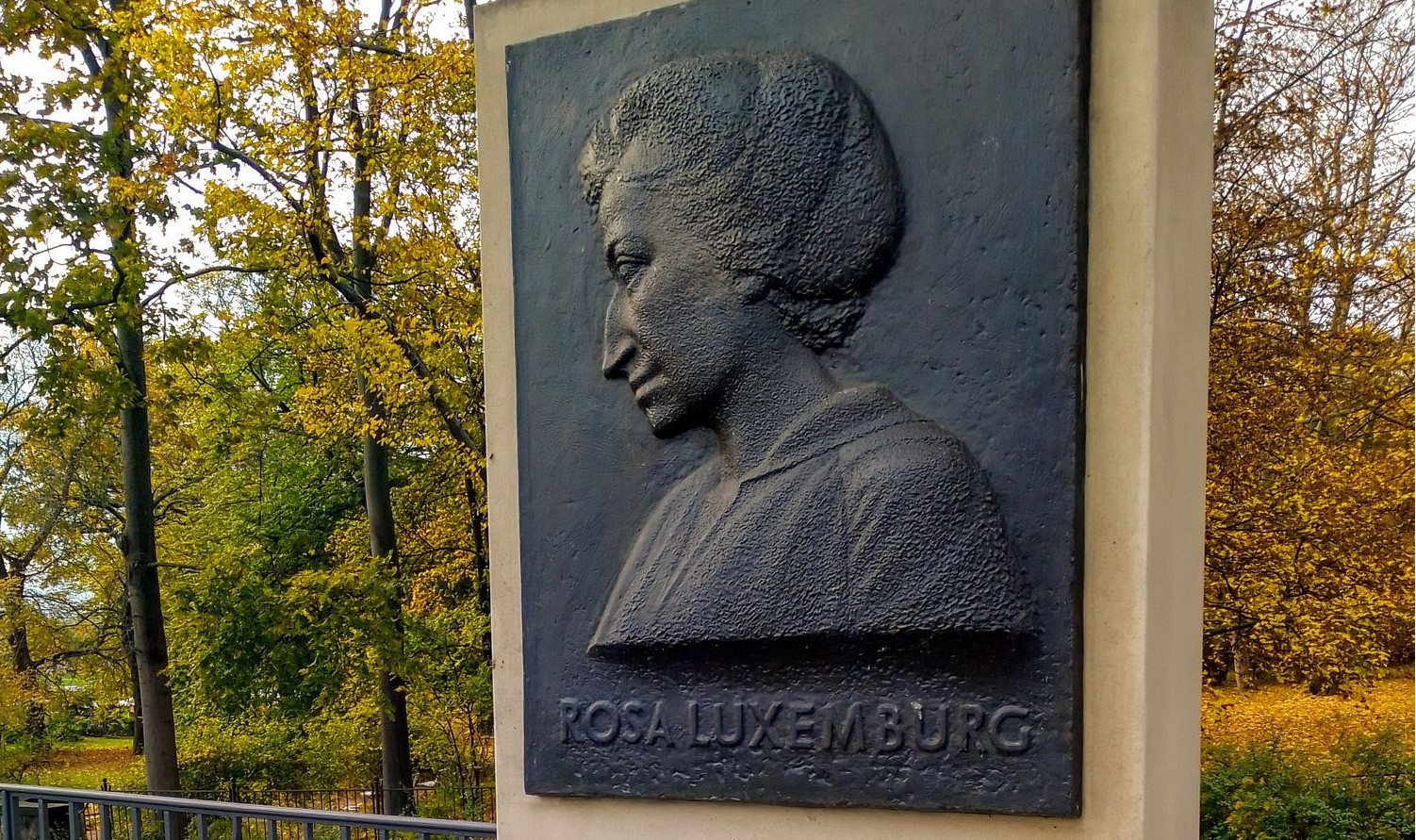
Rosa Luxemburg began her first jail term in August, 1904, sentenced to two months in Zwickau Prison for ‘offending the sovereign.’ In this letter Rosa looks forward to an Amsterdam trip with Luise when she is out, talks Schiller, Bebel’s censure of Max Schippel, and nurses a June bug.
‘From Zwickau Prison’ (September, 1904) by Rosa Luxemburg from Letters to Karl and Luise Kautsky, 1896 to 1918. Edited by Luise Kautsy, Translated by Louis Lochner. Robert M. McBride and Company, New York. 1925.
Undated, Zwickau, second half of September, 1904.
Can you imagine, dearest, how one feels when one receives letters like that last one of yours and is unable to sit down at once to reply? That is certainly adding cruelly to the punishment. In return, however, O how thankful I am to you when a sunny greeting like that casts its rays in here! The Sunny Child1 which you sent me has reached me safely and I can never tire of looking at it. It is a wonderful face; the oval especially reminds me of the Mona Lisa Gioconda.
Bremen makes an excellent impression upon me even as seen through the Mosse-rag2 upon which I am dependent. As regards the Max episode3 I had to tell myself with a sad smile that Nemesis in this case as so often otherwise strikes not the most guilty nor the most dangerous, but the least clever. What will he do now? I think he will say despite everything, “I’ll stick to you all the same.” In any case, as far as I can judge it, the general spirit is excellent. Of course, many things look very different from a distance. I am very curious to know what an impression Carl brings home with him. You will hear about it, of course; do write me soon. You know that every, even the smallest detail is of importance to me.—That you had not gone to Bremen surprised me, though at the same time it filled me with secret joy. One is so petty-minded: just think, because I could not be there I felt comforted to think that you, too, remained at Friedenau; it seemed to me as though you were nearer and I not so lonesome! How childish! How is Granny? Has she settled as yet? Give her my cordial regards. Cruel one, why don’t you send me the “wintry” picture? My guess is Granny. Have you explained to Troelstra and Mrs. Sjoukje that I am unfortunately unable to reply to their splendid letter? Aside from this, not a word from Holland! “Presageful angel” that I am, I took with me, as reading matter for my leisure hours, “your” Schiller,4 Vols. VII-IX: the history of the defection of the Netherlands. I am almost tempted to cry out with Marguerite of Parma, “And I wasted so much warm love upon this faithless people! Do you, as my faithful Alba, invade this apostate country with your mailed fist and remind it of its duties, of its vows.” But no, rather let their evil deeds ripen, and when we two go to Amsterdam in January or February, the United Netherlands are to be conquered for the second time! No quarter will be given.—Have you read Leop. Schmidt’s article on the opera in the Tageblatt? I was very well satisfied. But what will Herr Hans,5 who was so delighted at his Hfilsen,6 say? Even at this distance I felt by consulting the program that there is “nothing doing” now as before with the opera. Perhaps you are surprised to hear that I am thinking of music in my confinement. As a matter of fact, I am thinking about everything, and especially of joyous things. Do you know what picture of the future gives me the greatest recreation? When I picture to myself how you and I are going to “bum” in Amsterdam! That will be an awfully fine “escapade.” And the gang there must invite us to the opera—that will be a part of the tribute to be levied in connection with the coming re-capture of the country.—Day before yesterday I found a frozen June bug, a belated postscript to a summer that has passed, down in the courtyard that constitutes my “garden” for walking about. Of course I brought it to the nearest first-aid station—to a warm window in the kitchen, but I know nothing about its further fate. Yesterday, in the same courtyard, I found a tiny, pearl-grey, soft little feather, which in my ornithological feeble-mindedness I diagnosed as belonging to a young dove. Young Bendelein7 would certainly be in a better position to inform me as to who handed this anonymous visiting card to me. I had intended to send him the little feather with this letter as a “document humain” in these inhuman times, and therefore carefully took it with me into my cell after my constitutional, but now I’ve lost it after all. Bendel will no doubt wonder how one can “lose” anything in a cell that is 7 of my steps long and 4 wide. Alas, little Bendel, in so small a cell one can even lose a large object, as happened, for instance, on one occasion with my patience. It was a dank, rainy day and I looked in vain in my cell for the escaped one. But just then a bright letter came from Friedenau, and immediately I found her—this good-for-nothing lady lay close beside the letter on the table and sulked. I send you all heartiest kisses. Give my best regards to Franciscus and poor Paul.8
Your Rosina, Rosetta, as you please.
Dearest, perhaps you will write to Paris to inquire about Louise Guesde9 (Rue Rodier 5). She was dangerously ill and I am concerned about her.
NOTES
1. Photograph of Troelstra’s daughter. L.K.
2. Refers to the “Berliner Tageblatt,” owned by Rudolf Mosse. L.K.
3. At the Bremen party convention an exceedingly sharp vote of censure, introduced by Bebel, was passed against Max Schippel by a vote of 234 to 44. L.K.
4. Rosa had a queer aversion to Schiller, for which she assigned the still queerer motive that her mother had doted on him and she therefore could not stand him because of a childish spirit of opposition; besides, he seemed too “unmodern” to her. I was able gradually to persuade her that Schiller was precisely the right man for her, and gradually she developed into a great Schiller enthusiast. L.K.
5. Brother of Karl Kautsky, who was at that time royal theater painter at the Berlin Royal Opera. L.K.
6. Count Hfilsen, of an old Prussian aristocratic family, was a favorite of Emperor William II. He was then general manager (intendant) of the Royal Court Theatre. Transl.
7. Bendel, youngest son of the Kautskys. L.K.
8. Franz Mehring and Paul Singer. L.K.
9. Jules Guesde’s daughter. L.K.
Letters to Karl and Luise Kautsky from 1896 to 1918 by Rosa Luxemburg. Edited by Luise Kautsy, Translated by Louis Lochner. Robert M. McBride and Company, New York. 1925.
Contents: Introduction by Luise Kautsky, Beginnings, 1896-1899, Incipient Friendship1900-1904, From the Imprisonment at Zwickau to the First Russian Revolution, The First Russian Revolution 1905-06, Up to the World War 1907-1914, Letters from Prison During the War 1915-1918, Postscript by Luise Kautsky, Appendix: Biography of Karl Kautsky. 238 pages.
PDF of original book: https://archive.org/download/lettersofrosalux0000unse/lettersofrosalux0000unse.pdf
 Revolution's Newsstand