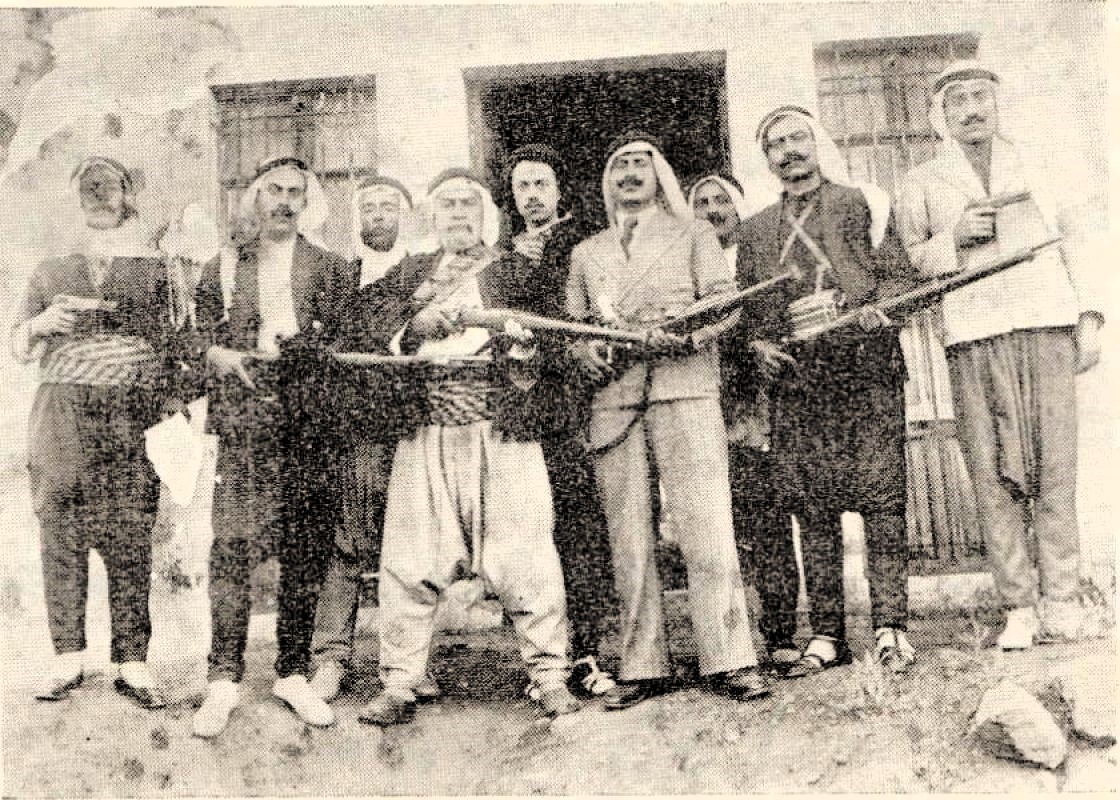
A leader of the Comintern’s ‘Near Eastern Department’ analyses the class and political forces at play in the Great Syrian Revolt of 1925.
‘Syria in the Struggle for Independence’ by P. Kataigorodsky from Communist International. Vol. 2 No. 17. October, 1925.
1. The Motive Forces of the National Revolution in Syria
THE rising in Syria has already lasted for almost four months. Up to the present the French command has been powerless to deal with the rising, despite the fact that it is every day receiving fresh military reinforcements from the metropolis. The rising is increasing more and more, like a snowball rolling down a mountain, and is embracing new districts. All the numerous tribes of Syria have come into the movement. Whole villages are being razed to the ground by the fire of tanks and batteries. Entire quarters of the largest urban centres have been pitilessly destroyed (witness Damascus).
The partisan movement is acquiring dimensions full of dangerous portent for the occupiers. A temporary revolutionary government has already been set up at Ham, one of the largest centres of the national liberation movement. This rising, which at the commencement was a separate and partial movement of the semi-feudal and patriarchal Jebel Druse, has become a general national movement within three months. It has also affected tribes which up till now have been the mainstay of the French occupation. Where are the roots of this rising and what are the motive forces of this national revolution in a country which has altogether a population of two and a half millions?
Different from other countries of Asia Minor, Syria is most “advanced” in the sense of the development of industry and the class differentiations of the population. Neither Palestine, nor Iraq, nor any of the Arab countries as a whole can be compared with Syria in the development of capitalist relations and social classes. Of course, this should all be understood relatively. Syria is still far from being an industrial country in the European sense of the word. The main industry was and remains agricultural. Sixty-five to seventy per cent. of the population is engaged in agriculture, only 15 to 18 per cent. in town handicrafts, and 10 per cent. of the population in trade. Industry is mainly of a handicraft nature. Only in Damascus, Aleppo and Beirut are small factories and works to be found, in which the number of workers engaged is up to 300. But such factories can be counted on one’s fingers. Out of a total of 100-120 industrial enterprises existing in Syria, the majority of 80 per cent. contained not more than an average of 20-30 workers.
The national-industrial bourgeoisie in Syria is almost completely non-existent. The entire heavy industry is almost completely in the hands of Europeans, mainly French capitalists. At the end of 1924, the French “Satiety for the Defence of Productive Forces in Syria” invested about 380,000,000 francs in Syrian enterprises. The native bourgeoisie owns chiefly domestic handicrafts and trades. Native capital is for the most part concentrated in the sphere of trade circulation. This national trading capital has to meet the almost insupportable competition on the part of European capital which makes use of the regime of capitulations in force since the days of the Turkish Sultan.
In addition to a fairly numerous urban bourgeoisie, there is a very considerable stratum of large-scale agrarians in Syria, in whose hands about 60 per cent. of all lands is concentrated. Only in Northern Syria–28 per cent. of all land plots remains in the hands of the peasantry. All the remaining lands are concentrated in the hands of the “Effendi” (prince-landowners), who by means of various rights and usurped rights have seized the land from the Syrian peasants.
The system of leases is very widely developed. The Arab fellaheen are compelled to give the landowners from one-sixth to one-half of the harvest. The heavy land tax “Oshar,” which has already been abolished by the Republican Government of Turkey, continues to oppress the Syrian peasantry. The Syrian villages have been greatly split up. In a report published by the French Commissary in 1922, there are fairly characteristic statistics describing the social position of the Syrian countryside. For example, it is established that throughout all Syria there are about 700,000 landless peasants, petty leaseholders and journeymen. Nearly three-quarters of a million of the population is thus comprised of petty farmers and landless peasants. In the social respect, the Syrian countryside is split up into two diametrically opposed classes, small quantities of large landowners and a tremendous stratum of landless. Between these two diametrically opposed classes a fairly thin stratum of rich peasants is wedged. Unfortunately we have no accurate and scientifically worked-out statistics on the Syrian countryside.
But in general outlines, the picture here given corresponds with reality.
In the towns there is also a strongly differentiated population. On the one hand are the merchants who are divided up into large, middle and a numerous class of petty traders; then there is the handicraftsmen class, also very numerous, and on the other hand a fairly large class of higher industrial workers employed, domestic servants, etc.
In the town of Damascus alone, there are about 75,000 to 80,000 people engaged in home or factory industries as hired workers, semi-artisans or semi-proletarians. The exploitation of child and woman labour is widespread in Syria. Such is a brief picture of the social classification of Syrian society, which is unequalled in any other of the neighbouring countries of Asia Minor.
But, side by side with the fairly pronounced commencement of capitalism in the large urban centres, we have also districts in Syria in which the features of primitive, natural-patriarchal economy, such as in the Jebel Druse for instance, on the borders of Trans-Jordania, are still preserved in all their nakedness. Besides this, there is a nomad population of Bedouins who comprise approximately one quarter of the entire Syrian population.
The national liberation movement in Syria is nourished by a tremendous reserve of discontent with their political and economic situation, of almost all strata of Syrian society, with the exception of certain groups of corrupted, landed aristocracy.
Of course, not all classes, oppositionally inclined to the French mandate, take equal part in the national revolution. The higher strata of the trading bourgeoisie and the Syrian nobility are not striving for revolution, but for reconciliation, contact and collaboration with French capital. Although at the present time all Party groupings of the Arab movement are putting forward simultaneous demands for the independence of Syria, nevertheless, each social group places its own class content in this slogan. The large landowners and tradesmen regard an armed struggle as the extreme measure of pressure on the French, in order to make them give for example the following concessions: (1) verbal recognition of an “independent” national government in reality subject to the French authority; (2) receipt of financial aid from French capital for building work in Syria, and (3) participation of the national government, i.e., of the large Syrian bourgeoisie, in the exploitation of concessions in the hands of the French. To this group belong the large landowners Nassib Bey Bakri and Ramadan Pasha-ibn-Shalash, who went over to the opposition and were even at the head of the national Government that was set up.
The wide masses of toilers of Syria–workers, artisans, small traders and peasants–are striving sincerely not in words, but in deeds for complete, not verbal, but actual political independence. The interests of these strata are reflected by the leaders of the Left nationalists such as Shakh Bandar, Tali, sincere revolutionaries who have understood the necessity for an armed struggle with French imperialism and have guessed at the role and aims of ·British imperialism which has flirted with the nationalists. In addition to these groups there are other forms of Syrian nationalists who also are in favour of a fight to a finish with French imperialism, but want the mandate to be handed over to Great Britain. This group is extensively furnished with financial assistance by British agents.
Taken as a whole, the Syrian bourgeoisie is the organiser of the national liberation movement, utilising excellently the general discontent existing in the country, to further its objects. It is true there is not yet a common language between the various political groupings; there is not yet a single generally recognised national centre, just as there is not a single leadership. At the commencement of September the leader of the Left nationalists, Dr. Shakh Bandar, who is well known for his attempt to form a “people’s party” with an extensive republican-democratic programme, was successful during the first raid of the Druses on Damascus (August 25) in hiding from the persecution of the French police, getting back to the Jebel Druse and together with the leader of the Druses, Al-Atras, setting up a temporary revolutionary government. The slogans pronounced by Shakh Bandar on behalf of the revolutionary government were radical, courageous and revolutionary. The demand was put forward for complete evacuation of the French troops, declaration of Syria to be a sovereign State and the summoning of an All-Syrian Constituent Assembly.
After the second raid of the Druses on Damascus (October 18th), which brought about the senselessly and incalculably cruel bombardment of those parts of Damascus affected by the rising–a bombardment which aroused a considerable section of the population against the French and stimulated the Arabs, who had been left without a roof above their heads, to join the insurrectionary detachments–another revolutionary government was set up in Khim, with the landowners Bakri and Shalash at its head. This second government was not so radical as the first.
We thus see that the rising is still without any united leadership from one centre and that in this rising the desires of various social groups of Syrian society have found their political expression. Only in the subsequent development of revolutionary events, may one expect the merging of all the separate insurrectionary detachments into a single revolutionary army under a common command.
The national revolution in Syria contains within itself tremendous possibilities and is fraught with serious consequences for the imperialist dominators. A section of the ”capitalised” landowners, trading bourgeoisie, workers, handicraftsmen and peasantry is at the present time entering into a united front against French imperialism.
The French themselves, with their idiotic colonisation policy have thrown into the arms of the revolution the tribes that had been fighting among themselves, and have united them with a single sentiment of hatred for the French yoke. The French proconsuls Courot, Weygand and Sarrail, with efforts that are worthy of a better fate, have established in Syria a kind of rotation-crop national system which is sowing the seed of dissension and intrigue among the Syrian Arab tribes. This, in respect to the religion formed into almost 27 sects, is now reaping its well-deserved harvest.
2. International Significance of the Syrian Rising.
At the present time Syria is the object primarily of British desire. Geographically Syria is linked up with Mosul. The British have already for some time been projecting the construction of a railway which should run from Jaffa to Baghdad through the Syrian Desert. This railway pursues economic and strategical objects; on the one hand the delivery of Mosul and Persian oil to the Syrian coast of the Mediterranean Sea, and on the other the dispatch of troops direct into the Mosul district.
The British are intriguing in Syria against the French with extreme adroitness. As far back as 1920 their puppet “king” Feisal, son of the Emir Hussein of the Hedjas, was on the throne. He belonged to the Hashimite family. It was only the French renunciation of Mosul at the San Remo Conference (24-4-1920) for the benefit of the British, which induced the latter to concede to the French the mandate over Syria. But despite the fact that formally the British conceded Syria to France, in reality they did not stop intriguing against her, utilising every set-back to the French occupational authorities with a view to bringing over the Arab nationalists on to their own side. It is already accurately established that British agents are affording certain nationalist Arab leaders financial and military assistance. The material has up till quite recently been obtained from TransJordania, where the Emir Abdullah, also a British puppet, is on the throne.
The bloody events in Damascus which took place on October 18-20th, gave a section of the British press a pretext for coming out openly in favour of depriving France of her mandate over Syria and handing same over to Great Britain. For example, the journal “Near East” of Nov. 6th, in an article on “France and Syria,” placed the dots on the “i’s” and demanded the “amalgamation of Syria and Palestine under a united British mandate, as the only means capable of pacifying the Arabs.”
It is true that this viewpoint was not shared by the entire leading British press, draped in the toga of a defender of the Arabs from the “imprudence” of General Sarrail. It is possible, that it is not particularly desirable for England to have Turkey as her direct neighbour on the North of Syria. It would rather be more advantageous for the British to have here a third Power between themselves and Turkey. But it is important for the British to weaken French influence in Syria and to create such a state of affairs there whereby Syria, sheltering British domination in the North from the Turks, would give complete freedom of economic expansion to Great Britain.
A section of the big French press, such as “Le Journal” and “Belair,” has already started a campaign for the evacuation of Syria, evidently reflecting the interests of French capitalists, who have invested their capital in Syrian enterprises. The rising has ruined the silk and cotton plantations, and has brought tremendous losses to their owners, mainly the banks. These financial groups, which support the Left bloc, consider that with an evacuation decided upon through diplomatic channels, it might be possible to arrange compensation for capital invested in Syria.
The Herriot group, on the contrary, opposes evacuation, because the Lyons Chamber of Commerce, which represents the interests not of the silk plantation owners, but of the owners of the silk manufacturing industry, are interested in cheap raw material. The paper “L’Action Francaise” points out that apparently certain French military circles, including General Sarrail, deem it sufficient to preserve a naval base in the district of Beirut-Tripoli, abandoning the hinterland which has caused so much trouble.
One way or the other, the bloody events in Damascus have considerably weakened French prestige in the East and have played into the hands of Great Britain. Meanwhile, Italy also would not be loath to receive a mandate over Syria given up by France. The semi-official newspapers, organs of Mussolini, made unambiguous statements on this subject quite recently.
Turkey, on its part, would not think twice about utilising the events in Syria in order somehow or other to get back the Northern District with the chief town of Alexandretta, which had been handed over to France, and where the Turkish population dominates.
The League of Nations, which in 1923 entrusted France with a definitely formulated mandate over Syria “with the object of culturally enlightening the Syrian population which has so much trust in France,” has bitten off more than it can chew and did not even want to send a Commission to investigate events in Damascus.
But all these gentlemen are reckoning without their host. The rising in Syria has its main repercussion on the entire Arabian East. The British themselves understand that they are playing with fire. They have moved up tremendous military forces towards Metulla (Trans-Jordania), so as not to allow the movement to spread to Palestine. Whether they will be successful in this is a big question.
The national bourgeois revolution in Syria is as yet in the first stage of its development.
If military activities in Syria drag out until the spring of next year, a general upward trend of the national-liberation movement in all Mussulman countries bordering on the Mediterranean Sea is inevitable. In Algiers, in Tunis and Tripoli, in Palestine and Egypt, the situation is growing very favourable for the liberation movement. This crisis is increasing. When it bursts forth in full force, the hour of retribution will be terrible for the imperialists.
P. KITAIGORODSKY.
The ECCI published the magazine ‘Communist International’ edited by Zinoviev and Karl Radek from 1919 until 1926 irregularly in German, French, Russian, and English. Restarting in 1927 until 1934. Unlike, Inprecorr, CI contained long-form articles by the leading figures of the International as well as proceedings, statements, and notices of the Comintern. No complete run of Communist International is available in English. Both were largely published outside of Soviet territory, with Communist International printed in London, to facilitate distribution and both were major contributors to the Communist press in the U.S. Communist International and Inprecorr are an invaluable English-language source on the history of the Communist International and its sections.
PDF of full issue: https://www.marxists.org/history/international/comintern/ci/new_series/v02-n17-1925-new-series-CI-grn-riaz.pdf
 Revolution's Newsstand