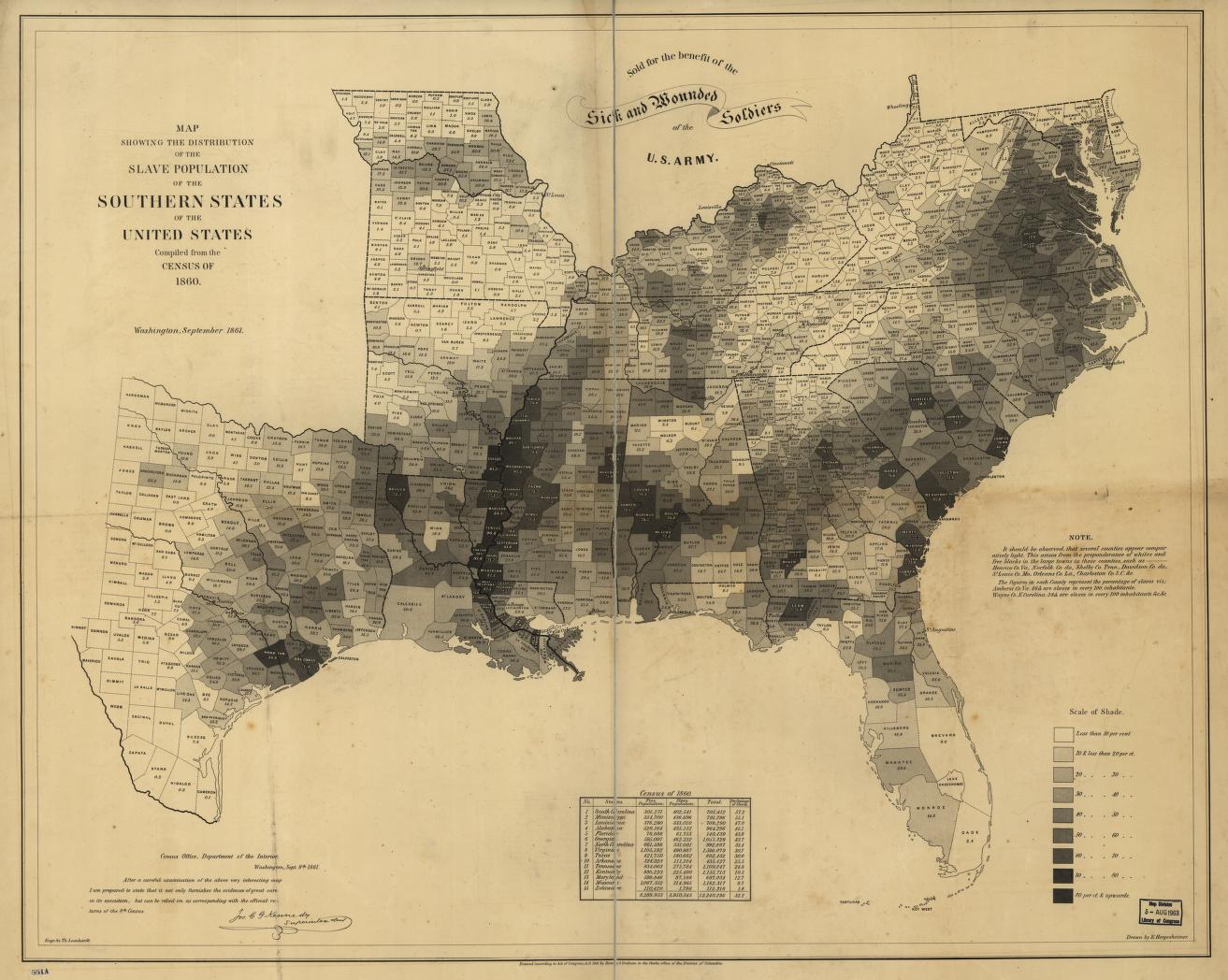
Weisbord revising the revisionists. With the late-30s Popular Front appealing to U.S. history for its legitimacy, the broader left reengaged that history, coming to many different conclusions, as Weisbord does here.
‘The Forces Leading to the American Civil War’ by Albert Weisbord from Class Struggle (C.L.S.). Vol. 7 No. 3. March, 1937.
Like the English Civil Wars of the 17th century, the American Civil War of the 19th has not by any means been sufficiently studied by Marxists of this country. In our articles on Abraham Lincoln and on John Brown, we have touched on this period of American history through the medium of biography. In this article we mean to make a slight sketch of the forces leading to the irrepressible conflict of 1860. Three distinct sets of antagonistic forces focused to produce that terrible conflict, namely, the South, the West and the East. In the early part of the 19th century the West broke away from the South and allied itself with the East or North. This shift was decisive for the struggle that ultimately broke out in the country.
The West represented the small agrarian property holder, who was trying to seek his fortune, to remain independent, retaining control of the means of production, and to escape from the increasing pressure of the State. Up to the 19th century, Western individualism could run away from the State; from then on, it had to face the State and capture it. The Liberal State was catching up with both farmer and frontiersmen. Slavery, too, was pressing its spurs into the independent small owner. Representing agrarian individualism, a vast democratic movement arose among the lower propertied elements especially of the West.
In its fight against the State, the democratic West could find friends among the Southern plutocracy. Having spurned as allies the hired laborer and slave, both of whom were alien to the region, the West could turn nowhere else for better support. On their side, too, the Southern slave holders could here play a profitable game. The South was losing out in its economic struggles against the Northern capitalists. It needed the West for its aims of Western expansion. It could use the West in joint battles against the North and East. At the same time the Southern oligarchy did not fear democracy. In the vast domains under its control, there was a slavery, which no one had yet dared to challenge.
It was to cement this alliance that the South could tolerate Jeffersonian democracy. “Jeffersonian Democracy did not imply any abandonment of the property and particularly the land qualifications on the suffrage of office holdings; it did not involve any fundamental alterations in the national constitution, which the Federalists had designed as a foil to the levelling propensities of the masses; it did not propose any new devices for a more immediate and direct control of the voters over the instrumentalities of government. Jeffersonian Democracy simply meant the possession of the federal government by the agrarian masses led by aristocracy of slave owning planters, any capitalistic groups, fiscal, banking, or manufacturing.” (C.A. Beard: Economic Origins of Jeffersonian Democracy).
Thus, too, at the time of the Missouri Compromise, when the cry of the abolitionists was already to be heard, the `democrat’ Jackson could suggest to congress, “To pass such a law as will prohibit under severe penalties the circulation in the Southern states of incendiary publications intended to instigate the slaves to insurrection.” (S.B. Leacock: Lincoln Frees the Slaves). This was the price the West paid for the Southern connections.
By the time of Andrew Jackson, however, the West, with its frontier now at the Mississippi, was beginning to find its voice. It could not be coerced; It would have to be duped. Larger concessions had to be made to those rough Westerners if the South was to maintain its control. Under Andrew Jackson, the Jeffersonian name of Republican was changed to Democrat and the franchise was extended, the old `rascals’ were cleaned out of political office and the Westerners were allowed to taste the bribes of government for the time being.
Incidentally, it is interesting to compare this rough democratic movement of the West with the genteel democratic sighs of such effete Easterners as Ralph Waldo Emerson, now hailed by so many Liberals. Writing in 1844, Emerson could declare: “The spirit of our American Radicalism is destructive and aimless. It is not loving; it has no ulterior and divine ends, but is destructive only out of hatred and selfishness.” The Concord School of thinkers headed by Emerson and Thoreau tried hard to run away from rude reality. They built little Utopias. They became mystics, transcendentalists, believers in oriental philosophies. They succeeded in escaping reality so well that as late as 1859, Emerson could write: “No man living will see the end of slavery.”
2
The alliance between Western individualism and the slave power could not last long. The future of individualism lay in Northern competition and not in the Southern slave camps. By means of canals and water routes the West was being bound up firmly with the Eastern cities. Hitherto Western products had been shipped down the southward flowing rivers to New Orleans. Situation on these rivers, Cincinnati, Louisville, Pittsburgh, became great traffic centers and were hooked up with all Southern markets. But in 1825, the Erie Canal was completed and freight rates dropped from $100 a ton to $15 or $25. Rapidly there arose a whole network of canals in the Northwest territory, connecting Ohio, Michigan, Pittsburgh and Cincinnati directly to the East.
The second blow in prying the West from the South came simultaneously with the canal network. The West, from the Appalachians to the Mississippi, had become the great granary of the world. In 1840, the West produced 7.4 bushels per capita, in 1860, 13.3 bushels. Self sufficient farming disappeared and in its place arose capitalist commercial farming. While the time of this shift varied for different portions of the Western farming area, by 1830, Ohio had generally completed this adjustment and by 1850, it was joined by the States farther West, Indiana, Illinois, Michigan and a part of Wisconsin.
And with this specialized farming came machinery produced in the North and East. In 1840, wheat was generally broadcast by hand; by 1850 the drill was rapidly coming into use and much of the wheat in the Mississippi Valley was now sown by machine. In the early ‘40’s wheat was reaped with a cradle; after 1860 the employment of the reaper swiftly increased. By 1850, most of the threshing also was done by portable machinery.
The final blow in tying up the West with the East was given by the railroads, running East and West and not North and South, that signalized the great railroad boom period of 1850-1860. The effects were immense. In the three years ending 1852, Cincinnati shipped 1,001,000 barrels of flour to the South and 37,000 barrels shipped to the East. By 1860 the three year total had changed to 300,000 barrels shipped South and 1,375,000 to the East. Nor was this all. entirely new centers were being built up far superior to the more Southern ones. In 1836, Chicago had shipped 78 bushels of grain, in 1850, 1,831,000 bushels and in 1860, 31,100,000 bushels. Already by 1850 the number of hogs packed at Chicago had exceeded the number packed for the Southern market..
Not only Chicago, but innumerable Western towns became absolutely dependent for their livelihood on the railroad and on Eastern capitalists. Far from attacking the railroads, Western States did their utmost to bring them in. Every professional politician and lawyer, who could do so tried to get into the pay of the railroads, which in turn, were only too glad to link themselves up with the legal and political lights of the times.
Thus, in this tug of war between North and South for the West, the North had to emerge victorious. The discovery of gold in California hastened the need for complete victory. Now the North could afford to play its trump card, a card, which the South could never match, namely , a free homestead to every man.
We have seen that even in the early days of the 18th century, the pinch of high land prices had been felt. Now the enclosure of the common lands in New England, the relentless drive of the Southern plantations and the rapid growth of the country had created an ever present land hunger, which in the light of the vast continent that stretched before the Americans, created an absolutely intolerable set of contradictions. The commercialism of agriculture and the discovery of gold had raised all land prices and had caused a land dearth greater than ever. This only accelerated westward expansion and sharpened the demand for free land. Finally, there was the new powerful force, calling for rapid capitalist cultivation of the West, namely, the railroads, backed up by the new metal machinery factories springing up. Eastern railway and finance capitalists could now unite with the Western farmers to push the West to the limit.
The slogan for a free homestead for every man took on such momentum as to become irresistible. With this slogan, the East was able to split the Middle West away from the Southern squirearchy to which it had been wedded so long, and to build a new Republican Party, in 1856.
To the Northern capitalists the opening up of the West was needed for another reason. The revolutions of 1848 in Europe had driven many revolutionary elements to these shores. These Irish, German and other colonists were far from docile. Settled in the new land they at once began to organize political societies and unions. The ‘50’s were marked with strikes and in the great crisis of 1857, the misery of the masses in the midst of plenty led to a dangerous situation. The Homestead Act was thus a measure calculated to stave off the Labor Problem becoming increasingly pressing in the Eastern cities. As the Beards put it: “Energies, which in the normal course of affairs would have been devoted to building up trade unions and framing schemes of social revolution were diverted to agitation in favor of a free farm for every working man, whether he wanted it or not.” (C.A. and M. Beard: Rise of American Civilization).
3
The economic battle, having been won so peacefully, it seemed that all that was necessary was to wait. But for this very reason the South could not wait. Up until 1860, it had dominating control of the Federal Government. Desperately it was trying to maintain this control and steadily it was losing out.
It has been popularly propagandized by historians and publicists that the Civil War was a struggle between a pre- capitalist slave system and modern capitalism. In this way, two ideas are emphasized: first, that slavery is incompatible with capitalism and second, that the Liberal capitalists freed the slaves. Here, then is another myth that has to be exploded.
The fact of the matter is that Negro slavery formed the very basis of the capitalist system in the United States. As we have seen it was the only way to get the laborer to work for another’s profit. It is estimated that about twelve million Africans were brought here in chains, not counting the untold millions killed in Africa or on the passage over.
During the Revolutionary War, Virginia Liberals and Pennsylvania Quakers declared against the slave trade and tried to stop further lawful importations. It was hard to maintain the principle of Slavery and the Declaration of Independence at the same time. (Indeed, later on the South was to denounce the Declaration of Independence.) Besides, the British were trying to stir up the slaves to rebellion. The newly imported Negroes were always the most recklessly militant and more time had to be allowed for their assimilation. The end of the slave trade, too, was calculated to deal a great blow to England and her West Indian colonies.
Ultimately, the deciding factors were economic, not political. The chief crop at the time, certainly in Virginia, the key State, was not cotton, but tobacco, and here white labor was decidedly superior. Besides, there was a great glut on the slave market. Already the South had become divided into regions in which the role that had been assigned to such States as Virginia and Maryland was that of a slave breeder. Thus, the struggle to stop the slave trade was at bottom a struggle to wipe out Virginia’s and Maryland’s foreign competition. And it was the New England States, particularly that most Liberal of all, Rhode Island, which blocked Virginia’s move.
In the end Virginia prevailed. With the termination of this foreign competition, Virginia was able to give some basis for its tradition of treating slaves well. To feed the slaves well and to bring them together so that they could produce plenty of slave children was a basic point in Virginia economy. And if the Negroes themselves would not produce enough children, the master could always call in the Negro women and either turn them over to his foremen or do the job himself. The South land, proud of its traditions of Southern chivalry, organized the greatest system of rape known to history.
In the ancient world where slavery was part of a self sufficient economy, and everything had to be produced on the place, the slave was often an educated craftsman. He was treated well and sometimes taken into the family. Such was not the slavery of the one-crop South, where cotton ruled. Education was forbidden. Conditions were fearful. Torture and terror were constantly applied. There was no redress save insurrection.
With the invention of the cotton gin, when great quantities of cotton could be shipped out to the world market, in other words, when the plantation system of the South became linked up with the capitalist system of the rest of the world, slavery became highly profitable and the number of slaves rapidly increased. The South became wedded to its `peculiar institution’.
But it was not only the South that benefitted. The Napoleonic Wars had accelerated the industrial revolution, particularly in cotton textiles. Cheap cotton became the very life food of British industries. It built up New England factories. It formed the basis of countless fortunes in every walk of life. As English cotton consumption jumped from 13,000 bales in 1781 to 3,386,000 bales in 1860, Southern production leaped to five million bales. Slavery made cotton king.
Here was the basic reason for the terrific hostility to the Abolition movement on the part of certain elements in the northern cities. These were the elements that were to sabotage the cause of the North. Now we can also better appreciate why so many British Liberals refused to aid the North in the Civil War. Gladstone wanted to get France and Russia to unite with England to stop the Civil War and thus recognize the South. Cobden argued that the South was more Liberal than the North since it believed in free trade! Bright believed that the South would be able to secede (but he didn’t want war with the United States), while Cairnes was sure that both the occasion and the moral feeling of Europe demanded that the South should be allowed to secede as this would be also better for the North! All these gentlemen had built their pyramids on the backs of Negro slavery and they were afraid their whole civilization would crash to earth.
Yet, by 1860, despite all, the South had come to the end of its rope. Slave labor was very wasteful and for it to be profitable there was needed an abundance of fertile soil and a crop, which demanded a steady combining of labor. Thus there arose large plantations, which could be devoted solely to cotton, for only cotton permitted large numbers of people to be used ten months in the year.
As the fertile soil became worn out, two methods were open to the Southern planter, namely, either the renewal of the soil through scientific methods of fertilization and use, or abandonment of the old plantation and utilization of fresh lands. Now the first alternative was completely closed to the Southern planter by the very institution of slavery. Slavery meant sparsity of population. It spelled the absence of towns and community isolation. It frowned on good highways and easy methods of communication. It meant dense ignorance. Only the coarsest and crudest tools could be given the slaves. The more machinery took hold in the grain belt, the more reactionary became slavery in the cotton belt.
Frenetically, the South took to the second alternative, territorial expansion. In spite of the sparsity of population, a ferocious land hunger made itself felt, forcing the South to push on towards the West. Slavery took Florida. It took Louisiana. It took Texas. it sent marauding expeditions into Mexico, into Cuba, into Nicaragua. Crowding behind the Mason-Dixon line, the South turned its attention to the North. it sent its `poor white trash’ into Kansas and Nebraskan Border Ruffians to terrorize the countryside. But the Border Ruffians were met by the John Browns. Finally, through its mouthpiece, Chief Justice Taney, it decided in the Bred Scott Case that there would no longer be recognized any territorial limits to slavery.
So, by 1860, the issue had now become clear—All or nothing: Either unlimited expansion, or the South would be choked to death by the operating law of diminishing returns. Feverish foreign policy became choleric domestic policy. The irrepressible conflict was at hand.
The Communist League of Struggle was formed in March, 1931 by C.P. veterans Albert Weisbord, Vera Buch, Sam Fisher and co-thinkers after briefly being members of the Communist League of America led by James P. Cannon. In addition to leaflets and pamphlets, the C.L.S. had a mostly monthly magazine, Class Struggle, and issued a shipyard workers shop paper,The Red Dreadnaught. Always a small organization, the C.L.S. did not grow in the 1930s and disbanded in 1937.
PDF of original issue: https://archive.org/download/the-class-struggle_1937-03_7_3/the-class-struggle_1937-03_7_3.pdf
 Revolution's Newsstand