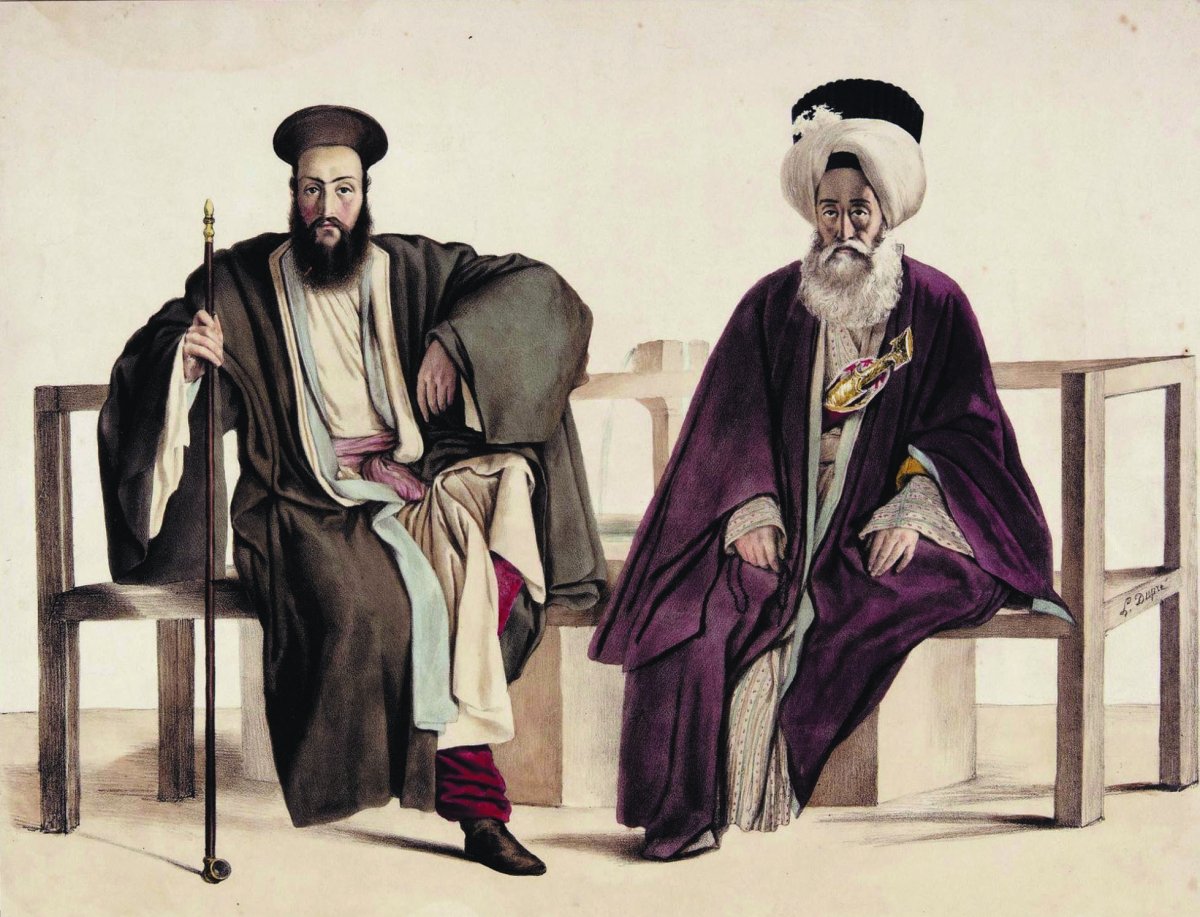
Marx uses the Macedonian Revolt of 1854 to look at the role of the Greek Orthodox Church amid cries of ‘Christian persecution’ in England.
‘The Greek Insurrection’ by Karl Marx from the New-York Daily Tribune. No. 4039. March 29, 1854.
The insurrection among the Greek subjects of the Sultan, which caused such alarm at Paris and London, has now been suppressed, but its revival is thought not impossible. With regard to this possibility we are able to say that after a careful investigation of the documents relating to the whole affair so far, we are convinced that the insurgents were found exclusively among the mountaineers inhabiting the southern slope of the Pindus, and that they met with no sympathy on the part of the other Christian races of Turkey, save the pious freebooters of Montenegro; and that the occupants of the plains of Thessaly, who form the only compact Greek community still living under Turkish supremacy, are more afraid of their compatriots than of the Turks themselves. It is not to be forgotten that this spiritless and cowardly body of population did not dare to rise even at the time of the Greek war of independence. As to the remainder of the Greek race, numbering perhaps 300,000 souls, distributed throughout the cities of the Empire, they are so thoroughly detested by the other Christian tribes that, whenever a popular movement has been successful, as in Servia and Wallachia, it has resulted in driving away all the priests of Greek origin, and in supplying their places by native pastors.
But although the present Greek insurrection, considered with reference to its own merits, is altogether insignificant, it still derives importance from the occasion it affords to the western Powers for interfering between the Porte and the great majority of its subjects in Europe, among whom the Greeks count only one million against ten millions of the other races professing the Greek religion. The Greek inhabitants of the so-called kingdom as well as those living in the Ionian Isles under British rule consider it, of course, to be their national mission to expel the Turks from wherever the Greek language is spoken, and to annex Thessaly and Epirus to a State of their own. They may even dream of a Byzantine restoration, although, on the whole, they are too astute a people to believe in such a fancy. But these plans of national aggrandizement and independence on the part of the Greeks, proclaimed at this moment in consequence of Russian intrigues, as is proved by the lately detected conspiracy of the priest Athanasius, and proclaimed too by the robbers of the mountains without being reechoed by the agricultural population of the plain–all have nothing to do with the religious rights of the subjects of Turkey with which an attempt is made to mix them up. As we learn from the English journals and from notice given in the House of Lords by Lord Shaftesbury, and in the Commons by Mr. Monckton Milnes, the British Government is to be called upon in connection, partly at least, with these Greek movements to take measures to meliorate the condition of the Christian subjects of the Porte. Indeed, we are told explicitly that the great end aimed at by the western Powers is to put the Christian religion on a footing of equal rights with the Mahometan in Turkey. Now, either this means nothing at all, or it means the granting political and civil rights, both to Mussulmans and Christians, without any reference to either religion, and without considering religion at all. In other words, it means the complete separation of State and Church, of Religion and Politics. But the Turkish State, like all Oriental States, is founded upon the most intimate connection, we might almost say, the identity of State and Church, of Politics and Religion. The Koran is the double source of faith and law, for that Empire and its rulers. But how is it possible to equalize the faithful and the Giaour, the Mussulman and the Rajah before the Koran? To do that it is necessary, in fact, to supplant the Koran by a new civil code, in other words to break down the framework of Turkish society and create a new order of things out of its ruins.
On the other hand, the main feature that distinguishes the Greek confession from all other branches of the Christian faith, is the same identification of State and Church, of civil and ecclesiastical life. So intimately interwoven were State and Church in the Byzantine Empire, that it is impossible to write the history of the one without writing the history of the other. In Russia the same identity prevails, although there, in contradistinction to the Byzantine Empire, the Church has been transformed into the mere tool of the State, the instrument of subjugation at home and of aggression abroad. In the Ottoman Empire in conformity with the Oriental notions of the Turks, the Byzantine theocracy has been allowed to develop itself to such a degree, that the parson of a parish is at the same time the judge, the mayor, the teacher, the executor of testaments, the assessor of taxes, the ubiquitous factotum of civil life, not the servant, but the master of all work. The main reproach to be cast upon the Turks in this regard is not that they have crippled the privileges of the Christian priesthood, but, on the contrary, that under their rule this all-embracing oppressive tutelage, control, and interference of the Church has been permitted to absorb the whole sphere of social existence. Mr. Fallmerayer very amusingly tells us, in his Orientalische Briefe, how a Greek priest was quite astonished when he informed him that the Latin clergy enjoyed no civil authority at all, and had to perform no profane business. “How,” exclaimed the priest, “do our Latin brethren contrive to kill time?”
It is plain then that to introduce a new civil code in Turkey, a code altogether abstracted from religion, and based on a complete separation of State and Church, would be not only to abolish Mahometanism, but also to break down the Greek Church as now established in that Empire. Can anyone be credulous enough to believe in good earnest that the timid and reactionary valetudinarians of the present British Government have ever conceived the idea of undertaking such a gigantic task, involving a perfect social revolution, in a country like Turkey? The notion is absurd. They can only entertain it for the purpose of throwing dust in the eyes of the English people and of Europe.
Karl Marx and Frederick Engels (for Marx) wrote hundreds of articles in English for the New York Daily Tribune which ran from 1841 and was closely associated with Horace Greeley and, until the founding of the Republican Party, progressive Whigs. Marx contributed from August 1851 to March 1862 as the Tribune’s London correspondent. One of the largest papers in the U.S., Marx’s work was read widely, including by Lincoln who was a subscriber. The Tribune was an important outlet for Marx’s political ideas in the years of European reaction between the failure of ’48 and the International. Marx would break with the paper in 1862 over its increasing conservatism and compromising attitude towards the abolition of slavery during the Civil War. The ten years of political writings for the Tribune in the 1850s, often covering European wars, empires and politics, show Marx’s evolving understanding of imperialism, particularly his work on India and China.
PDF of full issue: https://chroniclingamerica.loc.gov/lccn/sn83030213/1854-03-29/ed-1/seq-1/
 Revolution's Newsstand