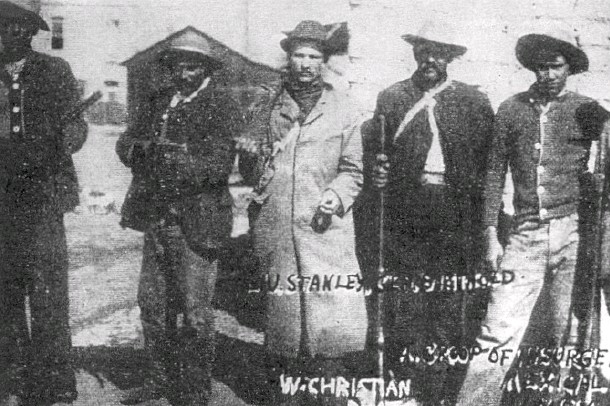
Details on the death of volunteer William Stanley in the Insurrecto army of the anarcho-syndicalist Liberal Party in northern Mexico. Stanley was born in Canada, moved to California, became a wobbly in Imperial Valley, where he was secretary of I.W.W. Local 413. A deserter from the U.S. Army who, like many other wobblies including Joe Hill, fought in Mexico. There Stanley led the PLM ‘Foreign Legion’ rising to ‘General.’ On April 11, 1911 comrade William Stanley was shot and killed during an ambush by his column of 80 men on a regiment of 500 Federals.
‘William Stanley: Soldier of Liberty’ by Ethel D. Turner from Regeneracion (Los Angeles). Vol. 4 No. 33. April 15, 1911.
Stanley is dead, “little wild-cat Stanley,” as one writer called him, the only one of the rebel force who fell mortally wounded. He is dead, but by his glorious charge of April 8 he has blazoned his name on the scroll of immortal heroes.
Stanley was no soldier of fortune. He was no mere adventurer. He fought because he hated all tyranny, because he was a champion of the oppressed. Like Lafayette he went to another country than his own to fight for the cause of liberty, for where the people were in arms against tyranny, there were his heart and his cause.
He was not a stranger to the proletarian cause in this country. In Spokane he was for thirty days in jail on bread and water during the free speech fight.
Stanley, Guerrero, Alanis, Jiminez, Fuertes and many other brave men have died, but from their ashes ever rises the glorious phoenix of liberty, to make hundreds of soldiers where there was but one before.
*****
Stanley Dies in Glorious Victory.
Rebels Lose One, Federals Sixty-Eight.
And the papers called that a defeat–that exultant charge of Stanley and his eighty men from Mexicali south upon four hundred federals! Look at the figures above–figures now verified from several sources. Look at them, read the story and judge for yourselves.
On Saturday morning, April 8, with several wagon-loads of provisions, Stanley’s band, consisting of twenty men on horseback and sixty-five on foot, sallied forth from Mexicali in the direction of the federals, who, under Colonel Mayol, had made their way through the mountain passes and were now encamped on Lee Little’s ranch.
About a mile east of the ranch advance scouts of the rebel column ran into about one hundred federals and were heavily fired on, according to the report made to the Junta by General Pryce, who was elected to take the place of Stanley after the latter’s death. The scouts fell back to the main force, and then General Stanley and the twenty mounted men, among them Colonel Adrian Lopez, second in command, charged down the road straight into the fire of the federals. In the heavy fusillade that met them several horses were shot, so that the cavalry was forced to fall back for the time.
The infantry then spread in a skirmishing line in the barley fields on either side of the road. The left flank advanced gradually by little rushes and eventually forced back the right flank of the enemy, occupying their position. Federal fire was turned on the right flank in the barley field, and it was here that Stanley received his mortal wound, the bullet ploughing through the base of the brain. Frightfully wounded as he was, he wanted to remain and fight, but Lopez tenderly carried him in his arms and placed him in a protected position in a wagon. Lopez returned to occupy his former position in the field.
Of the end of the engagement Adrian Lopez, in his report, says:
“At 4 p.m. the enemy sounded a charge, but without effect, for he was repulsed and forced to flee in complete disorder.
“Inasmuch as the flying enemy was scattered over a wide area, General Stanley’s forces were not able to surround him, and it was decided to hold the position, with a view to protecting the baggage wagons. These were commanded to retreat to Mexicali. The troops under my immediate command were instructed to fight as they fell back, so as to protect the baggage and ammunition wagons and the ambulance on the road to Mexicali. At that moment the federals endeavored to make a final attack, throwing out a line of sharpshooters, but our comrades followed their example, and dashing ahead, compelled the enemy to make a headlong retreat.
“Though about twenty thousand cartridges were fired, the only men wounded were Stanley, who was killed, and Timoteo, who received a flesh wound.”
And this is the fight in which the Times said that the whole rebel force was cut to pieces!
An eye-witness, from a high tower in Calexico, writing in the Examiner, says that the insurgents never flinched once in the face of the federal fire.
As to the number of federals killed, Mayol himself gives twelve dead and fourteen wounded. Cocopah Indians who were forced by the federals to bury the dead, declare up and down that they counted sixty-eight. As to the rebels, each wound received by the two men, Stanley and Timoteo, cost the federals 10,000 rounds of ammunition.
The very fact that they dared not follow up the rebels, whom they imagined to number 200 instead of 85, and they have not yet had the courage to attack Mexicali, proves what a very bad shock the federal forces received. The rebels are daily gaining new recruits. The first day after the battle they received fifty.
Escrito Por Trabajadores Y Para Los Trabajadores. Regeneración is easily one of the most important, radical Spanish-language papers in U.S. history, and given its role in an actual revolution, one of the most important in any language. Regeneración was the official organ of the Mexican Liberal Party, an anarchist and later anarcho-syndicalist party. The paper was founded in 1900 by Flores Magón brothers; Jesús published the paper with his brothers Ricardo and Enrique writing, and Liberal Party leader Anselmo Figueroa editing. With imprisonment, illegality, revolution, exile, and war getting in the way of publishing, the paper went through several phases since its beginnings. In 1904, the paper moved its production to San Antonio, then St. Louis, and then Los Angeles where it would stay for nearly a decade. Jesús returned to Mexico City where he published a more moderate version of Regeneración, while Ricardo continued published the increasingly radical one in the U.S. Regeneración, expanded with the revolution, and in 1910, the paper added in English language section, edited by British anarchist William Charles Owen. With natural allies in the growing I.W.W., the paper served as an organizing tool in the Mexican Revolution and was instrumental in popularizing the struggle with U.S. audiences and workers. 20,000 copies were circulated weekly at its height. The paper ran afoul of the U.S. authorities well before the rest of the left did in World War One and ended printing for good in 1918. Ricardo Flores Magón was in constant legal battles until his final arrest in the 1918 Palmer Raids for violation of the Espionage Act, along with thousands of other radicals. He died, some say was murdered, in Leavenworth Prison on November 21, 1922.
PDF of issue: http://archivomagon.net/wp-content/uploads/e4n33.pdf
 Revolution's Newsstand