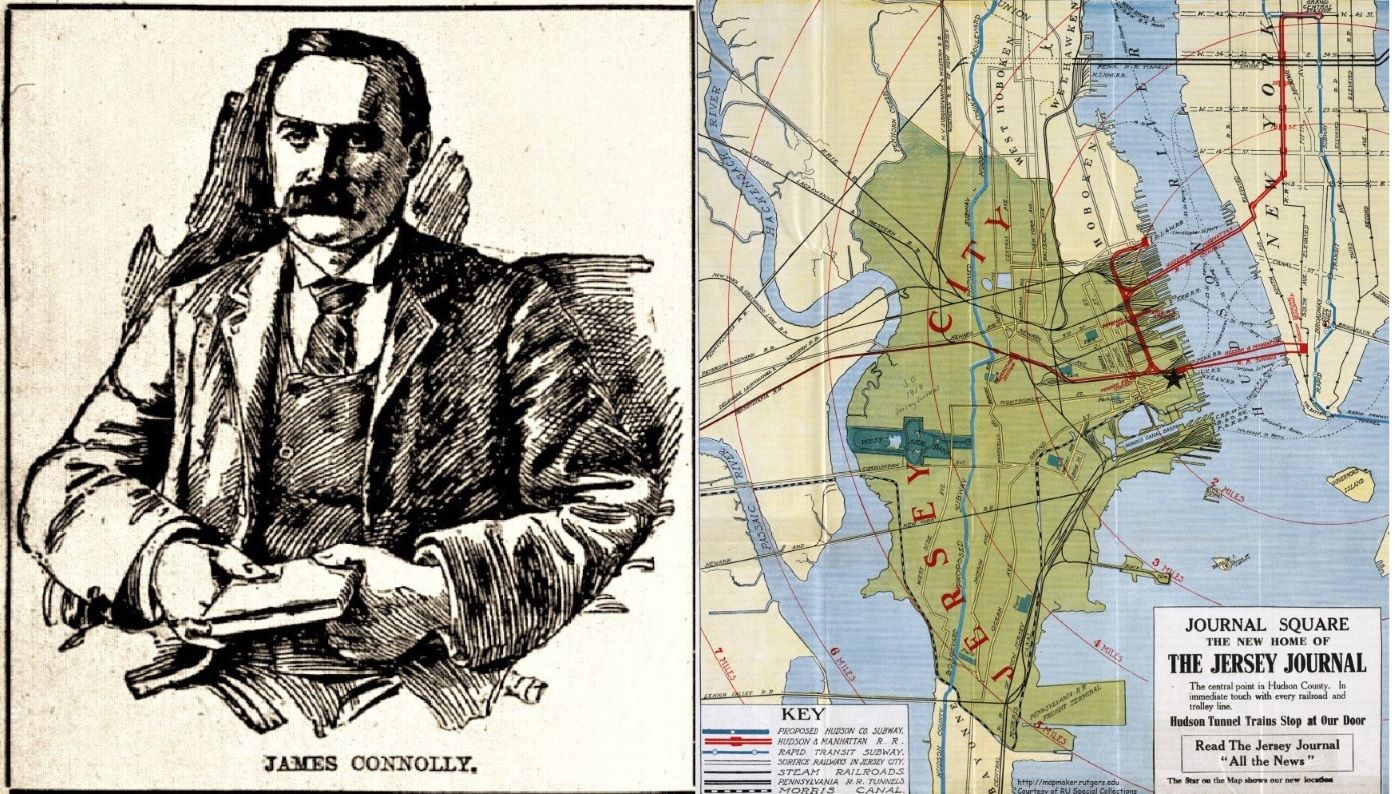
Details of one of James Connolly’s fist speeches in the U.S. given September 13, 1902 at Jersey City’s Union Hall (4th and Grove).
‘Jersey City Audience Likes Irish Agitator’ from the Daily People. Vol. 3 No. 77. September 15, 1902.
Hearing the Sturdy Champion of the Irish Working Class a Refreshing Experience After the Whining Cant of the Home Rule Politicians.
There is a great treat in store for the audience that will gather tonight at Cooper Union to hear James Connolly, the Irish Socialist Republican. That is the verdict of those who heard Connolly speak in Jersey City last Saturday night. Despite the rainy, disagreeable evening, Union Hall was crowded, and the audience followed the speaker with rapt attention from start to finish. Connolly is a good talker, and has a voice of strong carrying power. His speech fairly bristled with telling points in the indictment against the Irish skinners of Irish labor, who alternately use a bugaboo and weapon of oppression the force of the British government.
Connolly said he was not here to harrow the feelings, or play upon the sentiment of the people, in behalf of Ireland. Yet it would be necessary to picture conditions as they actually are there; especially as John D. Crimmins, the New York millionaire and “patriot” Irishman, had recently returned from making a tour of Ireland, and had declared that the country generally was prosperous and the People happy and contented. The speaker said he did not question the truth of Mr. Crimmins’ statement, so far as the labor skinning class in Ireland with whom he had hobnobbed was concerned. Like the labor skinners everywhere the wealthy class of Ireland are certainly prosperous, contented and happy.
This Crimmins is one of the gentry who, when Redmond was here recently whining about Ireland’s wrongs, sat on the platform and contributed to the fund. This incident was used by The Home Rule papers as an evidence of how American sympathies were turning toward the “cause,” and now the Irish labor skinners are using Crimmins’ recent utterances to show how happy the Irish people really are! The Home Rule delegates return to Ireland with glowing pictures of the Irish in free America, and as a consequence stampede the flower of the youth of the land to emigrate; not with the hope of a possible field marshal’s baton in their knapsack, but the hope of a possible Crimmins’ puts in their pocket. Connolly said that the Irish Socialist Republican party was slowly but surely gaining ground. Religion in Ireland is one of the most potent agencies to keep the people divided. Under the Banner of Socialism, however, religious differences no longer prove a barrier to united action by the workers along class conscious lines. Imbued with the lofty principles of Socialist philosophy the workers of all creeds freely fraternize.
Connolly said the beneficial influence or this coming together could not be overestimated, when it is known that in some parts of this country even the public houses are run on religious lines, this can be appreciated. A Protestant won’t take a drink of ale in a Catholic saloon for fear of imbibing popery, and a Catholic won’t take a drink of whiskey in a protestant saloon for fear of swallowing heresy. In shops hiring a number of workers, the Protestants occupy one side of the room while the Catholics have the other side. After the meeting Connolly was asked as to the significance of the recent reading of the “crimes act” in five of the counties of Ireland. He explained that the “crimes act” is somewhat in the nature of an injunction, as it is used here against strikers. It proceeds on the theory that criminal acts are about to be resorted to, and prohibits meetings as agencies provocative of crime. For instance, a tenant is evicted for non-payment of rent, and what in Ireland is termed a “land grabber,” another tenant takes hold. The other tenants oppose his action. They want the property to lay idle until the landlord or his agent can come to some terms agreeable to the one dispossessed. If nothing is done they perhaps call a meeting to denounce the offender and to “boycott” him. This furnishes the pretext for the reading of the “crimes act,” and the suppression of free speech. Incidents of this kind are the breath of life in the nostrils of The Home Rulers. The Home Rule Leaders, by the way, are the most thoroughly discredited set of men in Ireland today. But on occasions like this they take advantage of the popular fury and gain a further lease of life, posing as the champions of the oppressed. So often do the opportunities of this kind arise in places where and at times when The Home Rule influences is waning, that as Connolly naively put it, one would think they were able to have them made to order.
From Connolly’s description of the part played by the Home Rule leaders, an American would in a certain sense compare them to our own labor fakirs. Pretending to stand for the people, their reactionary conduct serves to dissipate concerted and intelligent action upon the part of the Irish, pretending to despise the English government it is notorious that five of the Irish Nationalists members of Parliament, Col. J.P. Nolan, Samuel Young, E.C. Thompson, Major John Jameson-Eustace and William O’Doherty, attended the coronation of King Edward.
This brief and rambling dissertation on Connolly’s meeting in Jersey City gives no idea of the speaker’s address, which, as an additional charm, was here and there spiced by genuine Irish wit. Connolly must be heard to be appreciated, and you can hear him tonight at Cooper Union. There will be other speakers, and there will be music. Attend yourself and bring a fellow worker. Irishmen will be especially impressed and thrilled by listening to a fellow countrymen, who will present the woes, the hopes and aspirations of their class in the old dart.
New York Labor News Company was the publishing house of the Socialist Labor Party and their paper The People. The People was the official paper of the Socialist Labor Party of America (SLP), established in New York City in 1891 as a weekly. The New York SLP, and The People, were dominated Daniel De Leon and his supporters, the dominant ideological leader of the SLP from the 1890s until the time of his death. The People became a daily in 1900. It’s first editor was the French socialist Lucien Sanial who was quickly replaced by De Leon who held the position until his death in 1914. Morris Hillquit and Henry Slobodin, future leaders of the Socialist Party of America were writers before their split from the SLP in 1899. For a while there were two SLPs and two Peoples, requiring a legal case to determine ownership. Eventual the anti-De Leonist produced what would become the New York Call and became the Social Democratic, later Socialist, Party. The De Leonist The People continued publishing until 2008.
 Revolution's Newsstand