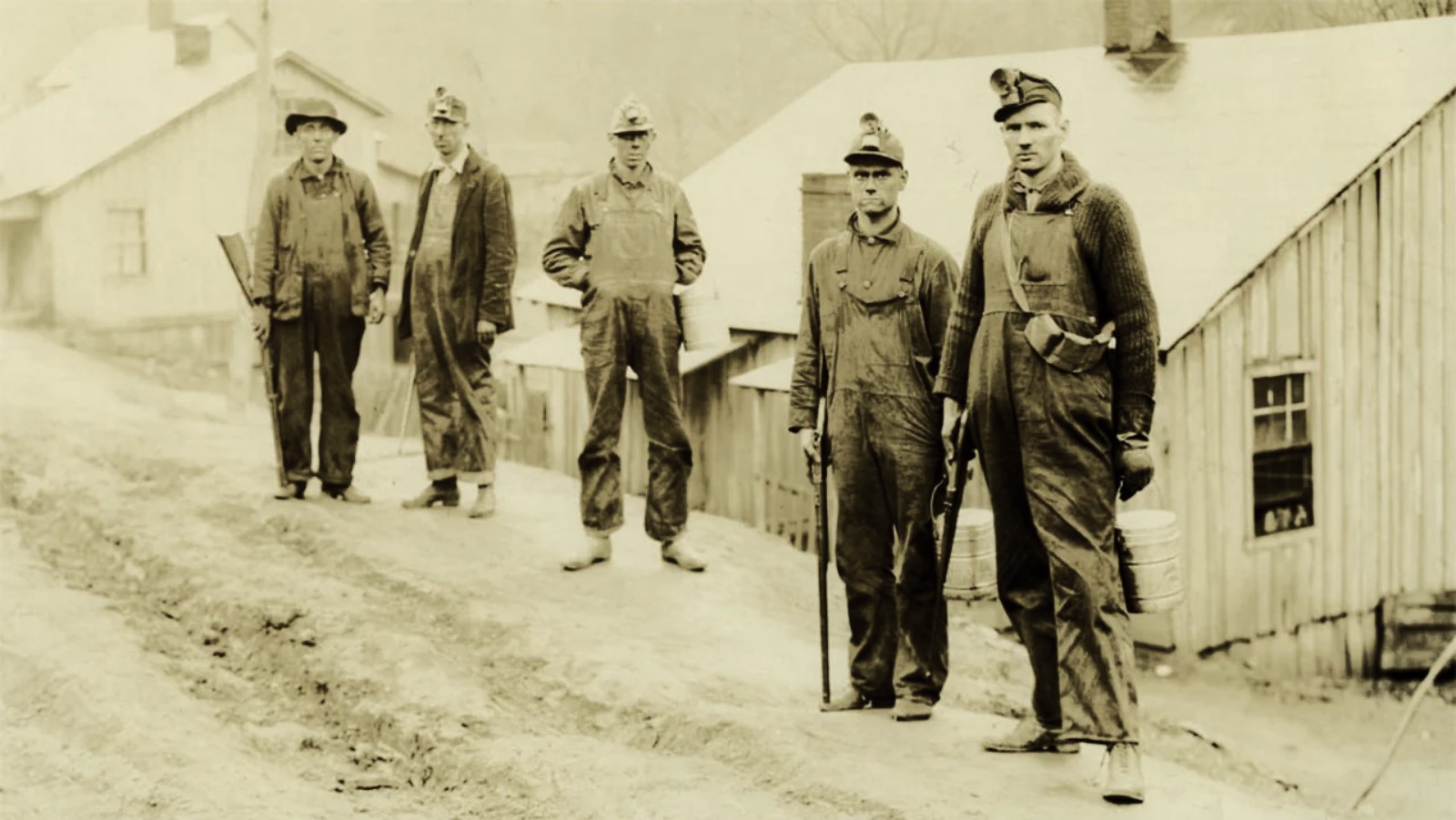
Tess Huff on the ground during ‘Bloody Harlan,’ the hard-fought Kentucky miners’ strike that gave us the anthem ‘Which Side Are You On.’
‘Coal War in Kentucky’ by Tess Huff from Labor Age. Vol. 20 No. 6. June, 1931.
THERE have been no more killings here since the Evarts fight in which four were killed and two wounded. Recently there was a widespread rumor that a miner and a guard had shot each other to death, but those in charge of civil and military affairs deny it.
However, there is great danger of another and perhaps more bloody outbreak between the law and the workers, as the situation, since the arrival of the soldiers, who the miners at first thought were to help them, becomes more aggravated daily.
There are 100 prisoners in jail now, about half them miners and miners’ friends who have been framed or legitimately arrested on charges resulting from the class struggle.
Judge Jones, a whale of a man, over six feet tall, with a big mouth that turns down at the corners, dismissed an entire term of court in order to give his time and attention to dickering with the grand jury that returned a raft of indictments against miners and their leaders, but not a single indictment against pistol deputies and company guards who have beat up, shot at and abused scores of miners without provocation.
These hirelings of the operators have punched miners with pistols until their bellies and breasts bled; they have thrown them out of company postoffices where they had gone to get their mail; and, at the point of pistols, they have made them wade rivers and creeks just for the “fun of it.” Strenuous efforts were made by friends of the miners to have the grand jury indict these bullies, but the grand jury, dominated by Judge Jones, refused to return indictments.
Jones is in a frenzy against the miners. In his race for judge he was opposed by the miners, who supported Grant Forester, former judge of the Harlan circuit court. Backed 100 per cent by the operators and their henchmen, who deliberately and openly forced thousands of miners to vote for Jones by intimidation and threats, Jones was still beaten—nobody here but will tell you that Grant Forester was elected judge—and yet Jones is Judge. The Harlan County Coal Operators Association takes by force and by courts what the people refuse to give it.
Fight at Drop of Hat
But there is a limit to human endurance, even the endurance of starving and oppressed coal miners. The 45,000 miners of Harlan country, as well as hundreds of others, have been crushed, brow-beaten and robbed to such an extent, and for so long, that two-thirds of the people are on the verge of civil war or rebellion. They are fired by mortal hatred of their oppressors, and will fight at the drop of a hat.
The operators and the law know this, which no doubt partly accounts for the brutal measures they are using. The sheriff, John Henry Blair, the county judge, Hamp Howard, and the circuit judge, D.C. “Baby” Jones, have shown that they will stop at nothing in their efforts to defeat the miner’s attempt to organize. They mean to do a quick clean job. For with a little help from the outside public sentiment would burst into the open, and it would be mighty hot for the sheriff, the judges and their gunmen.
In fact these three men—others too of course, but these three especially—are very much worried lest they be shot. And their fears are justified. Many miners will tell you openly that they would be only too willing to “swap out” in order to kill either of them.
This feeling is not confined to miners, either. Since labor leaders and Joe Cawood have been jailed and denied bond a quite different hornet’s nest has been stirred up, and the old timers are now becoming interested. These men are in the habit of settling things outside the courts.
Consequently the situation gets tenser hourly, and the lid would blow off immediately if the militia should be withdrawn. But the militia are here to stay awhile; they are here for two purposes—to protect the “law” which is out to bust the union, and to see that everything goes off according to “law and order” in the wholesale eviction of miners from company houses tinder judgements on yellow dog contracts.
Strange as it may seem, the militia was sent in at the request of district officials of the United Mine Workers of America. These union officials joined with representatives of Governor Sampson in an agreement that the governor should send state troops to Harlan to restore and maintain order, and that the armed guards should be disarmed and that the miners should have the right to join the union and hold meetings in the daytime.
But it did not take long for the miners to learn the real purpose of the troops, although they had been duped by Governor Sampson’s gesture of friendliness at the start. They now know that the troops are in Harlan to protect the interests of the operators and to see that the law of Judge Jones is carried out. Since this has always been the role of the militia in labor disputes it appears to the writer that the officials of the U.M.W. of A. acted very foolishly—if nothing worse can be said—in heeding the fine words of Governor Sampson.
The Militia Enter
The manner in which the state troops came into Evarts is perhaps significant. They apparently thought that they were dealing with desperate men and that their lives were in great danger. The captains took every precaution in going around curves and in crossing bridges. They came in on a train—a long string of empty flat cars in front, then gondolas for the infantry, and last the cabooses for the machine-gunners.
They remained in Evarts until the special grand jury had returned enough indictments to jail union leaders, whom they proceeded to arrest; that good work being accomplished they were scattered over the county, until now they patrol 20 mining towns.
The captains and colonels fare fine at the Lewallen Hotel in Harlan, hobnob with operators and preachers and politicians.
“I do not understand how the coal operators can recognize the union,” said Col. Daniel Carrell, head of the troops, to the writer a few days ago. “I have a business in Louisville in which I employ 100 men. I wouldn’t recognize the union—I couldn’t.”
“But have the operators a right to fire men because they belong to a union?”
“Certainly,” replied the Colonel. “Haven’t the men a right to quit work if they want to? Doesn’t the rule work both ways?”
Personally, Carrell is not a bad sort, but he seems to be dominated by Lieut. Col. Sidney Smith, second in command, and chief counsel for the Louisville and Nashville railroad.
“These damned miners thought we came here to help them,” sneered this up-standing American to the writer. He then put his arm about the shoulder of a coal operator and the two left the room.
Twenty indictments have been returned against miners on triple murder charges, and 15 of them have been jailed. Rev. Frank Martin, who spoke for the miners and urged them to organize, has been jailed on a charge of criminal syndicalism.
Jailing Rev. Martin
Martin, who is pastor of the Baptist church at Ages, is innocent, of course, but he is an impressive man, a good orator, and a real friend of the people, so they popped him into jail. While helping the miners in their efforts to organize he conducted a revival and had over a hundred converts, all of whom were babtized. In speaking to 1500 miners from the steps of the courthouse at Harlan recently lie said: “I have seen thousands of tombstones and have preached hundreds of funerals, but I have yet to see the grave of anyone who starved to death while righting a righteous cause.”
He described the condition of the miners as one of misery and slavery, and said that women and children were starving. He plead with the rich to open their eyes and soften their hearts.
Gill Green, a colored orator and labor leader, a witty old fellow of 67, was slapped into jail 4 weeks ago for absolutely nothing, that is no charges were brought against him.
“Who is it that’s doing all this shooting?” asked Green, in speaking to a group of miners a few days before he was jailed. “I’ll tell you. They have their heads out of a window listening to me right now.”
The sheriff and some of his gunmen were listening to Gill not 15 feet away.
“They are with the operators,” he shouted at them, “and why shouldn’t they be? The operators bought and paid for them on election day.”
His arrest came this way: with two other men, white, he called on the sheriff at his office the morning of the Evarts fight. They were a sort of committee from Evarts. They asked the sheriff to send the town of Evarts some protection against the armed guards of the Black Mountain Coal Company. A few minutes after they left, the news of the fight reached the sheriff and Gill has been in jail ever since.
Leaders Framed-Up
Nobody in the county doubts that these men are all the victims of a frame-up. Martin, Green, Hightower, Jones and Cawood are innocent of any crime, unless attempting to organize and aid the starving miners is a crime.
And apparently the “law” in Harlan county does consider it a crime.
At least Judge Jones, who is married to the daughter of one of the big operators, and who is said to be financially interested in a number of coal mines in the county, has refused to vacate the bench, and it does not look as if he can be compelled. With him on the bench the jailed miners have absolutely no chance.
“Judge Jones and sheriff Blair have formed a monarchy to rule Harlan county,” says Joe Cawood, one of the 15 who are being held without bond on a triple murder charge. “Sheriff Blair is the Kaiser, and Judge Jones is a rich man. They are the willing tools of the coal operators.”
Cawood, a stocky, well built man of perhaps 35, of a prominent family, is known in Harlan as the miner’s candidate for sheriff. He claims, and with good reason, that he has been framed because he is a friend of the miners in their struggle to organize.
“They are trying to get me out of the way,” he says. “Judge Jones is a bitter enemy of mine. No wonder he refused to vacate the bench or give us bond.
“It’s a trick to break the union. They mean to keep us in jail. They would like to destroy my political power. They know I was nominated for sheriff by a majority of 900 votes last election, and it frightened them stiff. They threw the election out, but they don’t want to see that happen again.
“The week before the fight I was elected trustee of the Evarts graded school district. I got 501 votes. My nearest opponent got 166. There are 1200 pupils in the district schools; that shows what the people think of me.
“When the shooting started I was in the heart of Evarts. I ran home to get out of the way of the bullets which were flying everywhere. Everybody saw me.
“The machine guns of the guards fired the first shots, and they killed a miner. But the monarch didn’t indict the guards. They are after the miners. They want to exterminate us, I reckon.”
Some of the largest mines in the county are owned by foreign capital—Andrew Mellon, Commonwealth Edison, and Sam Insull are large holders of mining property. None of them recognize the union, and all of them fire men as fast as they join the union.
Can the starving miners of Harlan county win against these great powers? Perhaps, but they need help, and immediately.
Labor Age was a left-labor monthly magazine with origins in Socialist Review, journal of the Intercollegiate Socialist Society. Published by the Labor Publication Society from 1921-1933 aligned with the League for Industrial Democracy of left-wing trade unionists across industries. During 1929-33 the magazine was affiliated with the Conference for Progressive Labor Action (CPLA) led by A. J. Muste. James Maurer, Harry W. Laidler, and Louis Budenz were also writers. The orientation of the magazine was industrial unionism, planning, nationalization, and was illustrated with photos and cartoons. With its stress on worker education, social unionism and rank and file activism, it is one of the essential journals of the radical US labor socialist movement of its time.
PDF of full issue: https://www.marxists.org/history/usa/pubs/laborage/v20n06-Jun-1931-Labor%20Age.pdf
 Revolution's Newsstand