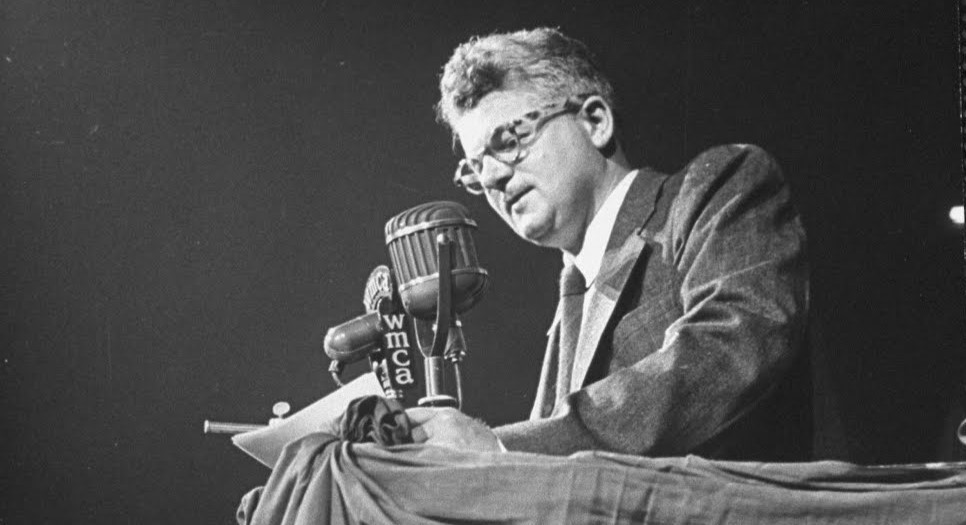
While there have been changes to its orientation, the Communist Party has lived politically within the orbit of the Democratic Party since the late 1930s. Beginning in 1935, with the larger change in the Communist International, the Party adopted a ‘Popular Front’ policy in which it sought an alliance of workers, farmers, and the ‘lower middle-class’ cemented in a Farmer-Labor Party. After Roosevelt’s landslide election in 1936, it was determined there was little room outside the Democratic Party for ‘progressive action’, in response the ‘Democratic Front’ which would include the ‘certain liberal sections of bourgeoisie’ was inaugurated as a bulwark against rising fascism. While its excesses were later denounced, the C.P.’s outlook continues to be framed by the ‘Democratic Front’ and an orientation towards the Democratic Party. Here is a useful explanation of the Front from C.P. leader Gene Dennis.
‘Some Questions Concerning the Democratic Front’ by Gene Dennis from The Communist. Vol. 17 No. 6. June, 1938.
A MISCONCEPTION regarding the democratic front which exists in some quarters is that the democratic front differs from the People’s Front in that the first is projected today because it is considered that “at this time it is not yet possible to organize the existing broad democratic mass movement into a new political party” such as a national Farmer-Labor Party.
This is not entirely correct.
Only those to whom Marxism has become a dogma and not a guide to action would contend that the eventual form of the American People’s Front must be that of a new political party. In this connection, Comrade Dimitroff, indicating at the Seventh World Congress of the Communist International the path along which the People’s Front in the United States might develop, stated:
“Under American conditions the creation of a mass party of toilers, a workers’ and farmers’ party, might serve as such a suitable form…”
Of course, the developing People’s Front may eventually take the form of a national Farmer-Labor Party. On the other hand, it may take the form of a political federation, operating, insofar as electoral activity is concerned, chiefly through the Democratic Party primary, as the emerging People’s Front and democratic front movement is already doing in a number of states, e.g., Washington, Michigan and Pennsylvania. Or it may be crystallized organizationally through the medium of a People’s Front pact or working agreement covering various forms of collaboration and joint activity around one, several or a whole series of anti-fascist demands and issues. In any case, it will not be only the organizational form that the antifascist movement will take which will determine when the democratic front has developed or grown into the People’s Front. It will probably be this and definitely, something more, as we shall examine in a moment.
Another definition of the democratic front which is frequently heard is that while its “program is generally progressive” it is, however, “less clearly defined” than that of the People’s Front. This conception is also inexact and is not fully confirmed by life. For instance, among the demands and points brought forward today by various sections of the labor and progressive movement, ranging from general progressive New Deal leaders to the C.I.O. and further to the Left—demands which already furnish the program for the democratic front movement and the gathering democratic front—there are a number which are of a more advanced political character than those put forward by the progressives, including the Communists, for a proposed program for a Farmer-Labor Party in 1935-36. This is particularly true regarding such demands dealing with the struggle for peace, with the fight for curbing the powers of the monopolies, etc. This has taken place because of recent political developments, nationally and abroad, including the developing economic crisis, and the consequent growing political experiences of the working class and of all progressive forces.
Of course, it is true, as in the municipal elections in New York last November that the political demands and program binding the whole democratic front movement and ticket were less clear and defined than those which united the forces of the People’s Front gathered around the American Labor Party, the main driving force in the democratic front. However, it would be a serious political mistake to draw a line of demarcation and difference between the democratic front and the People’s Front simply and solely on the basis of “more clearly” or “less clearly defined demands.” This would result in many cases in a distortion and watering down of the program and aims of the democratic front and in a subsequent weakening of the maturing anti-fascist People’s Front.
The key to understanding the essence of the democratic front is to understand clearly its objectives and class content.
What is the chief objective of the democratic front? It is to gather together all progressive forces and movements “to defeat the offensive of finance capital and block the road to fascism in the conditions of the developing economic crisis.”
What is the starting point and main content of democratic front? It is the organization of a common front, embracing various forms of organization and activities, sometimes more or less loosely knit together, to defend and extend existing democratic rights and liberties, to protect the most urgent and vital economic, political and cultural needs of the American working people, to safeguard American and world peace.
What are the class forces which go to make up the democratic front? These are the basic class forces which constitute the anti-fascist People’s Front: the working class in a fighting alliance with the toiling farmers and city middle classes, rallying and mobilizing also important sections of the upper middle classes and certain liberal sections of the bourgeoisie. For the democratic front, as it is developing and as it is projected, is the concrete application of the People’s Front policy in the conditions of a rising democratic mass movement. The democratic front is a democratic bloc of common action of all labor, progressive and democratic forces to fight against reaction and fascism, to maintain and extend democracy.
The draft resolution of our Central Committee for the Tenth National Convention points this out when it States:
“…especially important from this viewpoint [building of the democratic front— G.D.] is the deepening struggle of the progressives against the reactionaries in the Democratic Party and the growing differentiation in the Republican Party, whose progressive sections are moving in the direction of a common democratic front. These forces are drawn into closer collaboration with the growing independent organizations and political activities of the workers, farmers, middle classes and Negroes [i.e., with the forces of the People’s Front—emphasis mine.—G.D.]…The broadening of the organized movement for peace, for aid to Spain and China, and the boycott of Japanese goods, the movement of the American Youth Congress to include all major youth organizations, the advance of the National Negro Congress to the position of a unified and chief spokesman of the Negro people—all these testify to the further broadening of the democratic front…”
Some comrades ask, why did not our Party advance the slogan and tactic of the democratic front earlier? Clearly because the subjective as well as the objective conditions for this did not fully exist up until recently. For instance, among the new factors which have now entered into the political life and developments of our country, there are certain features and trends which have only matured on a big scale in the recent period, especially since the 1936 presidential election. Among these we must note the following:
1. The sweeping political realignments in the old parties which have been influenced by the rising labor, democratic and peace movement. Only in the course of and after the 1936 elections did this new trend in American politics assume mass proportions. What we witnessed at this time was the beginning of a broad realignment and crystallization of the progressive forces in the Democratic Party, and in certain places within the Republican Party, taking place simultaneously with the advance of the independent political organization and activities of the working class, expressed chiefly through the growth of the C.I.O movement and Labor’s Non-Partisan League. Moreover, a peculiarity of this development was that the growth of independent labor political action took place with the labor movement advancing in close collaboration with the progressive Roosevelt New Deal forces. While this development retarded organizationally the crystallization of a national People’s Front, it extended the People’s Front movement and helped create the present conditions which have made possible the organization of a broad, people’s democratic front.
2. Closely bound up with this development is the fact that the growth of political reaction and the increased menace of fascism in the United States, and of fascist aggression and military intervention abroad, as well as the brutal offensive of monopoly capital to solve the crisis at the expense of the working masses, the small businessmen, as well as the independent sections of the bourgeoisie—served in the first place to strengthen and augment the anti-fascist sentiments and activities of the working class and the people. But also, these factors have served to alarm, arouse and activize important liberal sections of the bourgeoisie, represented by Roosevelt and the progressive wing in the Democratic Party. They have, at the present, served to influence these sections of the upper-middle classes and bourgeoisie to seek in their own interests some common front with the consistent anti-fascist sections of the people, with the workers and toiling farmers as well as city middle classes—in order to oppose and restrict the unlimited power and the attacks of the most reactionary and fascist-minded sections of American finance capital.
Thus, in the conditions of the sharpening struggle between democracy and fascism, between reaction and progress, the camp of progress and peace has been broadened and the conditions have been created for the forging of a powerful democratic front on an extremely wide and effective scale.
Concretely, then, what do we mean by the democratic front under American conditions “representing the beginning of the development of a real People’s Front against reaction and fascism”? Here it will suffice to mention only three of several factors and considerations.
1. In the broadening of the democratic camp, in the extension of the democratic front movement for civil and trade union rights, for raising the purchasing power of the broadest sections of the people, for championing the cause of peace—the forces of the People’s Front, still as yet insufficiently organized, are rallied and mobilized on a wider scale than has been possible heretofore. The working class, the toiling farmers and lower sections of the middle classes have obtained and are establishing greater freedom of activity and organization, as well as more powerful reserves in their struggle for jobs, security, democracy and peace. And on this basis there are being established more favorable conditions and the necessary prerequisites for establishing unity of political action for organized labor, for overcoming the split in the working class, and for bringing about greater collaboration and a fighting alliance between the working class and its natural allies —all of which is essential for the development of a real People’s Front.
2. In connection with promoting and influencing the course of the progressive realignments in the two old parties in the direction of establishing a common democratic front with the organizations of the working class and people in general, and in connection with strengthening the collaboration between the labor movement and the progressive New Deal forces in particular, the following is taking place: Precisely as the Committee for Industrial Organization, Labor’s Non-Partisan League, etc., have developed, strengthened and extended their independent activities and influence, the political realignments in the major parties have progressed. Likewise, simultaneous with the broader scope and movement of these progressive political realignments, labor’s forces and organizations have been strengthened and become a more influential independent political factor. This is true regarding the C.I.O., the American Labor Party and Labor’s Non-Partisan League. Also in relation to this, the working alliance between labor and its natural allies has begun to be improved, i.e., the united legislative and election agreements between the C.I.O. and the Farmers Union, the close working relations between the C.I.O. and the National Negro Congress, etc.
3. Moreover, the dialectics of the class struggle and the anti-fascist movement are such that effectively, not to speak of completely, to realize the program and objectives of the democratic front—to struggle consistently against reaction and fascism, especially under the circumstances of sharpening struggles; it is and will be necessary for the basic and main forces of the democratic front, especially for the working class, to bear the chief brunt of the struggle, to unite and strengthen its own class organizations and to conduct on a wider scale independent activity. This is necessary in order to assure both the defense of the interests of the working class and people and the interests of the forces of democracy as a whole. Thus, under the very conditions of carrying out the program and achieving the objectives of the democratic front, the forces of the People’s Front which are developing and being strengthened, will be further crystallized, politically and organizationally.
Therefore, it is clear that the democratic front is not a negation of the People’s Front. Nor vice versa.
The democratic front under present conditions is the path to the establishment of the anti-fascist People’s Front, is the policy to ensure the victory of democracy over fascism.
And the key to the success of both the democratic and People’s Front remains the achievement of working class unity and the extension and consolidation of the independent activities and base of the economic and political organizations of the working class, operating in an ever firmer alliance with the toiling farmers and city middle classes.
Among the most urgent tasks confronting our Party and the entire labor and progressive movement in the practical application of the tactics of the people’s and democratic front, are the following:
1. The democratic mass movement, which is growing on a local, state and national scale, is still inadequately organized. The problem of gathering all the forces of the democratic front, of organizing the democratic front, remains a central one. Likewise, the question of political initiative, of who will lead whom, yet remains to be definitely decided. What is essential is that the political activity and influence of the working class, of the C.I.O., of Labor’s Non-Partisan League and the A. F. of L. Non-Partisan Political Leagues, of the A.L.P., etc., should be unified, strengthened and multiplied. This is not a question of a narrow struggle for organizational or political hegemony in the democratic front, but is a question of establishing on the basis of correct policies, activity and positive contributions—that political influence and direction which will best promote the welding together of an all-embracing front of all democratic forces.
2. All tendencies of Right opportunism, of neglecting and slurring over the independent role and tasks of the working class in the democratic front must be quickly overcome. Such Right manifestations as expressed in the labor movement in certain states, of relying upon the Democratic Party machine to nominate candidates and adopt an election platform (Alabama), of neglecting the democratic front character of the election program in the scramble for securing the nomination of this or that candidate, and more serious, of “postponing” the building of Labor’s Non-Partisan League until after the elections (certain tendencies in Illinois and Pennsylvania) must be brought to an end. This is important, not only for the welfare of the labor movement, but for ensuring the unfolding and developing of the full power and sweep of the democratic front movement against reaction and fascism.
3. But equally, if not more serious at the moment, than the liquidation of the existence of the Right opportunist tendencies, is the necessity of speedily eradicating all remnants of “Left” sectarianism in the application of the policy of the democratic front. We must wage a more consistent and uncompromising struggle against counter-revolutionary Trotskyism-Lovestoneism and its anti-united front, anti-democratic and People’s Front policy. We must once and for all put an end to a prevalent narrow “labor” approach in many states and congressional districts to the selection of candidates and the scope of the election program. This means to overcome energetically all tendencies to underestimate the paramount urgency of establishing united labor political action between the C.I.O., the A.F. of L., the Railway Brotherhoods; between Communists and non-Communist workers—the foundation upon which the people’s and democratic front can be built and be victorious. This means, further, more attention to such specific problems as:
a. In New York: Continuing the democratic front election policy pursued in the mayoralty campaign; establishing state and congressional democratic front election tickets and movements, broader than can as yet be built in support of the American Labor Party, such as will establish progressive unity of the A.L.P., C.I.O., and A. F. of L., the liberal Republicans and progressive Democrats solidly behind one progressive candidate for each elective office.
b. In California: Establishing correct working relations and an election agreement between the Federation for Political Unity, Labor’s Non-Partisan League, the C.I.O. and A.F. of L. the Townsendite and Epic forces, on the one hand, the middle-of-the-road progressive forces in the Democratic Party who are now gathered around McAdoo.
c. In Washington: Broadening out the progressive movement around the Washington Commonwealth Federation, the C.I.O. and A.F. of L. and the Old Age Pension movement, to bring about friendly relations and practical collaboration between these forces and the centrist New Deal groups in the Democratic Party.
d. In Wisconsin: Uniting the main section of the labor, farm and liberal movement for concerted and collective activity within and through the Progressive Party and primary, for promoting proper working relations with the liberal New Deal Democrats in Milwaukee County, for establishing broader political unity of action of all genuine progressives to defeat reaction in the 1938 elections.
e. In building Labor’s Non-Partisan League: While systematically pushing forward the growth and activities of the League, while further crystallizing the independent political organization and actions of labor—the C.I.O., the A.F. of L., Railroad Brotherhoods, etc.—through and around the League, while giving more attention to involving the toiling farmers and city middle classes in L.N.P.L.—to build around the League broader democratic front blocs and progressive coalitions.
4. And finally, in building the democratic front, it is necessary to bear in mind that the tactics of the democratic front are by no means limited to questions of the coming elections, important as these are for the political future of America. In the sphere of broadening the peace movement, in the struggle for civil liberties and trade union rights, in the current fight for jobs and relief and in other fields, it is possible and imperative to explore the conditions for, and to effect, a broad democratic front of common action. It is possible and necessary to unite the widest sections of the labor and democratic forces and organizations on each and every urgent economic, political and cultural issue and demand that will arise, so as to rally and set in motion, not only the present active forces, but all the potential democratic forces which can be mobilized to help “defeat the offensive of finance capital and block the road to fascism in the conditions of the developing economic crisis.”
There are a number of journals with this name in the history of the movement. This Communist was the main theoretical journal of the Communist Party from 1927 until 1944. Its origins lie with the folding of The Liberator, Soviet Russia Pictorial, and Labor Herald together into Workers Monthly as the new unified Communist Party’s official cultural and discussion magazine in November, 1924. Workers Monthly became The Communist in March ,1927 and was also published monthly. The Communist contains the most thorough archive of the Communist Party’s positions and thinking during its run. The New Masses became the main cultural vehicle for the CP and the Communist, though it began with with more vibrancy and discussion, became increasingly an organ of Comintern and CP program. Over its run the tagline went from “A Theoretical Magazine for the Discussion of Revolutionary Problems” to “A Magazine of the Theory and Practice of Marxism-Leninism” to “A Marxist Magazine Devoted to Advancement of Democratic Thought and Action.” The aesthetic of the journal also changed dramatically over its years. Editors included Earl Browder, Alex Bittelman, Max Bedacht, and Bertram D. Wolfe.
PDF of full issue: https://www.marxists.org/history/usa/pubs/communist/v17n06-jun-1938-The-Communist-OCR.pdf
 Revolution's Newsstand