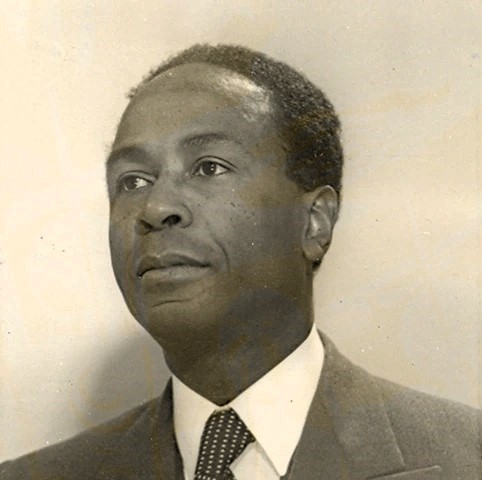
Report by Padmore to the R.I.L.U.’s International Trade Union Committee of Negro Workers conference held in Hamburg, Germany during July, 1930; a milestone meeting in international Black Communist organizing.
‘The Economic Struggles of the Negro Workers’ by George Padmore from Negro Worker. Vol. 3 No. 10. October 15, 1930.
This first International Conference of Negro Workers is meeting at the time of deep economic crisis, when the capitalists of all countries are intensifying the offensive against the wages and working conditions of the workers in all imperialist and colonial countries. It meets at a time when the workers are resisting their exploiters with ever increasing militancy and struggle which in the case of a number of colonial countries has assumed the character of armed revolts–India, Nigeria, Haiti, etc. and when the workers everywhere are more and more developing the counter-offensive against the capitalist under revolutionary working class leadership.
The crisis has affected with particular force the millions of super-exploited Negroes in both Africa and in the Americas. It has aggravated unemployment, wage cuts and speed-up among the Negro workers and accelerated the expropriation and ruination of Negro peasantry–all of this taking place under conditions of the most brutal colonial (racial) oppression has immeasurably deepened the misery and poverty of the Negro workers everywhere.
The Negro toilers goaded to desperation are answering the imperialist offensive by increasing mass struggles. The recent mass uprisings in South Africa, Nigeria, French Equatorial Africa, Congo, Madagascar, Haiti, the tremendous growth of the strike movement among the Negro workers as manifested particularly in South Africa, Gambia, the West Indies and in the increasing participation of the Negro workers together with white workers in strikes in the United States–all shows that the Negro masses have awakened and are adding new and powerful forces to the struggle against capitalist imperialism.
Even before the crisis the conditions of Negro toiling masses were unbearable. Everywhere they are confined to the most unskilled labour, for the same amount of work they receive less than the whites; numerous methods are employed for wringing super profits from their exploitation.
The social-fascist parties and trade union organisations whether affiliated with the Amsterdam and II International or the American Federation of Labour in the United States, have not defended the interests of the black and white workers, but on the contrary, apart from their strike-breaking activities in the metropolitan countries, these parties actively support the plundering and murdering of colonial and subject peoples by the imperialists.
However, the most dangerous obstacle to the development of the struggles or the Negro workers in Negro reformism.
The most subtle and therefore the most dangerous type of this reformism is Garveyism. Garveyism utilises the feelings of mutual sympathy which exist among Negro toilers in all parts of the world by virtue of their exploitation and oppression, NOT in the interests of the Negro toilers, but for the purpose of promoting reactionary utopias of the Negro bourgeoisie. “Back to Africa” means the substitution of the revolutionary struggles of the Negroes all over the world against capitalism by the utopian illusion of a “peaceful return to Africa under imperialism.” The logical development of this doctrine has ultimately led its leading exponent, Marcus Garvey, to alliance with the most reactionary forces against the Negro toiling masses, e.g. Garvey’s rapprochement with the Ku Klux Klan in the U.S.A., his negotiations with reactionary Southern senators, his manoeuvres with British and French imperialism, etc.
Reformism among the Negroes has its social basis in certain sections of the Negro middle class and intelligentsia. The representatives of this tendency whether already in open alliance with the imperialists or whether still claiming to struggle for the liberation of the Negro masses are betraying the Negro masses and acting as a break to their class conscious development. In the struggle between the imperialist ruling classes, and the oppressed Negro workers and peasants there can be no middle road, but only the road of class struggle.
National reformism also has its agents in the Negro workers’ organisations such as, for example, the leadership of such organisations as the I.C.U. in South Africa, the Brotherhood of Steeping Car Porters in the USA, etc. The leaders of these organisations while pretending to fight for the interests of the Negro workers are betraying them at every step and constantly concluding reactionary agreements with the capitalists behind the backs of the Negro workers.
A relentless struggle against the above tendencies is a prerequisite for working class leadership in the struggles of the Negro masses.
In the past the economic struggles of the Negro workers have in the majority of cases been spontaneous and isolated from the international labour movement, and in the main under the leadership of reformists. All of this has contributed to many defeats.
However, the present struggles of the Negro workers are taking place under more favourable objective conditions for the development of the working class leadership. The absorption of Negroes in capitalist industry in Africa and America, which has proceeded with remark/able rapidity in the last years, and the formation of a considerable Negro proletariat in the most important colonies and in the U.S.A., creates the conditions for the development of a working class leadership in all future Negro liberation struggles. The predominant mass of Negroes are however still tied to the land, where they live under semi-slave conditions, mercilessly exploited by the imperialists, landlords, and their henchmen in the agrarian districts usurers, native chieftains, etc. Politically and socially the Negro toiling peasants are as much oppressed and discriminated against as Negro workers, and in some case even more.
Without a mobilisation of this mass of Negro toilers the Negro industrial proletariat can not hope to successfully carry on its struggles for the overthrow of imperialism.
The representatives of the workers in the villages are the agricultural workers. It is through these that the industrial workers mobilise onward to the final toiling peasants as their class allies and leads them in the liberation struggle.
Only the revolutionary trade unions which unite the workers of all races on a revolutionary class basis, together with the masses of toiling peasants, organised respectively in tenant leagues, peasant committees, etc. and following the lead of the working class–only such combination of our forces in the struggle against capitalism can assure the victory to the workers.
Therefore the Conference calls the attention of the Negro workers to the following immediate tasks:
(1) The better organisation and preparation of the economic struggles of the Negro workers.
(2) The development of an efficient working class leadership, and the establishment of independent organs of struggle.
(3) The preparation of a programme of demands which should include the following:
a) Equal pay for equal work regardless of race, nationality, or sex.
b) For the immediate establishment of an 8-hour working day, and further struggle for a 7-hour day and for a 6-hour day in unhealthy occupations.
c) For legal existence of Trade Unions, for the right to organise and strike.
d) Against racial barriers in Trade Unions.
e) For the establishment and maintenance of the closest unity between the workers of all nations in the struggle against capitalism and imperialism.
f) Refusal to pay taxes and rents.
g) Formation of peasant organisations to carry on the struggle.
h) Active struggle against all open or concealed forms of slavery and forced labour–corvée, peonage, contract labour, etc.)
i) Struggle against the reserve system and the forced expropriation of lands from the natives.
j) Against all forms of national oppression.
k) For the return of the land to the toiling peasants.
l) For the immediate evacuation of the imperialists from all colonies.
m) For the complete national independence and the right of self-determination.
(4) The class education of the Negro workers through the utilisation of the lessons of the struggles of the working class as a whole. The spontaneous struggles of the Negro workers for equal wages against forced labour, segregation and colour bias, etc., must be developed into a conscious struggle against imperialism and the whole system of capitalist and colonial exploitation.
(5) Special attention must be devoted to the leadership of the Negro agricultural labourers and through them connections must be established with the broad masses of the Negro agrarian population. The Conference declares that the tasks of the whole revolutionary trade union movement is to unite with the Negro workers in their struggles and to fight against all forms of persecution of the Negro workers, and at the same time to conduct a broad agitational campaign for the purpose of warning them against all forms of persecution of the Negro workers, and at the same time to conduct a broad agitational campaign for the purpose of warning them against the attempts of the capitalists to isolate the Negro workers.
The development of the economic struggles of the Negro workers is an important state in the struggle of the colonial peoples against imperialism and a vital part of the general struggle of the whole working class.
First called The International Negro Workers’ Review and published in 1928, it was renamed The Negro Worker in 1931. Sponsored by the International Trade Union Committee of Negro Workers (ITUCNW), a part of the Red International of Labor Unions and of the Communist International, its first editor was American Communist James W. Ford and included writers from Africa, the Caribbean, North America, Europe, and South America. Later, Trinidadian George Padmore was editor until his expulsion from the Party in 1934. The Negro Worker ceased publication in 1938. The journal is an important record of Black and Pan-African thought and debate from the 1930s. American writers Claude McKay, Harry Haywood, Langston Hughes, and others contributed.
PDF of full issue: https://www.marxists.org/history/international/comintern/negro-worker/files/1930-v3-special-number-oct-15th.pdf
 Revolution's Newsstand