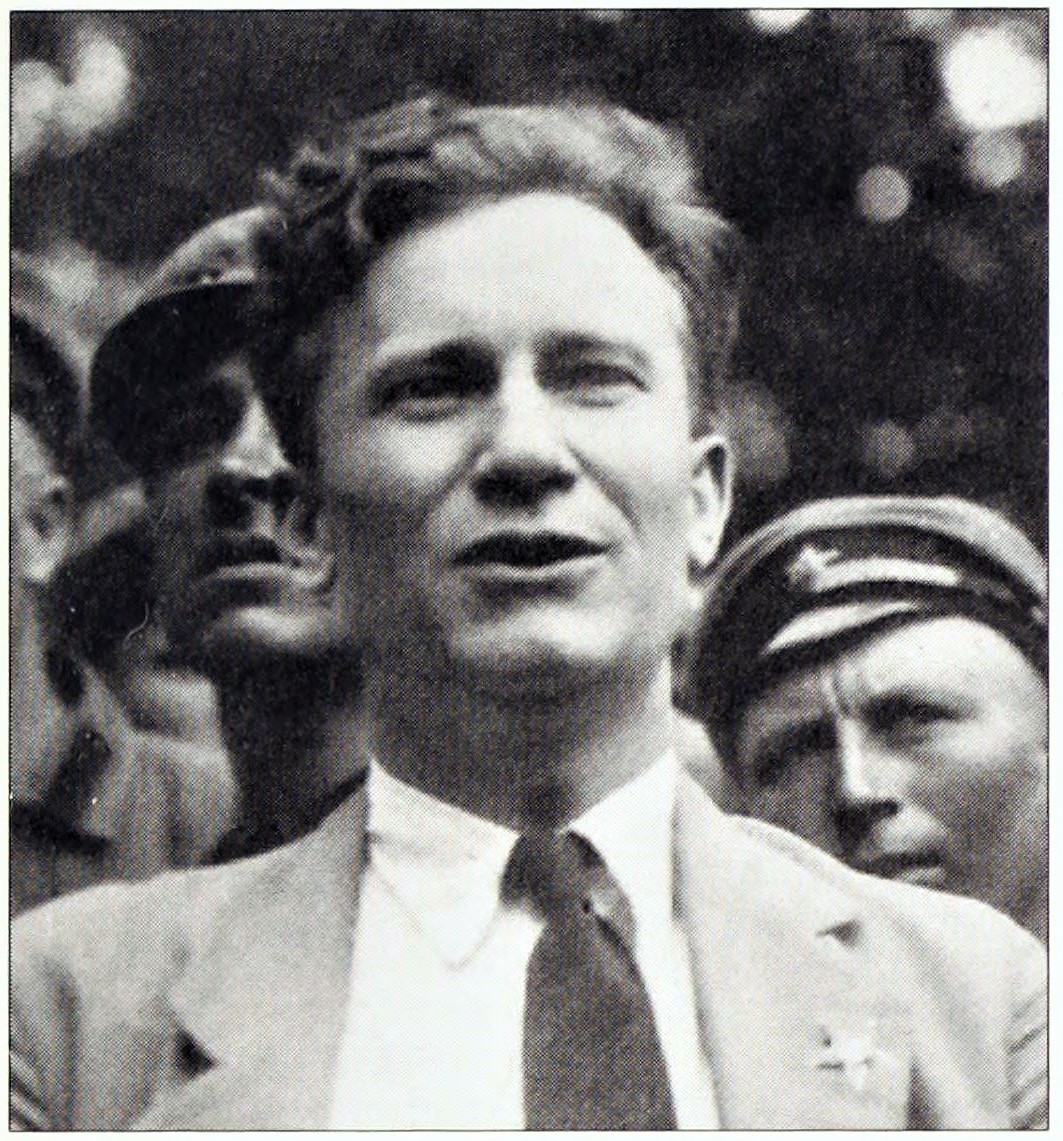
After years of divisions, though not entirely resolved, the Communist Party in the United States in its institutions and public face dates from the Workers Party conference of December 1921 when all but the recalcitrant undergrounders joined in a single, above-ground organization. James P. Cannon acted as the first chair and gave this opening address to the gathering. It was called the Workers Party to conform to its legal status, later changing its name to the Workers (Communist) Party, and in 1929 the name still used today Communist Party U.S.A.
‘Speech at the Founding of the Workers Party’ by James P. Cannon from The Toiler. No. 204. January 7, 1922.
Comrades, after our long struggle to unite our forces, we have succeeded. We have brought them together to unite them, and we will not listen to any man who speaks any other word than unity in this Convention (applause). We have had for two years many struggles and much strife in our ranks. This was inevitable after the great upheaval of the World War and the Russian Revolution that shook all of our organizations to their foundations and put every one of our old theories and dogmas to the acid test. Every one of us was compelled to revise some of his theories and some of his plans. It was no more than natural, I might say it was inevitable, that in the beginning we should have some confusion and some disintegration. Many of us who are here in this Convention responded and reacted very quickly to the call that came from Russia. Many who are here in this Convention answered the call of the Third International the first day its banner was raised. Others moved slowly. Others at times became impatient with us because they felt that we were too impatient, but we have all moved steadily and consistently to the position where we stand to- day, where I think, there is not a single man or woman in this Convention who is not ready to say in categorical terms that he looks for leadership and guidance, not to the Second International that betrayed the workers and lead them into the universal slaughter, not to the compromisers and evaders of the Second and a Half International, but I think every man and woman in this hall will say with me that we look for our guidance to the inspirer, organizer and leader of the world proletariat, the Communist International. (Loud, prolonged applause.) I say, comrades, we have come here by different roads. By many methods and as a result of many struggles, we have Some moved by one, some by another. come to a common ground where we shall unite. There are the part of any one about the character of the party we are no fears upon our part, and there need be no fears upon launching to-day, because the people who are here to do it are not men who have sprung up over night.
It is not an artificial gathering manufactured by our Conference Committee. The men and women who are here to make the Workers’ Party are the men and women who for that have led to it. They have struggled and suffered and many years past have been in the vanguard of the movements they bear the scars of battle, and that is the guarantee of the revolutionary integrity of this organization. Now, I think that there is no one here who is more optimistic about the task before us than the circumstances warrant. I think we know enough, comrades and fellow workers, of the colossal tasks ahead of us not to take them lightly, not to take them in a spirit that we are going to accomplish them by passing resolutions or by an excessive amount of phraseology in our programs. We know that we are going to accomplish them only if we try in a true Marxist spirit to analyze them and understand them and then face and fight out the issues.
The task is before us. We have a labor movement that is completely discouraged and demoralized. We have an organized labor movement that is unable on any front to put up an effective struggle against the drive of destruction, organized by the masters. We have a revolutionary movement which, until this inspirational call for a Workers’ Party Convention, was disheartened, discouraged and demoralized. Our labor unions, upon which the workers build their first line of resistance–and I want to say right here, comrades. that you must face it as the most menacing thing on the horizon–the labor unions of America are being broken up because there is not sufficient unified understanding, because there is not sufficient leadership to save them; and I say that unless we comrades, unless we, the revolutionary workers, we who know that only on a program of the class struggle can they mass and fight victoriously, unless we organize and prepare to unify and direct them, to lead their struggles, then I say, the American labor unions will be destroyed and black reaction will settle upon this country. We have a responsibility upon us, and we must find the way out.
Yes, reaction is in full sway in America. Many of our finest spirits, our bravest boys, our best fighters, wear their lives away in the penitentiaries of America. The boys that threw themselves into the struggle during the war, those who did not take down their flag when the persecution became severe, the very cream of the movement, have languished in prison for over two years, and I say it is a shame and a disgrace that we have not made any effective protest against it. It is a pitiful thing that for two years the campaign for the release of our fellow workers and comrades, which should have been carried on upon the basis of the class struggle, which should have been the rallying cry to arouse the workers and inspire an irresistible campaign for amnesty, has been left almost entirely to such as the American Civil Liberties Bureau on the one hand, the Socialist Party’s Amnesty Committee on the other, and the I.W.W. lawyers on the third, and there is very little difference between them.
Now, I say, we are going to stem the tide. We are going to stop the stampede by putting up a program and plan of action with a set of fighting leaders and give out the rallying cry: Fellow workers, stand and fight! It is better to die in the struggle than to be crushed to death without resistance! (Applause.)
I think that every one who was present at our great mass meeting last night had an answer to the question upon everybody’s lips: Is this real unity, is this at last a real getting together?
At last night’s meeting the question was answered, as it is to-day. There came to that meeting fighting men and women from all fields, from all movements. From the I.W.W. Committee for the Red Trade Union International came George Hardy. From the American Federation of Labor came J.W. Johnstone. From the Socialist Party, from the Left Wing, from those who long ago left the Socialist Party, from all parts of the country they came, they the battlers came, showing the marks and scars of conflict and persecution. They came together in the name of unity, and they sealed and guaranteed our pledge to present a unified movement to the workers of America.
There are only a few things I wish to touch upon further. They are a few suggestions upon the nature of our organization. In our Conference Call you will notice we are not very verbose. We did not put in very many revolutionary words or foreign phrases, because that period is past and the time has come for action. We laid down in our Convention Call the definite and emphatic principles upon which we stand. We want a fighting party, and that is the difference between us and other political organizations claiming the support of the workers. The difference between us and the Socialist Party or the Farmer-Labor Party or the Gompers Bureaucracy will not be alone in the fact that we declare for the final revolution and they do not, not because we are willing to hold before the workers the final goal, and all of these others are not, but because upon the basis of the class struggle, on questions of bread and butter, on housing, on labor organization, wages and hours, they are afraid to fight, and the Workers’ Party says it will fight on every single one of these issues. That is the difference between a betrayers’ organization, a cowardly organization, as against a workers’ organization.
I have talked to comrades who have fears of reformist tendencies. They are afraid we did not put enough revolutionary words in our program. Comrades, there is no danger of reformism in a party that is organized and led by class-conscious fighters. Reformism comes only from those who do not want to fight, and the guarantee that our organization will not be reformistic is not alone in our program, consistently and determinedly on the basis of the class struggle but in the personnel of the delegates who have fought in the past, and that is the guarantee of our activity in the future.
With regard to the form of organization, we also speak specifically. We want a centralized party. Now what do we mean by that?
We want to build a serious movement that will be bound together by enough discipline to enable it to act as a united body. We are not going to have an excessive amount of referendums in our organization, because those go with organizations that are more concerned with talk than with activity. We want an organization able to move as one man and effectively in the right direction, and for that purpose we build it up on the basis of democratic centralization. We bind it together by discipline, and we call upon every man and woman to enter it in the spirit of the soldier, ready to give everything the organization asks, and willing to do everything the organization says. We want to make it consequently a party of action, a centralized party, a fighting party. These are our slogans, comrades. If we will follow them, we will build up an organization to which the disheartened and demoralized workers of America will rally. They will hail it as the morning star. They are looking for it. I say, comrades, they are looking for it with longing eyes. The workers do not like division. There is nothing that dispirits them more than to see their own battle-front divided, their own leaders demoralized. In the past we were not able to give them unified leadership. Let us move quickly away from past mistakes. The first step in the right direction is to take out of our minds the last bit of small personal malice against individuals or organizations that militate against the true fraternal spirit in which we must meet and unite forces. Let us, every one of us, in the true spirit of revolutionary comradeship, join together in this work. The past is dead. Let the dead past bury its dead. We have come together to face the future. Let us judge each other upon the activities of the future and not upon the activities that lie behind us.
The final word is for unity, unity of the revolutionary workers.
Down with those who speak against it! Down with those who seek to divide the revolutionary movement! Long live the unification of revolutionary forces! Long live the Workers’ Party! Long live the Workers’ Republic that the Workers’ Party fights for!
The Toiler was a significant regional, later national, newspaper of the early Communist movement published weekly between 1919 and 1921. It grew out of the Socialist Party’s ‘The Ohio Socialist’, leading paper of the Party’s left wing and northern Ohio’s militant IWW base and became the national voice of the forces that would become The Communist Labor Party. The Toiler was first published in Cleveland, Ohio, its volume number continuing on from The Ohio Socialist, in the fall of 1919 as the paper of the Communist Labor Party of Ohio. The Toiler moved to New York City in early 1920 and with its union focus served as the labor paper of the CLP and the legal Workers Party of America. Editors included Elmer Allison and James P Cannon. The original English language and/or US publication of key texts of the international revolutionary movement are prominent features of the Toiler. In January 1922, The Toiler merged with The Workers Council to form The Worker, becoming the Communist Party’s main paper continuing as The Daily Worker in January, 1924.
PDF of full issue: https://www.marxists.org/history/usa/pubs/thetoiler/204-jan-07-1922.pdf
 Revolution's Newsstand