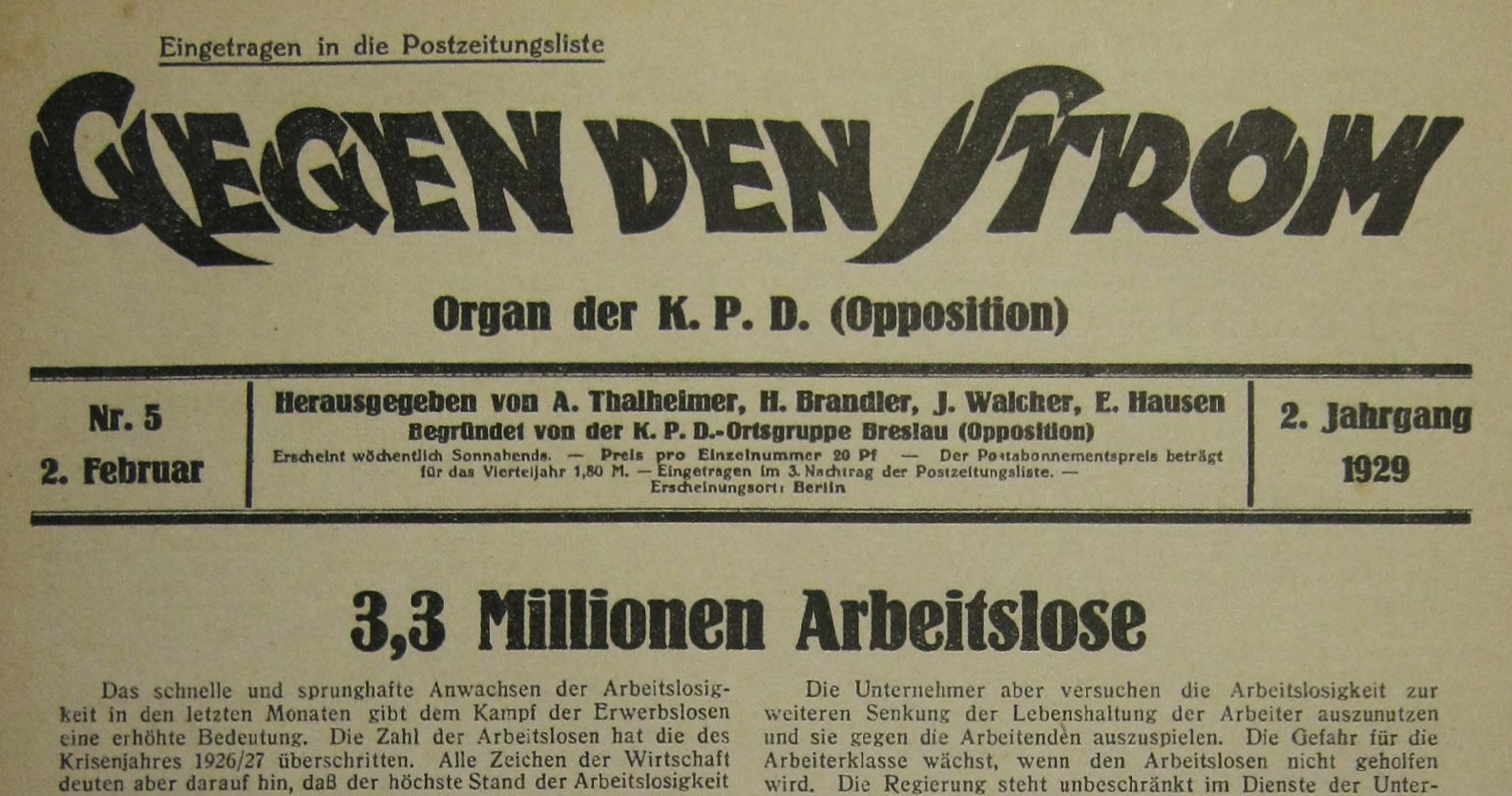
A report on the third national conference of the German Communist Opposition, the so-called Brandlerites, held in December, 1930. The largest and most influential of the affiliates of the International Communist Opposition (the so-called ‘Right Opposition’), the report includes the circumstances and composition of the meeting, and details of debates, most extensively on the ‘Russian Question.’
‘German Communist Opposition Holds Third Conference’ from Revolutionary Age. Vol. 2 No. 6. January 10, 1931.
Important International Problems Discussed
The conferences of the German Communist Opposition have always had a special significance for the international Communist Opposition as a whole. The first conference dramatized before the whole world the opening of a new stage in the history of the Communist movement–the definitive, even the temporary split of the organized Communist movement and the beginning of a period of parallel development of the Communist International and the international Communist Opposition. The second conference raised before the Communist Opposition movement of the world the fundamental question of perspective (Party or group) and presented, to what was essentially international consideration and discussion, the first draft of a platform of the Communist Opposition. But more striking than that of any of the others was the thoroughly international character of the third conference just held (December 13, 14). The problems raised and discussed there were fundamentally problems facing the Communist Opposition movement all over the world while the deliberations of the conference are certain to have profound influence on the political development of the opposition not only in Germany but on an international scale as well.
THE PREPARATIONS FOR THE CONFERENCE
The ideological preparations that were made for the conference could well serve as a model for the Comintern today, which sorely needs the vigor and self-confidence which cunt only be supplied by independent ideological activity. For almost a year the discussion on the Draft Platform went on in the local organizations. On the questions of fascism, the workers government, and other important problems there was a long and thoroly free literary discussion in the theoretical organ Gegen den Strom. As a result, when the conference did take place, the value of the discussion was very striking. The fraternal delegate of our American Opposition group declared:
“He greeted the fact that at the conference the disputed questions were being discussed in a thoroly constructive even if vigorous manner. He had participated in many international conferences before but he must declare that he has been greatly impressed at the high level of discussion.”
THE COMPOSITION OF THE CONFERENCE
The conference was attended by 68 delegates from 19 districts. In addition there were over 60 guests from all over the country while a number of representatives of foreign opposition groups who had come to the International Opposition Conference, to be held immediately after the German conference, were also present. Of the 68 delegates 58 were members of trade unions, 3 expelled members, and 7 organized (housewives, etc.). Of the 68 delegates, 4 had been politically organized (members of the Socialist movement) before 1918, and 24 between 1919 and 1926. The average age of the delegates was 36 years.
THE COURSE OF THE CONFERENCE
The conference was opened on Saturday evening, December 13, by Comrade Heinrich Brandler, who after a few preliminary remarks and the acceptance of the order of business, introduced the first reporter, Jacob Walcher, on the Activities of the National Committee. Walcher’s report showed considerable progress in every form of activity. He pointed out especially that the dues-paying membership had been raised by about a thousand since the second conference, now being about 6,100. (The actual membership of the German Opposition is of course greater while its influence is incomparably more extensive.)
After Walcher came Paul Boettcher, who reported on The Political Situation. Boettcher analyzed the world situation (quite along the line of our July Conference thesis), the situation in Germany (the economic crisis and its consequences, the re-alignment of class relations, the growth of fascism, etc.) the crisis in the German Social-democracy, the situation in the Communist Party, and finally the immediate tasks of the Communist Opposition. A vigorous discussion and summary followed this report.
The political center of the conference was unquestionably the report of August Thalheimer on The Platform of the German Communist Opposition. It was here that the discussion on the disputed questions took place. The questions grouped themselves under four heads and to a consideration of these questions we will] now proceed.
THE DISPUTED QUESTIONS
No attempt to evaluate the various viewpoints presented at the conference on the disputed questions will be made here, for obvious reasons. This article will limit itself primarily to stating the nature of those differences of opinion as clearly as the limited space will permit.
1. The Question of Fascism
On fascism the original differences of opinion had simmered down to practically nothing in the course of the discussion. The original differences had touched the class roots of fascism, the course of fascist development in Germany, the role of the bourgeoisie in fascism, etc. No differences whatever on these questions were manifested at the conference.
2. The Question of the Workers Government
The question of the workers government, as discussed at the conference, amounted essentially to a critique of the 1923 German events. The majority of the National Committee, as represented by Comrade Thalheimer, declared that:
“The Workers Government belongs to the general form of the proletarian dictatorship. It represents the initial stages of the dictatorship.”
As such it is therefore a stage in the development of the Soviet power, in which stage, as in Russia in October 1917, other parties may participate in the government. The Workers Government, therefore comes as a result of an armed uprising with the overthrow of the bourgeois state.
The minority of the National Committee, as appears from a resolution, introduced at the Berlin membership meeting and at the district conferences, conceives the Workers Government as having some sort of existence before the overthrow of the bourgeois state and the initiation of the Soviet power.
3. The “Russian Questions”
But surely the most interesting and important of these disputed questions were grouped under the head of Attitude to the USSR and the CPSU. These differences of viewpoint will here be presented entirely in the words of the official documents–the thesis of the National Committee and the amendment brought in by Walcher Froelich-Enderle-Koehler.
The viewpoint of the majority of the National Committee may be summarized as follows1:
“The false policy of the CPSU, as leader of the CI, does not signify that the policy of the CPSU as leader of the Soviet Union is necessarily false…
“The general line of the CPSU towards rapid Socialist industrialization and towards the rapid collectivization of agriculture is correct: (1) as the only possible road to Socialism; (2) for reasons of the defence of the proletarian state against the threatening attacks of imperialist powers….
“The inner-Party regime in the CPSU is conditioned: (a) thru the cultural backwardness of the Russian proletariat and its numerical weakness in relation to the peasantry working on the basis of individual economy; (b) thru the fact that hardly half of the Party is composed of workers at work in the factory; (c) thru the close interweaving of the Party and state apparatus…(d) thru the fact that the Communist Party is the only legal party and therefore the class enemy is continually striving to make its viewpoint effective within the Communist Party…
“The current party regime in the Soviet Union is therefore historically conditioned and necessary (i.e., inevitable–Editor.). Every Communist must therefore defend it in fundamentals which, of course in no sense excluded criticism of mistakes when they occur….
“For these reasons we reject our coming out for the slogan of formal inner-Party democracy (in the CPSU), as it has been put forward by various Russian opposition groups, especially the Trotskyist…
“With the forward march of Socialist construction the CPSU will have to pass over to a democratic inner-Party regime. It depends upon the leadership of the CPSU whether this transition…will take place with or without friction.
“The differences in the situation of a Communist Party before and after the seizure of power determine the necessary differences between the inner-Party regime of a Communist Party, which finds itself in power, like the CISU, and that of Communist Party, which is now only fighting for power, like the CP of Germany.
“It is basically false and dangerous to transfer the current regime in the CPSU to the Communist Parties outside of the CPSU, as does the leadership of the Comintern…
To this viewpoint the minority answered:
“The central task of the Soviet Union today is the transformation of the economic structure of the country, the creation of a strong heavy industry (industrialization), the raising of light industry, the transformation of agriculture (collectivization) and the cultural raising of the masses. These strivings find their expression in the Five-Year Plan of the Soviet Union.
“The most rapid possible realization of the basic idea of the Five-Year Plan is necessary as well for the military defence of the Soviet Union as for the construction of the economy in the direction of Socialism.
“Under the given conditions of life of the Soviet Union it is unavoidable to raise the social tension. if we are not to capitulate to difficulties. But they must not be over-strained. These limits were obviously not maintained in carrying out the Five Year Plan…
“There can be no doubt that the shortcomings and errors of the inner policy of the Soviet Union are intensified and their overcoming at the proper time hindered thru the absence of democracy within the leader of the proletarian dictatorship, the CPSU.
“The CPG-O is conscious of the fact that in a Communist Party, which is the first and still the only proletarian party holding the state power in its hands…limits are placed to inner-Party democracy. For full inner-Party democracy in the CPSU to be realized, it is objectively necessary numerically to strengthen the proletariat in relation to the peasantry and to raise the working class culturally and economically…
“The top leadership of the CPSU does not today stimulate this process of the education of the masses to responsibility thru their own deeds, but on the contrary puts obstacles in its way…
“The present system in the top leadership of the CPSU is also a source of mistakes and crisis manifestations in the Soviet Union. The system of leadership which never admits a mistake, but which always insists on the confirmation of its own infallibility, is a danger to the Russian Party and then also the Soviet Union and the Comintern.
“The CPSU cannot today do without organic and state measures even against Party members if it is to assure…the frictionless execution of Soviet policy.
“In the realization of these fundamentals it is not a question of introducing formal democracy in our Russian brother party, but to look forward to make the necessary adaptation to the organizational demands of the future and not to idealize the serious shortcomings of today.”
4. Party or Group?
On the question of Party or group there was hardly any discussion. Only the Danzig delegation took the viewpoint of a new party. The conference was substantially unanimous.
The political resolution of the National Committee was adopted by a vote of 50 against 5, with 18 abstentions. The Draft Platform was approved, 57 for, 2 against, 2 abstaining. The proposals on the composition of the next National Committee were adopted unanimously. The proposals on the composition of the next National Committee were adopted unanimously. Both the disputes on the Russian question and the question of the workers government were decided by the vote on the political resolution and the Draft Platform.
It is hardly necessary to point out that the questions raised at the German conference (and especially the Russian question) present fundamental problems for the whole Communist movement which we in America will also have to discuss and discuss thoroly. In our independent solution of these questions the deliberations of the third conference of the German Opposition will prove a great help.
1. A number of amendments and additions to the section of the political resolution dealing with the attitude to the USSR and the CPSU were made at the conference. These amendments on the question of our criticism of the CPSU, of the extension of inner-Party democracy in the CPSU, and the Comintern policy of the CPSU. They were at adopted. They have not yet been published so that they cannot be noted here. But presumably they do not change the line of the resolution. They will be published in the next issue of the REVOLUTIONARY AGE.
Workers Age was the continuation of Revolutionary Age, begun in 1929 and published in New York City by the Communist Party U.S.A. Majority Group, lead by Jay Lovestone and Ben Gitlow and aligned with Bukharin in the Soviet Union and the International Communist (Right) Opposition in the Communist International. Workers Age was a weekly published between 1932 and 1941. Writers and or editors for Workers Age included Lovestone, Gitlow, Will Herberg, Lyman Fraser, Geogre F. Miles, Bertram D. Wolfe, Charles S. Zimmerman, Lewis Corey (Louis Fraina), Albert Bell, William Kruse, Jack Rubenstein, Harry Winitsky, Jack MacDonald, Bert Miller, and Ben Davidson. During the run of Workers Age, the ‘Lovestonites’ name changed from Communist Party (Majority Group) (November 1929-September 1932) to the Communist Party of the USA (Opposition) (September 1932-May 1937) to the Independent Communist Labor League (May 1937-July 1938) to the Independent Labor League of America (July 1938-January 1941), and often referred to simply as ‘CPO’ (Communist Party Opposition). While those interested in the history of Lovestone and the ‘Right Opposition’ will find the paper essential, students of the labor movement of the 1930s will find a wealth of information in its pages as well. Though small in size, the CPO plaid a leading role in a number of important unions, particularly in industry dominated by Jewish and Yiddish-speaking labor, particularly with the International Ladies’ Garment Workers’ Union Local 22, the International Fur & Leather Workers Union, the Doll and Toy Workers Union, and the United Shoe and Leather Workers Union, as well as having influence in the New York Teachers, United Autoworkers, and others.
PDF of the full issue: https://www.marxists.org/history/usa/pubs/revolutionary-age/v2n06-jan-10-1931.pdf
 Revolution's Newsstand