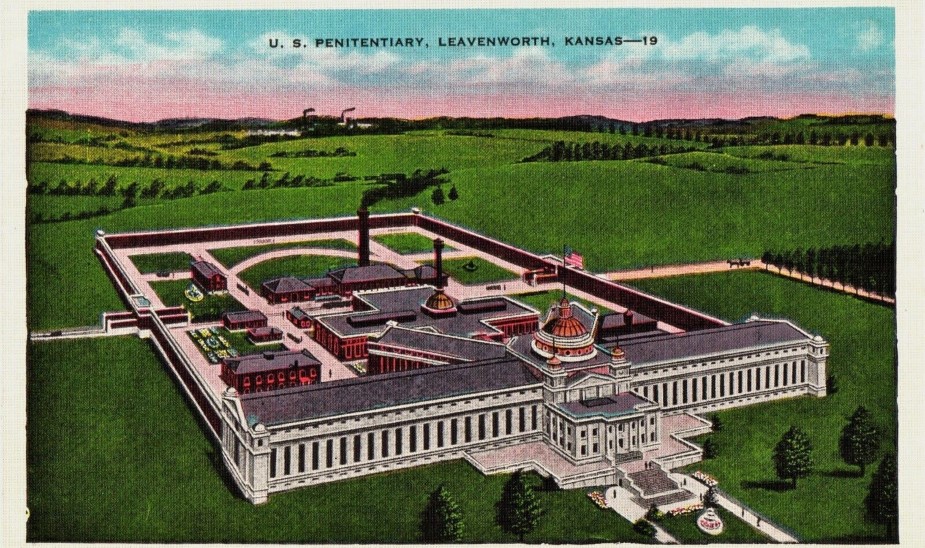
Over-crowding at Leavenworth in 1929 adds to the incalculable number of prisoners who have perished resisting inhuman conditions in U.S. prisons.
‘Seven Dead in Leavenworth Prison Mutiny’ from the Daily Worker. Vol. 6 No. 126. August 2, 1929.
Porter, Strike Leader, Prisoner There
LEAVENWORTH, Kan., Aug. 1. Six prisoners and one guard in the federal penitentiary were reported killed here this afternoon following an uprising which began during the noon meal hour.
This is the second prison mutiny in one week, two other revolts having occurred in Dannemora and Auburn prisons in New York state.
As in the New York prisons, vile food, overcrowding and mistreatment of the prisoners were largely responsible for it.
Guards Use Machine Guns.
Immediately after the uprising was crushed with the use of machine guns and rifles and tear gas, a double shift of heavily armed guards were placed on duty and the prisoners made the walls ring with curses and shouting.
The rebellion broke out within the prison about one o’clock and it was not until seven o’clock in the evening that the guards, heavily armed, were able to crush the resistance of the prisoners.
During the entire afternoon rifles lazed from the walls and loud blasts could be heard from the interior of the prison.
The prisoners dashed for the walls as guards were rallied to drive them back to the cell houses. Guards in wall towers opened fire on the running men in the prison yards.
Admit Crowding.
When the riot broke out of control of the guards on duty, Warden White called in the guards of two shifts off duty. The reinforcements manned the walls with shotguns and rifles. Machines guns were mounted in strategic positions. Their rat-tat-tat could be heard throughout the city of Leavenworth.
Crowded conditions have long existed in the prison. Observers outside the walls said there have been many rumbles of discontent among the prisoners recently. The recent rioting at Auburn and Dannemora prisons, New York, was believed to have helped to incite the outbreak. Warden Silent.
Warden Thomas B. White declined to discuss the riot. The firing and the screams of the wounded, however, could be heard far outside the walls.
It was believed the prisoners were well armed, both with firearms and explosives. Several heavy blasts at the start of the insurrection near the prison walls, indicating prisoners were attempting to dynamite their way to freedom.
Porter One of Prisoners.
John Porter, one of the leaders, of the New Bedford strike and a leading member of the Communist Youth League, is one of the prisoners in Leavenworth where he is serving a sentence of two and one-half years at hard labor. Porter had decided that he had enough of the U.S. army when he discovered that it was being used for strikebreaking purposes and to fight Wall St. wars. He became active in the New Bedford strike, and during the heat of the struggle was arrested and convicted. At that time, Porter was offered his freedom if he would promise to desert the strike. This offer Porter contemptuously rejected, and it was then that he was sent to Leavenworth.
OSSINING, N.Y., Aug. 31. Smarting under the recent revelations regarding overcrowding and vile food in all the prisons of the state, officials at Sing Sing, in an effort to befog the issue, declared today that they were “taking all precautions” to prevent an outbreak similar to the one which occurred in Auburn on Sunday.
Reports that an outbreak was possible were made to Warden Lawes by prisoners whose names he refused to reveal. The reports were that the men were bitter because of the recent state prison policy in refusing paroles to those who become eligible.
In Sing Sing prison factories were closed “indefinitely” and all industrial employment suspended. Thirty-one additional guards were placed on the walls to augment the daytime guard of 45 men.
Prisoners were forbidden to leave their cells, even to mess, except in small groups closely guarded by heavily-armed men. They were searched on leaving their cells and again on quitting the mess hall.
All cells were searched, even the mattresses being examined for possible concealed weapons.
The old dormitory, where for many years 200 prisoners had lived and slept collectively, was locked, and the prisoners were transferred to a newly opened cell block. This was the first time in 50 years that every prisoners in Sing Sing occupied a separate cell.
The Daily Worker began in 1924 and was published in New York City by the Communist Party US and its predecessor organizations. Among the most long-lasting and important left publications in US history, it had a circulation of 35,000 at its peak. The Daily Worker came from The Ohio Socialist, published by the Left Wing-dominated Socialist Party of Ohio in Cleveland from 1917 to November 1919, when it became became The Toiler, paper of the Communist Labor Party. In December 1921 the above-ground Workers Party of America merged the Toiler with the paper Workers Council to found The Worker, which became The Daily Worker beginning January 13, 1924.
PDF of full issue: https://www.marxists.org/history/usa/pubs/dailyworker/1929/1929-ny/v06-n126-NY-aug-02-1929-DW-LOC.pdf
 Revolution's Newsstand