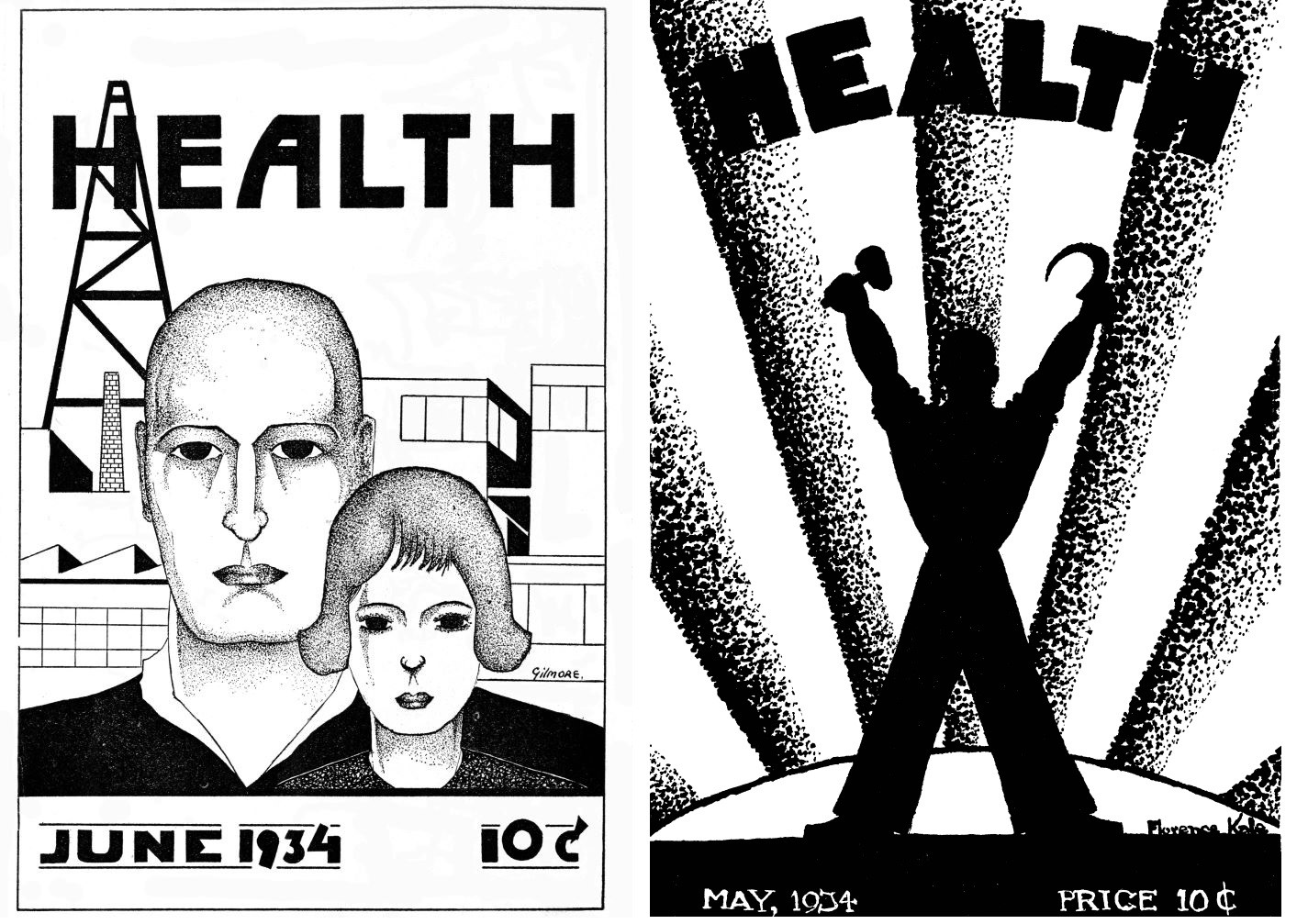
U.S. health ‘care’ is an abomination. Here, An episode in the very long fight for public medicine, the Medical League for Socialized Medicine lay out their reasons for being and answer the familiar objections to socialized medicine. Published in the premiere issue of the Daily Worker’s Paul Luttinger’s groundbreaking ‘Health and Hygiene’ magazine. Tannenbaum, aside from being a doctor and a Communist, was also an authority on William Shakespeare and the world’s leading expert of his handwriting.
‘The Medical League for Socialized Medicine’ by Samuel A. Tannenbaum M.D. from Health. Vol. 1 No. 1. May, 1934.
A LITTLE less than a year ago there was organized in New York City the Medical League for Socialized Medicine. Notwithstanding the anticipated reactionary opposition of what is known as “organized medicine,” large numbers of physicians, realizing the crisis which the medical profession is facing, joined this organization. Today the association has two branches, one in Brooklyn and one in Manhattan. The membership is growing steadily, undoubtedly because of a better understanding on the part of the general practitioner of the present situation of medical practice, of its difficulties, and its problems. The “leaders” of “organized medicine,” i.e., the officeholders in the large medico-political associations, are losing their power to mislead their uninformed followers.
The Medical League for Socialized Medicine is based on the following fundamental propositions or axioms:
1. The American public is getting neither adequate nor sufficient medical care during illness;
2. The American public is not being adequately protected against the occurrence of preventable diseases;
3. The vast bulk of the American people does not earn enough to be able to pay for adequate and necessary medical care, either as regards therapeusis during illness or prophylaxis during comparative health;
4. The great bulk of physicians is not able to earn even a modestly decent living from the legitimate and honorable practice of medicine;
5. The advance in medical science during the past fifty years, with its dependence on expensive mechanical and laboratory equipment, has made it impossible for physicians to treat the sick without the cooperation of specialists;
6. Only an insignificantly small percent of the American people can afford to pay for these highly specialized services;
7. In the struggle to earn even a bare living physicians have had to discard the ancient code of ethics (which was based on the assumption that the practice of medicine is a profession that should have regard only to the welfare of the patient) and to substitute in its place the selfish creed of the business man, and to adopt with the dishonorable methods of business the doctrine that service must bring “profits”;
8. The awakened medical profession refuses to continue to practice medicine by the competitive principle, refuses to degrade medicine to the level of a “business,” refuses to exploit those who entrust it with their health and their life;
9. At the same time the profession resents being exploited by the many millions throughout the country who are receiving medical care gratuitously at thousands of clinics and hospitals in which physicians are not being paid for their services;
10. Large numbers of the medical profession are unable to earn a living because they cannot compete with insurance companies and fraternal organizations engaged in the contractual practice of medicine, with philanthropies engaged in the practice of medicine on large scales, with government-owned clinics, laboratories, and hospitals; and so forth;
11. Even the poorest member of the community is entitled to the best medical services of which the medical profession is capable;
12. The prevention and the treatment of disease are of such a nature that they can be properly carried out only by the state acting for the common good;
13. The medical needs of these United States are so huge that there is room for work for all of the 140,000 physicians now registered and licensed in this country;
14. A system of socialized medicine in which the Government would employ all these physicians as public health officials and would give its subjects all the necessary therapeutic and preventive medical services is not only necessary but feasible;
15. Such a system of socialized medicine would cost the people of the country less than is now being expended for medical care and fraudulent substitutes for medical care;
16. State medicine, controlled, checked, and directed by the medical profession, would eliminate wasteful and often injurious nostrums, quackery, cultism, etc.;
17. Such a system of socialized medicine would do away with unfair and dishonest competition as well as with exploitation;
18. State medicine-like its counterpart, public education, would be paid for by funds raised by taxation and would place at the disposal of the public hospitals, supplies, equipment, physicians, nurses, pharmacists, dentists, and whatever else might be needed for its medical care;
19. Under such a system of socialized medicine, unencumbered by “sick benefits,” physicians would be paid in accordance with the nature of their services and in accordance with their years of service, and would be given needed vacations, opportunities for post-graduate study, for experimentation and research, as well as being insured against disabling emergencies and assured of retirement with pay at an age when their place should be taken by younger men.
20. Such a system of State medicine would be fair, honest, democratic, practicable, and economical.
Possible or likely objections which must be anticipated are these:
1. The scheme is socialistic.
Answer: It is not more socialistic than the public school system, the postal system, the police department, the fire department, the water supply system, etc. Besides, many states are engaging in various forms of social medical services (insane asylums, certain sanitaria, tuberculosis clinics, venereal clinics, inspection of school children, infant clinics, public laboratories for blood, urine and sputum examinations).
2. The public is averse to further taxation.
Answer: This was said also with regard to education. The public does not object to taxation if it knows it has a fair prospect to get its money’s worth, that the money will not be stolen by politicians or frittered away in high salaries to executives. The public knows it has to pay for medical and dental services and that it is becoming progressively less and less able to do so; it can be made to realize that paying a tax will make it easier to meet this obligation and will insure satisfactory medical service in time of need.
3. State medical service will be inferior to private medical service.
Answer: This was also said of education but it has not been proved true. Incompetent physicians supervised by older and more experienced physicians will be eliminated from the system or trained for better service. Under state medical service the treatment of a case of illness will be subject to supervision by the hospital staff. Medical service must improve in quality when every physician has laboratories of all kinds and consultants at his service, and when the hospital routine requires thorough examinations and complete records.
4. Politics will enter into medical service.
Answer: If we eliminate politicians at the beginning (which can be done by putting the system into the hands of representatives chosen by the allied professions) this will be guarded against. Notwithstanding the politicians, we have a fairly satisfactory educational and postal system. Besides, what physician does not know that one of his worst enemies today is the politics which controls the management of hospitals and clinics, both private and public? This will be done away with when every physician has a voice in the management of these institutions.
5. The personal relationship between physician and patient will be gone.
Answer: This is a gain, not a loss. Personal relationship was an asset only in the periods of empirical and unscientific medicine, when “suggestion” was the main curative agent. Today laboratories reduce the personal element in the treatment of disease to a minimum. Millions of patients today are satisfactorily treated in hospitals in which the sick do not know even the names of the attending physicians. Competence is more important than personal relationship. Personal relationship in the practice of medicine today is a myth or a pretense, except in mental cases.
6. It will cause stagnation in medical science.
Answer: On the contrary, it will stimulate research by placing laboratories at a physician’s service and by giving him the opportunity to watch the progress of his patient’s case from beginning to end (which he rarely has now) and to discuss the case with his colleagues. By freeing the physician from the cares of bread, from distrust of his colleagues, and from thoughts of exploitation, it will free his interest for the scientific study of his patient.
7. State medicine will deprive persons of the right to choose their own physician.
Answer: Children have no choice in their own teachers; students at college or in the universities have to accept the teachers and professors assigned by the boards of trustees. Patients admitted to public hospitals today have no right to choose their own physicians but the treatment they receive is not the worse therefore.
8. Physicians income will be limited.
Answer: Teachers’ incomes are limited; so are the incomes of other public servants. The security which an assured income gives more than counterbalances the lost opportunity for an unlimited (and hypothetical) income. As the servant of the state a physician will be insured against loss of income by reason of disease or accident and old age; he will be eligible to retirement on an adequate pension at the age of 70; his family will be taken care of in the event of his illness or death; he will be given regular vacations, opportunities for travel and study, etc. All this is worth more than the possibility of earning a larger income by exploitation and fee-splitting and commission-taking.
9. Physicians will be over-burdened with clerical duties.
Answer: No more than school teachers. Furthermore, such clerical duties will be discharged by clerks and bookkeepers. The absence of “sick benefits” (i.e., cash payments to the sick) will do away with most objectionable bookkeeping and with collusion between doctor and patient.
Those who have kept abreast of the times know that a number of philanthropic organizations are advocating some form of socialized medicine, other than State medicine. The system which has the most determined backing favors what is essentially a kind of basely glorified lodge system. The essentials of this system are somewhat as follow: the wage-earners in a particular community organize themselves into a group and hire a group of physicians, including specialists, who are to give them necessary medical services in return for a certain annual fee which is to be divided among the doctors in accordance with arrangements among themselves. Such a system would not improve the quality of medical practice, would not provide medical care to those who could not pay the annual fees, and would not solve the economic problems of the medical profession; on the contrary, cut-throat competition would increase and would pit doctor against doctor and group against group. Politics and commercialism of the most degrading kind would leave the doctor not a shred of self-respect.
Socialized medicine in the form of State medicine, as defined above, is the only system deserving the support of the medical profession. It is the only system which will divorce medicine from commercialism.
Health was the precursor to Health and Hygiene and the creation of Dr. Paul Luttinger. Only three issues were published before Health and Hygiene was published monthly under the direction of the Communist Party USA’s ‘Daily Worker Medical Advisory Board Panel’ in New York City between 1934 and 1939. An invaluable resource for those interested in the history history of medicine, occupational health and safety, advertising, socialized health, etc.
PDF of full issue: https://www.marxists.org/history/usa/pubs/health-luttinger/v1n1-may-1934-Health.pdf
 Revolution's Newsstand