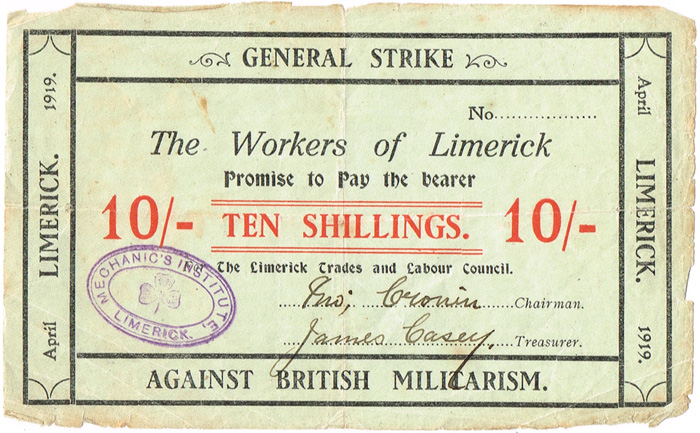
Two rare articles on the short-lived Revolutionary Socialist Party of Ireland, founded in 1919, from Irish editor Jack Carney’s Duluth newspaper. Active in struggles like the Limerick Soviet and Belfast strike of 1919, these fascinating articles offering a Socialist view of Ireland’s revolutionary period recount the trial and imprisonment of R.S.P. militants of John Hedley (O’Hagan), Charles O’Meagher and Simon Greenspon for unlawful assembly.
‘The Red Line of the Irish Proletariat’ from Truth (Duluth). Vol. 3 No. 29. July 25, 1919.
The Revolutionary Socialist Party of Ireland has received its baptism. It has been in existence only a few months, and already the governing forces of the master-class have put it through the ritual of warriors. The arrests of two of the most active propagandists of the party is an obvious attempt to harass and handicap the work of the Irish revolutionaries. But the revolutionaries will go on. If, in a few short months they have become a menace to the governing class, if they have set the pace, as it has not been set since Connolly’s death, for Irish Labour, then their justification in apparent These arrests are but a pin-prick compared to what they expect in establishing their purpose of emancipating the Irish working class. Nothing can daunt them or imperil their ardour because they know that the new economic order is with them. The thin line which has painted Russia red has begun its trail across this island, it bears the last sacrifices of the Irish workers like seeds in its stream–we can but work and speed the harvest of revolution..
On Friday, before A Special Crimes Court, presided over by two Dyson types of resident magistrates–Mr. John Gray and Mr. Alan Bell–the case was tried.
O’Hagan came first. In answer to a question as to whether he was legally represented he replied, “I am conducting my own case.” Mr. Forde, (who on another occasion defended Captain White), instructed by Mr. J.R. Moorhend, Crown Solicitor, appeared for the prosecution. Opening the prosecution counsel said:
Defendant was a man who came over to this country for the purpose of openly and frankly preaching extreme Russian revolutionary doctrines, in order to win over the working men of Belfast to that form of policy which had accomplished revolution and chaos in Russia. The principal meeting at which he spoke took place on Sunday, 4th May, at the Custom House Steps at which there were about 590 people. O’Hagan spoke at some length and with great force. Among other remarks be referred with apparently great approval to what had taken place in Russia. He pointed out, from its point of view, the admirable results achieved in Russia namely, the complete destruction of the social organism, not only of the old regime, but of the constitutional regime which was set up in its place, and approved of the control of capital, the control of the social machinery by the extreme Red faction, and he appeared to gloat over the results of complete anarchy. He had attempted to win over the Belfast workmen to these methods.
Proceeding, counsel stated that when apprehended accused had in his possession a card of membership of the Revolutionary Socialist Party of Ireland; also literature which included a copy of a Bolshevist manifesto; documenta purporting to be written by Karl Marx, and a pamphlet entitled “Collapse of the Second International,” by Lenin. Everything, said counsel pointed to the fact that defendant was saturated with extreme Russian ideas, which, in the old days, were associated with Nihilism
What the Constable Heard.
The first witness called was Constable Terence Kelly, who said he was present with other officers at the meeting at the Custom House Steps referred to. There would be an audience of about 500. Defendant was the principal speaker. Charles O’Meagher also addressed the meeting. Witness took a careful mental note of what O’Hagan said, and this he put in writing Immediately after the meeting was over.
Tell the Court some of the remarks made by the defendant. Did he refer to the Russian revolution and Russian propaganda?–Yes. He said: “In Russia the spirit of the workers arose and they had the courage to declare a revolution. The Allies, Lloyd George, Carson, and Milner, and the ring of financiers saw there was a chance of a Republican Government being set up under Kerensky: that they would get their millions that they had invested there back; that the war would be continued on the battle front, and they hailed the Republic with delight, but when Kerensky did not withdraw the capital punishment inflicted on soldiers for deserting from the front, the Bolshevists said there was no freedom in Russia. The capitalists and the ring of financiers are still in power.
The Bolshevists said we can command the means of production, and the peasants can command the production of food. What more do we want? With the aid of the Soldiers’ and Workers’ Councils and the Peasants Councils they sought about the overthrow of Kerensky and his Republic, and established Soviets Instead, The Russian soldiers refused to fight. The Bolshevists released the prisoners of war from Germany, Austria, and Bulgaria, and gave these friendly advice to go home to their own countries and establish councils similar to that they had done in Russia. They did not shoot them down or kill them. Now there are the Russians that England, France, Italy, and America are sending in troops to shoot down and kill, and are asking you to go and shoot down; but remember they are workers like yourselves. They are out to kill the wages system; they are out to secure the means of production, and secure for themselves the full fruits of their labours. You see they got their eyes opened–they found out the capitalist gang in Russia, and when they got the opportunity they took it, and all honour to them. We require the aid of the soldiers; I want you to get them to come with you! I want you to get them to come into your ranks, so that they will not shoot you down when you go on strike; and mark you, I do not advocate what other people do in other parts of Ireland for political reasons–that is stealing the rifle and ammunition. I will ask you to do more–steal the soldiers themselves; they are your brothers, and let them bring the rifles with them, and with their experience they will be able to instruct you in the use of such weapons, which can be used in your interests and against them. Trade Unions as are at present constituted, and organised are too slow. What we want and what I advocate is a committee formed in each Industrial works or plant–appoint your delegate from there to the principal councils and your grievance can be remedied at once.
In answer to the Bench, witness said there were perhaps four or five soldiers in the audience.
O’Hagans’ cross-examination of witness was a mere matter of technical obstruction, as he did not attempt to score any points or to question the veracity of any of his statements. He asked witness if He (defendant) had advocated bloodshed?
“No.”
“What then, is your estimation, was the motive in bringing over the soldiers with their rifles and experience into our ranks?”
“You stated, in order that they should not shoot down the workers, who were their brothers, on strike.”
“I was not out to kill?”
“No,”
“What about the wages system? Did I say nothing about killing in connection with that? What did you think I meant…?”
Witness began “I…”, then shifted uneasily, and turned his pale, pleading eyes to the magisterial authorities. “I…leave that to the Court.”
The faces of the Socialists gleamed with silent merriment. An altercation arose between defendant and prosecuting counsel ever the names of the Sinn Fein employers connected with the Limerick strike. Counsel protested against the mention of names. O’Hagan pointed out that these employers were prepared to act contrary to their Sinn Fein professions, and to side with the coercive forces of the British Government when it came to a question of their interests as employers against the interests of their employees. He waived the mention of names. Addressing the magistrates he said the prosecuting counsel had laid great stress upon the phrase stealing the soldiers, that special emphasis had been put on this aspect of the examination for the Crown, and that an effort had been made to insinuate that he had incited to bloodshed. The opposite was so–he was out to prevent, as far as possible, the slaughter of his class. The capitalists would see to it that blood would be shed in due course. He was accused of Bolshevism. The word Bolshevist was a bastard term which dates back to a Congress of the Russian Social-Democratic Labour Party held in 1903. The Bolsheviks were the revolutionary working class who had seized the means of production in Russia at a point when the capitalists had rendered those means, for all practical purposes, only fit for the scrap heap. They had saved Russia for the working people of Russia…At this point the magistrates interrupted that they knew what Bolshevism was, and that defendant must keep strictly to the charge preferred against him.
O’Hagan continued:
I am charged with illegal assembly, that I am an evilly-disposed person. I put it to you, gentlemen, that in order to prove that I am an evilly-disposed person you must prove that my motives and associations were evil. The meetings in question were undesirable to the British Government in that lay their unlawfulness. An assembly that would be desirable to the British Government would be futile, as far as the working class is concerned, because the working class and the British Government have nothing in common. Any attempt at improvement of our conditions is unlawful by the same ruling, which we are to obey–law or the will of the people? I tell you, gentlemen, we do not consider the legality of the question, we only consider the necessity of tactics, and if your law does not meet that necessity than it is the law which is at fault. We must have a new law. It is not you who are trying me, it is I and the purpose I represent that is trying you. Necessity controls all policy. If you are logical as circumstances compel you to be, you must uphold the interests of the minority you represent–that minority is human society, which is interested only in the exploitation of the majority of the people. I belong to the many who are exploited by you, the few. We are the people. It is we who are trying this Court not you, who are trying me. It is our will which demands justice, and if the law fails to give justice to the will of the people the law must fail.
There was a suppressed applause which deepened into tense silence so O’Hagan sat down. Never before had such a speech been delivered in a Belfast crimes court. The empty stupidity written on the heavy countenances of the R.I.C. group. which from a corner of the Court on the left of the Bench, seem to loom massively like a black shadow over Hagan’s utterances: the queer bereft perplexity on the warped faces of the magistrates, and O’Hagan’s defiance offered a comparison that left all the eloquence of redemption on O’Hagan’s side.
Charles O’Meagher was then called. Like O’Hagan, as he was conducting his own case he was accommodated with the same seat which O’Hagan had occupied behind the Crown prosecutor. Asked if he was legally represented O’Meagher replied, “I don’t know, this is your affair not mine,” and all through the trial he treated the procedure of the Court contemptuously:
Mr. Fforde said this was another of those gentlemen who seemed to think he was entitled to upset the existing social conditions of the country. After relating the circumstances of the meeting, counsel said when arrested the accused had in his possession a large number of pamphlets.
A copy of a leaflet was handed to the magistrates, and Mr. Gray remarked that it did not bear the name of the printer.
Counsel–No, they do not in these cases. In O’Meagher’s possession, added counsel, were so found military service exemption certificates, one of which bore an address at Rotherham and another at Ealing.
Sergeant Mooney said on the night of the 11th May, he was at a meeting at Peel Street, held in connection with the Revolutionary Socialist Party in Ireland. O’Hagan was chairman of the meeting, and introduced O’Meagher–who was described as a comrade–as the principal speaker. In his speech O’Meagher dealt with Socialism generally, and concluded by saying: “It is necessary for you to be organized before you can fight capitalism. Capitalists are only one-third of the population; we are two-thirds of the population, who produce the whole of the wealth, but only get one-third of it. The capitalist gets two-thirds. We are entitled to the whole of that wealth, and control it ourselves. We are entitled to fight for it by every means in our power.
Was a question put to defendant concerning James Connolly’s Revolutionary Socialism?–Yes.
What was the question?–Do you believe in James Connolly’s Revolutionary Socialism
What was O’Meagher’s answer?–He said “Yes, there are many methods and many ways by which we should get that which we are entitled to, but falling those I have no hesitation in saying that we should be prepared to fight for them, and thus adopt James Conolly’s ideas.”
Sergeant James Wilkin then gave evidence, which was similar to that given in O’Hagan’s case.
Addressing the Court O’Meagher said: “I maintain that the whole case for the prosecution is hazy. I say hazy advisedly. I, for instance, do not possess any knowledge of legal affairs. Only you who represent a privileged minority possess that knowledge, the major portion of the people have no knowledge of the law, and on these grounds be an individual ever so bad, or be he ever so good, he is liable without that knowledge to transgress the law at any moment, so go smash against it. The law, therefore, under these circumstances meant at any particular time anything, everything, or nothing accordingly as it suited the interests of the authorities. It was simply a farce to bring a man into that Court and tell him that on a certain date he had committed an offence. I tell you, my dear gentlemen, that I am ready and willing to go before any section of the working class, defend my case, accept and abide by their judgment. I refuse to abide any judgment of this Court whose findings are based upon coercion. All through this age members of my class have stood before similar tribunals to this one before which I stand to-day, and justice has never been meted out to them. I am proud to take the same road as them, proud to belong to them, because in the end the righteousness of our cause will prevail.
O’Meagher sat down in the midst of a great burst of applause.
He was convicted and sentenced to six months’ imprisonment.
O’Hagan was sentenced to six months with hard labour. As he left the Court he turned and shouted back into the furtive faces of the magistrates: “Someday, I hope, a revolutionary tribunal will try you.”
It was interesting to watch the attention of the highly skilled legal Mr. Fforde when these Socialist working men were delivering their pointed and concise speeches–he was apparently intrigued into the psychology of the forces which made them such professional black-legs in his lofty domain of the Crimes Court, and as for the poor magistrates–it was dirty work. Pilate, at least, in the search for truth had the decency to wash his hands.
‘Inside and Outside Belfast Gaol’ from Truth (Duluth). Vol. 3 No. 30. August 1, 1919.
Inside, the prisoners John O’Hagan, Charles O’Meagher and Simon Greenspon, have hunger-struck since the day of their trial–Friday, June 27–as a protest against not being treated as political prisoners. Though frequent inquiries have been made at the gaol gate as to the condition of these men, no information has been forthcoming. A letter to the Governor pointing out the seriousness of the situation and his responsibility for the lives of these men while in his custody, elucidated no enlightenment beyond the information that the matter was being brought before the prison’s board.
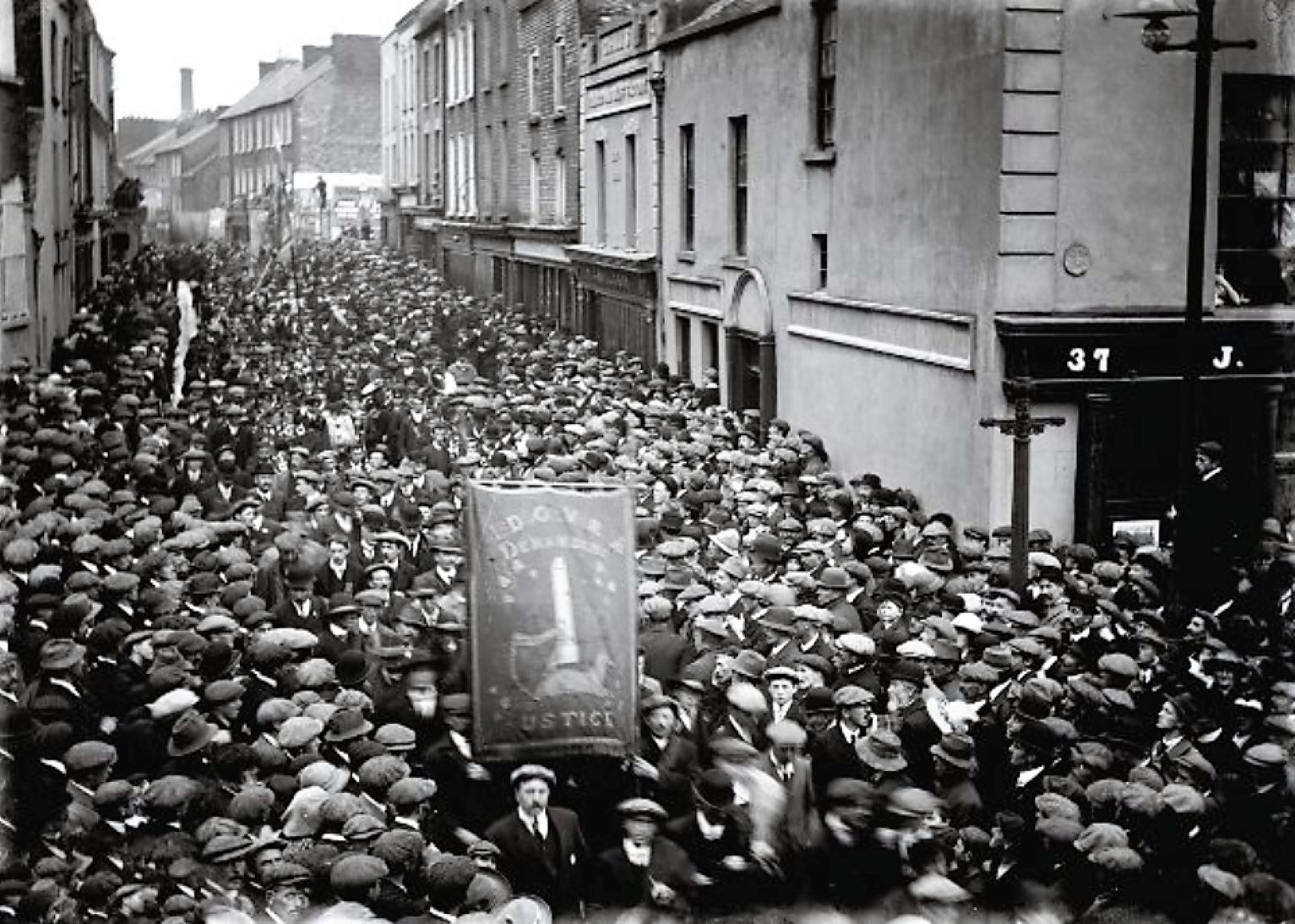
Since then–official silence! The Governor of this gaol must hold deafness as one of his qualifications of office, because if he does not he must be strangely bereft of serenity, for not even a gaol governor could maintain a conscience amidst the audible racket of the Sinn Feiners imprisoned there. After sunset. when the light falters and the traffic in the streets diminishes. towards midnight sounds of speech-making, punctuated with peals of applause and varied with a tin-can orchestra and voices swelling into rebel Irish songs, pour out of the narrow prison windows across the sentried space into the preoccupied atmosphere of Belfast thought. People, in spite of themselves, are compelled to listen, compelled to think, compelled to realise that whether the cause for which these men suffer is the cause which will liberate Ireland, or whether it is not, transcendently above its limitations the spirit of the men imprisoned there, because of it, is the spirit which will liberate the wide world from its trammels. No prison can chain that spirit or extinguish it. The Socialists imprisoned there have the same spirit, and in due time will join that mighty chorus and link it into the propaganda of the International proletariat. For the present their hunger strike has rendered them grimly silent–a silence which fills us with insurgence because of the memory of the day of their trial, when, after their sentence, their defiant voices besieged the glazed, unwholesome cells of Chichester Street police barracks with the “Red Flag” and “I’Internationale” and revolutionary speeches.
Outside Belfast the Big Drums of the 12th and all the insignia of Orangeism–which is but a barbaric survival of tribal ritual–commemorate the little insignificant incident of the Battle of the Boyne with a significance which has been made historic because the will and the power of the Ulster capitalist class decreed that it should be of weighty import in the minds of the Ulster working class.
Orangeism, however, has received its death-thrust–it received it when Sir Edward Carson betrayed his class interests during the recent strike. The thoughtful working class of Belfast is emerging from its fetters into a class-consciousness which beholds all party forces in their true colours. Once Ulster turns into the fight of the proletariat it will hold on with even more tenacious venom to the no surrender principles of its emancipation than it ever held to the political illusions with which its Northern capitalists have kept it subject and bound into the slavery of the present system. When Ulster rises there will be no end until the cause is won.
Sacrifice and Progress.
Judged by the ratio of man’s minute reasoning the progress made in the process of change is infinitesimal and slow. It has taken centuries–ever since the Luddite riots bit into the vitals of the working class with the sharp teeth of machine-production to pervade the social structure of the world with the immoral consequences of capitalism. It has taken centuries to pervade the masses, bred into acceptance of the capitalistic expression of human living with the revolt of redemption, centuries to establish their primal loyalty to the glory of the sunlight from which the mine of wages sought to exclude them.
For generations under enslaving Christendom children have been born wantonly into consciously and deliberately imposed ignorance. Their youth and maturity sapped with mockery upon the wheels of industry. And the working class, which represents the vast bulk of the whole place, accepted this as it accepted the mercy of God and its heritage of eternal punishment. Life lay forever beyond the frontiers of the present existence, and every day of slavery was part of the probationhood of Death. Humanity forgot to live.
But, always in the slow accumulation of evolution crises arrive when the form changes convulsively; when the earth is blasted with the suddenness of a new expression of its purpose and sweeps the mind of man into a response as pregnant as the patient fields yield to the summer rain. In such a period man rises into the majesty of life and turns routine into exaltation. He lives, and because he lives he has no fear of death. That is why all sacrifice is primarily a redemption, and heroism the great, blessed sign of the pioneer. He who would question the individual worth of sacrifice, who would plead its uselessness, has bound his vision within the paltry kingdom of self, and forgotten that the magnificence of mankind is composed of the courage of its units. Those who give nothing from their personal comfort to the margin of Liberation will find their memories buried like meals in the digestion of the race. Though I would be the last to deny that the emancipation of man is wrought peculiarly into the needs of his stomach, still contend that bread is not the only inspiration of our lives, and there are even some who will forswear sustenance in the consuming furnace of some high motive which obsesses them.
Sacrifice is only sacrifice by the laws of comparison–only because it is set against great heedlessness, only because it stands out in solitary unselfishness against callous selfishness. That is why some people call it worthless–because it is unheeded. But no human act goes unregistered in the trend of consequences, and, therefore, a deed. done for others soars with its powers of consciousness above a weight of unconscious action, and fulfils its aim according to the hour of its need.
There may come a time–beyond our age–when there will be no need for sacrifice, because people will have evolved from malice, and mental science will have reached a stage when an injury to an individual will be an injury to society. In those days people will read the records of capitalist crime and punishment with as much horror as we read to-day of the tyrannies of Torquemada, and they will marvel, even as we marvel at the endurance of men and women who faced those tyrannies unflinchingly for the faith that lay in them to redeem the world. It would seem as if every age will grow ripe with ready martyrs, and backs bent willingly to bear the burden of progress.
Irish Prisoners’ Fund.
JOHN O’HAGAN, National Organiser, six months’ hard labour. CHARLES O’MEAGHER, business manager, six months for holding meetings in Belfast under the auspices of the Revolutionary Socialist Party of Ireland.
A fund has been opened for the maintenance of dependents. All sympathizers and revolutionists are asked to rally to defence fund.
We trust that our Irish readers will send us a donation towards the above fund. Let us help the comrades at home and show by our financial support that we appreciate the fight that is being made. Deeds speak louder than words, so we trust the boys in Butte, the members of the Irish Progressive League and other Irish organizations will send in all the finance they can afford to JACK CARNEY, Rex Hotel, Duluth, Minn.
Truth emerged from the The Duluth Labor Leader, a weekly English language publication of the Scandinavian local of the Socialist Party in Duluth, Minnesota and began on May Day, 1917 as a Left Wing alternative to the Duluth Labor World. The paper was aligned to both the SP and the I.W.W. leading to the paper being closed down in the first big anti-I.W.W. raids in September, 1917. The paper was reborn as Truth, with the Duluth Scandinavian Socialists joining the Communist Labor Party of America in 1919. Shortly after the editor, Jack Carney, was arrested and convicted of espionage in 1920. Truth continued to publish with a new editor J.O. Bentall until 1923 as an unofficial paper of the C.P.
Access to full issue: https://www.mnhs.org/newspapers/lccn/sn89081142/1919-07-25/ed-1/seq-1
Issue 2: https://www.mnhs.org/newspapers/lccn/sn89081142/1919-08-01/ed-1/seq-1
 Revolution's Newsstand