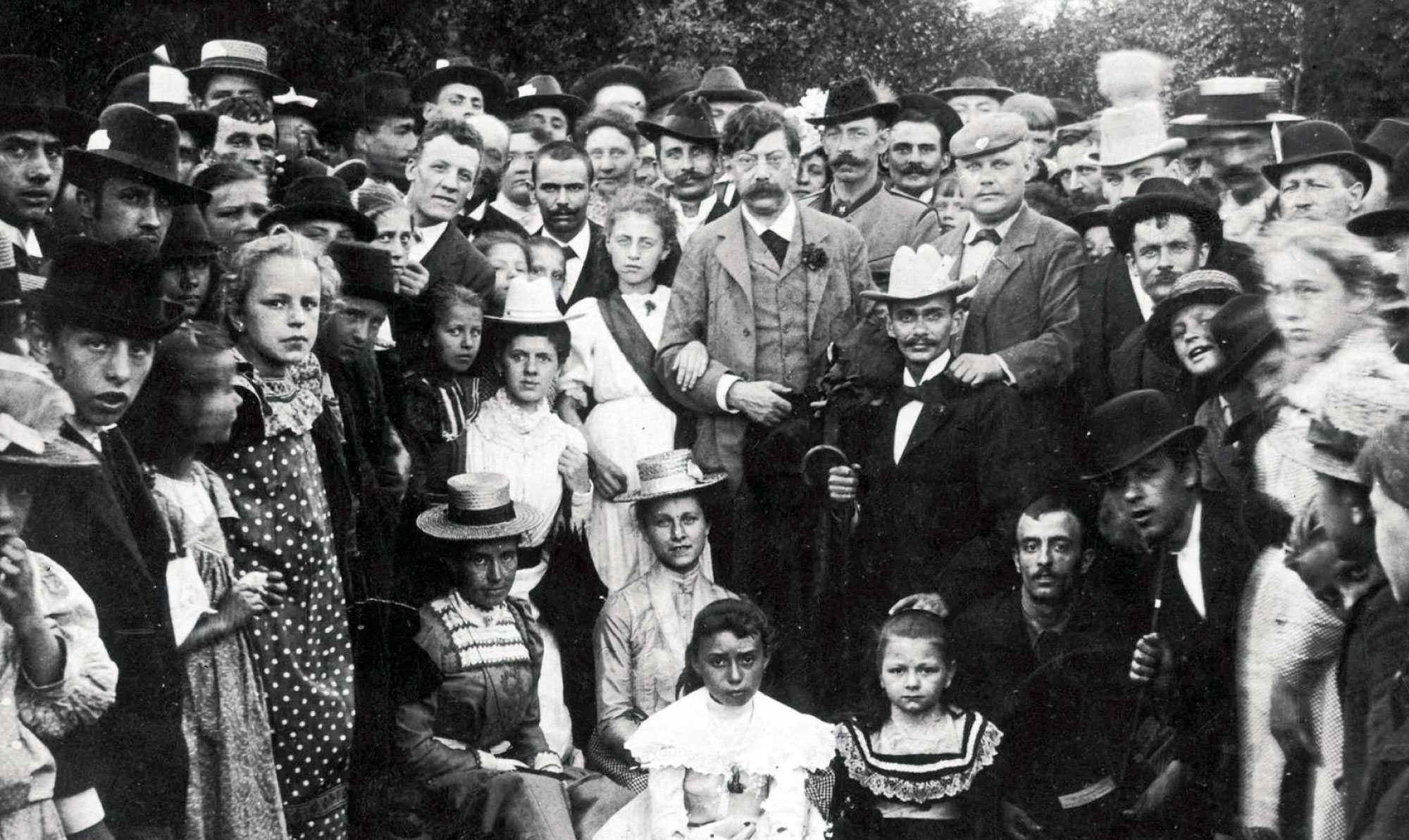
Veteran Sudeten Marxist Alois Neurath looks at the social-patriotic role of the Austrian Social Democratic Party in the World War on its tenth anniversary. As well, the rise of a left wing, and the positions of Otto Bauer and Fritz Adler, and the origins of the Czecho-Slovak Communist Party.
‘The Old Austrian Social-Patriotism’ by Alois Neurath from Communist International. Vol. 2 No. 5. August, 1924.
THE Communist Party of Czecho-Slovak has a twofold origin; it arose from the opposition of the old Austrian German and Czech Social-Democratic Parties. Even before the outbreak of the war, Austrian “international” social-democracy was split up into national sections (Polish, Czechish, German, etc.). The leadership of all these sections lay in the hands of well-known opportunists: Daszinsky was the leader of the Polish, Dr. Adler of the German, Anton Nemetz of the Czech, Buchinger and Kunfy of the Hungarian Social-Democratic Parties. The weak left-wing of the German Social-Democratic Party paid great attention to the big struggle waged between the Revisionists and Radicals within the German Socialist Party. It is well-known that the Revisionists were attacked at every conference of the German Socialist Party, a fact which we of the left-wing were very glad to observe. At that time we did not fully realise that Revisionism, though always theoretically beaten, in practice held the reins and had imprinted its mark on the Party. The Radicals carried off the greatest laurels at the Magdeburg Conference, at which August Behel got even with the South Germans, who voted for the Budget. Besides it appeared, that as a result of the political antagonism in Europe, the radical wing of the workers’ movement would probably gain the upper hand. This was especially the case when as a result of the disturbances in the Balkans, the outbreak of the world war seemed unavoidable in 1912. The international conference in Basie made a very powerful impression on the workers of all countries; its resolution against the war-mongers was accepted by all class conscious workers as being absolutely serious. The clauses which said that the Second International would be ready the moment the rulers attempted to begin war, to rouse the working masses to revolt and to lead them on against the exploiters, were particularly received with the greatest enthusiasm.
The catastrophe of the 4th of August, (27th of July), 1914 was immense. The Austrian social patriots were lucky not to have to show themselves in their true colours at once. Count Sturkh, the Austrian Prime Minister, had broken up parliament in good time, and had avoided having any consultations whatsoever with the representatives of the people. He knew the revolutionary international SocialDemocrats much better than we did, he knew that they were capable of being imposed on in any manner he thought fit. The Austrian Social-Democrats were not obliged to take part in the voting on the Budget question.
On the 4th of August, we were very eagerly awaiting the results of the German Reichstag meeting. When the report arrived that the Social-Democrats had decided to vote for the war credits, we regarded it as a kind of war canard, and made fun of the idiotic war journalists. Our triumph was short-lived. We were obliged to acknowledge that the German faction had agreed to the vote on the war credits and that there was not even a single member who had had the courage to make a protest against this unparalleled treachery. A few weeks previously, we had held consultations with Karl Liebknecht and Rosa Luxemburg about meetings which were to be held in German Bohemia. We were full of enthusiasm at the Radical outlook of these and other members of the left-wing of the German socialdemocracy; this only increased our disappointment at the news about the vote. The central organ of the Austrian Social-Democratic Party, the Vienna Arbeiterzeitung, took sides with the faction in the German Reichstag in the article, since become so famous, entitled, “The Day of the German Nation,” in which it agreed enthusiastically with the German Social-Democratic Party.
Every action taken by the Austrian Government showed that they knew not only to despise the leaders of the Socialist Party, but also how to make use of them, and that they were very well posted about the position of the working class movement, and also that of the Socialist Party. While the Vienna Arbeiterzeitung became the echo of the poor Austrian Government, which was forced into the war against its will, the Reichenberger Vorwarts, which had published a determined protest against the war-mongers and had taken up a definite attitude against war was banned by Count Sturkh.
Social-patriotism was legalised, its papers were sure of the protection of the authorities. All the measures it took against left-wing groups of the workers were directly and indirectly supported by State authority, in a word, the power of the social-traitors increased from day to day, whilst every act of opposition of the left-wing of the Labour movement, and at every attempt to take up a stand against the war policy, were mercilessly suppressed. Subsequently the Reichenberger Vorwarts was transformed into the so-called Arbendpost which was in reality nothing less than an organ of the war-mongers of the ruling classes in Austria. The Austrian working class movement received blow after blow in quick succession. The Party and trade union leaders served the ruling classes and Austrian absolutism in every possible way; it placed the whole apparatus of the Party, of the trade unions at the service of the Government. The Government was well able to use the powerful moral influence of the leaders. Victor Adler was responsible for the opinion that a party of the workers who went to the trenches must give the necessary moral support. “If war has already broken out, then the workers are obliged to protect the frontiers of the fatherland in their own interests, when the houses in which the workers are living is in danger of being burnt down, there is no sense in talking about class differences, we must all work together, and for this purpose we must make peace amongst ourselves so as to be able to secure the necessary measures for our physical existence.” In this way or somewhat in similar manner the social-patriotic bandits in all capitalist states express themselves. The SocialDemocratic leaders tried to make the workers believe that it was not in accordance with the theory of Marx to protect the status quo, a Marxist must understand better than anybody else that the frontiers are not permanent and hence annexations are not to be opposed on principle. It was with such miserable sophisms that the social-patriots protected the war aims of their Governments, supported with almost a spirit of religious sacrifice, every policy of the oppressors, who sent increasing numbers of workers into the trenches. The Marxist State theory was at that time “enlarged.” Dr. Karl Renner in conjunction with Friederich Neumann, produced a new State theory, he agitated for the creation of the new middle European State, which must come as the result of a revolution from above. Only radical sophists could overlook the fact that the revolution from below was now impossible since the cannons had taken away those who could make it.
After the outbreak of the war, it cannot be denied that the majority of the masses were against us. The social-patriots had enormous influence. The so-called Marxist centre capitulated entirely, not only before the great spirit of revisionism, but even before the barren social-patriotism and mediocrity under the leadership of Ebert in Germany, Forster, Sever, etc., in Austria. War Communism was regarded as a necessary first step to Socialism, victorious Central Europe was a decisive and most favourable forerunner for a new revival of the European working class. Even if such a victory could only be possible at the expense of the conquered peoples of other States, still one must think that the power of European Socialism would be sufficient together with the exploited of the conquered States to smash the capitalist yoke. Now we laugh about these fundamental theories of organised social treachery, one can hardly imagine that any workers during the early days of the war could listen to such opinions. But now we know that everywhere this was the case, and we must confess that social-patriotism had the easiest task in Austria in its work of betraying and selling the working masses.
Soon after the outbreak of the war, the opposition of the Austrian Socialist Party strengthened its position in many parts of the country; for example, in Northern Bohemia (the territory of Reichenberg) it was able to regain its old position completely. At the first national conference in Vienna, which was attended by several hundred delegates, the members of the opposition could be counted on the fingers of two hands. Eight or nine delegates, amongst them Fritz Adler, took a stand against the official policy of the Party. The methods of attack of the majority of the Austrian Party, under the leadership of Victor Adler, were both childish and contemptible. They tried to make little of the opposition in the eyes of the workers by ridiculing their then leader, Fritz Adler. His remarks were not taken seriously, and the position which he took up was attributed to dishonest motives. The opposition in the provinces had a more favourable position, especially in North Bohemia. A few months after the outbreak of the war, a sectional conference was held in Reichenberg, which took up a position as regards the leadership of the Party. Fifty per cent. of the delegates declared in favour of the opposition, which had condemned the war policy of the Party in a most violent manner. The Presidium of the Party sent as representatives to this conference the old politician, Seitz, also the well-tried Party member, Adelheid Popp, who even after the failure of the war continued to be a passionate Social-Democratic nationalist.
During the first two years of the war, the position of the social-patriots became much stronger in the Empire. The opposition, however, also organised itself throughout the Empire; it had its actual centre not in Vienna, but in Reichenberg. The comrades at Reichenberg founded a club (every legal activity of the opposition was impossible), which became known to a large circle of comrades under the name of “The Plotters’ Club.” This club kept up connection with the opposition and unfortunately only very indifferent connection with the opposition in Germany. This organisation accomplished wonderful things in the old Austrian Party, one can even say, that without this Reichenberg organisation, the systematic and successful organisation of the opposition would have been impossible.
The famous shot fired by Fritz Adler at the end of 1916, brought a fresh breath of air into the stuffy atmosphere of Austrian absolutism. A powerful movement began among the whole mass of the starving Austrian proletariat. The Austrian Socialist Party, for a second time showed itself as the social force ready to put all the means at its disposal in the hands of ruling classes to protect and to maintain order. A thing that no party of the working class movement expected was the way the official leaders of the party deserted Fritz Adler. The central organ of the Party the Arbeiterzeitung doubted whether Fritz Adler was a hopeless fool or a completely eccentric idealist. Others spoke in a more open, clear and brutal manner. They tried to explain the act of Fritz Adler as a sore on the healthy social-patriotic body of the Party. Fritz Adler on his part was disgusted by the meanness of the Social-Democratic policy, especially by the policy of Seitz, Dr. Renner, Leuthner amongst other passionate social traitors. Fritz Adler’s trial was to a certain extent a still greater sensation than his shot at Sturkh. Fritz Adler exposed the rottenness not only of the Austrian section, but also of the entire Second International. With a shudder the broad masses of the people recognised the under-currents within the Social-Democratic movement. It is a fact that the authorities did their best to prevent a complete exposure of the Social-Democratic war policy. The reports of the trial were strictly censored, but even that which was published sufficed to enlighten a large party of the masses about the official policy of the Austrian Social-Democratic Party. As already remarked, Adler’s action had a very rousing influence, not only on a large part of the Austrian, but also on the international proletariat. It became clear that the Austrian Government at that time was already very insecure, it must loosen the chains in which it had put the whole working population of Austria. Parliament was summoned, and it became clear that the events of the last two years had taught the counter-revolution very much, but the Social-Democratic party leaders had learnt nothing, and forgotten nothing.
The Russian March Revolution brought about a fresh revival of the Labour movement. But that did not last very long. When it became clear that Kerensky represented no power, which could serve in the struggle against international imperialism, the Austrian Government again had an easy task. Germany and Austria armed for a new offensive to bring about “final victory.” The misery of the masses of the working population increased to an insupportable degree; but the Government was not to be held back from making preparations, and side by side with it worked the leadership of the Austrian Social-Democracy. The Party sent its representative to every institution of war Socialism. In practical daily work and in a thousand important positions, it was the most successful and necessary assistant of the Hapsburg Government. Whenever there were demonstrations of starving women, you were sure to find Social-Democratic representatives, capable of holding back and suppressing any critical movement. It was quite clear that the Hapsburg Government would only remain faithful to the agreement with the Hohenzollerns because it had the whole apparatus of the Socialist Party at its disposal, and because the overwhelming majority of the leaders of this party, had thrown themselves into the service of the warmongers. The Government was obliged enormously to increase its pressure on the masses of the people. All the sophisms of the AustroMarxists were of no avail any longer. The discontent of the working masses grew from day to day in the most important industrial centres of the monarchy. It was not only directed against the Hapsburg regime, but also with equal hatred against the blackguardly leadership of the social-patriots who had done so much to increase the power of resistance of the ruling classes of old Austria. In August, 1917, the opposition in Northern Bohemia increased its influence to such an extent, that it regained the control of the Arbendpost. Meanwhile the Arbendpost changed its name to the Tagespost.
From this time onwards to the end of the war, this daily paper was to act as the only German daily paper in the Austrian monarchy to carry on an open struggle against the war policy of the Government, and against the social-patriotism of the Party. The foundation of the Austrian State had already begun to crumble. The practice of confiscation could not be applied with the same severity as formerly. Hunger demonstrations were and remained the order of the day. The Tagespost, under Social-Democratic leadership had acted as official war organ, as soon as we got the paper in our hands, we changed its character immediately and completely. The working masses breathed freely again. As we worked under the censorship the paper appeared daily with large white spaces, but it appeared and the numerous censored parts produced an even greater effect. Amongst the contributors to the Reichenberg provincial paper at that time, were the best theoreticians of the International. The articles and theses written by Comrades Lenin, Zinoviev and Radek which were so difficult to obtain at that time, were to a certain extent published in the Tagespost and discussed in the “Plotters’ Club” as well as it was possible. Other contributors to the Reichenberger Tagespost included the best brains of the Vienna opposition pf the Socialist Party, who have since regretted their youthful follies and in all humility subjected themselves again to the patriotic leadership of the Party.
In the autumn of 1917, at the national conference in Vienna, the opposition had already increased to twenty. Fritz Adler, who had been condemned to death, was in prison; but the opposition had a new leader in Otto Bauer, the theoretician in the Austrian Party. Otto Bauer had returned a few months after the March Revolution as a war prisoner from Russia. The official party leaders had already heard rumours that Otto Bauer intended to join the opposition openly. The Party Presidium was very excited at that time and lost its head, so to speak. At the Party Conference in 1917, until the breakdown of the war, Otto Bauer continued to be the leader of the opposition. To-day we are in a better position to judge the role that Otto Bauer played at that time. Otto Bauer’s policy objectively was to rescue the Socialist Party-that is to say, Otto Bauer was responsible for handing back the Party as a whole into the safe hands of the social patriots. When Otto Bauer returned from Russia, the actual leaders (Victor Adler was almost continuously ill) were about to use their whole strength to direct the Party in the lines dictated by the Hapsburgs. That is to say, the policy of Seitz, Renner, Victor Adler, etc., would have led it in 1918 to the delivery of the suppressed majority of the Austrian workers under the leadership of the social-patriotic lackeys. Otto Bauer prevented the social-patriots, Renner and Co., from committing this great act of stupidity. He placed himself at the head of the opposition so as to be able to hold back the destructive power of the social-patriotic presidium, and on the other hand, to prevent the radicals in the opposition from rescuing the workers at an opportune moment from the leadership of the social-patriotic blackguards. In reality, Otto Bauer was pf the greatest service to the leaders of the social-patriots, who have to this very day held back the proletariat from any kind of revolutionary action. At a most opportune moment, Otto Bauer left the opposition and took his position with both feet on the ground of the Austrian social-patriots.
In this connection, we must recall the strike in January of 1918. During this struggle, Otto Bauer did not distinguish himself in any special manner. The excitement of the Vienna workers was extreme. Otto Bauer did not support the revolutionary movement in January, 1918, to any extent, on the contrary, his influence was used to prevent the masses from continuing the struggle. It is quite certain that had it not been for Otto Bauer, no other member of the Party Presidium would have had the power to “pacify” the striking workers. Otto Bauer possessed this power because of his attitude to the opposition. Thus, Otto Bauer used his position only in the interests of social-patriots. The social-patriots themselves were finished in the eyes of all the revolutionary elements; they were not able to undertake anything against the will of the revolutionary workers. But Otto Bauer, was regarded as radical, he was the leader of the opposition which had fought against the Party Presidium. The moral and political credit of the opposition had greatly increased during those days in January, whilst the Party Presidium had completely lost caste. One can, therefore, see that Otto Bauer by placing himself at the head of the opposition, actually served social-patriotism rather than the revolutionary workers. Our mistake was that we were not able to see this game and could not stop it in time.
After the suppression of the January strike, the Central Powers got together their forces to pump the last energies of the millions of their exploited masses, and transferred all the troops that could be spared from the East front to the French theatre of war. The situation did not appear so terribly unfavourable for the unflinching Siegfried. After the October Revolution, Russia no longer counted as a supporter of Entente imperialism. The Russian Revolution not only promised peace to the peasantry, but actually brought it about. This fact constituted a temporary strengthening of the Central Powers. In addition to this, the Austro-German negotiators in Brest-Litovsk, behind the backs of Soviet Russian delegation, concluded a separate peace treaty with the fictitious Ukrainian Government. When the news came of the Ukrainian “bread peace,” the Reichenberg Tagespost was the only paper in all Austria which at once pointed out the counter-revolutionary character of this treaty of peace. This upset the hornet’s nest. The leaders of the majority policy of the Austrian Social-Democratic Party pounced like lunatics on the editors of the North Bohemian paper. We quite clearly remember the arguments which were then hurled on us. “The Ukraine “Bread Peace” we know is not a general peace, but is the first step to it, and above all it brings Ukrainian corn to the starving masses.” The social-patriots appealed to the starving women, who were obliged to stand in queues from morning to night for a piece of bread. However, we persisted. Every day we wrote against the Ukrainian “bread peace,” and showed that this agreement was only meant to increase the power of the Central Powers, so as to enable them to increase the blood-bath in the West, and that above all, this peace agreement was one of the most important forerunners of the overthrow of the Russian Bolshevik revolution. As things happened, events soon proved this. After a very short time it was quite clear that the German-Austrian military were not able to get corn in the Ukraine, but blows. Still, the Ukraine peace treaty served the purposes of the Austrian Social-Democrats, who used it to prop up the already decayed and crumbling Hapsburg regime. The well-known events in 1918 moved with tremendous rapidity.
In the same degree in which the retreat of the German army took place in the West, our propaganda developed. Already in August, we ignored the Austrian censorship. The “Plotter’s Club” ceased its illegal activity and sent its members into public meetings; at the end of September, we went to Vienna to the Austrian Conference. The conference met only to break up again. The Czechish nationalist revolutionary movement saw in these events its opportunity and gave the first blow to the unity of the Austrian dual monarchy. The Vienna conference was informed that the leader of the opposition, Otto Bauer, in agreement with the social-patriots, Renner and Company had declared his readiness to enter the bourgeois government coalition. The role of opponent which Otto Bauer had played for a few months for the benefit of Austrian opportunism, was at an end. In September, 1918, he quite officially completed the union with the social-patriots; he opposed them as we have already pointed out for a time, but finally he capitulated. The same applies to Fritz Adler, who was regarded not only by the Austrian revolutionary workers but also by the revolutionary masses of all countries as a brave revolutionary. It was to become evident that Adler not only shot at Count Sturkh, but killed his own radicalism.
When the democratic revolution released him from prison–after some hesitation–he decided to make his peace with those leaders whom he so despised; Dr. Renner, Leuthner, etc., and to accept the principles of social-patriotism.
We continued to organise the opposition. In the Czech Socialist Party, the Brunn paper Die Rownost had taken up the struggle against social-patriotism and against the war policy of the Social-Democratic majority. After the events of October, the Tagespost of Reichenberg again became the Vorwarts, which had honourably fallen in 1914, because of its attack against the war-mongers. A short time afterwards, at a sectional conference, the power was taken out of the hands of the social-patriots; still we remained in the Party. After the downfall of the old Austria, the Austrian Social-Democratic Party sprang up again in Czecho-Slovakia. And just as Czecho-Slovakia is nothing but a bad reflection of the Austrian monarchy, so too the Austrian Social-Democratic Party is a caricature of the old Austrian Party. After the conference as Carlsbad (Spring, 1921) the split in the German Party was complete: the left section of the Czech Socialist Party having made itself independent a few months previously. After the Third World Congress of the Communist International, in October, 1920, these two groups joined and became the Communist Party of Czecho-Slovakia, which is today the only revolutionary mass party in the State.
The ECCI published the magazine ‘Communist International’ edited by Zinoviev and Karl Radek from 1919 until 1926 irregularly in German, French, Russian, and English. Restarting in 1927 until 1934. Unlike, Inprecorr, CI contained long-form articles by the leading figures of the International as well as proceedings, statements, and notices of the Comintern. No complete run of Communist International is available in English. Both were largely published outside of Soviet territory, with Communist International printed in London, to facilitate distribution and both were major contributors to the Communist press in the U.S. Communist International and Inprecorr are an invaluable English-language source on the history of the Communist International and its sections.
PDF of full issue: https://www.marxists.org/history/international/comintern/ci/new_series/v02-n05-1924-new-series-CI-grn-riaz.pdf
 Revolution's Newsstand